Korea’s AI PhD Fast Track Won’t Fix the Talent Gap Unless It Fixes the PhD

His recent work examines the broader socioeconomic consequences of artificial intelligence, including labor markets, public finance, demographic change, institutional adaptation, and the distributional effects of technological progress.
He holds a PhD in Mathematical Finance from Boston University, and previously earned an MSc in Finance and Economics from the London School of Economics. He completed his undergraduate studies in Economics at Seoul National University under the Korea Foundation for Advanced Studies scholarship program.
Published
Modified
Fast AI PhDs won’t fix hiring if training stays shallow
Firms need proof of real research skills, not faster diplomas
Rigor and outcomes must drive funding and standards

Available data indicate that Korea's artificial intelligence workforce is bigger than people think. The Bank of Korea estimates that about 57,000 AI specialists were employed in Korea in 2024. Yet, companies still say they struggle to find qualified people. This gap shows the real test for the AI PhD fast-track program. If more people graduate, but hiring remains hard, the issue extends beyond the number of graduates. It relates to the suitability, knowledge, and credibility of potential employees. AI work needs a solid education. Systems can fail if the info changes. When those in charge of hiring see an AI PhD fast-track, they want proof that a person can do cutting-edge work, not just a degree earned quickly. The thinking behind the fast-track policy is that shortening the time to get a degree will attract more students. It seems simple, and the number of spots can be easily counted. But AI expertise takes time to grow in labs through coding and learning from mistakes. A PhD involves education, skill development, learning to deal with unforeseen issues, and time spent in a research setting. If the policy views the PhD as just longer schooling, the AI PhD fast track risks valuing speed over good research. The result might look good on paper, but it does not meet companies' needs.
The AI PhD fast track focuses on time, but companies want quality
In November 2025, Korea’s Education Ministry announced a nationwide plan to foster AI talent. A key part allows students to finish bachelor’s, master’s, and doctoral studies in 5.5 years. The plan also aims to increase the number of AI-focused schools from 730 to 2,000 by 2028 and to increase the number of science and special schools offering specialized courses from 14 to 27. The Korea Herald reported that about 1.4 trillion won is being invested. These numbers show the urgency and highlight what’s easiest to measure: time, numbers, and funding. Yet, employers care more about skills, judgment, and good research habits.
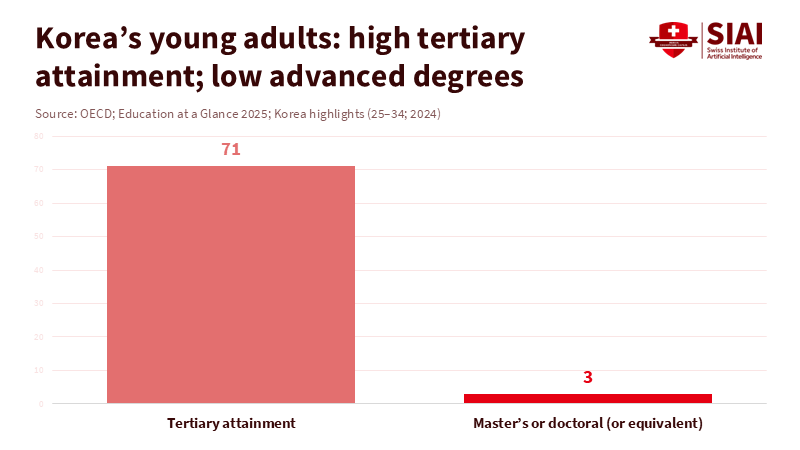
It is worth asking what the system seeks. Korea has strong educational results but relies on credentials. OECD data shows 71% of Koreans aged 25 to 34 have completed college, the highest rate among OECD countries. Only 3% of that group have a master’s or doctorate, well below the OECD average. This suggests degrees may be social symbols, while advanced study is just an addition. For the AI PhD fast-track program, that matters. It could raise the wrong question: "How fast can a student graduate?" Research should ask: "What did the student figure out, and how do we know it is correct?" If time is the primary measure, courses may cut the most challenging material, such as advanced math, statistics, and system iteration.
Public money also adds to what is at stake. Korea spends heavily on new ideas, allocating about 4.96% of its GDP to domestic R&D in 2023. With so much public support, inadequate training is more than a personal mistake; it is a loss for the country. Taxpayers pay for labs, grants, and programs to develop talent. If the AI PhD fast track leads to shallow research, companies will pay twice: first through taxes and then to fix failed systems, while graduates see their degrees mean less. Universities may also face reputational issues that are hard to fix. Speed can be helpful when it is earned through real competence and good guidance; otherwise, the program might just help people finish quickly rather than prepare them for meaningful work.
What the AI PhD fast track should provide for jobs
What companies want in AI is becoming clearer, not easier. The OECD says that in Korea, 56.5% of companies using AI have seen it replace parts of some jobs. Many also say AI has increased the types and level of skills needed for current jobs. For small to mid-size Korean businesses, the need for data examination skills is on the rise. The next need is computer skills. This tells universities designing the AI PhD fast-track that a quicker path only helps if graduates can handle complex data, create tests, and explain their decisions. This skill comes from repeatedly doing research, getting feedback, and creating tested and fixed systems. It does not come from taking courses alone.
The Bank of Korea’s research on the job market explains why more graduates do not necessarily lead to more hiring. They estimate that about 11,000 Korean AI experts worked outside Korea in 2024, about 16% of the AI workforce.
Their findings also show that AI workers' pay in Korea was only about 6% higher in 2024 than in the U.S. and other countries. When income is low, people tend to look for work elsewhere. It can also change how employers act at home. Companies raise the bar for hiring because it costs them a lot to employ someone who is not ready. They look for proof of ability, focusing on past work and solid modeling skills. In that environment, the AI PhD fast track will be tested by its results. If the degree does not point to someone who will do well on the job, it will lose value.
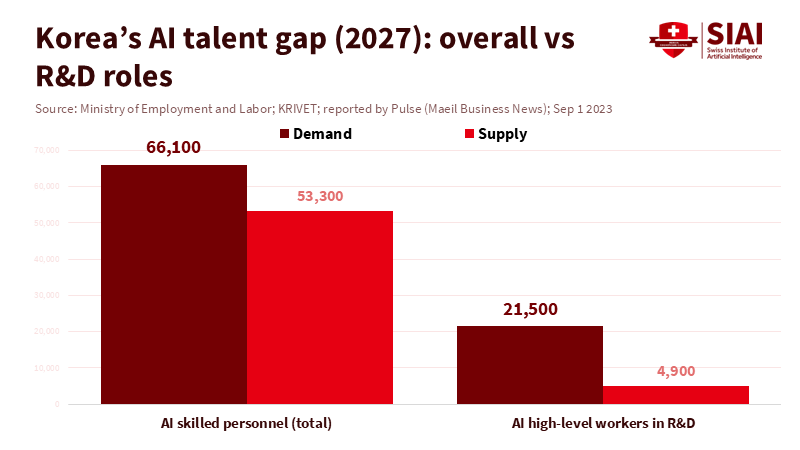
Estimates of job shortages show why fundamental skills matter. A 2023 forecast projected demand for AI staff to reach about 66,100 by 2027, while only about 53,300 are available, leaving a gap of roughly 12,800. SPRi stated that 81.9% of 2,354 AI firms in Korea had trouble finding enough workers. These numbers support investment but show the risk involved. Companies do not want just anyone with an AI title; they want people who can create and defend their work. One poorly skilled worker can slow a team and create hidden risks. So, the AI PhD fast track needs to raise the percentage of graduates who can contribute to research and new products from the start.
When speed turns into a meaningless degree
No one wants to create a worthless degree. The risk is that standards drop over time. Across the world, low-quality schools often have something in common: they promise a degree very quickly. The Council for Higher Education Accreditation warns that these schools might promise degrees in a very short period, making quick completion a main selling point. The Department of Education warns that these places may look real but fail basic quality checks, and encourages students and companies to verify claims.
Korea’s AI PhD fast track is not one of these degree mills. But local discussion already calls programs that award degrees without real training "degree mills." If 5.5 years is what it is known for and the rules are not consistent, the thinking can become flawed: students pay to save time, institutions sell degrees, and companies and taxpayers suffer when the degree does not indicate that someone is capable.
AI makes it harder to hide a poor education. A bad report might go unnoticed in some subjects, but in AI, it shows up quickly. Teams that do not comprehend testing find it hard to tell what is essential. Teams that do not understand statistics struggle with skewed results. Teams that do not understand modeling struggle to think about failures. That is why companies ask about portfolios and programs, not just grades. An AI PhD fast track can be sound, but it has to rely on proof of skill rather than time. If it takes less time and has no challenging requirements, it trains students to avoid risk, since difficult questions take longer and are more likely to be answered incorrectly. That is the reverse of how research training should be.
There is also a real cost to reputation. AI recruitment is global, and word spreads fast. Companies still judge degrees by what graduates can do, even if they never visit the school. Korea is already seeing skilled AI workers leave the country. With that said, a weak sign hurts everyone, even the best graduates. The market impacts everything, not just some departments. If the AI PhD fast track is seen as a waste of time, it can limit the chances for those it is meant to help. Therefore, consistency across institutions is essential. A few weak programs can ruin the signal for the good ones. It takes time to build a good reputation, but it can be lost quickly.
How to make the AI PhD fast track valuable for hiring
Instead of selling speed, the AI PhD fast-track should be about demonstrating skill with clear proof. Students who already have skills can move faster, but those who do should not be hurried. That requires a solid foundation in math, statistics, and modeling, which many AI research labs consider important. It also needs results that are hard to fake: tested experiments, well-documented programs, and a report that passes outside review. Schools can help by testing problem-solving skills instead of memorization. If a school cannot achieve these conditions, it should not promote itself as an AI PhD fast track.
Rules should match goals. OECD research on quality suggests that outside policies can encourage improvement inside higher education. Some might say the AI PhD fast track is only for great students so that quality will take care of itself. This will not occur when money and reputation boost productivity across departments. So, officials need rules that reward research, not just numbers. School leaders need to assign reasonable workloads that allow time for mentoring and feedback. Departments need external examiners who are not aligned with career interests. Precise results, like published work, matter too. These steps protect good students and stop companies from paying for credentials that are not credible.
The job market cannot be ignored. The Bank of Korea’s low pay rate means Korea is not valuing AI skills like other countries do. Some might argue that companies can teach what programs cannot, but fixing this is expensive. If great skill is not valued, it will be lost. Consequently, the AI PhD fast track needs a matching job plan. That could include stronger partnerships with companies, research standards, guidelines on ownership, and early job tracks that do not require talent to move abroad for good pay. Otherwise, Korea might train people quickly, pay for it publicly, and then see companies in other countries benefit. A quick degree is only one part of the plan; incentives and research also affect productivity.
The views expressed in this article are those of the author(s) and do not necessarily reflect the official position of the Swiss Institute of Artificial Intelligence (SIAI) or its affiliates.
References
Bank of Korea. (2025). Mismatches in Korea’s AI labor market (AI workforce estimate; overseas share; wage premium discussion).
Council for Higher Education Accreditation. (n.d.-a). Degree mills: An old problem and a new threat.
KBS World. (2025, November 10). Gov’t unveils AI education plan to nurture new talent.
Korea Herald. (2025, November 10). S. Korea to foster AI talent across all stages of life.
Korea.net. (2024, December 30). Domestic R&D spending as % of GDP ranked No. 2 in 2023.
Lee, K. (2025a, November 12). AI시대, 고급 교육을 포기한 대학의 미래는 없다. 디 이코노미.
Lee, K. (2025b, November 12). 한국 AI 연구 인력의 실상과 그 배경 (analysis of math/stat training and AI research labor markets). 디 이코노미.
MK Pulse. (2023, September 1). S. Korea faces shortage of skilled workforce in key technology fields.
OECD. (2025a). Artificial intelligence and the labour market in Korea.
OECD. (2025b). Education at a glance 2025: Korea country note.
OECD. (2025c). Ensuring quality in VET and higher education: Getting quality assurance right.
SPRi (Software Policy & Research Institute). (2024). Media page entry citing results of the 2023 AI industry survey.
The Korea Times. (2025, December 5). Korea sees brain drain of AI talent amid low wage premium: BOK (Yonhap).
U.S. Department of Education. (2025, April 24). Diploma mills and accreditation.
WIPO. (2025). Global Innovation Index 2025: Republic of Korea indicator notes.
His recent work examines the broader socioeconomic consequences of artificial intelligence, including labor markets, public finance, demographic change, institutional adaptation, and the distributional effects of technological progress.
He holds a PhD in Mathematical Finance from Boston University, and previously earned an MSc in Finance and Economics from the London School of Economics. He completed his undergraduate studies in Economics at Seoul National University under the Korea Foundation for Advanced Studies scholarship program.
Similar Post