Make Time Teachable: Scaling Learning with AI-Integrated Courses

Catherine McGuire is a Professor of Computer Science and AI Systems at the Gordon School of Business, part of the Swiss Institute of Artificial Intelligence (SIAI). She specializes in machine learning infrastructure and applied data engineering, with a focus on bridging research and large-scale deployment of AI tools in financial and policy contexts. Based in the United States (with summer/winter in Berlin and Zurich), she co-leads SIAI’s technical operations, overseeing the institute’s IT architecture and supporting its research-to-production pipeline for AI-driven finance.
Published
Modified
AI-integrated courses can handle routine questions and free teachers for higher-value work
Well-designed course bots cut response time without hurting learning quality
The real policy issue is how to govern AI, not whether to use it
Imagine if a big chunk of the questions students ask in an online course could be answered by the course materials themselves, with a little help from a smart computer program. It turns out, this is totally doable! This means teachers could spend less time repeating the same answers and more time on what really matters. So, instead of banning these AI tools, we should figure out how to use them to improve courses, reduce teachers' workloads, and ensure students get the most out of their learning. The goal is to create courses where AI acts like a helpful assistant, providing students with quick, reliable support while freeing up teachers to focus on coaching, grading, and ensuring everyone has a fair chance to succeed. The big question for leaders is whether to embrace these helpful tools or stick to old ways that might not be as good or cost-effective.
Rethinking Automation with AI Courses
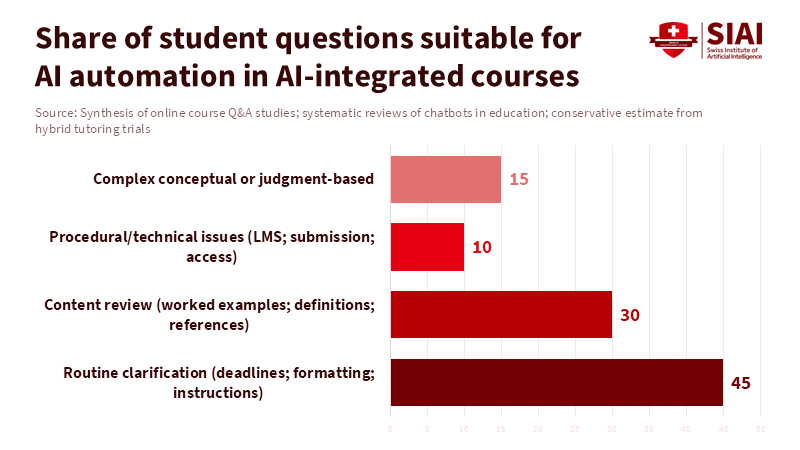
People often argue about whether AI is a threat or a miracle cure for education. But the truth is somewhere in between. Let's forget about whether AI should teach and instead focus on what parts of teaching can be automated and how. The best tasks to automate are those that involve many simple questions, such as explaining instructions, giving examples, or checking whether students followed the rules for formatting their work. An AI system can handle these tasks by sticking to the course materials and following clear guidelines. This means teachers get fewer interruptions, students get faster help, and we can see where students are struggling and need more personal attention.
Three things are coming together to make this possible: First, AI can now provide clear, helpful answers when asked the right questions. Second, course websites and tools enable us to connect course materials more effectively. Third, studies show that AI tutors can improve learning when used carefully. Instead of banning AI, we should focus on establishing rules and standards to ensure it's used safely and effectively. This way, we can reduce routine work for teachers and let them focus on what makes the biggest difference for students.
What Works and What to Watch Out For:
Studies are showing that AI tutors and chatbots can help students learn and save time. But it depends on how they're designed. One study in 2025 found that students learned more and were more engaged when using an AI tutor that adhered to specific teaching methods and used course materials to guide its responses.
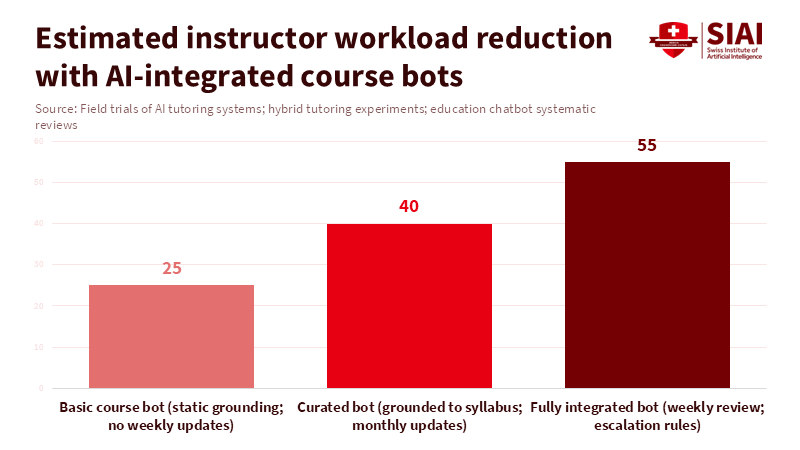
This means that if a course or program keeps track of common student questions and has clear answers ready, it can use AI to handle many requests accurately. Tests of systems that combine tutoring data with AI show they perform better when the AI follows a script and when teachers review tricky cases. Experts estimate that a course bot can handle about 60–90% of routine questions in its first year. This is based on the fact that many online course questions are repeated and that AI tutors can give accurate answers when used properly. Keep in mind that the more the bot is improved and updated, the better it will perform.
However, we need to be careful. AI can sometimes simplify or misrepresent scientific or technical information if not properly controlled. This can be dangerous in subjects like science and health. To prevent this, we need to ensure the AI uses only course-approved materials and that any complex or important questions are referred to a teacher. AI can save time, but it needs to be managed rather than used as a replacement for teachers.
Creating AI Courses That Students Can Trust:
To make AI courses work well, start by carefully planning the course. Identify the learning goals, solutions to problems, common mistakes, grading guidelines, and when to involve a teacher. Then create a collection of approved materials for the AI to use, and write instructions to guide it in providing helpful, accurate answers. Whenever possible, the AI should show students exactly where in the course materials it found the answer. This makes the AI more trustworthy and reduces the likelihood that it makes things up.
It's also important to keep collecting data and improving the AI over time. Track every interaction the AI has with students and label whether the issue was resolved, passed on to a teacher, or corrected. Use this information to improve the AI's answers, update the instructions, and adjust when to involve a teacher. Studies show that chatbots are most helpful when they're treated as tools that can be improved over time. For quality control, give teachers the ability to see how the AI is working and correct it if needed. Before using the AI in a course, test it with real student questions to make sure it's accurate and helpful. According to a study on Tutor CoPilot, students whose tutors used the AI tool were 4 percentage points more likely to master topics, with even greater improvements seen among students working with lower-rated tutors.
Fairness and Policy:
It is important to consider who benefits from AI in education and who may not have equal access to it. Automating routine tasks should give teachers more time to help students who are struggling or have special needs. But if AI is only used in certain courses or programs, it could create even more inequality. To prevent this, policies should connect the use of AI with fairness goals. Schools should report how much time teachers save, how quickly students receive responses, and how often questions are referred to teachers, broken down by student groups.
There also needs to be clear rules and oversight. Governments and organizations should require that AI systems use approved materials, have a clear process for involving teachers, align with learning goals, and protect student data. The U.S. Department of Education says that AI in education should be inspectable, allow for human intervention, and be fair. Providing funding for pilot programs, shared resources, and teacher training will make it easier for all schools to use AI effectively. Without this support, AI will remain a luxury for some rather than a tool for everyone.
The debate over AI in classrooms shouldn't be about banning it or blindly accepting it. Instead, we should focus on designing AI courses that are reliable, transparent, and know when to ask for human help. By preparing carefully, collecting data, and providing ongoing support, schools can free up teachers to focus on the complex tasks that only humans can do well. Leaders should fund shared tools and require transparency. Teachers should demand AI systems that are inspectable and ensure AI helps them teach, rather than replacing them. Students deserve quick, accurate help, and teachers deserve time to teach. We can achieve both by using AI wisely to improve education.
The views expressed in this article are those of the author(s) and do not necessarily reflect the official position of the Swiss Institute of Artificial Intelligence (SIAI) or its affiliates.
References
ACM. (2025). Combining tutoring system data with language model capabilities. ACM Proceedings.
Davard, N. F. (2025). AI Chatbots in Education: Challenges and Opportunities. Information (MDPI).
Kestin, G. (2025). AI tutoring outperforms in-class active learning. Nature (Scientific Reports).
Research on LLMs summarization errors. (2025). Analysis: LLMs oversimplify scientific studies. LiveScience.
Systematic review: Chatbots in education objectives and outcomes. (2025). Computers & Education (ScienceDirect).
U.S. Department of Education. (2023). Artificial Intelligence and the Future of Teaching and Learning (policy guidance).
Catherine McGuire is a Professor of Computer Science and AI Systems at the Gordon School of Business, part of the Swiss Institute of Artificial Intelligence (SIAI). She specializes in machine learning infrastructure and applied data engineering, with a focus on bridging research and large-scale deployment of AI tools in financial and policy contexts. Based in the United States (with summer/winter in Berlin and Zurich), she co-leads SIAI’s technical operations, overseeing the institute’s IT architecture and supporting its research-to-production pipeline for AI-driven finance.
Similar Post