The Death of the Entry-Level Role and the University Mandate

David O’Neill is a Professor of AI/Policy at the Gordon School of Business, SIAI, based in Switzerland. His work explores the intersection of AI, quantitative finance, and policy-oriented educational design, with particular attention to executive-level and institutional learning frameworks.
In addition to his academic role, he oversees the operational and financial administration of SIAI’s education programs in Europe, contributing to governance, compliance, and the integration of AI methodologies into policy and investment-oriented curricula.
Published
Modified
AI is permanently erasing the entry-level roles that once trained new graduates
Public reinvestment funds will fail to rescue these jobs from corporate efficiency measures
Universities must urgently adopt high-intensity training models to prevent a workforce crisis

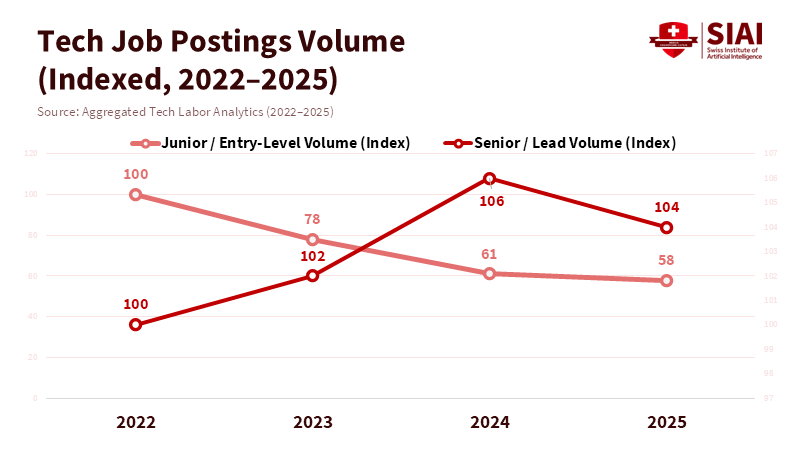
By 2025, it looks like the traditional starting point for young tech professionals will be gone. According to a report from the Korea Labor Institute, while traditional forms of AI were linked to lowered growth in full-time, permanent jobs in areas such as manufacturing between 2018 and 2023, there is no evidence that generative AI, such as Large Language Models, has caused a fundamental drop in entry-level jobs in tech-related fields in Korea during that period. These AI systems can now handle basic tasks—like fixing code errors, writing drafts, and cleaning up data—that used to be how new graduates learned the ropes.
Some people suggest creating a special fund to help people get new skills and find different types of apprenticeships. But this idea doesn't account for how companies actually operate or the fact that these kinds of training funds haven't worked well in the past. What we're seeing is a real problem: the path from college to a job is breaking down. Schools need to take swift, severe action to address this gap. If they don't, less reputable bootcamps that make big promises but don't deliver will likely take their place and charge high fees.
Why an AI Retraining Fund Won't Work
The idea of a fund to save junior positions sounds good at first. But in today's political and economic situation, it’s not very realistic. There have been past attempts by governments or groups to tax companies for using automation to pay for worker retraining. These funds rarely work as intended. Right now, companies are trying to cut costs by reducing staff and using AI to improve efficiency. It doesn't make sense to expect them to voluntarily give money to a fund that supports the very entry-level jobs they're trying to replace with AI. Even if a fund like this existed, it would probably take years for the money to be distributed because of all the red tape involved. By the time a training program is approved, the AI tools used in that field will already have changed significantly.
There's also a basic problem of motivation. Companies focus on their results every three months, but people need years to develop their skills. If a company can switch from paying a junior employee $70,000 a year to paying $20 a month for an AI tool, a small subsidy isn't going to change their minds. This creates a gap in the workforce: we have experienced professionals who can manage AI, and we have students who understand the theory, but there's no clear way to gain experience and advance their careers. Depending on donations or taxes to fix this problem ignores the fact that the job market has already moved on. Schools need to step up and accept responsibility, since they're the ones who promise to prepare students for their careers. They're not keeping up with how quickly the market is changing.
The Problem with Low-Quality Coding Bootcamps
When schools don't equip people with the skills they need for jobs, other options arise. This was clear during the rise of coding bootcamps from 2015 to 2023. Many private schools popped up promising to turn anyone into a software engineer in just a few months. But the results haven't been that great. In places like South Korea, there are now too many graduates from these coding schools who know the basics of coding but don't really understand computer science or AI.
These programs usually focus on how to use a tool rather than on why it works. When AI is doing more and more, knowing just the how isn't very useful, because the AI already knows it. If you only teach someone to write simple code, you're teaching them to compete with a machine that can do it better, faster, and for free.
The most concerning aspect of this trend is that quality is getting worse. A good AI training program is hard, and many people won't pass. According to Algocademy, coding bootcamps often lack uniform curricula, which can lead to inconsistent course quality and gaps in essential knowledge, potentially making it easier for students to enroll without guaranteeing that they will be job-ready. According to a 2024 Gartner survey, marketing teams are leading in AI adoption, but their approaches vary widely, as reflected in how AI bootcamps are currently marketed. According to an OECD report on AI and the labor market in Korea, while many programs offer training in areas like prompt engineering or model tuning, these often provide only a basic understanding of the technology. As a result, there is a growing number of certified individuals who may still lack the advanced skills required for the remaining entry-level technical roles that have not yet been automated by AI.
Why Universities Have to Step Up
Schools can't just teach theory and leave the practical training to employers anymore. Employers have made it clear they're unwilling to pay to train new graduates. This means schools need to provide the equivalent of a residency program. They need to include hands-on, challenging projects that are similar to the work experienced professionals do. This isn't simply about adding a few more labs; it's about changing the way schools are funded and taught. Universities need to stop operating in silos and start acting as incubators that help students develop advanced skills. If a student graduates today with only a conceptual understanding of algorithms, they probably won't get a job. They need to demonstrate that they can use AI systems to produce professional-quality work from the outset.
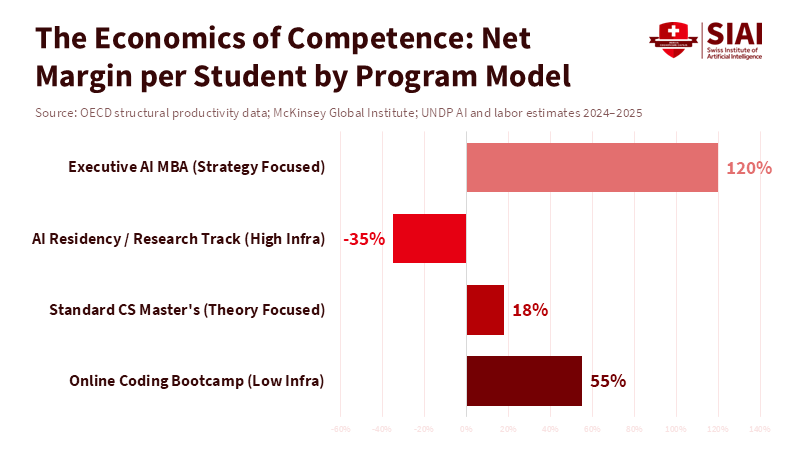
This change is difficult because it's expensive. The Swiss Institute of Artificial Intelligence (SIAI) provides a clear case study of the need for a structural pivot. Faced with the economic reality that a rigorous, high-quality Master’s track in AI operates effectively as a "loss leader," the institute was forced to innovate its underlying business model. The solution was to establish an "Executive AI MBA"—aimed at high-level leaders who need to understand AI strategy—to cross-subsidize the intensive, capital-heavy training of research students. This financial juxtaposition allows the institute to maintain a survival rate that reflects the true difficulty of the subject matter, preserving elite standards without succumbing to the insolvency that currently threatens traditional academic departments. Most universities aren't willing to make this kind of change yet, but they'll have to if they want to stay relevant.
The Reality of Layoffs and Professional Survival
Some people might say that universities shouldn't be trade schools and should focus on teaching students how to think. That sounds good, but it ignores the reality of student debt and the shortage of jobs. If learning how to think doesn't lead to a job, the university system as we know it will collapse as students choose cheaper, even if lower-quality, options. We can't stop companies from cutting jobs to save money. Efficiency is the primary driver of today's economy. So, the only way to protect the future of the workforce is to ensure that entry-level graduates can perform at the level of someone with several years of experience. This requires a level of rigorous education that most schools aren't prepared to provide.
The message is clear: education leaders need to stop waiting for a government-funded retraining program that's unlikely to materialize. They need to stop competing with low-quality bootcamps by lowering their own standards. Instead, they need to change how they're funded to support challenging, job-ready training. This means accepting the possibility of higher failure rates and the cost of expensive, practical resources. We need to connect schools and industry within the university. If we don't, we'll leave a whole generation of students stuck in a situation where they're too qualified for manual labor but not qualified enough to compete with AI systems taking over their jobs. The time for small changes is over; universities need to become the gatekeepers of professional success.
The views expressed in this article are those of the author(s) and do not necessarily reflect the official position of the Swiss Institute of Artificial Intelligence (SIAI) or its affiliates.
References
Bureau of Labor Statistics. (2024). Employment Projections: 2023-2033 Summary. U.S. Department of Labor.
Gartner. (2024). The Impact of Generative AI on the Tech Talent Market. Gartner Research.
International Labour Organization. (2023). Generative AI and Jobs: A Global Analysis of Potential Effects on Job Quantity and Quality. ILO Publishing.
OECD. (2024). OECD Employment Outlook 2024: The AI Revolution in the Workplace. OECD Publishing.
Stanford Institute for Human-Centered AI. (2024). Artificial Intelligence Index Report 2024. Stanford University.
World Economic Forum. (2023). The Future of Jobs Report 2023. WEF.
David O’Neill is a Professor of AI/Policy at the Gordon School of Business, SIAI, based in Switzerland. His work explores the intersection of AI, quantitative finance, and policy-oriented educational design, with particular attention to executive-level and institutional learning frameworks.
In addition to his academic role, he oversees the operational and financial administration of SIAI’s education programs in Europe, contributing to governance, compliance, and the integration of AI methodologies into policy and investment-oriented curricula.
Similar Post