Japan Silk Road Diplomacy

Ethan McGowan is a Professor of AI/Finance and Legal Analytics at the Gordon School of Business, SIAI. Originally from the United Kingdom, he works at the frontier of AI applications in financial regulation and institutional strategy, advising on governance and legal frameworks for next-generation investment vehicles. McGowan plays a key role in SIAI’s expansion into global finance hubs, including oversight of the institute’s initiatives in the Middle East and its emerging hedge fund operations.
Input
Modified
Japan is positioning governance as an alternative to China’s infrastructure power
AI rules and institutions are emerging as tools of geopolitical influence
Central Asia’s autonomy will hinge more on standards than on concrete

The Silk Road diplomacy of Japan has arrived in Central Asia.Public Attention is still captured by the scale of material projects. Back in the first six months of 2025, the Belt and Road Initiative saw a big jump in Chinese building deals and investments. Money was flowing into energy, mining, and transportation, changing how trade and politics work in that area. But Tokyo decided to do things differently. On December 20, 2025, Japan had a meeting in Tokyo with leaders from Central Asia, calling it the Central Asia plus Japan summit. Along with this, they announced a five-year business goal that was clearly linked to supporting governance and growing skills in the region.
There's a real difference between what the two countries are offering. China is providing quick infrastructure and jobs that people can see. According to People's Daily Online, China is encouraging Central Asian countries to deepen cooperation through results-oriented rules and frameworks, aiming to advance trade, investment, and connectivity. The choices that governments and organizations in Central Asia make now will shape how they approach economic partnerships and development for years to come.
Japan's Silk Road Diplomacy: Focusing on Strong Institutions Instead of Just Big Projects
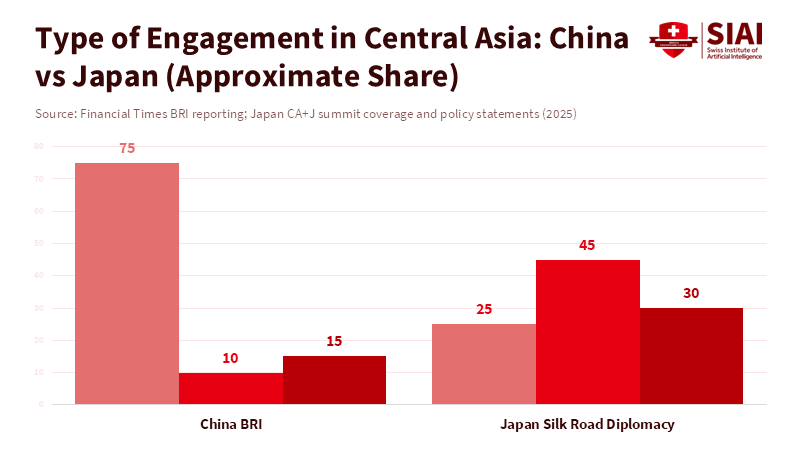
Japan presented the December 2025 summit as a step up in its diplomacy. The meeting in Tokyo brought together the leaders of Kazakhstan, Kyrgyzstan, Tajikistan, Turkmenistan, and Uzbekistan, as well as Japan's leader. They created a statement called the Tokyo Declaration, which emphasized environmental sustainability, connectivity, and education. Japan then backed this up with a business goal of about $19 billion over five years. The plan isn't to spend as much as the BRI, but rather to prove that putting governance first is the right move. This means providing training, templates, test projects, and conversations about regulations to help Central Asian countries manage new technologies and big investments. The summit was meant to build lasting working relationships, not to compete with huge financial deals.
Japan's plan is simple and realistic. Infrastructure changes the physical landscape quickly. A new road, factory, or train line is visible and convincing. But institutions change the way deals are made. A law that requires open bidding or a rule that protects data doesn't often make headlines, but it changes who can win contracts and the rules. So, Japan's Silk Road Diplomacy is investing in the people who create these rules, such as the groups that draft laws, government trainers, judges, and people who handle procurement. The goal isn't to stop projects from happening, but to ensure they occur within a legal system that reduces the risk of corruption and lasting dependence.
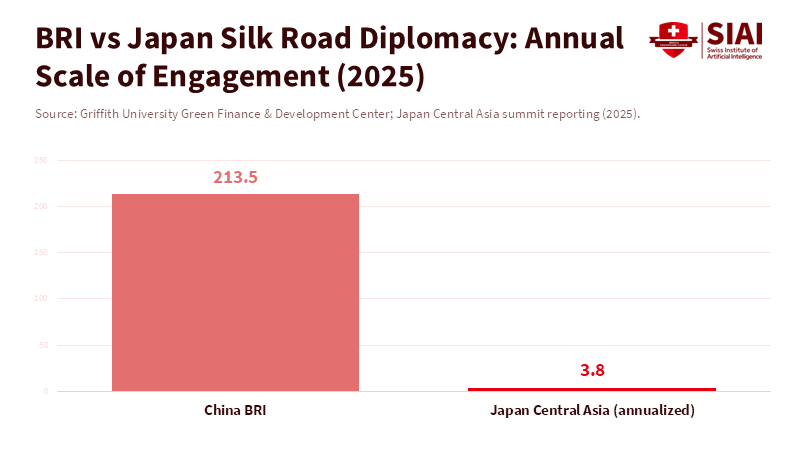
Still, the amount of money China spends through the BRI is a big deal in many situations. Reports from 2025 show record levels of Chinese construction and investment deals, with major projects in energy and mining across Central Asia. These projects create jobs and things that people can see right away. They also create negotiating power. The country that builds and operates large infrastructure often gains special access to maintenance contracts, local data, and long-term agreements. Japan's focus on institutions has to compete with that pull. According to The Peninsula Qatar, Japan's new five-year business goal of $19 billion in Central Asia highlights how countries are weighing the long-term value of building strong governance against the immediate political and economic benefits of large-scale projects. The debate is less about moral superiority and more about when and how best to use different strategies.
Japan's Silk Road Diplomacy: Using Support for AI Institutions as Influence
AI is one area where having strong institutions can give you a market advantage. AI systems need rules for how they are acquired, tested, and reviewed. If the rules are weak, the companies that can show up quickly and lock data away gain an advantage. Japan is addressing this by helping countries develop their own standards. Japan's plan for Central Asia focuses on real-world skills: short courses for people who make regulations, ethics training for government workers, shared labs that adapt AI models to local needs, and test projects that demonstrate how AI that can be checked can save money on infrastructure or resource management. The goal is to make it easy for governments to demand explanations, audit trails, and proof of following the rules when they are considering bids.
The way this works is simple and can be copied. Short courses create groups of people who can judge the dangers of algorithms. According to research by Hota and Jokinen, using structured templates provides law-making teams with a starting framework for proposing new rules, helping make the process more efficient. The study also highlights how collaborative projects can produce datasets and models tailored to local requirements and vetted according to local standards. When these things are paired with small test projects, the result isn't just abstract rule-making. Instead, it's real governance that governments can point to, such as an AI tool that predicts when a mine needs maintenance or a model that makes irrigation better. According to East Asia Forum, the institutionalisation of the Belt and Road Initiative through a legally binding multilateral treaty has helped generate political support for stronger purchasing standards by positioning the BRI as a key framework for cooperation among Central Asian nations. This development offers significant political benefits by reinforcing the BRI’s central role in the region. If countries own the rules, it's less likely that technology transfers will be used for outside control. When governments discuss standards and courts handle disagreements, purchasing choices are opened up to public review and legal challenges, instead of being dictated from the outside. This makes it harder for any outside company to take over markets with unclear terms. Japan's Silk Road Diplomacy seeks to turn legal and administrative capacity into a shield against being forced into dependence.
Japan's Silk Road Diplomacy: What it Means for Policy, Education, and Alliances
For teachers and training groups in Central Asia, this policy change is very real. Classes should teach how to write rules along with coding. Degrees and certificates should combine technical AI skills with purchasing law, audit methods, regulatory reviews, and ethics. Real-world training is key, including law-writing workshops, supervised policy labs, and projects that develop purchasing rules or audit plans for governments. When a school program creates a legal document that can be used right away, that education becomes a direct tool for governance. Short, focused programs for government officials in the middle of their careers, along with internships in Tokyo or shared labs, can accelerate the implementation of initiatives.
How alliances work will determine whether Japan's focus on governance translates into real influence. Japan's five-year goal is good, but it's small compared to the BRI's huge deals. To really matter, Tokyo needs to work with partners. A practical plan is to pair Japanese governance grants with money from allies or international groups. Japan provides legal templates, training, and technical help. Allies and development banks provide affordable capital when projects meet governance standards. Then, Japanese and allied companies bid in open purchases. This lowers political risk for Central Asian governments and increases the financial return for companies that follow the rules.
Critics are right to be concerned about speed and what people can see. Governments facing pressure at home often prefer projects that promise quick jobs. So, diplomacy that puts governance first needs to be timed well. The practical approach is to combine projects that deliver clear wins with governance requirements that protect long-term value. This way, quick results and lasting rules don't always have to be at odds. When governance is put in place early, countries tend to attract more different investors and avoid deals that take too much. Japan's goal is to make governance central to political success, not just a footnote.
Finally, international groups and networks matter. Development banks can provide capital over the long term. They can insist on governance standards and increase the impact of Japanese help. Networks among regulators accelerate the spread of norms and create opportunities for shared audits and learning from one another. When Japan's technical offers are given through or with international funding, they gain scale and strength. By coordinating technical help, setting conditions for funding, and monitoring together, a model is created for projects that are both visible and follow the rules. This is how small governance grants can unlock much bigger flows of capital while protecting a country's independence.
In conclusion, compared to China’s Belt and Road Initiative, which focused heavily on major investments and construction projects in Central Asia—reaching a record $66.2 billion in contracts and $57.1 billion in investments in early 2025 according to Caspianpost.com—Japan’s Silk Road Diplomacy takes a different approach by emphasizing institutions, skilled people, and the gradual development of administrative strengths. This plan won't make headlines right away. It will win more quietly, in purchasing offices, classrooms, and courts where standards are created, tested, and enforced. According to Caspianpost.com, Central Asia secured a record $25 billion in investment from China’s Belt and Road Initiative in just the first half of 2025, highlighting the scale of support large infrastructure projects can achieve with clear funding and international collaboration. For Central Asian leaders and educators, the next step remains clear: they should continue investing in the people who write and enforce laws, not just in the projects themselves, to turn strategies into successful results. The battle for influence in Central Asia will be decided not by a single meeting, but by how well countries manage the technologies and deals that follow. If Japan's bet on institutions is to succeed, it must be judged by the standard of rules it helps create, not the number of roads it can build.
The views expressed in this article are those of the author(s) and do not necessarily reflect the official position of the Swiss Institute of Artificial Intelligence (SIAI) or its affiliates.
References
China Global South. (2025, December 20). Japan targets Central Asia’s critical minerals in bid to reduce reliance on China. China Global South.
Euronews. (2025, December 20). Central Asia and Japan discuss new cooperation formats at inaugural Tokyo summit. Euronews.
Financial Times. (2025). China’s Belt and Road investment and construction activity hits record. Financial Times.
Griffith University & Green Finance & Development Center. (2024). China Belt and Road Initiative Investment Report. Griffith University / Green Finance & Development Center.
Japan Prime Minister’s Office (Kantei). (2025, December 20). The Summit of the “Central Asia plus Japan” Dialogue (CA+JAD). Kantei, Prime Minister’s Office.
Ministry of Foreign Affairs of Japan (MOFA). (2025, December 20). Tokyo Declaration of the Summit of the “Central Asia plus Japan” Dialogue (PDF). MOFA.
South China Morning Post (SCMP). (2025). Japan ‘is back’ in Central Asia with new summit on AI, minerals and transport. SCMP.
Ethan McGowan is a Professor of AI/Finance and Legal Analytics at the Gordon School of Business, SIAI. Originally from the United Kingdom, he works at the frontier of AI applications in financial regulation and institutional strategy, advising on governance and legal frameworks for next-generation investment vehicles. McGowan plays a key role in SIAI’s expansion into global finance hubs, including oversight of the institute’s initiatives in the Middle East and its emerging hedge fund operations.