Hands-On AI Adoption: How Europe Must Move from Policy-Boxes to Practice

David O’Neill is a Professor of AI/Policy at the Gordon School of Business, SIAI, based in Switzerland. His work explores the intersection of AI, quantitative finance, and policy-oriented educational design, with particular attention to executive-level and institutional learning frameworks.
In addition to his academic role, he oversees the operational and financial administration of SIAI’s education programs in Europe, contributing to governance, compliance, and the integration of AI methodologies into policy and investment-oriented curricula.
Input
Modified
Europe’s AI gap is not about technology — it is about weak hands-on use at work
Productivity gains come from daily tool use, not from policy frameworks alone
Without faster workplace adoption, Europe will fall further behind global peers

In 2023, only 8% of businesses in the EU with at least 10 workers reported using any form of AI in their day-to-day work. This shows a significant difference between what people say about AI and what's really happening in workplaces. This number should make us think differently about the issue. Europe isn't just behind on AI because of rules or debates about keeping tech local. It's because most businesses haven't found a way to turn general ideas about AI into practical tools that workers can use every day. This is a problem because the real value of AI comes from using it to get things done, not just from planning or talking about it. When companies use AI, they can pay higher wages, develop new products, and invest in business growth. If leaders spend too much time marking boxes on AI readiness forms and picking the appropriate platforms, they'll miss what really matters: workers using AI to solve specific problems, managers changing how work is done to fit the new tools, and businesses trying out small-scale projects that can be expanded if they work well.
Changing the Focus: From Filling Boxes to Getting Hands-On with AI
Right now, most approaches to measuring a country or business's AI readiness focus on factors such as data governance, government policies, cloud options, and research budgets. These things are essential, but they don't tell the whole story. A business might score high on AI readiness because it has a lot of rules, a team to make sure everyone follows those rules, or plans to build its own tech infrastructure. But that might mean the business has boxed AI, focusing on rules rather than allowing people to use it in their jobs.
There's a big difference between having rules and actually using AI. When people use AI regularly at work, they learn from experience and find ways to improve their work, thereby increasing productivity. But if you have rules without practice, things get stuck. The Bank for International Settlements (BIS) estimates that when EU businesses use AI, their labor productivity increases by approximately 4% in the short term. This is a positive sign, but that increase occurs only when AI is genuinely part of how work is done and when businesses invest in making it work well. If we count rules without counting how often people use AI tools, we might think we're making progress when we're not.
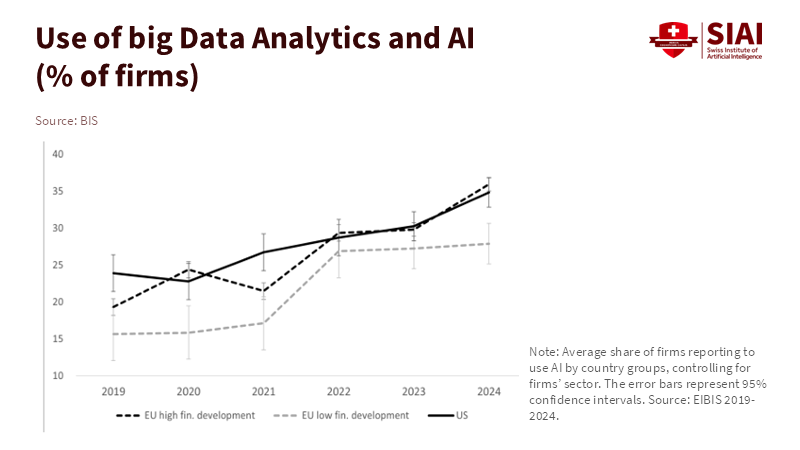
If we shift our focus to helping people use AI in practical ways, we'll need to adjust our priorities. Instead of simply investing in big, top-down projects or creating lists of AI principles, governments and businesses need to fund and measure actions that start from the bottom up: short-term pilot projects, training for specific roles, and changes to how tasks are done. I'm not saying we should abandon rules, but we need to strike a better balance. Rules can protect us, but they shouldn't be an excuse to wait or a substitute for teaching people new skills. A better way to measure progress would be to track how many workers use AI tools each week to perform their primary tasks, rather than counting the number of AI strategies a country has published. We learn more when we track what people are actually doing, not just what they plan to do.
Why Using AI Matters for Productivity and Equal Opportunity
When people regularly use AI tools, it changes how work is done. Workers learn to let AI handle the boring, repetitive parts of their jobs. Managers figure out where human thinking is most valuable. And businesses reorganize tasks to get more output per hour. The BIS study found that, on average, labor productivity increases by approximately 4% in the short term when companies use AI. This occurs because companies invest in more advanced equipment and train workers for specific roles, rather than laying off many people.
But the benefits aren't shared equally. Larger companies and those that have already invested in digital tech get most of the advantages. If we only look at the total numbers, we miss the bigger picture. If AI is adopted only in some places, it widens the wage and opportunity gaps. This is because the workers and companies that use AI get more of the rewards, while those that don't fall further behind. This creates a situation in which some parts of Europe are doing well, while others are struggling, and productivity is increasing only in certain areas.
How do we know this isn't just an idea? According to Eurostat, in 2023, 8% of businesses in the EU reported using AI, highlighting both uneven adoption rates and significant differences across countries and industries. Where AI is used, most projects involve process automation, text analysis, and machine learning for prediction. These are practical uses that directly impact how work is done. These kinds of projects depend on workers being comfortable with AI and on making changes to local processes. Policies that encourage pilot programs and day-to-day testing, and help managers reallocate tasks around AI, are vital to unlocking productivity potential. Without that, investments and rules risk being just for show.
What's Holding Us Back? Rules, Local Tech Debates, and Fear of Change
A common idea in Europe is that maintaining control over our own tech and adopting strict rules are the keys to addressing AI risks. This idea is popular because people think it makes sense to control critical infrastructure and data. But focusing too much on keeping things local can make us forget a simpler, more immediate need: helping workers use AI tools right now. When public discussion and business plans focus on infrastructure, purchasing technology, and supporting local companies, the everyday work of training managers, revising job descriptions, and running small pilot projects is pushed aside. This creates a strange situation: the more effort we put into grand plans, the less able we are to learn quickly and gain hands-on experience. Recent studies show that many businesses don't want to use public cloud services or managed AI services because they're worried about trust and security. These worries are real, but they often hide a more profound concern about changing how tasks are done.
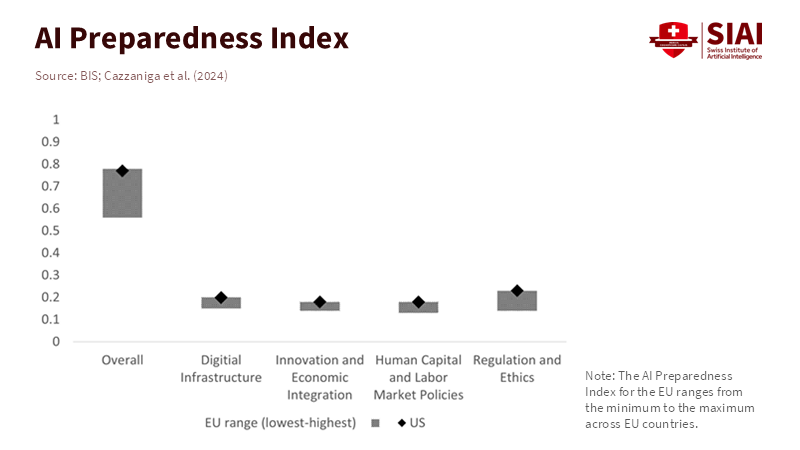
There's also a cultural aspect. According to research by Cummings-Koether and colleagues, cultural factors such as language and age can strongly influence people's willingness to adopt AI and their perceptions of its reliability. While some countries and workplaces encourage experimentation with new technologies and learning through experience, others prioritize adherence to procedures and risk minimization, which can slow AI adoption and delay the implementation of pilot projects. Additionally, concerns about keeping operations local may be driven by a fear of dependence on others and can lead to the failure to put AI to practical use. The way to address this is to combine reasonable safety measures with strong encouragement for rapid, measurable experiments at the local level. This means funding networks where companies can learn from one another, reducing legal issues in controlled pilot projects, and changing government procurement rules to reward businesses that demonstrate that workers are actually using AI, rather than merely maintaining paperwork on the rules.
There are also problems with management and education. Many managers don't know how to turn an interesting AI feature into a change in daily work. Many workers have never had the opportunity to solve problems using AI tools. Solutions that focus solely on infrastructure won't work unless we also help businesses and workers adapt their roles to leverage AI for quick results. If we don't do this, the benefits will continue to be concentrated in large, digitally advanced companies, and progress will be slow everywhere else. This will lead to wider gaps between people and slower overall improvement.
A Plan for Getting Practical with AI
If we want to see real, widespread gains in productivity, we need to judge policies by whether they increase the number of workers using AI tools in their daily jobs. First, governments should fund numerous short-term pilot programs across industries that require measurable results: faster turnaround times, lower rework, or increased output linked to AI adoption. What we measure matters. Pilot programs should require companies to report both how they use the technology and how many employees use the tool each week. This creates demand for practical applications, not just platforms.
Second, public funding for local tech projects should be partly redirected to help small and medium-sized businesses (SMEs) hire coaches and get small grants to run practical AI projects. This shifts the focus from buying tech to helping people use it.
Third, education and certification should focus on specific tasks and be short. Instead of lengthy degree programs in AI theory, we should invest in short, role-based certifications that demonstrate a worker's ability to use AI tools for specific tasks—such as sorting invoices, drafting customer responses, reviewing images for quality control, or making local forecasts. These certifications should be recognized across companies and in government procurement decisions.
Fourth, rules should be developed incrementally. We should introduce safe harbor rules for low-risk pilot projects and set deadlines for reassessment. This reduces the legal risk that currently discourages practical trials.
Fifth, we should create networks where companies can share case studies, analyze failures, and share usable guides in standard formats. People learn faster when they learn together and when the information is clear and practical.
All of these steps shift the focus from just being prepared to actually doing. They use public funds to address the biggest challenge: turning policies and infrastructure into skilled workers who regularly use AI tools. They also address the fairness issue by supporting SMEs and tracking how benefits are distributed. This isn't about rushing things; it's about finding ways to unleash the potential we see in larger companies and spread practical knowledge across the economy.
Start with Using AI, Then Improve the Rules
The most important thing to remember is that productivity increases when people use tools to do real work day after day. Europe's current focus on readiness and independence is a good long-term goal, but it shouldn't be the main way we try to boost progress in the short term. Leaders need to focus on steps that increase the number of workers who are actually using AI in their primary tasks. They need to fund short pilot programs with clear measures of worker use and change, and to train programs to focus on specific tasks. If we want to increase productivity, protect jobs, and close internal gaps, the first question we should be asking isn't which cloud service to trust or which local tech to build, but how many workers used AI this week to solve a work problem they couldn't solve before. Measuring and rewarding is where Europe will find the practical advantage it needs.
The views expressed in this article are those of the author(s) and do not necessarily reflect the official position of the Swiss Institute of Artificial Intelligence (SIAI) or its affiliates.
References
Bank for International Settlements. (2026). AI adoption, productivity and employment: evidence from European firms (BIS Working Paper No. 1325). Basel: BIS.
Eurostat. (2024). 8% of EU enterprises used AI technologies in 2023. Eurostat News.
McKinsey & Company. (2025). Accelerating Europe’s AI adoption: The role of sovereign AI. McKinsey & Company.
David O’Neill is a Professor of AI/Policy at the Gordon School of Business, SIAI, based in Switzerland. His work explores the intersection of AI, quantitative finance, and policy-oriented educational design, with particular attention to executive-level and institutional learning frameworks.
In addition to his academic role, he oversees the operational and financial administration of SIAI’s education programs in Europe, contributing to governance, compliance, and the integration of AI methodologies into policy and investment-oriented curricula.