When Planning Meets Price: Why “China Overcapacity” Remakes Global Industry

Ethan McGowan is a Professor of AI/Finance and Legal Analytics at the Gordon School of Business, SIAI. Originally from the United Kingdom, he works at the frontier of AI applications in financial regulation and institutional strategy, advising on governance and legal frameworks for next-generation investment vehicles. McGowan plays a key role in SIAI’s expansion into global finance hubs, including oversight of the institute’s initiatives in the Middle East and its emerging hedge fund operations.
Input
Modified
China overcapacity is designed, not accidental
Cheap exports depress prices and spark tariffs
Teach managed markets; hedge buys; build skills
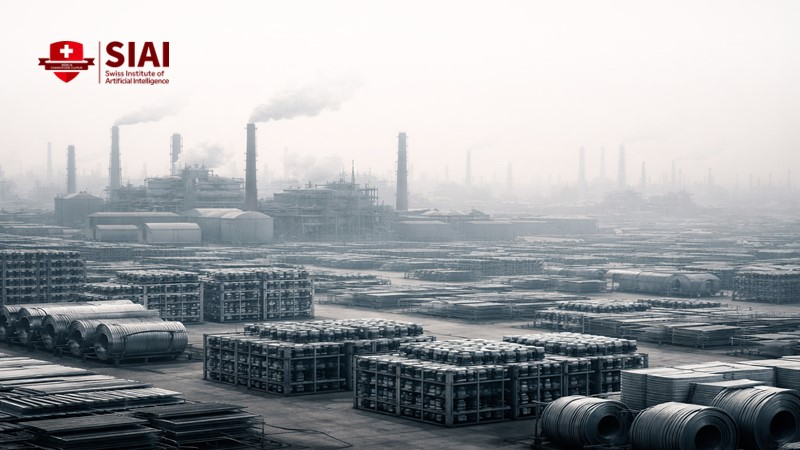
In 2024, China churned out over three-quarters of the world's battery cells. Global capacity hit over 3 TWh, about three times what electric vehicles and grid storage actually used that year. The bulk of this capacity is in China, which shifts the whole discussion. It's not just about subsidies. China's overproduction isn't an accident; it's a pattern driven by a planning system combined with top-notch execution. This drives down prices in China and then spills over into other countries through exports of batteries, steel, and cars. That's why importing countries call it dumping, and consumers see it as cheap. The big question isn't whether subsidies exist, but whether a system that's directed from the top can handle unexpected events and cut back on production when needed. If it can't, the rest of the world will keep feeling the pinch through lower prices and increased political tension.
China's overproduction is by design, not a mistake.
The idea is simple: government agencies pick industries, map out supply lines, and arrange land, credit, and permits. Then, major companies move fast and produce on a vast scale. It looks efficient because factories are built on time and production improves quickly. The thing is, this setup leads to overproduction. Coordination lowers the risk of getting started, so too many factories survive in the beginning. When policies change, such as shifting from real estate to EVs or from one type of battery chemistry to another, spare capacity shows up in related areas like steel, glass, and basic chemicals. The same thing that makes the system strong – alignment – is what makes it weak when it comes to scaling back. Prices at the factory level show this imbalance. Factory prices dropped 2.2% in 2024 and stayed low into early 2025. The system spread price cuts through trade, even as domestic efforts tried to boost demand. It's by design: planned investment affects global prices.

You see it in heavy industry, too. Big industrial companies were running at 76.2% capacity in the last quarter of 2024. Some raw material sectors were much lower, like non-metallic minerals at 61.1%. Despite this, exports rose. China shipped about 110.7 million tons of steel in 2024, the most in nine years, and bought record amounts of iron ore, even as construction slowed down at home. When China can't use everything it makes, the state-owned companies keep things going by pushing products into foreign markets. Prices drop, and pressure builds in other countries. So, China's overproduction isn't just a temporary bubble; it's the normal state of a system that's set up to build more than it can use and sell the rest to the world.
How does China's overproduction lead to global price drops?
First, look at cars and batteries. China now makes about 85% of the world's battery cells. In 2024, total capacity was more than three times the actual need. This gap pushed battery pack prices down to $108/kWh in 2025, creating a big cost difference with Europe and North America. Cheaper batteries lead to cheaper EVs, which is great for consumers, but they also put pressure on foreign companies and lead to trade restrictions. The U.S. increased its tax on Chinese EVs to 100% in May 2024. The EU added extra taxes of 17.4%–37.6% on top of its existing 10% import tax. These aren't just symbolic moves; they're attempts to set a minimum price in response to China's overproduction, which is designed to grow first and worry about profits later.
Exports make things worse. China exported about 1.25 million electric cars in 2024, which is 40% of global EV exports. Total vehicle exports reached around six million in 2024. Steel exports at nine-year highs put downward pressure on metals prices everywhere. This pushes China's domestic prices onto the rest of the world. When factory prices drop, and factories aren't running at full capacity, the easiest thing to do is sell to foreign markets.

Can price signals work in a planned system?
Some say market forces will fix the oversupply: too much supply will lower prices, weaker companies will close, and things will balance out. But in China, price signals are affected by factors beyond profit. Local governments would rather keep factories running to protect jobs and tax revenue. Banks keep lending money to avoid admitting losses. National goals, such as energy security and technological independence, justify keeping inefficient factories open. In 2025, regulators even cracked down on price wars in the auto industry to slow down price drops. This isn't a market correction; it's a controlled process. The way out exists, but it's long, politically determined, and varies by province. China's overproduction takes longer to fix than you'd expect, which means other countries have to deal with cheap exports for longer.
Does that mean government support doesn't matter? Of course not. It's the starting point, especially the hidden support. Studies show that Chinese state-owned companies receive better loan terms and support through government procurement and competition rules. However, focusing only on direct subsidies misses the big picture: government coordination reduces risk and accelerates scaling. Even when direct support decreases, the infrastructure, industrial parks, and access to credit remain. That's why we should see China's overproduction as a result of government-influenced markets. Fixing it means changing how the government operates, not just cutting funding.
What should educators and the government do?
Education systems will have to deal with this for the next ten years. We need to update what we teach and how we plan public spending. First, economics, business, and engineering courses should use China's overproduction as a key example of managed markets. Students need to understand how government tools shape company actions and global prices. Case studies should cover batteries, steel, and cars, showing the typical patterns: quick entry, slow exit, and exporting as a way to relieve pressure. Graduates who will run factories, negotiate contracts, or create trade policies need to understand the cost implications and the political forces at play.
Second, vocational programs should focus on supply-chain knowledge. It's not just about making a product; it's about understanding a market where one company's overproduction can change global prices in months. Training programs should teach plant managers how to track capacity, export levels, and trade taxes. When the EU or the U.S. changes tariffs, or when a Chinese province adjusts credit, schools should show students what it means for orders and staffing. A school that can model these changes will prepare graduates who can protect profits and jobs.
Third, government buyers should change purchasing rules to benefit from lower prices while reducing risk. If a university buys a bus fleet or a battery, it should ask who is cheapest? And how reliable is this price? If the price is low because China is working through overproduction, the contract should protect against risk: guarantees for spare parts, backup suppliers, and clauses that activate if tariffs change.
Fourth, governments should link trade policies with domestic capacity planning. Higher taxes on imports alone don't create engineers, supply networks, or test labs. When the U.S. and Europe added tariffs on Chinese EVs, they also invested in training and local factories. Education spending should reflect this: more courses on battery safety, power electronics, and data analysis; more apprenticeships; more language training for auditing suppliers. The goal isn't complete self-reliance at any cost. It's having enough skills to prevent price changes caused by China's overproduction from disrupting schools, labs, and local companies.
Fifth, universities should create publicly available data that clearly tracks the situation. A dean can mention factory-price drops or capacity figures, but many decisions are based on guesswork. Create a campus group that gathers statistics, trade data, and price information and publishes a clear overcapacity report for each industry. Professors can write short technical notes to explain the numbers. Students will learn to spot early warnings. Governments will see where problems are building before they become trade disputes.
Sixth, school leaders should prepare for price swings. Battery pack prices dropped to around $108/kWh in 2025 because of competition and excess factory capacity. That's great, but prices could rise if trade barriers increase or if China reduces production to increase profits. Purchasing plans should budget around average prices, not the lowest price, and include risk factors in grant proposals. Student teams can practice this by planning EV fleet options with different tax and exchange-rate scenarios.
Finally, education leaders should add this perspective to national strategies. The goods market will affect the job market. Some domestic producers will shrink because of cheap imports, while others will succeed by using Chinese parts. That means retraining programs, not just tariffs. Programs should link short courses and relocation support. The goal is for students to be able to handle China's overproduction rather than being overwhelmed by it.
What would a responsible exit look like?
If this is correct, how can a planned system learn to scale back as well as it scales up? One answer is transparency. China could release regular capacity reports by province and industry and link funding to those reports. Inefficient factories would face predictable closure schedules. Another answer is to connect industrial finance to problems: cut cheap credit faster in industries where exports cause the most trade issues. A third is agreements that link tax reductions to real reductions in China’s overproduction.
Some say this is unrealistic. Why would China change a system that made it a leader in EVs, batteries, and solar? The response is that long-term overproduction hurts profits in China and causes international issues. There's already learning happening. Regulators stepped in to control price wars. State-owned steel companies have talked about cutting production. China's own statistics show low factory utilization and ongoing price declines. The system isn't blind; it's balancing different goals. If the focus changes, then scaling back becomes essential and more complex, which is why education systems should teach it now.
Teach for the system we have
The battery statistic that started this – capacity more than triple demand, with China holding most of it – shows a new situation. The world is competing with a system that scales up quickly, learns fast, and reduces losses with planning. It lowers prices at home and then abroad. It causes tariffs, counter-tariffs, and legal battles. We won't solve that argument soon, but we can teach about it. Schools can show how planning affects prices. Administrators can buy carefully in a market of surpluses and rules. Governments can combine trade tools with skills funding. The goal is to protect schools, labs, and companies from damage in a scale contest. If we teach for the system we have, we can turn a glut into a benefit.
The views expressed in this article are those of the author(s) and do not necessarily reflect the official position of the Swiss Institute of Artificial Intelligence (SIAI) or its affiliates.
References
BloombergNEF. (2025, December 9). Lithium-Ion Battery Pack Prices Fall to $108 per kWh.
European Commission. (2024, July 4). Provisional countervailing duties on imports of battery electric vehicles from China.
International Energy Agency. (2025). Global EV Outlook 2025: Executive Summary.
International Energy Agency. (2025). Electric vehicle batteries: Global manufacturing capacity and market structure.
International Monetary Fund. (2024, May 28). IMF Staff Completes 2024 Article IV Mission to the People’s Republic of China.
National Bureau of Statistics of China. (2025, January 14). Producer Price Index in the Industrial Sector for December 2024.
National Bureau of Statistics of China. (2025, January 18). Industrial Capacity Utilization Rate in the Fourth Quarter of 2024.
OECD. (2025, June 23). The State of Play of Industrial Subsidies as of 2023.
OECD. (2024, June). Quantifying the Role of State Enterprises in Industrial Subsidies.
Reuters. (2025, January 13). China 2024 iron ore imports hit record; steel exports at nine-year high.
S&P Global Commodity Insights. (2024, July 4). European Commission imposes duties up to 37.6% on Chinese EV imports (on top of 10% MFN).
The White House. (2024, May 14). Fact Sheet: Protecting American Workers and Businesses from China’s Unfair Trade Practices.
Ethan McGowan is a Professor of AI/Finance and Legal Analytics at the Gordon School of Business, SIAI. Originally from the United Kingdom, he works at the frontier of AI applications in financial regulation and institutional strategy, advising on governance and legal frameworks for next-generation investment vehicles. McGowan plays a key role in SIAI’s expansion into global finance hubs, including oversight of the institute’s initiatives in the Middle East and its emerging hedge fund operations.