Fairness First: Conscription Morale in an Age of Hybrid War

Catherine McGuire is a Professor of Computer Science and AI Systems at the Gordon School of Business, part of the Swiss Institute of Artificial Intelligence (SIAI). She specializes in machine learning infrastructure and applied data engineering, with a focus on bridging research and large-scale deployment of AI tools in financial and policy contexts. Based in the United States (with summer/winter in Berlin and Zurich), she co-leads SIAI’s technical operations, overseeing the institute’s IT architecture and supporting its research-to-production pipeline for AI-driven finance.
Input
Modified
Morale—not gear or term—decides deterrence
Fair, transparent rules and real training build buy-in
Enforce fast, honor civil service, beat disinfo
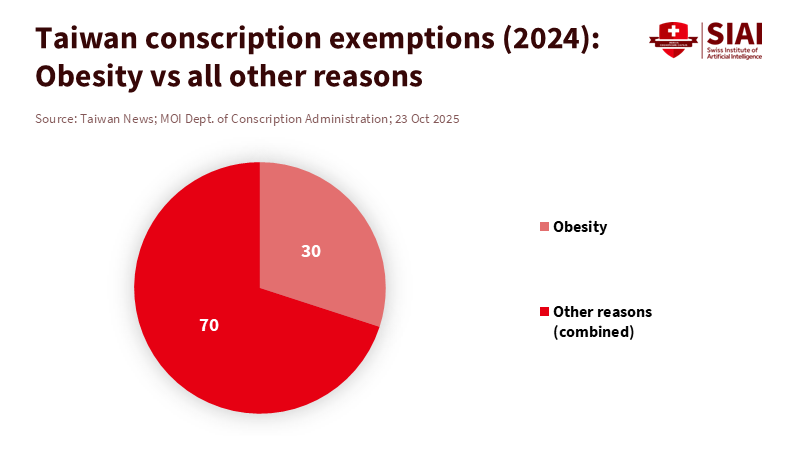
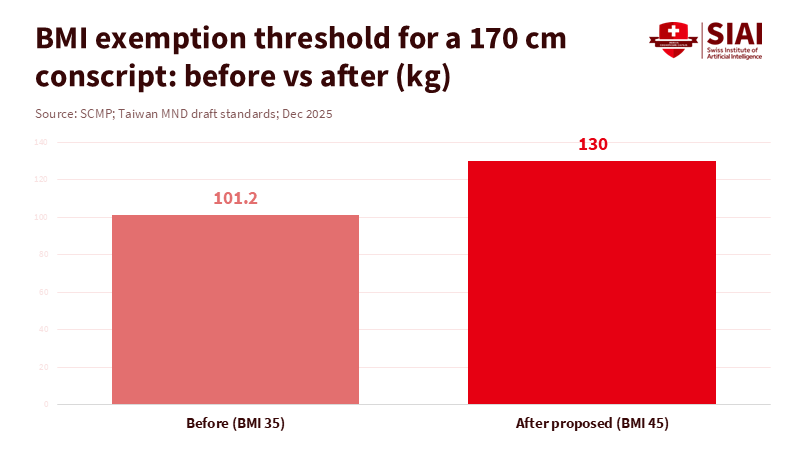
Here's a number that should worry any defense minister: 16%. That's how many Taiwanese people got out of conscription last year, with 30% of those exemptions because of obesity. The government is raising the BMI limit for exemptions to 45 and closing other loopholes to make things fairer. But the real issue is legitimacy and morale. If people think the system is rigged—if rich guys get out while everyone else risks their lives—then morale drops and deterrence weakens. Effective deterrence isn't just about having powerful weapons; it's about building trust that everyone does their part. This legitimacy problem isn't unique to Taiwan. Across Europe, the war in Ukraine has forced countries to rebuild their military defense. The central challenge is restoring morale quickly and making the system trustworthy before a crisis hits. Debates about service length or equipment matter less than whether people believe the system is legitimate. Conscription fails if it seems unfair, arbitrary, or meaningless. It works only if citizens understand why service matters and see the rules as universally applied. That's harder now, with new technologies making fast mobilization vital and information warfare undermining public trust. So, closing loopholes is necessary, but the absolute priority is boosting morale by ensuring legitimacy.
Morale and the Legitimacy Problem
Taiwan's trying to fix things by making medical exemptions harder to get and raising the BMI cutoff. They're trying to make things fairer after a series of draft-dodging scandals. It's not just about getting more bodies; it's about building trust. If lots of people are getting exemptions and famous people are dodging the draft, people will think service is only for those who aren't well-connected. People don't want to help out if they see others with money getting out of shared obligations, and this happens more during wartime. What they should do is show that the rules are enforced fairly.
South Korea shows both the good and bad sides of this. The draft is just a normal part of life there, and they let both celebrities and regular people go after about 18 to 21 months. But there have been lots of draft-dodging scandals, from fake diagnoses to people trying to gain weight, so it's been hard for people to let go of the idea that the conscription system is fair. People have been punished, and there's public shaming when someone gets caught. But being resigned to something isn't the same as actually supporting it. Taiwan can't just hope people will accept things because they're under pressure every day; if its citizens expect allies to fill gaps at the front while their own elite sons sit out, conscription morale erodes, which affects legitimacy. A believable draft needs fast, clear, fair rules that people think are equal before it's time to mobilize.
Morale in Europe's Return to Mass Defense
Europe's getting serious about security again. Latvia reinstated compulsory service, and many people are actually finishing it. Sweden began selective conscription in 2017 and is increasing the numbers as it rebuilds. Germany is also considering adopting a system like Sweden's. Poland is spending heavily on defense and building a large civilian training system. They're all doing things a little differently, but they're all moving toward citizen-based defense because of the war next door.
The problem is to get more people to join up. It's building morale in countries where people haven't served in the military for a long time and view service as a job rather than a duty. The best way to get people on board might be to show them the system is fair. If they're using a selective model, they might have transparent lottery, independent medical boards with set criteria, external audits of who gets exemptions, and equal options if someone doesn't fit in, and these are more effective than slogans. Countries should link services to training that people value, such as cyber defense or emergency medicine, so they look useful even if a person doesn't go into combat. Poland is spending a lot of money and showing off what it's doing, which sends a message. If they mix that with fair national training that teaches people useful skills, they'll get everyone on board. For Germany, a selective model must ensure that wealthy people don't find ways around it.
Morale Versus AI Soldiers
Some people might say we don't need to worry about morale because battlefields are gonna be full of drones and robots now. So, they ask: why not just use machines? But machines need people to operate and fix them! The lesson is that drones increase the effectiveness of soldiers with specific skills in maintaining and countering these systems. The more a robot can do on its own, the more important it is to have humans backing it up and be trustworthy of these systems.
That's why morale's still important, even with robots. If countries that depend on citizen soldiers are to have motivated, technically skilled citizens to operate drones, dig, and link networks while under attack. This won't work if no one thinks the draft is fair. If rich people get out of it, then the message will be that machines will fight for us. But if service is seen as a fair system with real training, people will accept that machines have a role, without replacing human responsibility.
How to Boost Morale
A good draft starts with fair rules, but it can't stop there. Taiwan needs to show that things are fair. Changing the exemption rules sends a message, but publishing annual stats on exemptions with clear explanations would make that message stick. Next, they need to show people why their service matters. The new one-year training program includes drone training; designing training that shows how all these different skills go together will help people see why their time matters. Training in cyber defense, civil resilience, and anti-drone skills. If people can point to fundamental skills like flying a drone, protecting a power grid, or dealing with injuries, they'll believe joining up means something.
Education systems and universities have a big job here. Morale improves when schools treat service as a positive path, not just a detour. To support this, schools can give credit for pre-service training and ensure people can return to school and housing after serving. Additionally, they can partner with defense agencies to create programs on topics such as drones and secure communications, taught by regular professors alongside military guest instructors. These partnerships help people accept service and reduce career disruptions from a year in uniform. In Europe, universities can pilot service models that address national skill needs, such as cyber skills. Throughout, transparency should be the priority: clearly show the process, use set criteria, and offer fast appeals.
Finally, policymakers should protect info. Taiwan warns people about information warfare, and Europe has learned that there is disinformation around Ukraine. Draft systems require a public-facing system that addresses any misinformation: quick teams that share facts on exemptions, ways to show how people are following the rules, and penalties for those who commit fraud. The goal isn't just to put on a show but to prevent those problems. Finally, countries should offer equal, dignified alternatives to military service, such as disaster relief, eldercare, and critical infrastructure, which should be fully integrated with national defense and accorded the same public honors.
Go back to that original number: 16%. These standards indicate that the draft has many problems. If a war is starting up, it doesn't. Taiwan is trying to close loopholes; Europe wants to reintroduce citizen service. The most important thing is conscription morale: people believe things are being applied fairly, are well-trained, and are doing a good job together. Build that up, and the equipment's effectiveness will become more visible. Forget about it; every scandal becomes a big problem. The solution is simple: show that things are fair, make training valuable, dignify alternative services, and respond faster to rumors. If we do, the number that matters won't be exemptions. It'll be trust.'ll be trust.
The views expressed in this article are those of the author(s) and do not necessarily reflect the official position of the Swiss Institute of Artificial Intelligence (SIAI) or its affiliates.
References
Al Jazeera. 2025. “Taiwan unveils $40bn budget for defence spending to counter China’s ‘intensifying’ threats.” 26 November 2025.
Euronews. 2025. “Poland’s president vows to spend 4.7% of GDP on defence this year.” 5 February 2025.
FPRI (Foreign Policy Research Institute). 2025. “Latvia’s Renewed Conscription Turns Two.” 27 June 2025.
Government Offices of Sweden. 2024. “New Total Defence Resolution for a Stronger Sweden.” Press release, 15 October 2024.
Hudson Institute. 2025. “The Impact of Drones on the Battlefield: Lessons from the Russia–Ukraine War.” 13 November 2025.
Institute of National Defense and Security Research / Taiwan MND. 2025. Quadrennial Defense Review 2025. 5 March 2025.
Library of Congress (Global Legal Monitor). 2023. “Latvia: New Law Introduces Compulsory Military Service Starting in January 2024.” 4 October 2023.
Le Monde. 2025. “Germany introduces voluntary military service.” 6 December 2025.
RAND Corporation. 2025. The Implications of the Fighting in Ukraine for Future U.S. and Allied Force Design. 2025.
RAND Corporation. 2025. Opportunities and Challenges for Integrating Directed-Energy Weapons into Counter-UAS. 8 December 2025.
Reuters. 2024. “Taiwan defence spend to outpace GDP growth as China threat rises.” 22 August 2024.
Reuters. 2025. “No room for compromise on Taiwan’s security, president tells reservists.” 2 December 2025.
Reuters. 2025. “Taiwan plans extra $40 billion in defence spending to counter rising threat.” 26 November 2025.
Royal United Services Institute (RUSI). 2025. “Drones Drive the Battlefield Motorcycle Tactical Shift.” 21 August 2025.
South China Morning Post. 2025. “Taiwan moves to tighten conscription rules after high-profile draft dodging.” 16 December 2025.
Taiwan Ministry of National Defense. 2025. National Defense Report 2025. 12 October 2025.
Taiwan News. 2025. “Taiwan revises exemption standards for military conscription.” 14 December 2025.
The Diplomat. 2025. “Taiwan Races to Scale Up Revamped Conscription Program Before 2027.” 11 April 2025.
Wilson Center (Global Europe Program). 2025. “‘Security, Europe!’: Poland’s Rise as NATO’s Defense Spending Leader.” 6 March 2025.
Catherine McGuire is a Professor of Computer Science and AI Systems at the Gordon School of Business, part of the Swiss Institute of Artificial Intelligence (SIAI). She specializes in machine learning infrastructure and applied data engineering, with a focus on bridging research and large-scale deployment of AI tools in financial and policy contexts. Based in the United States (with summer/winter in Berlin and Zurich), she co-leads SIAI’s technical operations, overseeing the institute’s IT architecture and supporting its research-to-production pipeline for AI-driven finance.