Beyond the Paycheck: Non-Monetary Compensation Should Reshape Education Labor Policy

David O’Neill is a Professor of AI/Policy at the Gordon School of Business, SIAI, based in Switzerland. His work explores the intersection of AI, quantitative finance, and policy-oriented educational design, with particular attention to executive-level and institutional learning frameworks.
In addition to his academic role, he oversees the operational and financial administration of SIAI’s education programs in Europe, contributing to governance, compliance, and the integration of AI methodologies into policy and investment-oriented curricula.
Input
Modified
Benefits and working conditions make up a third to two-fifths of pay
Unions shift value into enforceable rights when cash is tight, boosting retention
Measure and fund non-monetary compensation to stabilize schools

According to the U.S. Bureau of Labor Statistics, in March 2025, state and local government employers—where K-12 schools and colleges make up the majority of the workforce—allocated 38.4 percent of total compensation to benefits rather than cash wages, meaning employers paid about 61 cents in non-cash benefits for every dollar of salary. In the private industry, the split is still about 70/30. In unionized sectors, the share of benefits increases further. The numbers are precise. While we often focus discussions on wages and budgets for education professionals, a recent report from the National Education Association highlights that real earnings for education support professionals, when adjusted for inflation, have fallen over the past decade, even as attention to non-monetary compensation, such as benefits and working conditions, remains important. If we continue to view these elements as soft extras rather than essential pay, we will misprice labor, misdiagnose shortages, and misallocate funds. A policy reset is overdue.
The retention engine: non-monetary compensation in practice
Schools face high costs when staff leave. A 2024 study by the Learning Policy Institute estimates a direct turnover cost of about $25,000 per teacher in large districts. This figure does not include the loss of student learning and the adverse effects on morale that come with constant turnover. Additionally, teacher absences now carry a growing price tag. In 2024, analysts estimated the annual cost at nearly $4 billion, with many districts paying between $100 and $250 per day for substitutes. These are real losses that can be quantified. Improved non-monetary compensation, including paid sick leave and predictable prep time, can help decrease both staff turnover and absences. Recent research on paid sick leave mandates shows significant increases in coverage and a decrease in “working while ill. According to The Economics Daily, compensation costs for civilian workers rose by 3.6 percent from March 2024 to March 2025, which was a slower increase than the previous year, suggesting that strategies beyond significant cash raises may help manage staffing and reduce costs over time.
The teacher labor market also highlights why working conditions are essential. National data from NCES confirm that attrition and mobility remained high in 2021–22. Stress and workload continue to drive exit risk, as ongoing RAND survey work indicates persistent burnout. Rights established in contracts—like duty-free lunches, class-size limits, guaranteed planning periods, and predictable schedules—serve as retention tools because they restore time and reduce daily challenges. In unionized sectors, paid leave coverage and other benefits are typically higher, not lower. In summary, more rights lead to greater employee retention. We should recognize the bundle as non-monetary compensation, price it appropriately, and design it carefully. It is the most effective tool schools have.
How bargaining moves value into non-monetary compensation
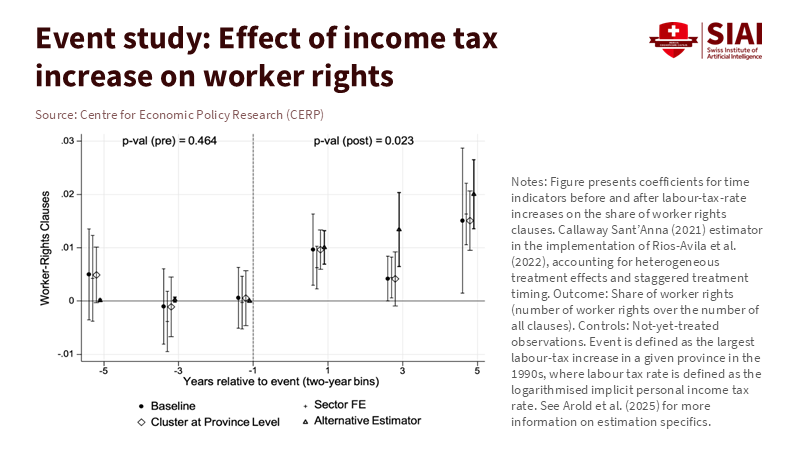
When raising wages becomes harder due to tax pressures or budget constraints, unions negotiate for more rights in collective agreements and accept lower relative cash wages. This is not speculation; it is an observable trend: new contracts responding to changes in income tax. Rights expand as funds shrink. The straightforward conclusion is that non-monetary compensation is not just fluff. It serves as a meaningful economic substitute that both parties negotiate when cash is limited. Treating it as an afterthought underestimates the actual cost of labor and obscures policy trade-offs from school boards and finance departments.
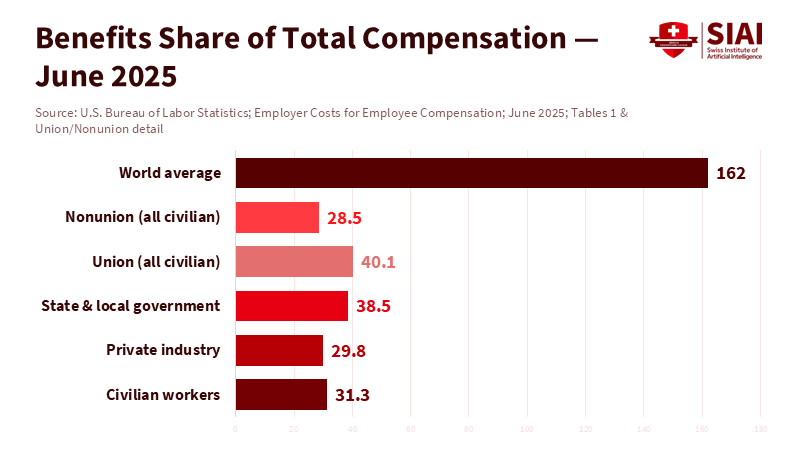
To understand the scale, examine the cost structure. In June 2025, private-sector employers spent 29.8% of compensation on benefits. State and local employers spent 38.4%. In unionized industries, the benefits share can exceed 40% of total compensation. According to research published by Baker and colleagues in 2024, unionization increases salaries for Canadian university faculty by an average of 2 percent in the first year after unionization and by 6 percent after six years. For schools, this suggests that both the wage premium and the mix of workers and firms matter when considering the impact of unions. The value beyond the paycheck is substantial, measurable, and responsive to bargaining power. A funding and accountability framework that overlooks these factors misses the essence of how value is actually delivered to staff.
Pricing what matters: class-size caps, preparation time, and safer work
Education leaders can evaluate non-monetary compensation with the same rigor as salaries. Start with class-size caps. Research shows mixed average effects on test scores but consistent benefits for particular groups and settings, along with clear correlations to workload and behavior management. Caps often appear in collective bargaining agreements because they stabilize classrooms and protect teachers' time. That time is valuable. Reducing one class from a full schedule can add an hour of prep time each day, improving planning and feedback loops. Link that additional time to decreased turnover and fewer days spent with substitutes, and the savings become clear. The goal is not to assert a single universal effect size; rather, it is to establish a standard for valuing the rights that teachers identify as vital to job retention.
Safety is part of this package as well. In 2023, the EU recorded 2.82 million non-fatal and 3,298 fatal work accidents. While education differs from manufacturing, schools are facing increasing behavioral and mental health risks. Unionization in care settings has been linked to improved equipment, fewer injuries, and greater compliance with safety reporting requirements. While these findings may vary across sectors, they center on a simple idea: organized workers secure procedures that reduce risk. In schools, this means fully staffed duty rosters, clear de-escalation protocols, and guaranteed coverage when staff are injured or fall ill. These elements are lines of non-monetary compensation with a measurable value. They should be budgeted accordingly.
A policy playbook for funding and reporting non-monetary compensation
First, measure and publish the complete set of benefits. Every district and higher education employer should report an annual ratio detailing the value of benefits and rights per $1 of wages. Use the Bureau of Labor Statistics' existing frameworks and adapt them for education. Require contract inventories that list significant non-monetary compensation items: class-size caps, planning time, paid leave policies, schedule protections, duty-free breaks, mentoring loads, and professional development days. Once this inventory is established, policymakers can track how rights shift as budgets or tax policies change, much like researchers already do. Transparency will help align bargaining, budgeting, and workforce planning.
Second, finance condition-based reforms with the same seriousness as salary increases. If a district can reduce attrition by even one percentage point through added prep time, enforced caps, or improved sick-leave access, the savings from avoiding turnover and the need for substitutes can fund the policy itself. The evidence is growing: mandates for paid sick leave expand coverage and lower presenteeism; burnout decreases when time is protected; and costs related to absenteeism are real and recurring. Create grants that provide time and predictability—two elements that workers value, and unions can enforce. In places where labor taxes alter the balance of wages and rights, monitor those changes to prevent unintended reductions in cash pay. Overlooking non-monetary compensation is not neutral; it is a choice to leave high costs off the books.
In summary, policymakers should: 1) identify all components of non-monetary compensation, 2) report their value transparently, 3) fund and protect these benefits alongside salaries, and 4) adjust labor policy to optimize the package for retention and efficiency. Schools that do so will retain more staff, reduce costs, and stabilize classrooms. Those that do not will continue to incur hidden expenses and staff turnover. The essential question is not whether non-monetary rights matter, but whether education systems will formally value and manage them.
The views expressed in this article are those of the author(s) and do not necessarily reflect the official position of the Swiss Institute of Artificial Intelligence (SIAI) or its affiliates.
References
Abraham-Aggarwal, K., et al. (2024). The Impact of Unions on US Direct Care Workers in Long-Term Care. JAMDA.
Arold, B. W., Ash, E., MacLeod, W. B., & Naidu, S. (2025). The Economic Value of Worker Rights in Union Contracts. VoxEU/CEPR.
Beauregard, P.-L., Lemieux, T., Messacar, D., & Saggio, R. (2025). Why Do Union Jobs Pay More? New Evidence from Matched Employer-Employee Data (NBER Working Paper No. 33740).
Bureau of Labor Statistics (2025a). Employer Costs for Employee Compensation — News Release, June 2025.
Bureau of Labor Statistics (2025b). Employer Costs for Employee Compensation — Detailed PDF, June 2025.
Bureau of Labor Statistics (2025c). Employer Costs for Employee Compensation — State and Local Government, March 2025.
Bureau of Labor Statistics (2025d). Employment Cost Index — Q3 2025.
European Commission (Eurostat) (2023). Accidents at Work Statistics.
Economic Policy Institute (2025). Unions Aren’t Just Good for Workers—They Also Benefit Communities and Democracy.
Learning Policy Institute (2024). What’s the Cost of Teacher Turnover? Factsheet.
Maclean, J. C., et al. (2025). Mandated Sick Pay: Coverage, Utilization, and Crowding-in. Journal of the European Economic Association.
National Center for Education Statistics (2023). Teacher Attrition and Mobility (NTPS 2021–22).
OECD (2025). Labour taxes edge up in the OECD as real wages recover in 2024. Press release.
RAND (2023). State of the American Teacher.
Roza, M., quoted in Fortune (2024). Teacher absences are costing schools billions.
Bloomberg (2024). Absent Teachers Risk Costing American Schools $4 Billion a Year.
David O’Neill is a Professor of AI/Policy at the Gordon School of Business, SIAI, based in Switzerland. His work explores the intersection of AI, quantitative finance, and policy-oriented educational design, with particular attention to executive-level and institutional learning frameworks.
In addition to his academic role, he oversees the operational and financial administration of SIAI’s education programs in Europe, contributing to governance, compliance, and the integration of AI methodologies into policy and investment-oriented curricula.