From Narratives to Prices: AI and the New Data Architecture of Prediction Markets

His recent work examines the broader socioeconomic consequences of artificial intelligence, including labor markets, public finance, demographic change, institutional adaptation, and the distributional effects of technological progress.
He holds a PhD in Mathematical Finance from Boston University, and previously earned an MSc in Finance and Economics from the London School of Economics. He completed his undergraduate studies in Economics at Seoul National University under the Korea Foundation for Advanced Studies scholarship program.
Published
Modified
Digital markets convert previously unpriced expectations into observable data
LLMs connect news, discussion, and policy language to real-time price movements
Prediction markets may create measurable signals for political, scientific, and social risk

Financial markets have long provided researchers with a continuous record of human expectations. Prices, volumes, spreads, volatility, and order flow reveal how investors respond to earnings, interest rates, regulation, geopolitical events, and changing perceptions of risk. These data are imperfect and often difficult to interpret, but they offer something that most other areas of social inquiry lack: an observable sequence showing how collective beliefs change over time.
Many important forms of uncertainty have historically remained outside this structure. Political instability, regulatory intervention, scientific breakthroughs, institutional failure, technological disruption, and social conflict are frequently discussed through reports, interviews, and qualitative assessments. Analysts may describe a risk as increasing or declining, but they usually cannot observe a continuously updated market value attached to that assessment. The absence of a tradable asset means that beliefs remain dispersed across documents and conversations rather than consolidated into a common numerical signal.
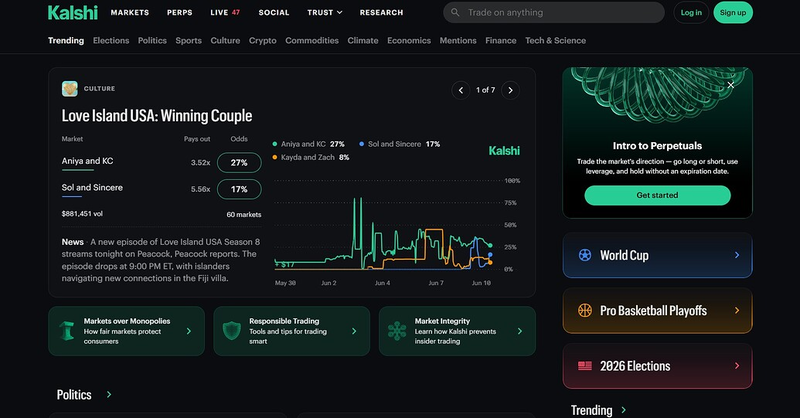
Digital prediction markets are beginning to narrow this gap. By creating contracts around specific future events, they transform expectations that once existed only as language into observable bids, offers, and transaction prices. The resulting markets remain smaller and less mature than conventional financial exchanges, but they introduce a potentially important form of data infrastructure. They make it possible to observe not only what people believe about an uncertain event, but also when those beliefs change, how strongly participants disagree, and which information appears to move the market.
The Expansion of Observable Market Data
For much of modern economic history, market data referred primarily to financial assets, commodities, currencies, and derivatives. These markets generated sufficiently frequent transactions to support empirical analysis, risk modelling, and the development of pricing theory. Researchers could estimate distributions, examine volatility, identify regime changes, and test how new information affected asset values. Other forms of uncertainty remained difficult to quantify because no corresponding market existed.
The development of digital platforms has changed the economics of market creation. A market no longer requires a physical exchange, specialised dealer network, or substantial operational infrastructure. A platform can define a contract, register participants, record orders, match trades, and preserve the complete history of activity within a database. Once these functions become inexpensive, markets can be created for narrower and more specialised questions than traditional exchanges would support.
This enables the emergence of segmented markets. Instead of observing only broad political or economic conditions, researchers can construct markets around individual elections, policy decisions, research outcomes, climate records, disease declarations, court rulings, or technological milestones. Each market produces a small dataset, but thousands of such markets could collectively form a new layer of information about expectations across society. The importance of prediction markets may therefore lie less in any single forecast than in the infrastructure they create for recording beliefs that were previously invisible.
From Qualitative Risk to Measurable Expectations
Political risk provides a useful example. Firms, investors, and governments routinely assess the probability of elections, sanctions, regulatory changes, political unrest, and international conflict. These assessments influence investment decisions and strategic planning, yet the underlying reasoning is usually contained in confidential reports, expert judgment, or narrative scenarios. Because the information is fragmented and expressed in incompatible forms, it is difficult to compare expectations across time or institutions.
A prediction market can impose a common structure on these beliefs. Participants must translate their judgments into positions linked to a defined event and deadline. The market price does not become an objective measure of political risk, but it creates an observable estimate generated through interaction among multiple participants. Researchers can then study how that estimate changes after speeches, polls, diplomatic developments, court decisions, or media reports.
With sufficient data, the value extends beyond the individual contract. Price reactions across related markets may reveal how participants connect events. A new regulation may change expectations not only for one company or industry, but also for elections, public spending, technological investment, or international relations. Prediction markets could therefore help reveal the implicit structure through which participants price political and institutional risk—an area that has traditionally resisted direct measurement.
Text Has Always Moved Markets
Market prices have never been determined by numerical information alone. Earnings announcements, central-bank statements, political speeches, newspaper articles, analyst reports, rumours, and public commentary all influence expectations. The difficulty has been that text is far more complex to analyse than prices. A price is already represented in a standard numerical format, while language must be interpreted in context.
Earlier forms of text analysis relied heavily on dictionaries, keyword counts, and manually labelled datasets. These methods were useful but limited. The meaning of a sentence could change with context, negation, technical vocabulary, or institutional setting. A word such as “risk” could indicate deterioration, prudent management, or merely a formal disclosure requirement. Researchers could process large volumes of text, but the resulting classifications often lost much of the meaning contained in the original documents.
Large language models materially expand this capability. They can identify claims, entities, causal relationships, uncertainty, disagreement, and changes in tone across large collections of documents. They can compare a new statement with earlier statements, distinguish expert analysis from speculative commentary, and organise text according to the events or markets to which it is relevant. This makes it increasingly feasible to connect the information environment directly to subsequent market behaviour.
Connecting Messages to Price Movements
A prediction-market platform can record the precise time at which orders are submitted and prices change. News and discussion platforms also preserve timestamps. When these datasets are integrated, researchers can begin examining how particular forms of language affect collective expectations. A newspaper article, government announcement, scientific paper, or community discussion can be linked to the price movements that followed.
The simplest analysis would measure whether a price increased or decreased after a relevant message appeared. A more sophisticated system would examine the size, speed, duration, and distribution of the response. Did prices move immediately, or only after the information was repeated by other sources? Did trading volume increase before the price changed? Did the initial movement reverse after expert criticism appeared? Did a small group of participants react first, followed by the wider market?
LLMs can help classify the textual event that preceded each reaction. They can identify whether the message introduced new evidence, repeated known information, expressed an opinion, challenged an existing consensus, or used unusually emotional language. The resulting dataset would allow researchers to study not merely whether news moves prices, but what types of messages move them, which participants respond, and how long the effects persist.
Beyond Sentiment Analysis
The term “sentiment analysis” is often used to describe the classification of text as positive, negative, or neutral. This framework is too limited for prediction markets. A statement can be pessimistic in tone while reducing uncertainty, or optimistic while providing little new information. What matters is not simply emotional direction, but how the message changes beliefs about the probability of a defined event.
An AI system designed for prediction-market analysis would therefore need to identify informational structure. It would distinguish new facts from interpretations, separate evidence from speculation, and recognise whether a statement supports or contradicts the conditions specified in a market contract. It would also need to estimate whether the information was already reflected in the price before publication.
This opens a broader research question: how does information become price? The answer may depend on source credibility, technical complexity, participant expertise, market liquidity, and the clarity of the contract. LLMs provide a way to represent and compare the textual inputs, while market data provide the behavioural response. Together, they create an empirical setting in which the transmission of information can be observed rather than assumed.
Market Prices as Behavioural Data
Prediction-market prices are frequently interpreted as forecasts, but their value as behavioural data may be equally important. A price movement can reflect a rational response to new evidence, but it can also reveal anxiety, herding, overconfidence, political identity, or excessive attention to dramatic events. These effects are often treated as noise from the perspective of forecasting. From the perspective of behavioural research, they are central observations.
The combination of price data and textual data makes it possible to separate some of these mechanisms. If a scientific report produces a gradual adjustment consistent with its empirical findings, the market may be processing information efficiently. If a sensational headline creates a large temporary movement that later reverses, the data may reveal an attention shock. If community discussion amplifies a movement without adding new evidence, the platform may be observing social contagion.
Repeated observations across many markets could allow researchers to identify recurring behavioural patterns. Certain topics may be especially vulnerable to fear, technological optimism, political loyalty, or media amplification. Certain participants may consistently react early and accurately, while others may follow momentum. These patterns would provide a richer account of collective judgment than either surveys or final market prices alone.
Detecting Changes in the Information Regime
Financial markets are often analysed in terms of regimes. A market may shift from low volatility to high volatility, from stable expectations to crisis conditions, or from fundamental valuation to speculative momentum. Prediction markets may exhibit comparable changes. A contract can remain largely inactive and then suddenly become the focus of intense trading after a major event.
The analytical task is to determine whether a movement represents ordinary updating or a transition into a different information regime. A temporary price change may disappear once uncertainty is resolved, while a persistent change may indicate that participants have adopted a new interpretation of the event. Volume, spreads, order concentration, textual intensity, and the diversity of participating accounts may all contribute to identifying such shifts.
AI can assist by combining these heterogeneous signals. Statistical models can detect distributional changes in market data, while LLMs can identify changes in the surrounding narrative. When both the numerical and textual environments shift simultaneously, researchers may have stronger evidence that the market has entered a new state. This integrated approach could be useful not only for prediction markets, but also for financial, political, and strategic risk analysis more broadly.
The Importance of Database Architecture
The analytical potential of prediction markets depends on data design from the beginning. A platform built only to display current prices will lose much of its scientific value. Research requires detailed records of orders, cancellations, trades, positions, participant histories, contract revisions, resolution decisions, and external information events. The database must preserve the sequence through which the market evolved.
Metadata are equally important. Each contract should have a clearly defined subject, deadline, resolution source, geographic scope, and event category. External documents should be linked to relevant markets with timestamps and source classifications. Participant privacy must be protected, but behavioural continuity should be preserved sufficiently to study calibration and learning over time.
This is where digital infrastructure becomes part of the research design. The database is not merely a technical support system for the platform. It determines which scientific questions can later be answered. A poorly structured system may produce visible prices while discarding the underlying process. A research-oriented system should treat every order, message, and revision as part of a longitudinal record of collective belief formation.
A Non-Monetary Market as Research Infrastructure
Real-money markets use financial incentives to encourage participation and penalise inaccurate confidence. They also attract gambling demand, expose participants to losses, and introduce legal and regulatory concerns. For a scientific institution, a non-monetary system may provide a more appropriate starting point.
Participants could receive equal virtual capital and accumulate reputation through calibrated forecasts and successful information contribution. Performance could be evaluated across many markets rather than through a single large wager. The platform could reward consistency, early incorporation of reliable information, and transparent reasoning. This would make the service less attractive to gambling users while preserving much of the market structure required for research.
The absence of real money would not remove every distortion. Participants could still trade carelessly, follow others, or attempt to manipulate rankings. These behaviours would themselves become subjects of analysis. The key advantage is that the institution could design the system around data quality, experimental control, and participant learning rather than transaction revenue.
The Emerging Research Opportunity
The convergence of prediction markets, modern databases, and large language models creates a research opportunity that did not previously exist at comparable cost. Digital markets can generate continuous behavioural data for narrowly defined forms of uncertainty. Databases can preserve the full history of how beliefs evolve. LLMs can organise the text that influences those beliefs and connect narrative changes to market responses.
This combination may help researchers approach questions that have remained resistant to measurement. How rapidly do people incorporate scientific evidence? Which media sources exert disproportionate influence? When does uncertainty become panic? How are political and regulatory risks translated into numerical expectations? Which participants possess genuine forecasting skill, and which merely benefit from favourable outcomes?
Prediction markets will not provide definitive answers to these questions by themselves. Their prices remain products of market design, participant composition, and imperfect information. Yet they can create something valuable: a structured empirical record where previously there were only scattered opinions. Once beliefs, messages, and price movements can be observed together, uncertainty becomes more amenable to scientific analysis.
Toward an SIAI Labs Research Platform
For SIAI Labs, the strategic opportunity is not to replicate an existing betting platform. It is to build an experimental environment in which market design, statistical modelling, behavioural analysis, and AI-based text interpretation can be studied together. A non-monetary prediction system could begin with a limited number of scientific, technological, economic, and policy questions and expand as its research methods become more reliable.
The platform could compare market forecasts with expert judgments, statistical models, and LLM-generated estimates. It could test how different information sources affect prices, identify regime changes, and examine whether participants improve through repeated forecasting. Over time, the resulting data could support research in political risk, scientific forecasting, strategic intelligence, and the economics of information.
The deeper significance lies in the creation of a new data category. Financial markets made asset expectations observable. Digital prediction markets may make event expectations observable. LLMs can then connect those expectations to the language through which society interprets uncertainty. The result is not a machine that predicts the future with certainty, but a research infrastructure that reveals how humans continuously attempt to price it.
His recent work examines the broader socioeconomic consequences of artificial intelligence, including labor markets, public finance, demographic change, institutional adaptation, and the distributional effects of technological progress.
He holds a PhD in Mathematical Finance from Boston University, and previously earned an MSc in Finance and Economics from the London School of Economics. He completed his undergraduate studies in Economics at Seoul National University under the Korea Foundation for Advanced Studies scholarship program.
Similar Post