AI Lifelong Learning Must Arrive Before the Skill Gap Hardens

His recent work examines the broader socioeconomic consequences of artificial intelligence, including labor markets, public finance, demographic change, institutional adaptation, and the distributional effects of technological progress.
He holds a PhD in Mathematical Finance from Boston University, and previously earned an MSc in Finance and Economics from the London School of Economics. He completed his undergraduate studies in Economics at Seoul National University under the Korea Foundation for Advanced Studies scholarship program.
Input
Modified
AI access helps only when workers can recognise system failure
Task-specific learning can spread that supervisory capacity
Delay will widen the divide between AI Haves and AI Have-Nots

In a field experiment with 758 consultants, access to GPT-4 made participants faster and improved their performance on tasks within the system's capabilities. However, on a task just beyond the model's capability frontier, AI users were 19 percentage points less likely to get the right answer. That inversion illustrates the central problem facing working-age adults. The skill is no longer just the ability to query AI systems and deliver AI-generated answers. It is the ability to know which answers to trust, what missing evidence to seek and when to turn the tool off. The starting point for AI lifelong learning is therefore not self-learning but judgment. Universities and governments that treat the AI judgment challenge as either a new university degree market or an e-learning platform will reach too few adults and develop only limited competence. The central challenge is to deliver recurrent, task-specific, adult-oriented learning to workers who need to test, monitor, and control evolving systems before the benefits become concentrated among the most self-directed learners.
AI Lifelong Learning Is a Calibration System
The standard narrative of lifelong education, viewed as a supply problem, is: technology evolves, old skills depreciate, workers need additional training. That narrative is insufficient for generative AI, because the tool itself can perform components of the skill being acquired. The human role shifts from producing output directly to decomposing work into steps, checking quality and correcting errors. This is best termed calibration: the skill of estimating a system's capabilities in a given circumstance, evaluating its output against criteria and recognizing and managing uncertainty based on its demonstrated reliability. Calibration depends on domain understanding, iterative problem formulation and monitoring, or metacognition, the capacity to monitor one's own reasoning. That cannot be learned in a broad prompting seminar. A nurse checking a generated discharge summary, a technician diagnosing a machine fault and an administrator preparing a benefit ruling face different uncertainties, standards and consequences. Effective AI-focused lifelong training must focus on those real workplace tasks, repeatedly refining practice as workflows evolve.
General AI literacy enables upskilling but remains only the most basic layer of a capability that will continue to be occupation- and task-specific. Moreover, that specialized expertise cannot be codified in a fixed syllabus, as the behavior of specific models, interfaces and organizational protocols will shift within months rather than decades. The urgency comes from the fact that calibration capacity is limited. The OECD's 2023 Survey of Adult Skills finds that 29 percent of adults from participating countries performed at Level 1 or below in adaptive problem-solving and only 5 percent achieved the highest level. These tests assess an adult's capacity to update a strategy, to leverage social and digital resources and to check whether a goal has been reached in shifting circumstances; in short, tasks at the heart of supervising a probabilistic AI system.
Meanwhile, the ILO reports that during the previous year, only 16 percent of workers worldwide participated in organized learning. Informal workers, adults with low literacy and those outside stable employment face particular institutional gaps; a degree-only response by design excludes these groups and, instead, expects adults to enroll in a lengthy academic process, a path they may not have the time or means for, rather than offering shorter routes through public services, professional bodies, unions, libraries, community organizations, or portable digital accounts. Failing this, learning is reduced to a private investment of time and money. Such mismatches are structural: those suffering the greatest shocks are least likely to find employer-provided support or to be capable of independently researching and comparing credible training options.
The Same Tool Produces Opposite Results
Controlled studies demonstrate why mere access represents a weak proxy for preparation. In Shakked Noy and Whitney Zhang's experiment with 453 college-educated professionals, ChatGPT reduced the time needed for short writing tasks by 40 percent and increased assessed quality by 18 percent. The lowest-performing users benefited most, implying that AI assistance can spread effective practices and narrow performance gaps. A larger-scale workplace study by Erik Brynjolfsson, Danielle Li and Lindsey Raymond found a similar effect among 5,172 customer support agents. The chatbot increased issues resolved per hour by 15 percent on average, with the largest gains among less-skilled and less-experienced workers. It appeared to transmit some of the practices used by top performers. Such research is significant because it demonstrates that AI is not necessarily a boon to the already-privileged. In bounded settings, where the right tool is used to support a measurable output, assistance can serve as a scaffold. It can accelerate both performance and learning, especially when employees are given guidance in the process instead of being asked to navigate it in isolation.
The opposite outcome is equally important. The same consultant workplace experiment found strong gains on tasks within GPT-4's frontier, with a sudden drop in correctness outside it. In 2025, a small, randomized METR experiment involved 16 experienced open-source developers completing 246 coding tasks in familiar codebases. They expected AI to improve performance and still believed it had after completing the work. Measured completion time showed a 19 percent slowdown. The sample is narrow and reflects early-2025 tools, so it cannot be used to settle the relative effect of coding assistants on software work. It does, however, show a fundamental failure of self-assessment: experts misjudged the tool's effect, even when time was directly measurable. Taken together, they rule out any simple pattern: neither automatic gains for novices nor reliable advantages for experts. Results depend on task structure, model fit, local factors, review costs and user proficiency at identifying the boundary. AI lifelong learning must therefore teach comparison with a baseline. Workers should measure time, error, rework and outcomes, not just claim the tool was beneficial. Calibration training can make those uncertainties obvious by requiring predictions first, testing second and explanation third.
Why Calibration Gaps Become Capability Gaps
Without timely AI lifelong learning, the causal chain begins with unequal starting points. Workers who understand the problem domain better can frame better problems and solutions, see where constraints are lacking and judge reasonableness. Workers with strong adaptive capacity will learn to adopt new tools. Repeated use then creates a second benefit: they gain a private set of prompts, tried-and-true examples, checks, efficiencies and workflow shortcuts. Each high-yield step makes the next experiment less costly, so learning accelerates: assistance becomes an advantage multiplier rather than a novelty. This pathway creates SuperHuman Labor: not a person with machine-like intelligence, but a worker whose expertise and calibrated AI use enable a worker to produce a wider range of outputs at unusual speed and quality. A small number of such workers can capture large productivity gains because they can monitor more output, cross traditional job boundaries and adopt new tools without waiting for formal instruction. The chasm then separates AI Haves from AI Have-Nots less by age than by differences in prior knowledge, adaptiveness, confidence calibration and access to coached practice.
Poorly designed use can also push in the opposite direction. A 2025 CHI survey asked 319 knowledge workers about 936 real uses of generative AI. The results showed that higher confidence in the tool was associated with less reported critical thinking, while confidence in one's own task ability was associated with more. As an observational, self-report-based study, it does not establish that AI leads to deterioration in reasoning. It does, however, suggest a plausible mechanism: as more production is outsourced, mental effort shifts to verification and integration; a worker with insufficient knowledge to verify may accept a fluent answer while one with sufficient knowledge can use the mental effort saved for thorough review.
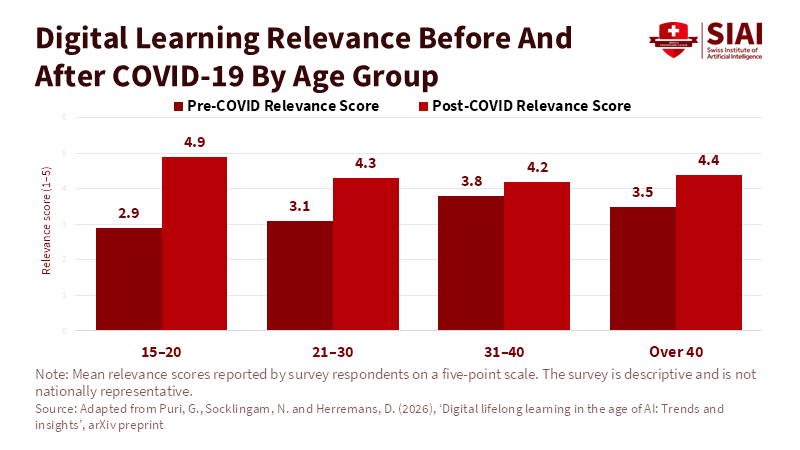
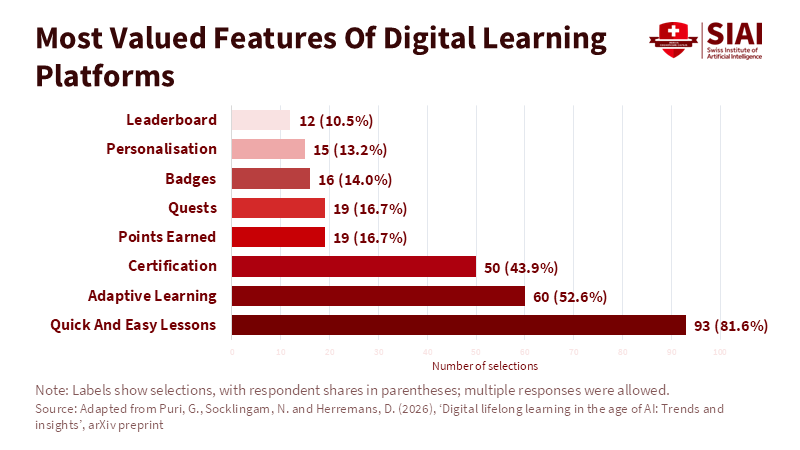
Digital learning research also reveals that adult learners do not treat platforms the same way. A 2026 preprint survey of 200 learners found that ease of use was the main driver of engagement; older professionals preferred structured platforms and concerns about accuracy remained a barrier. Limited by a convenience sample, it offers a useful design lesson: easier access does not guarantee better learning; platform design must still preserve the cognitive effort needed to develop judgment. Courses should require learners to explain why a result is acceptable, identify the evidence used and complete related tasks unaided so retained knowledge remains visible.
Build Training Around Work Before the Divide Widens
The strongest challenge is that productivity trials often find that AI narrows performance gaps. If most workers benefit, universal access may be more egalitarian than any training system governments could put in place. The customer-service and writing trials show how AI can deliver genuine compression and improve work quality and training systems should not generate unwanted credentials that impede wider productive use. Yet the equalizing effect is predicated on supporting infrastructure, including relevant input data, well-scoped tasks, standards of quality, feedback metrics and sufficient human knowledge for workers to detect when the system is wrong. The evidence also relates more to short-term output than durable capability across changing tasks. The ILO review of 174 training evaluations finds that integrated programs combining instruction with workplace learning provide more reliably positive employment effects than stand-alone workplace exposure and recognized qualifications are more effective than non-quality-assured certificates. The evidence is correlational, not necessarily causal, across diverse training designs, but it supports a reasonable principle.
Workers should receive the tool, guided practice, feedback, assessment and portable recognition, especially when their employers do not provide training. The aim should be to develop AI lifelong learning as a public capability infrastructure before unequal self-learning hardens into an occupational divide. Programs should begin with actual tasks and coach workers to establish a no-AI baseline, practice verification, log recurrent errors and achieve competence through external validation. Programs must be short enough for working adults, modular enough to adapt with new systems and available outside universities and large firms. A human-centered, rights-based approach offers an important boundary: digital access cannot be inclusive while billions remain offline or while privacy, accessibility and accountability are treated as optional. The 19 percent reversal in the experiment should be a guiding warning. AI creates gains when people understand the task and the tool's limits; it produces confident error when supervision is weaker than generation. Timely, task-based learning should spread the skills to supervise AI; delay would leave them concentrated among a small set of firms and SuperHuman Labor, allowing productivity to rise while human capability and opportunity diverge.
The views expressed in this article are those of the author(s) and do not necessarily reflect the official position of the SIAI or its affiliates.
References
Becker, J., Rush, N., Barnes, E. and Rein, D. (2025) ‘Measuring the impact of early-2025 AI on experienced open-source developer productivity’, arXiv preprint, arXiv:2507.09089.
Brynjolfsson, E., Li, D. and Raymond, L.R. (2025) ‘Generative AI at work’, The Quarterly Journal of Economics, 140(2), pp. 889–942.
Dell’Acqua, F., McFowland III, E., Mollick, E.R., Lifshitz-Assaf, H., Kellogg, K.C., Rajendran, S., Krayer, L., Candelon, F. and Lakhani, K.R. (2023) ‘Navigating the jagged technological frontier: Field experimental evidence of the effects of artificial intelligence on knowledge worker productivity and quality’, Harvard Business School Working Paper No. 24-013. Boston, MA: Harvard Business School.
Delaporte, I., Escudero, V. and Liepmann, H. (2026) ‘Lifelong learning is becoming increasingly important in response to labour market transformations’, VoxEU, 22 July. London: Centre for Economic Policy Research.
International Labour Organization (2026) Lifelong Learning and Skills for the Future. World of Work Series. Geneva: International Labour Office.
Lee, H.-P., Sarkar, A., Tankelevitch, L., Drosos, I., Rintel, S., Banks, R. and Wilson, N. (2025) ‘The impact of generative AI on critical thinking: Self-reported reductions in cognitive effort and confidence effects from a survey of knowledge workers’, Proceedings of the 2025 CHI Conference on Human Factors in Computing Systems, Article 1121, pp. 1–22.
Noy, S. and Zhang, W. (2023) ‘Experimental evidence on the productivity effects of generative artificial intelligence’, Science, 381(6654), pp. 187–192.
OECD (2024) Do Adults Have the Skills They Need to Thrive in a Changing World? Survey of Adult Skills 2023. OECD Skills Studies. Paris: OECD Publishing.
Puri, G., Socklingam, N. and Herremans, D. (2026) ‘Digital lifelong learning in the age of AI: Trends and insights’, arXiv preprint, arXiv:2602.03114v1.
Ramana, K.V. (2026) ‘AI and lifelong learning: How adults are reskilling through intelligent education platforms’, AIExploreTools, 6 February.
UNESCO (2025) AI and Education: Protecting the Rights of Learners. Paris: UNESCO.
His recent work examines the broader socioeconomic consequences of artificial intelligence, including labor markets, public finance, demographic change, institutional adaptation, and the distributional effects of technological progress.
He holds a PhD in Mathematical Finance from Boston University, and previously earned an MSc in Finance and Economics from the London School of Economics. He completed his undergraduate studies in Economics at Seoul National University under the Korea Foundation for Advanced Studies scholarship program.