AI Early Diagnosis: How Pattern Recognition Is Changing Healthcare

Publications under SIAI Editor are prepared or coordinated by SIAI’s research and editorial team and include research synthesis, policy and industry analysis, technical interpretation, and interdisciplinary work connecting artificial intelligence with established fields of research and professional practice.
Input
Modified
AI pattern recognition is improving early clinical detection
Real-world trials show gains across several medical settings
Human oversight, diverse data and workflow design remain essential
In five hospitals in the United States, software that monitors the vital signs, laboratory values and history of more than 590,000 patients in real time achieved something that few previous warning systems had achieved: it was associated with 3.3 percentage points lower in-hospital mortality, an adjusted relative reduction of 18.7 percent, when clinicians confirmed the alert within three hours in cases where medical staff confirmed the alert within three hours of its occurrence. The study was published in 2022 in Nature Medicine by a Johns Hopkins University research team, and was not about an experimental model in controlled conditions but a system that works every day in real hospital departments, both academic and community. This is one of the most tangible examples of a wider shift that has been taking place in recent years: pattern recognition algorithms, trained on huge volumes of clinical data, are beginning to be integrated into the routine of early diagnosis, from intensive care units to radiology departments and psychiatric clinics.
AI Early Diagnosis Is Entering Routine Clinical Workflows
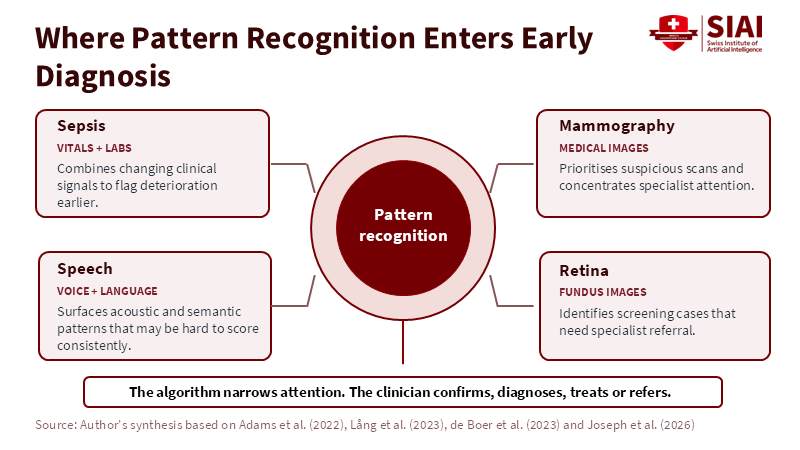
The system is called the Targeted Real-time Early Warning System, known as TREWS, and analyzes data from the patient's electronic record from the time of admission to discharge so that no shift change or department transfer leads to a loss of information. In the 2022 study, researchers identified 6,877 patients with sepsis to whom the system had sent a notification before starting antibiotic treatment. Those who had their alert confirmed by a doctor within three hours experienced 3.3 percentage points lower in-hospital mortality than those who were delayed by confirmation, a relative decrease of 18.7 percent. In high-risk patients, the absolute reduction reached 4.5 percent, while antibiotic administration started on average about two hours earlier.
Sepsis is difficult to recognize early because its early symptoms, such as fever, tachycardia, and confusion, also occur in many other conditions. Earlier automated alert systems often generated enough false alarms to contribute to alert fatigue, which the Johns Hopkins team attempted to fix by combining more variables and integrating the tool directly into the nursing staff's workflow rather than acting as a separate app. The result is not a system that replaces clinical judgment, but a filter that directs staff attention to where speed of reaction matters most.
AI-Assisted Mammography Changes Screening Workflows
Every year about a million women are called for a preventive mammogram in Sweden, where each examination is usually read by two breast radiologists, a specialty that faces staff shortages in several European countries. In the Mammography Screening with Artificial Intelligence trial, known as MASAI, the Lund University team behind the MASAI trial randomized 80,033 women to either a standard double reading or an AI-assisted reading, where the software triaged examinations to single or double reading and provided AI-based detection support. The interim safety analysis, published in 2023 in The Lancet Oncology, recorded 244 cancers were detected versus 203, a 20 percent numerical difference; false-positive rates were identical and reading workload fell by 44.3 percent, with no increase in false positives, while reading load decreased by 44 percent.
A second analysis, a subsequent 2025 analysis of the MASAI trial, extended to nearly 106,000 women and found that the predominance had widened to 29 percent more cancers and 24 percent more invasive cancers, with the increase concentrated mainly in small, lymph-node-negative cancers, precisely those where early detection changes the prognosis the most. This finding did not come from a limited group of volunteers selected for the study, but from Sweden’s national screening programme at four screening sites in southwest Sweden, which gives it a different weight from retrospective comparisons on selected image samples.
Speech Patterns Could Support Earlier Schizophrenia Detection
In the United States, a 2015 study of 404 patients from 34 non-academic clinics in 21 states found that the median duration of untreated psychosis was 74 weeks, about one year and five months, with 68 percent of patients exceeding the six-month delay. Part of the problem is that the diagnosis is based on symptom scoring scales that depend on the subjective impression of the clinician, which makes it difficult to standardize and opens up room for disagreement between different evaluators.
A Dutch study involving the universities of Groningen and Utrecht, published in 2023 in Psychological Medicine a study where they extracted 88 auditory speech characteristics, such as pause duration, intonation, and vowel articulation, from recordings of 142 patients with schizophrenia spectrum disorder and 142 matched healthy participants. A random forest algorithm trained on these characteristics distinguished the two groups with an accuracy of 86.2 percent, while being able to distinguish patients with dominant positive symptoms from those with dominant negative symptoms with an accuracy of 74.2 percent. At the same time, A separate U.S. study applied natural language processing methods to transcripts of interviews and found that computational measures of speech coherence differed. In a separate study of 31 participants, NLP-derived features classified the groups with 87% accuracy, compared with 68 percent for clinical ratings alone, even though the two groups had almost identical averages on the same scale.
Retinal Screening Brings AI Into Primary Care
Diabetic retinopathy remains one of the leading causes of blindness in working-age adults, but annual screening that stops it early requires access to an ophthalmologist, which is not a given in rural areas or in primary care systems with limited resources. A pragmatic multicentre trial in Australia and colleagues at five general medicine and endocrinology centres between August 2021 and June 2023 examined 863 participants using an AI-integrated automated fundoscopy camera, which analysed images on-site without the need for a specialist. The publication, published in 2025 in the British Journal of Ophthalmology, recorded an accuracy of 93.3 percent in the detection of diabetic retinopathy that requires referral, with a sensitivity of 83.7 percent and a specificity of 96.1 percent.
The significance of the finding lies not just in the number but in where it was measured. This is not a laboratory evaluation of images selected after the fact, but a workflow within real doctors' offices, where the patient could receive a result on the same day and be referred immediately if needed, without waiting for an appointment with a specialist that may be months away. For health systems struggling with ophthalmologist shortages, this transforms screening from something dependent on the availability of a rare specialist to something that can fit into a diabetic patient's regular visit to their general practitioner or endocrinologist.
The Limits of AI Pattern Recognition in Early Diagnosis
A common objection to these findings is that they come from controlled trial conditions and do not withstand the normal turmoil of a real hospital, or that AI risks substituting for clinical judgment instead of supporting it. The evidence does not confirm this fear in the way it is often formulated. TREWS was not assessed in an academic centre of excellence but in 590,736 actual patient admissions to academic and community hospitals combined, while the MASAI trial did not select a specific sample of women but was integrated into Sweden's own national screening population. In both cases, the software acted as a filter directing human attention, not as a standalone diagnostician issuing a final judgment without human confirmation.
This does not mean that there are no real limits. Auditory and language studies in schizophrenia were based on relatively small and relatively homogeneous samples, a few hundred participants in total, while a person's speech changes with age, mother tongue, medication and anxiety of the moment, factors that have nothing to do with a psychiatric diagnosis but can confuse an algorithm trained in a narrower population. Continuous monitoring of voice through applications opens up additional issues of consent and privacy that existing legislation has not yet clearly addressed.
For hospitals planning to adopt similar tools, the TREWS experience shows that technology alone is not sufficient without a response protocol with a clear time window, while the MASAI experience shows that the restructuring of radiologists' workloads must be planned before the tool is introduced, not after it. For psychiatric services that examine speech biomarkers, validation in larger and more diverse populations is a priority before any clinical use, while for primary care networks that integrate automated retinal testing, the readiness to absorb the resulting referrals counts as much as the accuracy of the device itself.
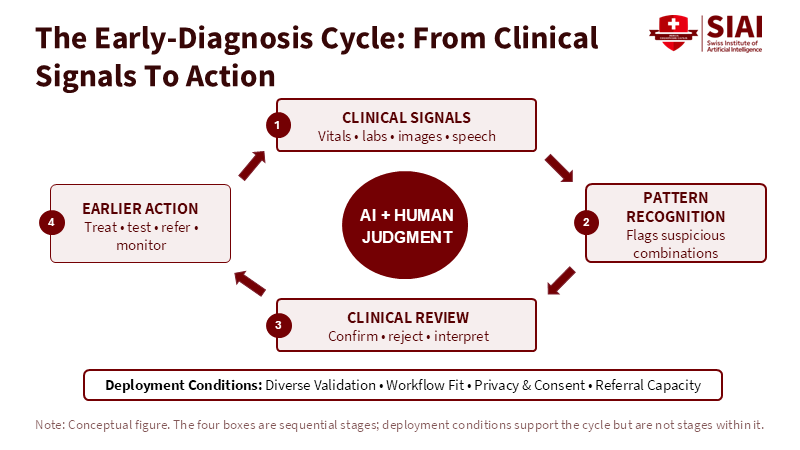
None of these four systems replaces the clinician deciding what to do with the alert, and none were validated in one afternoon in a lab. TREWS was tested in 590,736 actual hospitalizations, MASAI in tens of thousands of women within Sweden's own national screening program, and the Australian retina test inside real general practice practices, not in simulations. What now remains open is not whether pattern recognition software can detect a disease earlier than a tired resident or an overloaded radiologist, since in several areas the evidence already shows that it can, but whether hospitals, insurance organizations and regulators will restructure their surrounding workflow quickly enough to take advantage of it, and whether the smaller, less diverse datasets that underpin some of these tools, particularly in psychiatry, will be expanded before their implementation catches up with the scientific documentation itself.
This article reflects the analytical judgment of The SIAI Editorial Board and does not constitute policy advice or the official position of any affiliated institution.
References
Adams, R., Henry, K.E., Sridharan, A. et al. (2022) ‘Prospective, multi-site study of patient outcomes after implementation of the TREWS machine learning-based early warning system for sepsis’, Nature Medicine, 28, pp. 1455–1460.
Addington, J., Heinssen, R.K., Robinson, D.G. et al. (2015) ‘Duration of untreated psychosis in community treatment settings in the United States’, Psychiatric Services, 66(7), pp. 753–756.
de Boer, J.N., Voppel, A.E., Brederoo, S.G. et al. (2023) ‘Acoustic speech markers for schizophrenia-spectrum disorders: a diagnostic and symptom-recognition tool’, Psychological Medicine, 53(4), pp. 1302–1312.
Henry, K.E., Adams, R., Parent, C. et al. (2022) ‘Factors driving provider adoption of the TREWS machine learning-based early warning system and its effects on sepsis treatment timing’, Nature Medicine, 28, pp. 1447–1454.
Hernström, V., Josefsson, V., Sartor, H. et al. (2025) ‘Screening performance and characteristics of breast cancer detected in the Mammography Screening with Artificial Intelligence trial (MASAI)’, The Lancet Digital Health, 7(3), pp. e175–e183.
Joseph, S., Wang, Y., Drinkwater, J.J. et al. (2026) ‘Effectiveness of artificial intelligence-based diabetic retinopathy screening in primary care and endocrinology settings in Australia: a pragmatic trial’, British Journal of Ophthalmology, 110(1), pp. 76–82.
Landon, A. (2026) ‘Listening for schizophrenia: how AI can help with early diagnosis’, Scientific American, 12 September.
Lång, K., Josefsson, V., Larsson, A.-M. et al. (2023) ‘Artificial intelligence-supported screen reading versus standard double reading in the Mammography Screening with Artificial Intelligence trial (MASAI): a clinical safety analysis’, The Lancet Oncology, 24(8), pp. 936–944.
Tang, S.X., Kriz, R., Cho, S. et al. (2021) ‘Natural language processing methods are sensitive to sub-clinical linguistic differences in schizophrenia spectrum disorders’, Schizophrenia, 7, article 25.
Publications under SIAI Editor are prepared or coordinated by SIAI’s research and editorial team and include research synthesis, policy and industry analysis, technical interpretation, and interdisciplinary work connecting artificial intelligence with established fields of research and professional practice.