New Jobs From Artificial Intelligence: Which U.S. Roles Grow and Which Disappear

Publications under SIAI Editor are prepared or coordinated by SIAI’s research and editorial team and include research synthesis, policy and industry analysis, technical interpretation, and interdisciplinary work connecting artificial intelligence with established fields of research and professional practice.
Input
Modified
AI is shrinking entry-level hiring in exposed U.S. jobs
New demand grows in infrastructure, care and AI-using roles
Credentials, location and mobility decide who reaches them

On September 29, 2026, the McKinsey Global Institute published an account that hardly fits into a news headline. Automation may remove demand equivalent to about 36 million jobs from the U.S. economy by 2035, while growth in other industries will create demand for about 41 million. The net sign is positive, but behind it are about 11 million workers who will need to leave their profession altogether. The public debate about new jobs from artificial intelligence is stuck on whether the total will go up or down, while the most useful question is which specific jobs are being lost, which ones are appearing and how quickly people are moving from the first to the second. In the United States, this shift has already begun and is heading towards jobs that use AI tools instead of competing with them.
Entry-Level Roles Are the First to Close
The clearest picture of which jobs are being lost does not come from layoff announcements but from payroll data. In its August 2026 revision, the Stanford Digital Economy Lab estimated that the employment of 22- to 25-year-olds in the occupations with the greatest exposure to AI is about 19% below the level it would have had if it followed the same age group in less exposed positions, while a year earlier the gap was 15%. Since the end of 2022, youth employment has fallen by 11% in the most exposed positions and increased by 10% in the least exposed ones. The layoffs do not explain the difference, because the mechanism is quieter and the doors are simply opened less frequently. An analysis by Liminal Capital at the task level estimates that hiring young people aged 22 to 25 in the most substitutable quartile of the economy fell by a third, i.e. about 227,000 entry positions per year that no longer open, without a corresponding drop in hiring young people in jobs that technology cannot undertake.
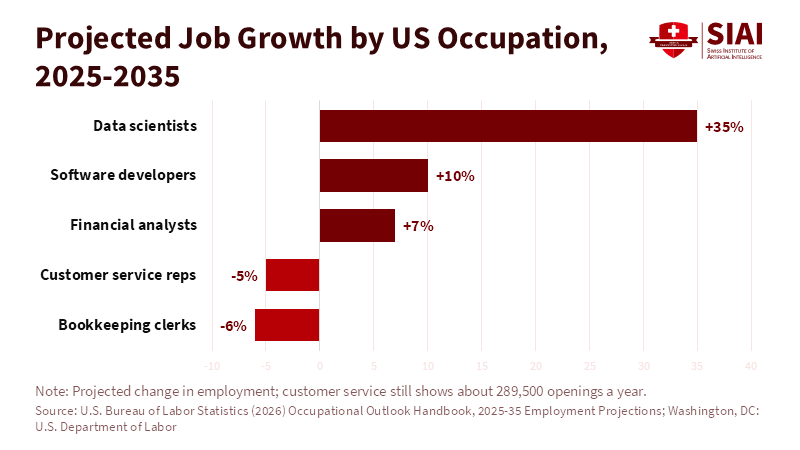
Professions under pressure have one thing in common: the production of the first draft. The newly hired programmer writes code for a project that someone else has already designed, the legal assistant sorts documents and summarizes contracts, the accounting clerk categorizes receipts. The U.S. Bureau of Labor Statistics predicts a 5% reduction in customer service representatives from 2025 to 2035 and a 6% reduction in bookkeeping clerks, while for paralegals and legal assistants it predicts little or no change. Customer service employs nearly 2.6 million people, so even a single-digit drop concerns tens of thousands of young people who will not find their first job there. The picture is weighed down by low mobility, as the rate of voluntary departures remained at 1.9% in July, according to the same office and fewer departures mean fewer empty chairs for those who have just finished their studies.
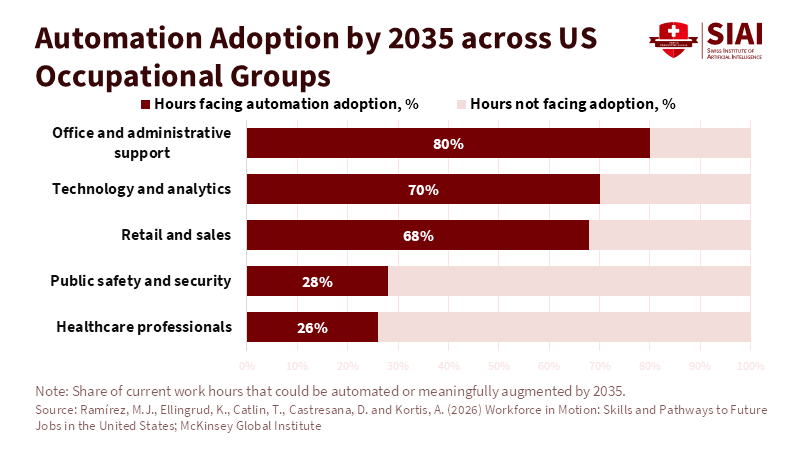
At the level of the entire economy, the decline is concentrated in three occupational groups. According to the McKinsey Global Institute, more than 75% of those who may need to change professions work in administrative support, retail and transportation, while about a third come from just five occupations: customer service representatives, retail sales associates, office assistants, cashiers and warehouse workers. Cashiers are the most tangible case, as the institute estimates that their employment will fall from 2.9 to 2.4 million full-time equivalents, with automatic cash registers and mobile payments already absorbing much of the transaction. Low-wage earners are 7.6 times more likely than high-earners to have to change occupations altogether and the same asymmetry appears, more mildly, in workers without a degree, who are about 1.8 times more likely to be in the same position.
Where New Jobs From Artificial Intelligence Are Emerging
The creation side starts with something very physical. Every model that answers a question runs on a data center that someone built, cools, connects to the grid and maintains. The McKinsey Global Institute estimates that the explosion of technology infrastructure will add about 2 million full-time equivalents by 2035, the expansion of energy, powered in part by artificial intelligence, another 2 million and construction needs about 3 million. These are electricians, refrigeration technicians, installers and crane operators, for jobs that require physical presence. The same institute estimates that about 76% of growing jobs cannot be done remotely, in hospitals, on construction sites and in the data centers themselves, while healthcare, construction and management concentrate much of the increase. The aging population is expected to add about 8 million places in care, pharmacies and home support on its own.
At the same time, roles that work directly with the tools themselves are being developed. The Bureau of Labor Statistics predicts a 35% increase in data scientists from 2025 to 2035, with starting salaries of about \$67,240 a year. Model trainers and data annotators, who rate system responses and label the data they learn from, are paid between $25 and $50 per hour in the general categories according to the rates published by DataAnnotation, with higher rates for those who specialize in law or medicine. There are also AI operations and implementation associates, the people who make a tool purchased by the company actually work within day-to-day processes. Handshake records that the share of full-time postings mentioning generative AI has increased nearly fivefold since 2023 and in internships it has more than quadrupled, although ICIMS estimates that positions directly related to AI still make up just 4% of the demand for hiring in the US.
A third category does not yet have a name. Based on the rate at which previous general-purpose technologies gave birth to occupations, the McKinsey Global Institute estimates that artificial intelligence can create between 500,000 and 2 million jobs in occupations that today either do not exist or are too small to count, in software agent engineering, workflow design, governance and systems evaluation. Electrification brought electricians and elevator technicians and the computer brought systems analysts and information security specialists and occupations that emerged from successive general-purpose technologies now account for about one-third of American employment, according to the same institute. No one in the early twentieth century could describe the work of an information security analyst and the corresponding list for 2035 is still largely unwritten.
Jobs That Change Without Disappearing
A large part of job creation does not appear as a new title in a job posting because it happens within professions that already exist. A study published in Management Science in 2025 found that auditor employment increased by 4.3% after the adoption of artificial intelligence by audit firms, while the quality of auditing also improved, so the extra productivity went to more and better audits instead of fewer staff. Insurance underwriters are following a similar trajectory, as the McKinsey Global Institute estimates that their number will remain stable at 87,000 full-time equivalents, with less time collecting and verifying data and more time assessing risk, reviewing the recommendations generated by the systems and explaining decisions to brokers and clients. Tractor-trailer truck drivers are perhaps the most unexpected example, since the profession is estimated to grow from 1.3 to 1.5 million full-time equivalents, while AI takes over order handling, compliance and data entry.
Developers are the most talked-about case and perhaps the most instructive. Demand for software developers fell sharply after the peak of 2022, partly due to the correction of excessive pandemic hiring and partly because automation took over parts of the job. Since the beginning of 2025, however, job postings for developers have increased by about 15% according to the Indeed Hiring Lab, with vacancies found in senior positions and AI-oriented roles. The Bureau of Labor Statistics predicts a 10% increase in the occupation from 2025 to 2035, with about 106,100 openings per year in software development and testing, meaning the profession is growing while its entry gate is narrowing. Spending data from the Ramp Economics Lab shows that businesses that adopted enterprise AI tools increased their employment by 10% in the two years following adoption, with the effect coming mainly from those that spent more per employee.
At the level of the entire U.S. economy, Liminal Capital's analysis classifies each task according to what it requires of a human and finds that, since 2021, the tasks that artificial intelligence complements, such as a therapy session or teaching in the classroom, are growing 3.3 percentage points per year faster than those it does not touch. But because complemented tasks make up 15% of employment-weighted work and substitutable tasks 32%, the same calculation results in about 0.7 million jobs added per year versus about 1.5 million that are removed, before taking into account construction, energy and care that are outside this metric. Employers, however, are already looking for people who stand on the complementary side and the McKinsey Global Institute records that the demand for fluency in the use of artificial intelligence tools in job postings has increased about eleven times since 2022, while the demand for adaptability has increased fivefold.
The Gap Between Lost Jobs and New Openings
If the numbers show that there will be enough positions, the problem shifts to mobility. In the McKinsey Global Institute's baseline scenario, about 11 million workers, around 7% of the workforce, will need to leave their profession completely by 2035, with a range of 6 to 16 million depending on the speed of automation. This means about 770,000 transitions per year between occupational groups, about 3.6 times the historical average of 215,000. The economy has done something similar recently, since from 2019 to 2022 about 788,000 workers a year changed occupational groups without the long-term dislocation that many feared, but that was a shock of two or three years, while what is now described lasts a decade. Only one in seven workers who will need to move has a direct path to a growing position, with minimal retraining and no loss of income, four out of ten have a winding road that requires substantial training and almost half face a road that has not yet been paved.
The institute's examples show how different the barriers can be. A dishwasher who becomes a home care assistant generally maintains his income, but the skills overlap is only 20% and needs certification, in a transition that could affect 300,000 people by 2035. The packer who switches to component manufacturing shares 52% of the skills, while the office assistant who becomes a project manager has a 58% overlap and a 154% pay increase, but often needs a bachelor's degree and professional certification in project management. About 85% of growing positions require some kind of certification, either from the law or the employer and the distinction counts, because the requirements set by the companies themselves can be changed by a decision by management. ICIMS also warns that employers who silently freeze the hiring of beginners for two or three years end up without internal candidates for first-line manager roles.
Income, on average, is moving upwards. According to the McKinsey Global Institute, 57% of employment in growing occupations will be in the two highest wage quintiles, while more than 70% of jobs shrinking are in the bottom two and just about 305,000 of the 11 million, around 3%, will follow a path that requires a pay cut. Growing jobs, however, require an average of 68 distinct skills in their postings versus 47 in declining ones and 84% require post-secondary education versus 45%, so the higher salary comes with a more expensive ticket for anyone starting behind a supermarket checkout.
The Interest Rate Objection and What the Data Show
The most serious objection to this reading is that AI is charged for losses caused by other factors. The Federal Reserve began aggressively raising interest rates in March 2022, months before ChatGPT's public launch in November of the same year and two studies published in January 2026, one by the Economic Innovation Group and one posted on arXiv by a team of U.S. researchers, find that hiring in exposed occupations began to fall after the monetary policy shift but before ChatGPT. The Stanford Institute for Economic Policy Research notes that unemployment in the most exposed quintile of workers has risen by 0.77 percentage points since 2022, less than the 0.85 points of the least exposed, while some companies attributing layoffs to artificial intelligence appear to be correcting excessive pandemic hiring or freeing up cash for infrastructure investments.
The objection explains 2022, but not what followed. When the Stanford Digital Economy Lab added controls on interest rates and other possible causes, the drops in youth employment in exposed occupations became noticeable from 2024, when the capabilities of the models and their adoption had already advanced significantly. Liminal Capital's analysis finds no effect when the same test is applied to the years 2015 to 2019, before ChatGPT existed and its result holds up when tested directly for the post-pandemic recovery and for the interest rate cycle. Calm overall unemployment fits this picture rather than negating it, because two streams in opposite directions are offset in total and for policymakers the practical consequence is that hiring data by age and by type of work say more about where the transition is than any aggregated metric, especially when in the Census Bureau's business trends survey only 5% of businesses report any effect of artificial intelligence on employment, with those reporting increases being about as many as those reporting decreases.
The bill of 36 and 41 million jobs describes the arrival point of a decade, not the path to it. Along the way, cashiers are estimated to decrease from 2.9 to 2.4 million full-time equivalents, truck drivers will increase from 1.3 to 1.5 million and data scientists will increase by 35 percent. The U.S. labor market is already shifting toward jobs that use the new tools, in data centers, in audits, in care and in the implementation of systems within businesses. Whether that move will reach the 770,000 transitions between occupational groups a year required by the baseline, for ten consecutive years rather than three as in the pandemic, depends on certifications, hiring practices and locations that no language model regulates. The approximately 227,000 entry-level positions that no longer open each year for young people aged 22 to 25 are not automatically offset against a place that opens in a data center or home care service.
This article reflects the analytical judgment of The SIAI Editorial Board and does not constitute policy advice or the official position of any affiliated institution.
References
Batchelder, Colleen (2026) 'How AI is changing entry-level jobs', Forbes, 30 September.
Brynjolfsson, Erik, Chandar, Bharat and Chen, Ruyu (2026) Canaries in the coal mine? Stanford Digital Economy Lab.
Frank, Morgan, Sabet, Alireza, Simon, Lisa, Bana, Sarah and Yu, Renzhe (2026) 'AI-exposed jobs deteriorated before ChatGPT', arXiv.
Gallacher, Guillermo (2026) AI and job postings. Indeed Hiring Lab.
Iscenko, Zanna and Curto Millet, Fabien (2026) Looking for the ladder. Economic Innovation Group.
Kharazian, Ara, Simon, Lisa and Stevens, Ryan (2026) A new look at AI's impact on jobs. Ramp Economics Lab.
Law, Kelvin K. F. and Shen, Michael (2025) 'How does artificial intelligence shape audit firms?', Management Science, 71(5).
Mahoney, Neale, McEntarfer, Erika and Wahal, Karsen (2026) What is really happening to jobs? SIEPR Policy Brief.
Ramírez, María Jesús, Ellingrud, Kweilin, Catlin, Tanguy, Castresana, Diego and Kortis, Anna (2026) Workforce in motion. McKinsey Global Institute.
U.S. Bureau of Labor Statistics (2026) Occupational outlook handbook, 2025-35 projections. U.S. Department of Labor.
Verschuere, Benjamin and Cameron, Angus (2026) Hiding in the mean. SSRN Working Paper 7195359.
Publications under SIAI Editor are prepared or coordinated by SIAI’s research and editorial team and include research synthesis, policy and industry analysis, technical interpretation, and interdisciplinary work connecting artificial intelligence with established fields of research and professional practice.