What Korea's Gaming Curfew Reveals About Meta's Two-Hour Limit

Publications under SIAI Editor are prepared or coordinated by SIAI’s research and editorial team and include research synthesis, policy and industry analysis, technical interpretation, and interdisciplinary work connecting artificial intelligence with established fields of research and professional practice.
Input
Modified
Korea's 2011 gaming curfew failed to change teen behavior
Meta's two-hour limit repeats the same enforcement design
Circumvention already outpaces both countries' verification technology

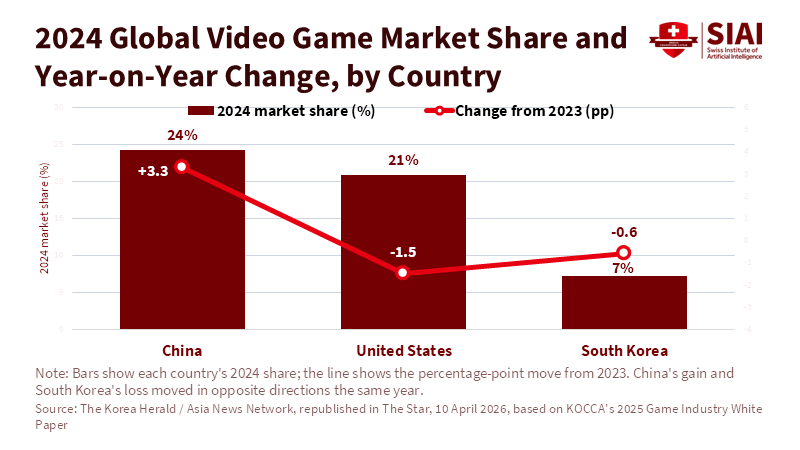
In 2024, South Korea recorded a share of just 7.2 percent of the global gaming market, the lowest figure since 2020, while China climbed to 24.2 percent and surpassed the United States for the first time, according to the Korean Creative Content Agency's 2025 Game Industry White Paper. In the early 2000s, Korean games covered almost 70 percent of the Chinese market. Between these two points lies a decade of regulatory policy that prohibited minors under the age of 16 from accessing online games from midnight to six in the morning. The restriction was abandoned in 2022 without having been proven to have achieved its goal, while the Korean industry lost ground that it never fully regained. This history matters now that Meta is adopting a two-hour daily usage limit for its teenage users, with identical enforcement logic.
The Termination Law and the Logic of Prohibition
The Korean Termination Law, also known as the Cinderella Law, was passed in 2011 by the Ministry of Gender Equality and Family with the aim of reducing the amount of sleep time children and teenagers lost due to games. It banned users under the age of 16 from accessing online computer games from midnight to six in the morning, with fines of up to ten million won, about $8.560, or up to two years in prison for companies that violated the rule. At the same time, an alternative selection system was in place, in which parents or minors themselves could set the allowed hours of play. The rate of use of this system in 40 games of seven companies ranged between 1 percent and 28 percent, a figure that shows how limited its practical application was.
The logic behind the law seemed simple. Limiting access hours would reduce overall play time and protect minors' sleep. In practice, however, the law was exclusively about online computer games, leaving out consoles, mobile and later livestreaming and video-based content. The scope remained narrow, while teens' entertainment behavior quickly moved to platforms that regulation did not touch at all. This gap between the rule's scope and actual behavior would later resurface in similar efforts elsewhere.
Workarounds That Defeated the Law's Purpose
Opposition to the law started early and intensified in 2021, when Microsoft changed the account system of Minecraft, a game suitable for children over ten, requiring an Xbox Live account instead of simply blocking hours. This change effectively excluded Korean players under the age of 19 from a game that had not even been rated as inappropriate for their age. An online petition against the law collected over 100,000 signatures in a matter of weeks, adding to public pressure that the government eventually addressed.
Long before this crisis, teenagers had already found their own way to circumvent the restriction. According to a Korea Herald report cited by Granite Tower, many minors were simply logging into their parents' accounts to access games outside the permitted hours, effectively nullifying the age control that the system was supposed to impose. The phenomenon did not involve a minority of technologically literate children but a common practice that made the law largely ineffective in daily practice. The government announced in August 2021 its intention to repeal the law, citing the rights of young people and the encouragement of homeschooling and the repeal was officially completed on January 1, 2022, ten years after it was initially enacted.
The Cost to the Gaming Industry
At the time of the restriction, the global gaming market was undergoing a fundamental shift towards web games and later mobile games. Lawyer Kim Jong-il, head of the Game Center at law firm Yoon & Yang, explained that China began systematically investing in web games around 2009, attracting foreign capital that was then redirected to the development of mobile games, as reported by the Korean media via the Asia News Network. At the same time, the Korean industry, bound by regulatory obligations around online games, was slow to follow the same shift towards new forms of gaming. China's overall market surpassed that of Korea in revenue as early as 2012.
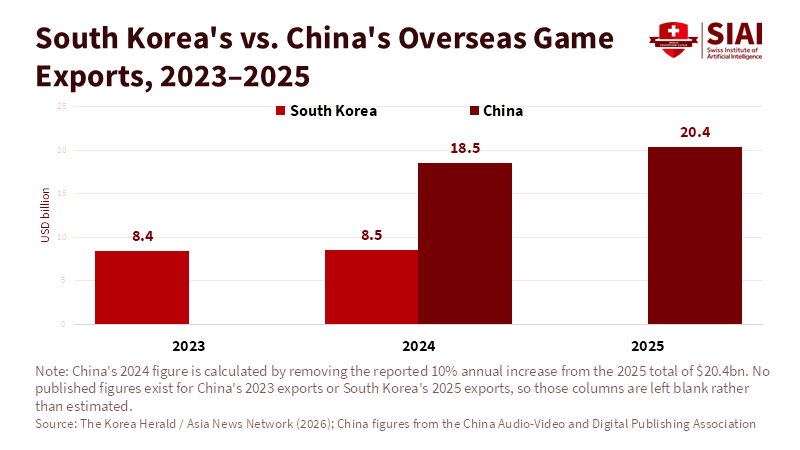
The gap has never really closed. Korean game exports abroad reached $8.4 billion in 2023 and $8.5 billion in 2024, while Chinese exports reached $20.4 billion, an increase of about 10 percent from the previous year, according to data from the China Audio-Video and Digital Publishing Association. Part of the Korean industry is currently looking for a new growth model in Poland, trying to make up for lost ground in the Asian market. After all, the Korean industry is not only facing China's competition in games. Similar pressures are being recorded in other sectors of the Korean economy, where it is now commented that Korea has the "craziest stock market in the world", a sign of wider concern for industries reliant on a few semiconductor giants while losing ground elsewhere. President Lee Jae-myung publicly removed the label of addiction from games in a meeting with industry executives in October 2025, a move symbolic rather than effective for a market that had already migrated elsewhere.
Meta Adopts the Same Two-Hour Logic
At the end of August 2026, Meta agreed to an $18 billion settlement with the attorneys general of 48 states in the United States, over a lawsuit accusing the company of cultivating addiction in adolescents through algorithms and notifications, as reported by journalist Jane Lee in EduTimes. As part of the settlement, the use of the platform by users under the age of 18 is now limited to two hours per day, with a complete blocking of access from midnight to six in the morning and disabling notifications during school hours. Restrictions are lifted only with parental approval. If YouTube, TikTok and Snap adopt similar rules, the daily two-hour limit will be reduced to one hour and the night block will be extended from ten in the evening to seven in the morning.
This structure closely mirrors the logic of Korean law. A specific time limit is imposed on an age category, with a technical enforcement mechanism based on an account rather than actual authentication, while the scope remains narrow, as it initially concerns only one company and not all the platforms used by teenagers. The Korean experience has shown that such a design creates a strong incentive to circumvent it without substantially changing overall behavior, since the demand for a platform rarely disappears. It usually shifts to hours, bills, or devices that get out of control.
Same Workarounds, New Tools
Australia, the first country to implement a complete ban on social media accounts for users under the age of 16 as of December 10, 2025, is already offering early evidence of how effective such a restriction is. The eSafety Commissioner's survey of a sample of more than 4,000 children and families recorded that the percentage of minors under the age of 16 who held an account fell from 52.4 percent to 42.1 percent, while the actual usage rate fell by just 4.4 percentage points, from 85.9 percent to 81.5 percent. Research by Newcastle University found that 15 percent of 12- and 13-year-olds and 19 percent of 14- and 15-year-olds used fake accounts, while around 3 percent resorted to virtual private networks.
Proponents of Meta's rule could argue that today's AI-powered age verification technology is far more powerful than simple account checks in Korea in the 2010s. Available evidence does not confirm this optimism. Testing eight age estimation models on digitally modified faces with beards, gray hair, makeup and wrinkles found that up to 83 percent of images originally classified as minors were reclassified as adults, according to a February 2026 pre-publication. France's Constitutional Council in the same month rescinded a ban on social media use for under-15s, ruling that the law required age verification without specifying a method or data protection guarantees. At the same time, rising equipment costs driven by demand for artificial intelligence fuel concerns about widening digital inequality in universities, reminding us that each technological regulation has unequal consequences depending on each family's resources.
The issue is not only technical. A study by the National Academy of Sciences, Engineering and Medicine of the United States concluded that the available evidence is not sufficient to prove that social media causes population-wide changes in adolescent health, while also recognizing communication benefits for specific groups of young people. The absence of scientific certainty did not prevent either Seoul in 2011 or Meta in 2026 from choosing a specific number of hours as a solution, although neither regime relied on a clear causal relationship between the time of use and the harm it seeks to prevent.
Korea's 7.2 percent share of the global gaming market did not result from a single decision. But it reflects a decade in which tight regulation, designed around an arbitrary time limit, coincided with a time when competition was rapidly reorganizing elsewhere. Meta is now betting on a similar design, in the hope that artificial intelligence will make enforcement more reliable than checking accounts in Seoul was. Early data from Australia and bypass tests through synthetically modified faces show that the distance between a rule and supposedly changing behavior remains wide. If the history of the Korean gaming industry has anything to teach those planning the next two-hour limit, it's that demand rarely disappears when it's banned. It just moves to where no one is looking anymore.
This article reflects the analytical judgment of The SIAI Editorial Board and does not constitute policy advice or the official position of any affiliated institution.
References
Hwang, M. (2021) Shut Down Korea's Shutdown Law. The Granite Tower, 4 September.
Im, E. (2021) Korea to Ax Games Curfew. The Korea Herald, 25 August.
Korea Creative Content Agency (2025) 2025 Game Industry White Paper. Seoul: Korea Creative Content Agency.
Lee, J. (2026) Meta Imposes Two-Hour Social Media Limit on Teens, but Can It Stop AI Age Manipulation and VPN Workarounds? The EduTimes, 28 August.
The Korea Herald (2026) China Winning in Gaming Race as South Korea Stumbles on Policy. The Star / Asia News Network, 10 April.
Publications under SIAI Editor are prepared or coordinated by SIAI’s research and editorial team and include research synthesis, policy and industry analysis, technical interpretation, and interdisciplinary work connecting artificial intelligence with established fields of research and professional practice.