The AI-Dependent Firm: A Review of Three Governance Capabilities

Publications under SIAI Editor are prepared or coordinated by SIAI’s research and editorial team and include research synthesis, policy and industry analysis, technical interpretation, and interdisciplinary work connecting artificial intelligence with established fields of research and professional practice.
Input
Modified
Three internal capabilities, not AI access, decide who captures its value
Firms must judge, measure and govern how much work depends on AI
Most AI pilots show no return, proving access alone guarantees nothing

Discussion of artificial intelligence in the workplace tends to treat the challenge as a staffing question: new job titles, a department to manage friction between people and machines, a broader rethink of what counts as work. That framing describes symptoms without naming the organizational capability behind them. Three distinct capabilities are being built inside firms at present, are frequently confused with one another and are unevenly distributed across the economy in ways that determine which organizations extract value from artificial intelligence. The first is managerial: deciding what machine labor is asked to do and when a human intervenes. The second is economic and cognitive: determining whether AI use is actually worth its cost once spent, review time and the erosion of independent judgment are counted. The third is architectural: deciding how much of a team’s or firm’s output should depend on AI systems at all. This review summarizes the evidence behind each capability and closes on why the practical dividing line among firms is no longer access to AI, but the capacity to govern it.
The Managerial Capability: Who Runs Machine Labor
A managerial role built specifically around directing machine labor has spread quickly across large employers, extending well beyond the technology sector. Unlike a conventional manager, whose central tasks are motivation, communication and the resolution of interpersonal conflict, a manager of machine labor works with a different set of levers: decomposing tasks into steps a model can execute, selecting the right model for each step, setting permissions and detecting when an output looks plausible but is wrong.
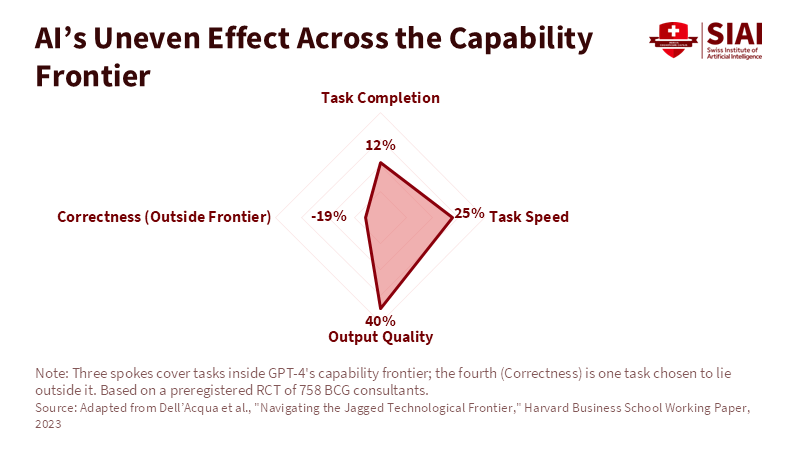
This judgment is difficult and constitutes a distinct competency rather than an extension of ordinary technology oversight because AI assistance helps and harms performance unpredictably depending on the task, a pattern known as a jagged technological frontier. A worker cannot reliably tell in advance which side of that boundary a given task will fall on and workers with only narrow exposure to the technology tend to generalize the wrong lessons from their own experience to others.
A field experiment's results across four outcome measures show task completion, task speed and output quality all improving for tasks inside a model's capability frontier, while correctness fell sharply for a task deliberately chosen to lie outside it. The unevenness itself, not a simple average effect, is what a machine-labor manager has to learn to anticipate.
The Economic Capability: Does AI Use Actually Pay Off
More AI usage is not the same as more value created and organizations cannot reliably rely on workers’ or managers’ own sense of whether a tool is helping. The productivity case for AI is real: a staggered rollout across thousands of customer support agents produced a fourteen percent average gain in issues resolved per hour, concentrated heavily among newer and lower-skilled workers. Yet the same body of evidence shows that self-assessment is unreliable even among direct beneficiaries of a tool.
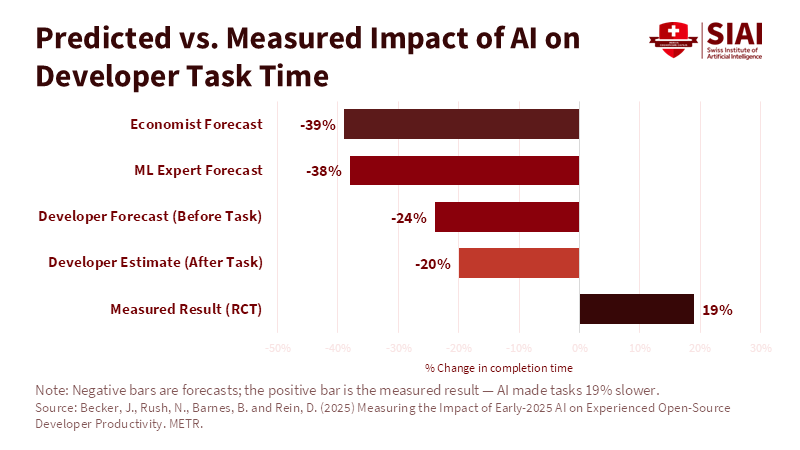
A randomized controlled trial recruited experienced open-source developers who forecast, before the study, that AI access would cut completion time by roughly a quarter; economists and machine-learning experts surveyed separately made similarly optimistic forecasts. The measured result was the opposite: tasks took nineteen percent longer with AI tools allowed and three-quarters of participants performed worse with assistance than without it, remaining unaware of the slowdown even after experiencing it directly. What this demonstrates is methodological rather than just empirical: if professionals with direct access to the outcome of their own work can be confidently wrong about whether a tool helped, self-reported usefulness cannot be an adequate basis for deploying AI at scale.
This measurement problem compounds at the organizational level. Ninety-five percent of enterprise generative AI pilots produce no measurable effect on profit or loss, not because the underlying models are incapable, but because most deployments fail to integrate into the workflows they were meant to improve, while employees keep using personal AI tools regardless of what has been formally approved. Firms that cannot see how AI is actually being used inside their own operations have no basis for judging whether that use is creating or destroying value.
The Architectural Capability: How Much Should Depend on AI
The third capability concerns the aggregate pattern that emerges once many individual roles and tasks are combined across a team and then an organization. Two firms with comparable resources and comparable access to the same commercial AI products can arrive at very different levels of AI dependence and that difference is substantially a product of governance choices rather than enthusiasm or access.
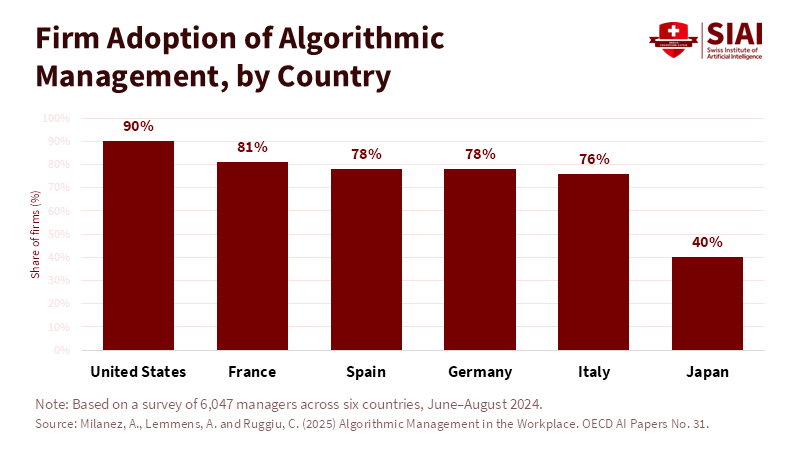
Adoption rates range from ninety percent of surveyed United States firms down to forty percent in Japan across broadly comparable advanced economies. Since access to the underlying technology is not meaningfully different across these countries, the gap shows that dependence is a governance variable rather than a technology-access variable and that depth of adoption has to be deliberately built rather than assumed to follow from availability.
The strongest counterargument to treating AI dependence cautiously holds that the technology could extend high-stakes decision-making capacity to a much larger set of workers, potentially rebuilding rather than hollowing out middle-skill work. The evidence reviewed here does not rule out that possibility, but it does specify a precondition: the benefit depends on workers holding the complementary foundational knowledge to use AI’s output responsibly and on deliberate investment in the training that builds it. Without that foundation, high dependence looks like the measured slowdown described above, or like the ninety-five percent of stalled pilots that still count as adoption.
Why Governance, Not Access, Is the Real Divide
The boundary between AI “haves” and “have-nots” has been described until recently in terms of possession: whether a worker or firm holds a license or account. That boundary is dissolving quickly. Access has become close to universal, yet most firms that have acquired it are seeing no measurable financial return. The capability that actually distinguishes firms sits at the three levels reviewed above: managerial judgment about where automation should stop, economic and cognitive accounting for AI’s true cost and deliberate architectural choices about how much of a firm’s output should depend on AI systems. Firms able to answer, function by function, how much of their output depends on AI, at what verified cost and with what fallback, are meaningfully AI-capable regardless of how many licenses they hold. The next corporate divide separates organizations that consume AI from organizations that have learned to govern it.
This article is based on an original research article published by the SIAI Research. For the original version, please refer to Beyond Robot Relations: Managing, Measuring and Organizing the AI-Dependent Firm.
This article reflects the analytical judgment of the SIAI Editorial Board and does not constitute policy advice or the official position of any affiliated institution.
References
Autor, D.H. (2024) Applying AI to Rebuild Middle Class Jobs. Cambridge, MA: NBER Working Paper 32140.
Becker, J., Rush, N., Barnes, E. and Rein, D. (2025) Measuring the Impact of Early-2025 AI on Experienced Open-Source Developer Productivity. METR.
Brynjolfsson, E., Li, D. and Raymond, L.R. (2023) Generative AI at Work. Cambridge, MA: NBER Working Paper 31161. Published (2025) in Quarterly Journal of Economics, 140(2), pp. 889–942.
Challapally, A., Pease, C., Raskar, R. and Chari, P. (2025) The GenAI Divide: State of AI in Business 2025. Cambridge, MA: MIT Project NANDA.
Dell’Acqua, F., McFowland III, E., Mollick, E., Lifshitz-Assaf, H., Kellogg, K.C., Rajendran, S., Krayer, L., Candelon, F. and Lakhani, K.R. (2023) Navigating the Jagged Technological Frontier: Field Experimental Evidence of the Effects of Artificial Intelligence on Knowledge Worker Productivity and Quality. Boston: Harvard Business School Working Paper.
Kellogg, K.C., Lifshitz, H., Randazzo, S., Mollick, E., Dell’Acqua, F., McFowland III, E., Candelon, F. and Lakhani, K.R. (2024) Don’t Expect Juniors to Teach Senior Professionals to Use Generative AI: Emerging Technology Risks and Novice AI Risk Mitigation Tactics. Boston: Harvard Business School Working Paper 24-074.
Milanez, A., Lemmens, A. and Ruggiu, C. (2025) Algorithmic Management in the Workplace: New Evidence from an OECD Employer Survey. Paris: OECD Artificial Intelligence Papers No. 31.
OECD (2023) OECD Employment Outlook 2023: Artificial Intelligence and the Labor Market. Paris: OECD Publishing.
Srinivasan, S. and Wei, V. (2026) ‘The Fastest-Growing Job Title of 2026: What an “AI Agent Manager” Actually Does’, The Interview Guys.
Sweeney, E. (2025) ‘AI is fostering new job titles within HR and people management’, Business Insider.
World Economic Forum (2025) The Future of Jobs Report 2025. Geneva: World Economic Forum.
Publications under SIAI Editor are prepared or coordinated by SIAI’s research and editorial team and include research synthesis, policy and industry analysis, technical interpretation, and interdisciplinary work connecting artificial intelligence with established fields of research and professional practice.