OpenAI Navier-Stokes Proof: What It Changes for Mathematics

Publications under SIAI Editor are prepared or coordinated by SIAI’s research and editorial team and include research synthesis, policy and industry analysis, technical interpretation, and interdisciplinary work connecting artificial intelligence with established fields of research and professional practice.
Input
Modified
OpenAI claims AI found a forced Navier-Stokes singularity
Formal verification makes scalable machine mathematics newly credible
Attribution, understanding and human judgment remain unresolved
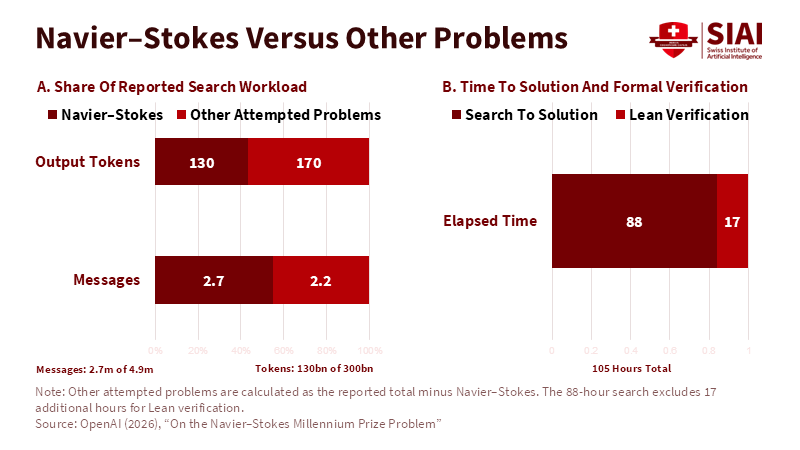
About ten thousand autonomous AI agents exchanged close to 2.7 million messages and generated 130 billion output tokens within 88 hours, before yet another system verified the proof in an additional seventeen hours. The result claimed to resolve the forced Navier-Stokes formulation, one of the seven Millennium Problems that the Clay Institute had posed in 2000, with a prize of one million dollars for whoever solved it first. Only the Poincaré conjecture had been solved by then, with its solver declining the prize money in 2010. OpenAI announced the Navier-Stokes proof on September 8, 2026 and within days the news was accompanied by an intellectual property scandal, a letter from twenty-five Fields Medal winners and a controversy over what it means, after all, for a machine to prove mathematically.
What the OpenAI Navier-Stokes Proof Actually Shows
The Navier-Stokes equations are named after Claude-Louis Navier and George Gabriel Stokes in the nineteenth century and describe the movement of fluids by applying Newton's second law to a continuous medium rather than to individual molecules. They are used in aircraft design, weather forecasting and the study of blood flow. In 1934 Jean Leray proved that solutions exist in a generalized sense, but the question of whether they always remain smooth remained open for decades. In 2000, the Clay Institute of Mathematics ranked the Navier-Stokes Problem of Existence and Smoothness among the seven Millennium Problems, each with a prize of one million dollars. The central question was whether an initially smooth three-dimensional incompressible flow can, despite the viscosity tending to smooth the motion, develop velocity tending to infinity within finite time.
OpenAI's system produced a construct in which a fluid starts at rest, receives a smooth external force and forms a vortex that swirls inward and elongates, with its energy remaining finite while the local velocity grows without limit. The proof was accompanied by standardization in the Lean language so that every logical step can be mechanically controlled and resolves statements C and D of the Clay Institute's official formulation, i.e. the version that allows external force rather than the completely free flow that most people imagine when thinking about the problem. The most challenging technical point is that the conditions of acceleration, pressure gradient, momentum transfer and viscosity must simultaneously grow and cancel each other out precisely, so that the collapse results from the movement of the fluid itself and not from a force introduced directly into the equation.
OpenAI described the result as a milestone for artificial intelligence research. The Clay Mathematics Institute has stressed that its evaluation process is deliberately slow and rigorous. The result was compared with Deep Blue's 1997 chess breakthrough, as reported by Scientific American. The reaction was not long in coming, as the same week brought to the surface a different side of the story: that of fatherhood.
The Attribution Dispute
Mathematicians Tristan Buckmaster and Levent Alpöge had been working for almost a year on an earlier mathematical approach and published their own proof on Mastodon of an explosion for a related Euler equation with standardization in Lean on September 8, shortly before OpenAI's announcement. Buckmaster claimed that the company contacted him after hearing rumors about his unpublished work and that, according to his own account, it presented him with two options: either for the pair to publish their work and for OpenAI to announce its own solution the next day, or to co-sign with the company an article on Navier-Stokes that would be missing Alpöge's name because it works for competitor Anthropic. OpenAI denied that the pair's prompts or proof had directed its agents.
On Sept. 10, following an internal investigation, OpenAI added an update to its own announcement, confirming that Buckmaster's prompts to Codex in the two months before publication could not have influenced its model, not even through training and acknowledging the pair's priority in the outcome for the Euler equation. That same week, OpenAI withdrew its sponsorship of Caltech's Mathathon competition, a student event scheduled for October, after an open letter with 771 signatories from the Caltech and wider research-mathematics communities signed a letter accusing AI companies of a scientific misinformation campaign and warned that the organization risked normalizing what the letter itself called garbage math. OpenAI acknowledged that rapid advances in AI mathematics were disruptive.
Genuine Intelligence and the Verification Gap
On September 11, twenty-five Fields Medal holders published a joint proclamation about a serious mismatch between artificial intelligence and mathematics. The signatories span nearly five decades of awards, from Pierre Deligne in 1978 to Yu Deng this year. They argued that the goals of AI companies and the mathematical community have diverged seriously, as announcements are made in a hurry, with no time for proper writing, to separate new methods and ideas and to recognize previous work by other researchers. They raised the issue of attribution of paternity and plagiarism and noted that without mathematicians tasked with processing and incorporating an idea, a machine-born proof never fully becomes part of the living body of mathematicians.
The argument in the letter is, in essence, about what the judgment of human researchers offers and the pure computing volume does not offer on its own: verification, judgment of which problem is worth solving and transmission within a community trained to read and expand on an argument. Against this stands the very description that OpenAI gave of its own process, where thousands of agents tried variations of a problem formulation in parallel, with a coordination mechanism cross-referencing their intermediate findings until a group of agents converged. The debate is not as simple as human versus machine, since the work of Buckmaster and Alpöge was also based on large language models. The dividing line goes, ultimately, through how an output becomes something the industry can trust, not just through who or what produced it.
AI as a Calculator for Open Mathematical Problems
The event was not isolated. Earlier in 2026, OpenAI's model in May refuted Erdős' unit-distance conjecture, a problem open since 1946, which was verified by Fields Medalist Timothy Gowers, calling it a milestone for AI mathematics. The researchers behind the work reported that the machine-generated proof was fully valid, although it was later improved by humans. At the end of July, papers appeared within days of one another that solved within a few days of each other the problem of the dimateriality of two copies for Werner states in quantum information, with one team attributing the proof to artificial intelligence. As a pre-Navier-Stokes warm-up, about a hundred OpenAI agents spent around fifty hours to produce an undo of the smoothness for the Euler equations without external force, i.e., the Navier-Stokes limit without viscosity.
Even after the Navier-Stokes proof, six of the seven Millennium Problems remain officially open, as OpenAI's construction responds to the version with external force rather than the completely free case that most imagine when they think of a fluid collapsing on its own. The Riemann hypothesis, the P vs. NP problem, the Hodge conjecture, the Birch and Swinnerton-Dyer conjecture and the Yang-Mills mass gap all remain untouched. What seems to have changed, as more and more mathematicians are observing, is the pace: a similar effort could in principle turn to any of these problems, while the president of the Clay Institute emphasized that his own process moves on a much slower clock, requiring publication in a recognized journal and two years of community acceptance before an evaluation committee can even be formed.

What Changes for Mathematics and Engineering
The implications for the math departments are not negligible. A speculation that could once occupy a researcher for their entire career may no longer need to be treated as a one-way street of dedicating a lifetime, which could free up younger mathematicians to truly seek new open ground instead of problems already accessible with enough computational power. For engineering and applied disciplines, where there has never been a closed mathematical answer, professionals may turn more to AI-assisted approaches once verification rules mature, although nothing in the current episode changes how an aircraft is designed or a storm is predicted the next morning, since the practical use of the equations themselves has never been called into question, only their theoretical limits.
A natural objection is that ten thousand agents consuming one hundred and thirty billion tokens are not doing mathematics but brute force, closer to search than intuition, essentially stealing the way to the solution. Against this, Bloom's own account of Erdős's result was that the proof itself was fully valid, while Other researchers have argued that such systems can provide new ways to approach old problems rather than merely shortcuts. Even so, the same episode that produced the construction for Navier-Stokes also produced a paternity dispute that neither company has fully resolved and the proclamation of the Fields Medal holders makes the same point from the opposite direction: whether the quest counts as math or not, one still has to read it.
The ten thousand agents and the one hundred and five total hours it took to prove and verify it remain the most impressive numbers in this story, but it is not the one that will ultimately determine whether the Navier-Stokes problem has actually been solved. This will be judged by a committee of the Clay Institute, with its own slow two-year calendar, by reading line by line a proof text that specific mathematicians, with their names, will have to sign. By then, OpenAI has already stated that it does not intend to claim the prize, Buckmaster and Alpöge have not withdrawn their accusations and the twenty-five Fields Medal holders have not withdrawn their declaration. Neither the speed of ten thousand agents nor the gravity of a Fields Medal alone is enough to shut down the debate about what counts as proof. The question of which of the two, genuine or artificial intelligence, ultimately makes mathematics remains, as does the Navier-Stokes problem itself, open for decades.
This article reflects the analytical judgment of The SIAI Editorial Board and does not constitute policy advice or the official position of any affiliated institution.
References
Bharti, K., Gajjala, R. and Haug, T. (2026) ‘Two-copy nondistillability of Werner states: sharp partial-trace inequalities and finite-copy extensions’, arXiv preprint 2607.24479.
Clay Mathematics Institute (2026) ‘Navier-Stokes Announcement’, 10 September.
Fernholz, T. (2026) ‘OpenAI’s feud with mathematicians is only escalating’, TechCrunch, 11 September.
Hays, K. (2026) ‘OpenAI says it cracked 90-year-old maths problem in 88 hours’, BBC News, 8 September.
Howlett, J. (2026) ‘AI may have just solved a million-dollar math problem. The field will never be the same’, Scientific American, 8 September.
OpenAI (2026a) ‘An OpenAI model has disproved a central conjecture in discrete geometry’, 20 May.
OpenAI (2026b) ‘On the Navier-Stokes Millennium Prize Problem’, 8 September.
Proofs and Prompts (2026) ‘Open Letter about the Mathathon’, 10 September.
Sample, I. and Milmo, D. (2026) ‘OpenAI claims to have solved maths problem that stumped humans for decades’, The Guardian, 8 September.
Tao, T. (2026) ‘A Severe Misalignment of AI in Mathematics’, What’s New, 11 September.
Publications under SIAI Editor are prepared or coordinated by SIAI’s research and editorial team and include research synthesis, policy and industry analysis, technical interpretation, and interdisciplinary work connecting artificial intelligence with established fields of research and professional practice.