Does AI’s Chess Advantage Reveal the Biological Limits of Human Intelligence?

Publications under SIAI Editor are prepared or coordinated by SIAI’s research and editorial team and include research synthesis, policy and industry analysis, technical interpretation, and interdisciplinary work connecting artificial intelligence with established fields of research and professional practice.
Input
Modified
Chess engines sustain strategic tension far longer than grandmasters
Human simplification may reflect bodily limits, though evidence is indirect
Load and stress left choice consistency intact in experiments

Chess engines have outplayed the strongest humans since IBM’s Deep Blue beat Garry Kasparov in 1997 and the usual explanation has been raw calculation. A study from the Complexity Science Hub in Vienna, published in APS Open Science on 11 September 2026, describes the AI chess advantage in other terms. Engines keep the board tangled for longer, while human players untie it early. That finding invites a biological reading, since a human brain works inside a body that has to feed it, rest it and keep it calm. How far that reading can be pushed is less clear than it first appears.
What the AI Chess Advantage Looks Like on the Board
The Vienna team needed a way to put a number on how complicated a position is. Their answer was to redraw every position as a network, with pieces and empty squares joined wherever one piece attacks, defends or controls another and to take the largest eigenvalue of that network as the level of strategic tension. A high value means many pieces depend on one another at once, so a single capture can set off a chain of consequences.
Two sets of 1,200 games were then compared: grandmaster games on one side and, on the other, Stockfish against Leela Chess Zero in the Top Chess Engine Championship between 2019 and 2024. The two curves part ways early. In grandmaster play, the tension climbs through the opening, tops out somewhere between the thirtieth and fortieth half-move and then drops quickly as pieces are traded off. Engine games stay tense for much longer and come down slowly.
Skill and time move the human curve in the engine’s direction. Across Lichess games, the accumulated tension grows almost in a straight line with a player’s Elo rating and rapid games carry more of it than blitz games at every rating level, with classical games carrying the most. Stockfish behaves the same way when it is allowed to search deeper. More resources, whether minutes on a clock or depth of search, go with a greater willingness to leave the position unresolved.
What the study does not show matters just as much. The tension measure describes the state of a game and does not predict who wins. Decisive human games begin to separate around the thirtieth half-move, before tension peaks and the authors read the later fall as a result of the outcome and not as its cause. Working memory, psychological pressure and deliberate play for a draw are all offered as possible reasons for human simplification and all are labelled speculative. So the paper documents a difference in how complexity is managed and leaves open why a grandmaster with time still on the clock so often chooses the simpler board.
Human Thinking Runs on the Whole Body’s Energy Budget
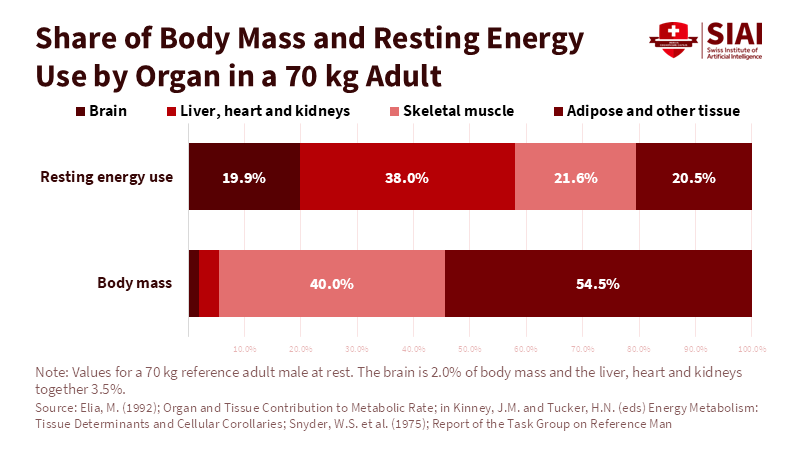
One answer starts outside chess. The brain accounts for roughly 2 percent of body weight and about 20 percent of the body’s resting energy use, a budget set out by researchers at Washington University in St. Louis in the Proceedings of the National Academy of Sciences in 2002. That supply is delivered by the heart, lungs, liver and gut and it is disturbed by poor sleep, stress and illness. A grandmaster five hours into a classical game is a tired organism as well as a calculating mind and a tired organism has reasons to prefer positions that are cheaper to hold in the head.
The trouble is that fatigue is only one candidate among several and the candidates are easy to blur together. Physiological limits concern energy, sleep and stress. Computational limits concern working memory and attention, which are narrow even in a rested and well-fed player. A third kind is behavioural: effort is spent where the expected payoff justifies it and every minute spent on one line of calculation is a minute not spent on another. A 2017 review in the Annual Review of Neuroscience, written by researchers at Brown and Princeton, treated mental effort as a decision about how much control to allocate and found no agreement on whether its cost comes from metabolism, from processing bottlenecks or from opportunity cost. The feeling that hard thinking is expensive is well documented. Its biological source is not settled and the chess data cannot resolve it.
Engines are physical systems too. In championship games each engine had 120 minutes plus 12 seconds per move, and behind that allowance sat processors, memory, electricity and cooling. The difference lies in how the resource is supplied. An operator can add hardware or deepen the search, and the engine’s capacity at move sixty matches its capacity at move six. Human capacity cannot be provisioned that way, and it drifts over the course of a game. A hypothesis follows, one the chess data do not test: part of the gap between human and machine play reflects the different physical systems that carry the thinking. Herbert Simon made a related argument at the Carnegie Institute of Technology in 1955, when he proposed that real decision makers search for options that are good enough because exhaustive search is beyond them. Simon’s argument was about limits on information and computation, though, and it said little about the body.
More Complexity Does Not Guarantee Better Decisions
If simplifying is a response to limited resources, the obvious next step is to call it a weakness. Experimental economics gives reasons to hesitate. Three things tend to be run together here. Cognitive endurance is how long difficult mental work can be sustained. Economic rationality, in the technical sense, is whether a set of choices is internally consistent, usually tested against the Generalized Axiom of Revealed Preference, known as GARP. Decision quality is whether a choice was the best one available. A player can score low on the first and still pass the second.
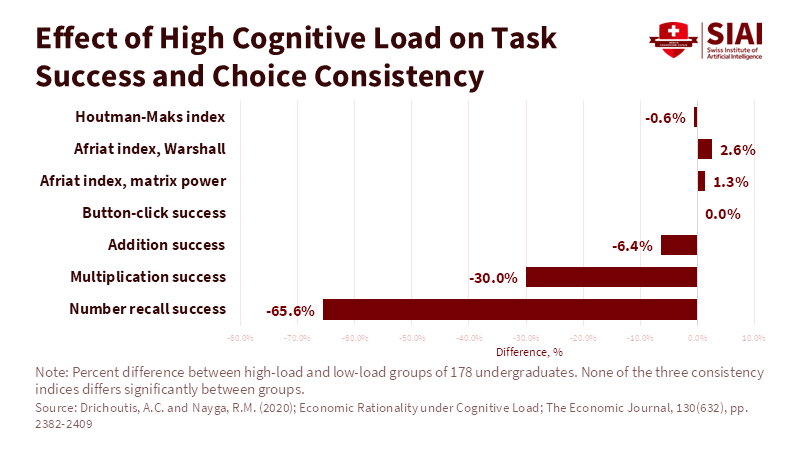
Two experiments published in 2020 tested this directly. At the Agricultural University of Athens and the University of Arkansas, participants had to keep a number in memory while dividing a budget between options. The load hurt their performance on reasoning tasks, yet the authors concluded that economic rationality does not break down under a temporary load on working memory. The second experiment came from Tilburg University. Stress was induced there with the Cold Pressor test and tracked through cortisol in saliva. Cortisol rose significantly in the stressed group, and the consistency of their choices with GARP did not fall. A follow-up test in the same paper found that choices made just after the stressor were, if anything, more consistent.
Neither result licenses a strong claim about chess. GARP checks whether choices fit together, which is a lower bar than choosing the best move and a budget task lasting a few minutes is a long way from a six-hour game against an opponent. Still, the two studies block the easy inference that a loaded or stressed mind must be choosing badly. A grandmaster who trades queens to reach an ending that can be played accurately may be giving up winning chances that an engine would have kept, or may be avoiding a blunder that the engine was never at risk of making. The tension measure cannot tell these apart.
That leaves at least three readings of the same curve. Simplification could be an adaptation to scarce resources; it could be an obstacle to optimal play, or its value could depend on the problem. Chess favours the engine because the rules are fixed, the whole board is visible and the goal is unambiguous and few economic or scientific problems share those features. The Vienna authors themselves warn against extending their result beyond chess, while noting that systems able to sustain tension might make standoffs in fields such as international relations more complicated and miscalculation more costly. An experiment that measured sleep, stress and move accuracy in the same players, with rating and time limits held constant, would begin to separate biology from preference. No such data exist yet, so the chess result remains an observation about style whose cause is unknown.
This article reflects the analytical judgment of The SIAI Editorial Board and does not constitute policy advice or the official position of any affiliated institution.
References
Cerioli, A., Lee, E.D. and Servedio, V.D.P. (2026) ‘Artificial intelligence sustains higher strategic tension than humans in chess’, APS Open Science, 1, 000131.
Cettolin, E., Dalton, P.S., Kop, W.J. and Zhang, W. (2020) ‘Cortisol meets GARP: the effect of stress on economic rationality’, Experimental Economics, 23(2), pp. 554–574.
Drichoutis, A.C. and Nayga, R.M. (2020) ‘Economic rationality under cognitive load’, The Economic Journal, 130(632), pp. 2382–2409.
Elia, M. (1992) ‘Organ and tissue contribution to metabolic rate’, in Kinney, J.M. and Tucker, H.N. (eds) Energy Metabolism: Tissue Determinants and Cellular Corollaries. New York: Raven Press, pp. 61–79.
Hutson, M. (2026) ‘Scientists might have discovered what makes AI so effective at chess’, Scientific American, 15 November.
Raichle, M.E. and Gusnard, D.A. (2002) ‘Appraising the brain’s energy budget’, Proceedings of the National Academy of Sciences, 99(16), pp. 10237–10239.
Shenhav, A., Musslick, S., Lieder, F., Kool, W., Griffiths, T.L., Cohen, J.D. and Botvinick, M.M. (2017) ‘Toward a rational and mechanistic account of mental effort’, Annual Review of Neuroscience, 40, pp. 99–124.
Simon, H.A. (1955) ‘A behavioral model of rational choice’, The Quarterly Journal of Economics, 69(1), pp. 99–118.|
Snyder, W.S., Cook, M.J., Nasset, E.S., Karhausen, L.R., Howells, G.P. and Tipton, I.H. (1975) Report of the Task Group on Reference Man. ICRP Publication 23. Oxford: Pergamon Press.
Publications under SIAI Editor are prepared or coordinated by SIAI’s research and editorial team and include research synthesis, policy and industry analysis, technical interpretation, and interdisciplinary work connecting artificial intelligence with established fields of research and professional practice.