AI Labor and Human Labor: Why Replacement Is Slower Than the Hype, but More Serious Than Workers Think

His recent work examines the socioeconomic consequences of artificial intelligence, including labor markets, public finance, demographic change, institutional adaptation, and the distributional effects of technological progress.
He also serves as Executive Editor, Research & Review at The Economy, overseeing research-oriented editorial coverage, analytical contributions, and engagement with academic and industry specialists.
He holds a PhD in Mathematical Finance from Boston University, an MSc in Finance and Economics from the London School of Economics, and a bachelor's degree in Economics from Seoul National University, where he studied under the Korea Foundation for Advanced Studies scholarship program.
Authored on
Modified
AI is not yet a universal substitute for human labor. Enterprise deployment remains expensive, operationally fragile, and dependent on human review
The immediate transition is labor compression: fewer AI-leveraged workers may be expected to produce more output before end-to-end automation becomes viable
Falling inference costs, expanding infrastructure, and better workflow design will make more tasks economically contestable - so firms and workers should redesign work now

Today’s AI remains expensive to deploy reliably at scale. But falling inference costs, expanding infrastructure, and better workflow design are pushing more tasks toward economic automation - creating labor compression before wholesale replacement.
The real question is economic, not merely technical
The public debate about artificial intelligence and employment often begins with the wrong question: Can an AI system perform a human task? Employers make a harder calculation. They need to know whether AI can perform that task repeatedly, reliably, securely, and cheaply enough to carry operational responsibility. Capability alone does not determine substitution. The cost of integration, monitoring, error correction, governance, and human escalation can matter as much as the model itself.
This distinction explains the apparent contradiction of the current market. Technology companies can reduce headcount while also discovering that AI deployment is expensive. Workers can be displaced before an AI system is capable of replacing an entire role. Firms can spend more on tokens and infrastructure even while unit model prices fall. In a recent Fortune discussion, I described this as a short-term mismatch in the economics of AI labor: companies are under pressure to demonstrate AI-driven efficiency before the technology has become a universal low-cost substitute for people.
The near-term future is not “AI replaces every worker.” It is labor compression: fewer workers, using AI well, producing more output.
AI labor is not free labor
A consumer subscription or a low API price creates the impression that AI is almost costless. Production systems reveal a different bill. Enterprise AI requires model inference, data preparation, retrieval infrastructure, access control, security, evaluation, monitoring, human review, and workflow redesign. An agent may appear to deliver one answer while internally retrieving documents, calling tools, re-reading context, checking outputs, and repeating failed steps. The relevant metric is therefore not price per token. It is cost per useful, reliable, governed task.
The strongest evidence against a simple replacement narrative comes from the difference between technical exposure and economic viability. A 2024 MIT study of computer-vision tasks estimated that, under then-current costs, only about 23 percent of wages paid for tasks involving vision were economically attractive to automate. In the remaining share, human labor was still cheaper once deployment costs were included.
| Technically & Economically Feasible | Either Technically or Economically Infeasible |
|---|---|
| 23% | 77% |
| Economically attractive | Human labor remained cheaper |
Source: MIT CSAIL / MIT IDE, Beyond AI Exposure: Which Tasks Are Cost-Effective to Automate with Computer Vision?
This does not mean that 77 percent of work is safe. It means that replacement is an economic threshold, not a technical switch. As model prices fall, infrastructure improves, and firms redesign workflows, the economically contestable share can expand. The present evidence argues against complacency and panic at the same time.
The current layoff signal is noisy
Recent technology-sector layoffs are clearly shaped by AI, but they are not clean proof that AI has already replaced the affected workers. The first source of noise is the post-pandemic staffing correction. Meta’s 2022 layoff announcement explicitly acknowledged that the company had extrapolated the Covid-era shift to online commerce too far and had invested on the assumption that the acceleration would persist. When demand normalized, the company moved toward capital efficiency and a smaller cost base.
The second source of noise is capital-market pressure. Large technology firms have committed extraordinary resources to chips, data centers, models, and AI talent. Investors now expect evidence that the spending improves margins and productivity. Headcount restraint, fewer management layers, and the consolidation of routine work can therefore appear before a complete AI substitute exists. Through June 2026, Challenger, Gray & Christmas reported that AI was cited in 101,743 announced U.S. job cuts - about 23 percent of the total - while market conditions, closures, restructuring, and other factors also accounted for substantial reductions.
| % Job cuts by AI | # of Job cuts by AI | AI replacement limit |
|---|---|---|
| 23% | 139,156 | Not 100% |
| Share of announced U.S. job cuts citing AI through June 2026 | Technology-sector job cuts announced in the first half of 2026 | AI is an important cause, but not the only cause of the current cycle |
The more defensible interpretation is that the layoffs are AI-shaped rather than purely AI-caused. They reveal what firms are trying to prove - productivity, lower labor intensity, and budget reallocation toward AI - even when the technology is not yet capable of fully replacing the roles being reduced.
Jobs are bundles of tasks, not indivisible objects
A job combines routine drafting, information retrieval, pattern recognition, customer communication, exception handling, judgment, coordination, and accountability. AI reaches these components at different speeds. Routine and codifiable tasks are repriced first. The occupation changes when one worker, supported by AI, can absorb tasks previously distributed across several people.
This is why the most important early effect may be hiring restraint rather than immediate mass substitution. Firms do not need perfect end-to-end automation to reduce headcount growth. They only need enough task-level productivity to combine roles, shrink teams, or expect the same number of employees to manage a larger workload.
The intermediate stage is the AI-leveraged worker
Evidence from customer support illustrates this intermediate stage. In a study of 5,179 agents, access to a generative AI assistant increased issues resolved per hour by 14 percent on average and by 34 percent for novice and lower-skilled workers. The tool did not remove the job; it transferred elements of high-performer knowledge to less-experienced employees and raised the output of the human-AI system.
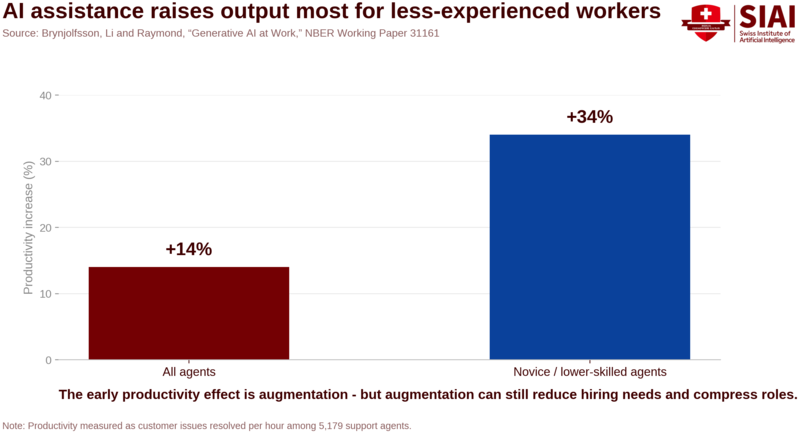
Source: NBER, Generative AI at Work
For workers, this is encouraging and unsettling at once. AI can increase capability, especially for people who receive good workflow support. But once higher output becomes normal, firms may need fewer people to produce the same volume. The immediate divide is therefore not simply AI labor versus human labor. It is ordinary human labor versus AI-leveraged human labor.
| Ordinary labor | Superhuman labor | Gap |
|---|---|---|
| 10 workers | 4 AI-leveraged workers | Same or higher output |
| Fragmented tools Manual coordination | AI workflows Human review | Shorter cycles Lower labor intensity |
The number “four” in the illustration is conceptual, not a forecast. The mechanism is what matters: augmentation can reduce labor demand even before technology can run the full process autonomously.
Why today’s cost advantage for humans may not last
The case against immediate replacement should not be confused with a permanent defense of the current labor structure. The cost curve is moving rapidly. Stanford’s 2025 AI Index reported that the cost of querying a model at GPT-3.5-equivalent performance fell from \$20 per million tokens in November 2022 to \$0.07 by October 2024 - a decline of more than 280 times at a fixed performance threshold.
Lower unit prices do not automatically create lower total spending. Agentic workflows can consume far more tokens than a single chatbot exchange because they retrieve, reason, call tools, validate, and retry. This is the token-price paradox: the price per unit falls while the number of units used rises faster. The Economy has documented the same tension in enterprise AI spending, where falling API prices coexist with rapidly expanding token volumes and infrastructure demand.
Token discipline becomes a managerial capability
The next stage will be determined not only by model providers but by how well firms manage AI consumption. What is sometimes called “token maxxing” is, in an executive context, better understood as token discipline. The practical tools are model routing, smaller specialized models, caching, context compression, better retrieval, hard stopping rules for agent loops, and human escalation where judgment is more economical than another round of inference.
The winning organization will not be the one that consumes the most AI. It will be the one that produces the greatest amount of accepted work per dollar of compute, with a risk level the organization can defend. This is also where workers can create bargaining power: the employee who understands workflow economics, quality control, and exception handling can become more valuable than the employee who merely knows how to prompt a model.
Infrastructure is the hidden constraint
AI labor becomes cheaper only when software efficiency and physical capacity improve together. Chips, advanced packaging, high-bandwidth memory, data centers, power, cooling, and grid connections determine how much inference the economy can support. The International Energy Agency estimates that global data-center electricity demand will rise from about 415 TWh in 2024 to around 945 TWh by 2030, with AI the largest driver of the increase.
This investment initially raises costs because capacity is scarce and construction is slow. Over time, however, more efficient hardware, better packaging, additional power capacity, and denser inference infrastructure can push the cost per useful task downward. The Economy’s reporting on advanced packaging and the TSMC-led backend ecosystem is relevant for exactly this reason: the labor economics of AI depend on the semiconductor and infrastructure stack, not just on model intelligence.
The human work that remains
As routine tasks become cheaper, human value does not disappear; it migrates. The durable human layer is concentrated in context, judgment, accountability, coordination, and ownership of exceptions. These capabilities are not invulnerable to technical change, but they are harder to commoditize because they sit at the point where organizations must interpret uncertainty and accept responsibility.
| Human layer | What it means | What it meansWhy it remains scarce |
|---|---|---|
| Domain context | What matters in this industry, customer segment, and workflow | Models can retrieve information but do not own institutional context. |
| Judgment | Decisions under uncertainty, trade-offs, and incomplete data | High-stakes work requires interpretation, not only pattern matching. |
| Accountability | Responsibility for safety, compliance, and customer outcomes | Organizations still need a human or legal entity that owns the result. |
| Coordination | Aligning teams, systems, vendors, and stakeholders | AI can summarize and route, but cross-functional trust remains scarce. |
| Exception ownership | Handling novel failures, edge cases, and escalation | Automation is strongest on the normal path; value shifts to abnormal cases. |
The practical lesson for employees is neither reassurance nor fatalism: do not panic, but do not remain passive. Workers should map their jobs into tasks, learn to supervise AI inside a real workflow, and make their contribution visible in terms of quality, risk, speed, and customer outcomes. Workers who own the exception path will often be more durable than those who only execute the normal path.
What this means for cable and telecom
Cable and telecom provide a useful test case because the industry combines highly standardized operations with high-stakes exceptions. AI can absorb large volumes of routine information work, but network reliability, regulatory obligations, customer trust, and incident response preserve a significant human accountability layer.
| Function | AI can absorb | Human value shifts toward |
|---|---|---|
| Customer care | Summaries, routing, routine troubleshooting | Retention, empathy, escalation, policy exceptions |
| Network operations | Anomaly detection, log summarization, recommended actions | Incident command, root-cause judgment, operational accountability |
| Ad ingest / compliance | Classification, multi-stream flagging, metadata checks | Regulatory interpretation, contract judgment, final responsibility |
| Software / product | Draft code, tests, documentation, prototypes | Architecture, security, product judgment, hidden-defect management |
The likely change is not a clean handoff from people to machines. It is a redistribution of work: AI absorbs routine layers, while humans supervise the system, intervene in difficult cases, and carry responsibility for outcomes. Firms that automate the normal path without investing in exception ownership will create operational fragility rather than durable productivity.
An executive agenda for the transition
The World Economic Forum projects 170 million roles created and 92 million displaced by 2030 across the macrotrends in its employer survey. The net number is positive, but the gross churn is large. Transition speed, job quality, and who receives training matter more to individual workers than the global net balance.
The training gap is already visible. A Federal Reserve Bank of Boston survey found that fewer than 29 percent of workers believed they could adapt to AI on their own, while 49 percent believed they could adapt with proper training. The managerial task is therefore not simply to purchase tools, but to redesign work and create credible pathways into AI-leveraged roles.
| On their own | By training | Training gap |
|---|---|---|
| <29% | 49% | 10% |
| Workers who said they could adapt to AI on their own | Workers who said they could adapt with appropriate training | Approximate share identifying a personal training gap |
| Steps | Objectives | Tasks |
|---|---|---|
| 1 | Map tasks before mapping jobs | Identify which activities are routine, judgment-intensive, exception-driven, regulated, or trust-dependent |
| 2 | Measure cost per accepted output | Include tokens, integration, review, failures, security, and the cost of human escalation |
| 3 | Route models by task | Use the smallest reliable model and reserve frontier systems for tasks that justify the premium |
| 4 | Redesign roles, not only processes | Define who supervises AI, who owns exceptions, and how productivity gains change career paths |
| 5 | Train for workflow control | Prompting is insufficient; workers need domain-specific evaluation, data literacy, and escalation judgment |
| 6 | Govern the labor transition | Track disparate impact, preserve institutional knowledge, and make accountability boundaries explicit |
Conclusion: augmentation can become substitution
AI is not yet a universal low-cost replacement for human labor. That conclusion is important, but temporary. Firms are still learning how to integrate models, control token usage, redesign workflows, and build reliable governance. Infrastructure remains constrained, and human review remains essential in many processes. For now, the dominant pattern is augmentation combined with labor compression.
The direction of travel is nevertheless clear. Fixed-performance inference costs have fallen dramatically. Infrastructure investment is expanding. Organizations are learning how to route models, compress context, and formalize agent workflows. As the cost per accepted task declines, more activities will cross the threshold from technically automatable to economically substitutable.
The future is not simply AI labor versus human labor. The real divide is between poorly organized human labor and AI-leveraged human labor
The organizations that manage this transition well will not treat workers as a temporary bridge to full automation. They will use human judgment, domain expertise, and accountability as design inputs. The workers who adapt successfully will not compete with AI at raw generation. They will govern AI output inside consequential business processes.
Related reading from The Economy
- AI Labor Costs Are the New Test of the Automation Economy
- The AI Labor Divide: Who Wins, Who Survives, and Who Falls Away
- “Token Prices Are Falling, but AI Costs Keep Rising”
- Leverage Builds Behind the AI Investment Frenzy
- “Breaking Through the Limits of Process Shrinkage”
Sources and further reading
1. “The cost of compute is far beyond the costs of the employees”: Nvidia executive says right now AI is more expensive than paying human workers. Fortune, Includes an interview with Keith Lee.
2. Beyond AI Exposure: Which Tasks Are Cost-Effective to Automate with Computer Vision?. MIT CSAIL / MIT Initiative on the Digital Economy, 2024.
3. Artificial Intelligence Index Report 2025 - Research and Development. Stanford Institute for Human-Centered AI, 2025.
4. Energy and AI - Executive Summary. International Energy Agency, 2025.
5. Job Cut Announcement Report, June 2026. Challenger, Gray & Christmas, 2026.
6. Mark Zuckerberg’s Message to Meta Employees. Meta, 2022.
7. Generative AI at Work. National Bureau of Economic Research, 2023, revised.
8. Future of Jobs Report 2025. World Economic Forum, 2025.
9. Shaping the Future of Work: Workers’ Optimism and Pessimism about AI. Federal Reserve Bank of Boston, 2025.
10. “Token Prices Are Falling, but AI Costs Keep Rising”. The Economy, 2026.
11. Leverage Builds Behind the AI Investment Frenzy. The Economy, 2026.
12. “Breaking Through the Limits of Process Shrinkage”. The Economy, 2026.
13. AI Labor Costs Are the New Test of the Automation Economy. The Economy Review, 2026.
14. The AI Labor Divide: Who Wins, Who Survives, and Who Falls Away. The Economy Review, 2026.
His recent work examines the socioeconomic consequences of artificial intelligence, including labor markets, public finance, demographic change, institutional adaptation, and the distributional effects of technological progress.
He also serves as Executive Editor, Research & Review at The Economy, overseeing research-oriented editorial coverage, analytical contributions, and engagement with academic and industry specialists.
He holds a PhD in Mathematical Finance from Boston University, an MSc in Finance and Economics from the London School of Economics, and a bachelor's degree in Economics from Seoul National University, where he studied under the Korea Foundation for Advanced Studies scholarship program.
Similar Post