Artificial Intelligence and the Job Market: Jobs Created and Lost at Once

Publications under SIAI Editor are prepared or coordinated by SIAI’s research and editorial team and include research synthesis, policy and industry analysis, technical interpretation, and interdisciplinary work connecting artificial intelligence with established fields of research and professional practice.
Authored on
Modified
AI removes some tasks while creating demand elsewhere
Single exposure scores hide these opposing task effects
Hiring of young workers falls while aggregates stay calm

In the most widely used exposure index, medical secretaries and secondary school teachers sit only 0.027 points apart, yet about two-thirds of one job's tasks can be done by AI and about one-fifth of the other's. In what economic research now calls artificial intelligence and the job market, the effect is almost always measured by a number per occupation, while technology simultaneously pushes in two opposite directions, subtracting work from some tasks and adding to others and the average erases precisely this double motion.
Artificial Intelligence Acts on Tasks, Not on Whole Occupations
Economic research on technology and labor has for over two decades used the task rather than the position as the core unit. A job is a package of heterogeneous tasks and a technology can take on some of them without touching the rest, like a language model that drafts a memorandum in minutes but doesn't show up in court in place of a lawyer. Despite widespread acceptance of the idea, nearly every published AI exposure indicator was constructed at the occupation level, with a number per position, because manually scoring the American occupational database's 17,536 task descriptions was never practically feasible. Language models began to remove this restriction, but comparing their results revealed a second problem, since when the same data is scored by different models, the percentage of American occupations classified as highly exposed ranges from 2.7 percent with one model to 51.5 percent with another, according to a multi-model analysis published in May 2026.
The problem of the single number is deeper than inaccuracy. In the AIOE index, one of the most widely used indicators of occupational exposure, medical secretaries and secondary school teachers are only 0.027 points apart on a multi-point scale, that is, they appear essentially the same. When their duties are broken down separately, about two-thirds of a medical secretary's duties can be fully performed by AI, summarizing, transcribing and scheduling appointments, compared to about one-fifth for the teacher, whose job contains five times the share of work that technology makes more valuable rather than replacing it. The two professions together employ almost two million Americans and are subject to forces of opposite direction and very different intensity, something that an index with a price per occupation has no way of expressing.
Substitution, Complementarity and the Inert Majority
A useful theoretical distinction asks what each task requires of a human. The analysis published in 2026 by researchers at Liminal Capital classifies each task description into three categories. The first includes what can be produced end-to-end without a human, such as drafting a contract or filling out a form and that's where technology substitutes. The second includes those that require a real-time physical presence or the signature of a licensed professional, such as a psychotherapy session or classroom teaching, where technology does part of the work, reduces the cost of the final product and increases the demand for the human who completes it. The third category covers the physical work that artificial intelligence cannot perform: the plumber, the builder, the barber and remains unaffected by it. A task is substitutable when AI produces it end to end, complementary when AI cheapens an input that a human still completes and inert when AI cannot perform it. Weighted by employment, American labor is broken down into 32 percent substitution, 15 percent complementarity and 53 percent inert labor, a ratio of about two to one between the two pools on which technology acts.
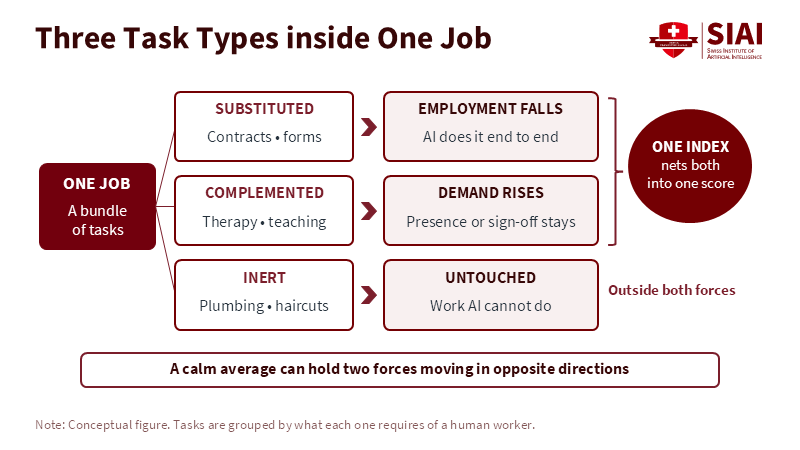
When the two forces are entered separately in employment data from 2021, they both appear in the same regression with opposite signs. Substitutable labor grows 3.3 percentage points per year slower than labor that technology does not touch, while complementary labor grows 3.3 percentage points faster. In terms of number of positions, this corresponds to about 1.5 million fewer jobs per year than the untouched benchmark would imply, against about 0.7 million more through complementarity. The two gradients move at the same speed, so the net result depends on the composition of the economy and not on the intensity of each force. Neither margin predicts the evolution of employment between 2019 and 2021, before technology could reasonably have mattered and the same test in the years 2015 to 2019, long before ChatGPT, finds no effect.
The distinction mechanically explains why the literature disagrees on the magnitude and even the sign of the effect. When published uniform indicators are tested next to the two separate margins, they lose their statistical significance because each inherits a different mix of the two opposing forces and one study whose index measures mostly substitution will find losses, while another that measures complementarity primarily will find gains. In an independent time-use study published in 2025, researchers who constructed their own distinction between substitution and complementarity found the two forces pulling weekly working hours in opposite directions.
Artificial Intelligence and the Job Market: Why Aggregates Look Calm
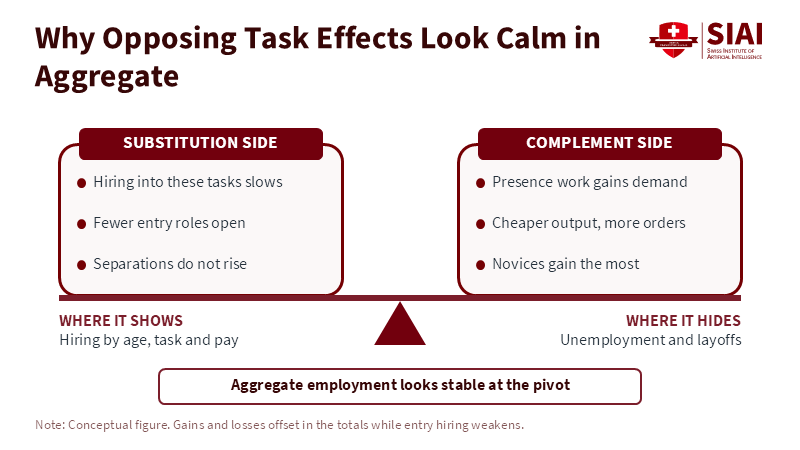
If technology simply removed positions, the most exposed occupations would have to show faster growth in unemployment. A July 2026 policy brief from the Stanford Institute for Economic Policy Research shows something different, since unemployment in the quintile of the most exposed workers increased by 0.77 percentage points from 2022 and in the least exposed by 0.85 percentage points, a picture that fits a general easing of the market. Aggregate indicators inherit a mix of opposing forces, so calm totals say little about either force.
The picture of productivity is equally divided and it helps explain where the complementary side comes from. In a large call center, a generative AI assistant increased overall productivity by 15 percent, with a 30 percent improvement in hourly resolved requests for beginners and no improvement for more experienced ones, while in an experiment with GitHub Copilot, developers completed a task 56 percent faster. These gains are not yet shown in the aggregates, something that economic history has seen before, since in 1987 Robert Solow observed that the computer age was visible everywhere except productivity statistics and the measurable returns of the personal computer revolution did not appear until the late 1990s, when businesses had already invested in software, retraining and reorganization, a delay that the literature describes as the J-curve of productivity and in which measured productivity may even decline at first.
Adjustment Runs Through Hiring and Falls on Young Workers
Within the most substitutable occupations, departure rates did not increase after the release of ChatGPT, which means that change does not go through layoffs. It goes through hiring and falls on younger people. According to Liminal Capital's analysis, hiring 22- to 25-year-olds in the most substitutable quartile fell by a third, with no corresponding decline in hiring young people in jobs that technology cannot replace. Stanford Digital Economy Lab payroll data finds the same pattern among new customer service representatives and new software developers, while the employment of their older colleagues in the same occupations remained stable or continued to rise. Recent graduate unemployment reached 5.6 percent at the beginning of 2026, 1.6 percentage points higher than three years earlier. Timing tests that control for the 2022 rate cycle and post-pandemic recovery leave the two-margin effect intact.
The effect does not stagnate on the wage scale. Within substitutable work, it became statistically significant first in low-paid occupations with high staff turnover and is now also important in middle-paid occupations. For statistical agencies and policymakers, this translates into a specific measurement request: recruitment flows by age, by type of duty and by salary scale, because that is where every shift that the overall unemployment rate silently assimilates appears first.
From Shifting Tasks to Redistributing Labor
Over a decade, the simultaneous creation and destruction of jobs takes the form of redistribution. The McKinsey Global Institute estimates that automation could absorb about 54 percent of today's working hours by 2035, but four mechanisms offset about 60 percent of this effect: relief from overwork in shortage occupations, additional demand created by cheaper production, new systems oversight and control activities and institutional barriers to layoffs. The net reduction in labor demand is thus limited to 21 percent of hours, against new demand coming from aging, rising living standards, construction, energy and the digital economy. Adjustment happens within occupations for most workers and across occupations for a smaller, harder group.
The theoretical consequence is that the adequacy of positions and the ease of access to them are two different questions. Only one in seven workers who will move has a direct path to a growing profession, without substantial retraining and without loss of income, while about 85 percent of growing jobs require a certificate and about 76 percent cannot be done remotely. The objection that the market will adapt on its own, as it adapted to computers, has historical basis, since the occupations created by successive general-purpose technologies now account for about one-third of American employment. But the historical basis says nothing about speed and the required pace of transitions between occupational groups is far above the historical average.
Optimists and pessimists read different pieces of the same movement and the single exposure index allows them to be both right. The most worrying clue in today's data concerns direction: the effect of substitution became significant first in low-paid, high-turnover occupations and now it also appears in middle-wage occupations. Whether it will continue to climb the pay scale or stop where physical presence and licensed signature begin is not yet seen in any available dataset. Task-level, two-margin indicators, with hiring flows by age, task type and pay band, are the measurements that would show it.
This article reflects the analytical judgment of the author and does not constitute policy advice or the official position of any affiliated institution.
Autor, David H., Levy, Frank and Murnane, Richard J. (2003) 'The skill content of recent technological change', Quarterly Journal of Economics, 118(4).
Brynjolfsson, Erik, Chandar, Bharat and Chen, Ruyu (2025) Canaries in the coal mine? Stanford Digital Economy Lab.
Brynjolfsson, Erik, Chandar, Bharat and Chen, Ruyu (2026) Canaries, interest rates, and timing. Stanford Digital Economy Lab.
Brynjolfsson, Erik, Li, Danielle and Raymond, Lindsey (2025) 'Generative AI at work', Quarterly Journal of Economics, 140(2).
Brynjolfsson, Erik, Rock, Daniel and Syverson, Chad (2021) 'The productivity J-curve', American Economic Journal: Macroeconomics, 13(1).
Felten, Edward, Raj, Manav and Seamans, Robert (2021) 'Occupational, industry, and geographic exposure to artificial intelligence', Strategic Management Journal, 42(12).
Jiang, Wei, Park, Junyoung, Xiao, Rachel J. and Zhang, Shen (2025) AI and the extended workday. SSRN Working Paper.
Mahoney, Neale, McEntarfer, Erika and Wahal, Karsen (2026) What is really happening to jobs? SIEPR Policy Brief.
Peng, Sida, Kalliamvakou, Eirini, Cihon, Peter and Demirer, Mert (2023) 'The impact of AI on developer productivity', arXiv.
Ramírez, María Jesús, Ellingrud, Kweilin, Catlin, Tanguy, Castresana, Diego and Kortis, Anna (2026) Workforce in motion. McKinsey Global Institute.
Solow, Robert M. (1987) 'We'd better watch out', New York Times Book Review, 12 July.
Verschuere, Benjamin and Cameron, Angus (2026) Hiding in the mean. SSRN Working Paper 7195359.
Yin, Michelle (2026) 'When the ruler is made of the thing it measures', VoxEU, 12 May.
Publications under SIAI Editor are prepared or coordinated by SIAI’s research and editorial team and include research synthesis, policy and industry analysis, technical interpretation, and interdisciplinary work connecting artificial intelligence with established fields of research and professional practice.
Similar Post