Why National AI Capability Needs Three Numbers, Not One

His recent work examines the broader socioeconomic consequences of artificial intelligence, including labor markets, public finance, demographic change, institutional adaptation, and the distributional effects of technological progress.
He holds a PhD in Mathematical Finance from Boston University, and previously earned an MSc in Finance and Economics from the London School of Economics. He completed his undergraduate studies in Economics at Seoul National University under the Korea Foundation for Advanced Studies scholarship program.
Authored on
Modified
National AI capability splits into three separate functions
Training, hosting and deployment often move in different directions
No country leads every function at once

In 2025, private investment in AI in the United States reached $285.9 billion, more than twenty-three times its Chinese counterpart. At the same time, according to Stanford HAI's AI Index 2026 report, the number of AI researchers and developers moving to the U.S. has dropped by 89 percent since 2017, with an 80 percent drop in the last year alone. The two figures do not negate each other. They measure different aspects of national AI capability that public debate is accustomed to summing up in one ranking, without explaining how a country attracts capital while losing flows of people. The same question comes up every time a government announces a new work visa or a company publishes hiring numbers, without specifying exactly what dimension of the capability changes.
National AI Capability Has Three Dimensions
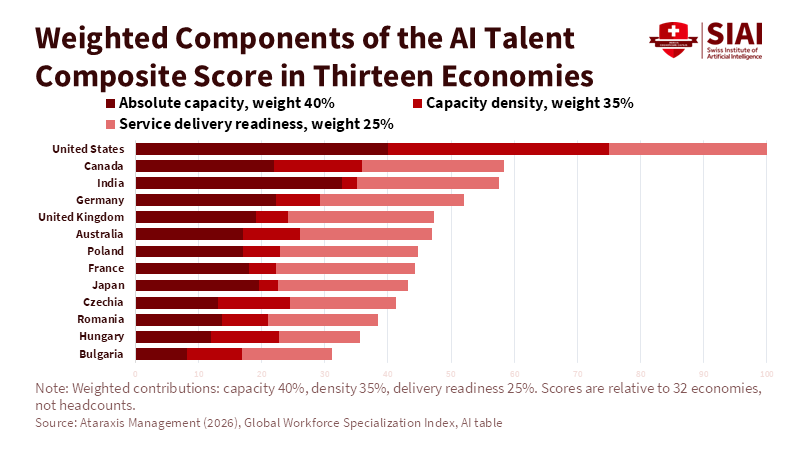
National AI capability is typically represented as a single skill pool, scored by a number. Ataraxis' Global Workforce Specialization Index, covering 32 countries, gives the U.S. a score of 100 in the AI category, Canada 58.345 and India 57.57, combining absolute scale, density and readiness to provide services to Western buyers. Such scale informs task-assignment decisions, but it says nothing about China, South Korea, or Singapore, countries that are completely absent from the table.
The problem lies not in a specific indicator but in the pursuit of a single number itself. The production of talent, its hosting and the ability of domestic businesses to exploit what it manufactures are three separate functions, not sequential stages of the same process. A country can train excellent researchers and watch them leave. It can host top laboratories without its small and medium-sized enterprises even using basic artificial intelligence tools.
The confusion is compounded by the fact that AI talent metrics often shuffle populations that don't add up. Cutting-edge researchers who publish at selective conferences, application engineers who integrate models into products, industry professionals who use the tools in their daily work and the broader workforce that is impacted without using them directly are four different populations, with a huge difference in size between them. A transparent matrix of indicators by function, where one country may be strong in one dimension and weak in another, reflects reality much better than a composite index that squeezes everything into one score.
Who Educates, Who Employs
In the sample of researchers admitted to the NeurIPS conference and analyzed by MacroPolo, the share of higher-level researchers with undergraduate studies in China rose from 29 percent in 2019 to 47 percent in 2022, while the corresponding share in the U.S. fell from 20 percent to 18 percent. But the same sample shows that the workplace is moving in reverse. The U.S. remained the place of employment for 42 percent of these researchers in 2022, compared to just 28 percent for China. The country that trains the most is not the country that ultimately employs them.
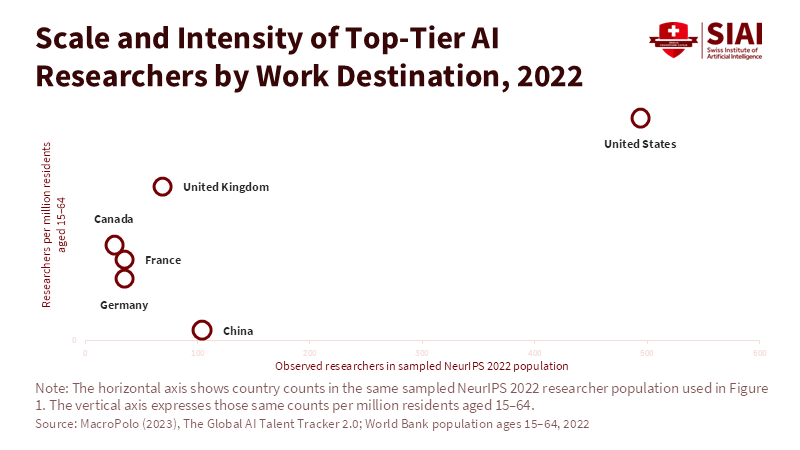
This asymmetry is not new in the literature on the migration of highly skilled workers. A widely cited review in the Journal of Economic Literature had already shown that countries that gain from international talent mobility are usually large economies with a low rate of exit of skilled workers, while smaller countries with a high rate of exodus tend to lose. A Harvard University Press study of engineers returning to Taiwan, India and China from Silicon Valley described an alternative route, where mobility functions as a circulation of know-how rather than a pure loss. This path presupposes open markets and relatively free movement of capital, conditions that are limited as visa and export controls increase.
The distinction between stock and retention rate deserves special attention, because it is often confused. A large stock of foreign researchers working in a country proves nothing about how many of them stay there in the long term. Using data from the National Science Foundation's Survey of Doctorate Recipients, Georgetown University's Center for Security and Emerging Technology found that about 77 percent of the more than 178,000 international PhD holders in science and technology at American universities from 2000 to 2015 were still living in the U.S. in 2017, with rates close to 90 percent for Chinese and 87 percent for Indians. This is an actual retention rate of a specific cohort, not a snapshot of stock and such data are almost completely missing outside the United States.
Research Scale Versus Density
The second reversal occurs when the measurement shifts from absolute scale to density. In the AI category of the Ataraxis Index, India scores 81.9 in absolute capacity and just 6.6 in density, while Canada shows 54.7 and 39.9, respectively. The AI Index 2026 comes up with a similar picture with completely different data. Switzerland has 110.5 AI researchers and inventors per 100,000 inhabitants, Singapore 109.5 and the US only 64.8. The choice of denominator is not neutral, since the total population of a country includes children and retirees, so economies with different demographic compositions are not equally compared when density is calculated in this way.
South Korea shows that not even the production of innovation itself ensures the retention of human resources. It ranks first in the world in artificial intelligence patents per capita, but a report by the Korea Chamber of Commerce and Industry recorded a net loss of AI professionals in 2024, with the main destinations being the U.S., Canada, Japan and Germany. A dense ecosystem of research laboratories and large technology groups alone is not enough to contain the talent it produces.
Business Diffusion Tells a Different Story
The third function, the use of technology by domestic businesses, produces the most unexpected ranking. In the European Union, the share of businesses using AI rose from 13.5 percent in 2024 to 20.0 percent in 2025, with Denmark surpassing 42.0 percent and leading them all. Neither Denmark nor Finland nor Sweden hosts large cutting-edge labs. Recent commentary frames this spread as merit-based AI adoption rather than a uniform rollout across the bloc. Among European businesses that considered the use of AI but ultimately did not move forward, the most frequent reason was a lack of relevant expertise, with over seven out of ten reporting it.
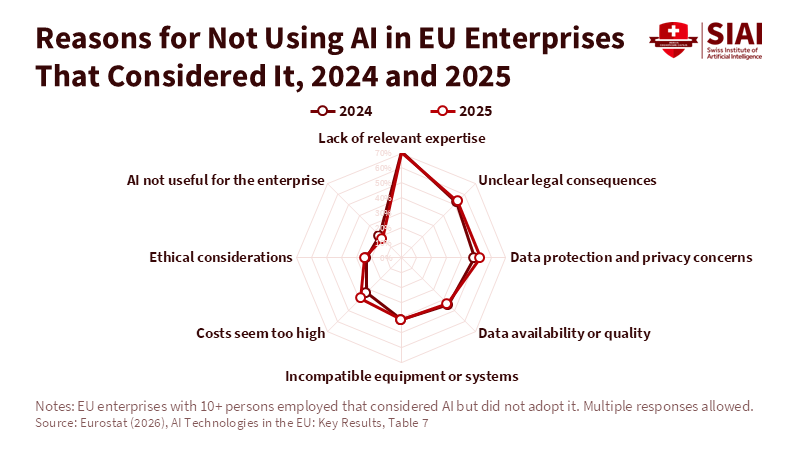
An alternative explanation is worth seriously considering. If the use of artificial intelligence depends primarily on the size of businesses, the differences between countries may reflect their production structure rather than the talent they have. In the US, the usage rate reached 37 percent in companies with at least 250 employees, well above the national average. But this explanation is weakened by the fact that businesses themselves name skills as the main obstacle. The OECD estimates that about four out of ten employers in manufacturing and finance who have not adopted AI consider skills to be the main reason. Structure and skills probably work in parallel, not alternatively.
Poland and Romania offer another contrast that deserves attention. In the Ataraxis index, their readiness to provide AI services to Western customers is rated very high, while their own domestic businesses are at the bottom of the European Union in terms of AI adoption domestically. A stock of exportable skills can coexist comfortably with low domestic diffusion when the same engineers work mainly for overseas customers.
What Is Changing for Governments, Universities and Businesses
The distinction between the three functions translates into concrete consequences. Recent policy moves clearly illustrate this. The U.S. tightened visa rules and imposed additional costs on some work visa applications for foreign professionals; China created a new visa for young scientists without requiring an invitation from a domestic employer and Singapore announced a commitment of more than a billion Singapore dollars for research and talent development. Each measure aims at a different function, usually without explicitly stating so and this makes any future evaluation of it difficult.
Governments designing AI strategies should explicitly state which function each policy measure targets, since a decrease in researcher inflows is not an indication of weak diffusion and high business use does not compensate for the loss of researchers. Universities know where their graduates studied but rarely publish where they work five or ten years later, which would turn reputational reserves into real retention rates. Only a quarter of European governments currently run programmes for retaining AI postgraduate students, one recent policy review found. For businesses, the decision is rarely about hiring a cutting-edge researcher and almost always about whether to allow an experienced industry professional to evaluate and integrate AI tools into their daily work. The OECD estimates that about one in three job postings are for positions with high exposure to AI, while only about 1 percent require specialized, complex AI skills. The distance between these two numbers is the actual size of the labor market that the diffusion function must cover.
Table 1. Country Positions Across the Three AI Talent Functions
| Country | Production | Hosting | Deployment |
|---|---|---|---|
| China | Strong | Moderate | Not measured |
| United States | Moderate | Strong | Moderate |
| Denmark | Not measured | Not measured | Strong |
| South Korea | Strong (patents) | Net outflow | Not measured |
National AI capability is not a reserve that fits into a number. It is the production of people, their hosting and the ability of domestic businesses to use what they build, three functions in which the same country may occupy a completely different position. The $285.9 billion invested in the U.S. in 2025 and the simultaneous 89 percent drop in researcher inflows are not a contradiction. They prove that funding, hosting and retaining people follow a different logic. Whether an ecosystem of businesses and research opportunities alone can retain the talent a country trains remains an open question and the available evidence is not yet sufficient to answer. As long as the comparison between countries continues to compress three unequal functions into one score, it will continue to reward anyone who simply chooses to measure their most favorable dimension.
This article is based on an original research article published by The Economy Research. For the original version, please refer to [AI and Workforce] Talent and National Capability: Formation, Mobility, and Retention.
This article reflects the analytical judgment of the author and does not constitute policy advice or the official position of any affiliated institution.
His recent work examines the broader socioeconomic consequences of artificial intelligence, including labor markets, public finance, demographic change, institutional adaptation, and the distributional effects of technological progress.
He holds a PhD in Mathematical Finance from Boston University, and previously earned an MSc in Finance and Economics from the London School of Economics. He completed his undergraduate studies in Economics at Seoul National University under the Korea Foundation for Advanced Studies scholarship program.
Similar Post