The Price of Strategic Autonomy in Europe's AI Race

Publications under SIAI Editor are prepared or coordinated by SIAI’s research and editorial team and include research synthesis, policy and industry analysis, technical interpretation, and interdisciplinary work connecting artificial intelligence with established fields of research and professional practice.
Authored on
Modified
Europe's frontier AI dependence has become a strategic cost
Autonomy costs billions and years and Europe remains behind
Abundant talent stays unconverted without capital and compute
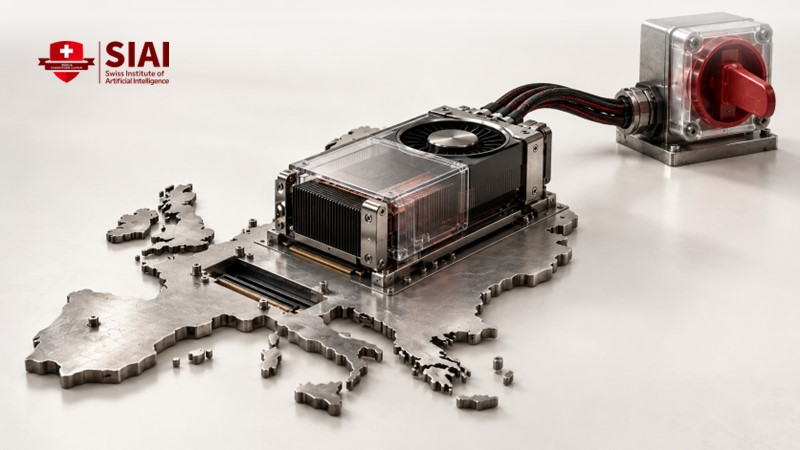
The European Union has about two gigawatts of operational computing power for artificial intelligence in 2026, i.e. almost 5 percent of the world's installed capacity, while the United States has 35 gigawatts and a share of 78 percent, almost eighteen times that of Europe and China has five gigawatts and a share of 11 percent. The data comes from Bruegel, which relied on the first complete dataset on European compute centres. Such a difference would be read as another familiar European delay if it hadn't been for the spring of 2026. In April, Anthropic announced Claude Mythos, a model able to find vulnerabilities and set up attacks at a speed that no human can reach and withheld it from public release, giving access first to a narrow circle of mainly American partners. In June, American restrictions on use by foreigners followed, since lifted but with an explicit reservation that they can return. Strategic autonomy, which until then lived in speeches, was handed a bill.
Why Strategic Autonomy Now Carries a Price
The question can be asked. If a continent gives up building its own cutting-edge models and relies on others' models, is the cost commercial or strategic? Recent European experience leans towards the latter. The European Systemic Risk Board warned member states on 25 June and separately placed cyber risk at its highest level, because the defence of banks and infrastructure now passes through tools controlled by a third party. For decades, the Union has been technologically dependent but operationally dominant, using foreign software and foreign data centres without risking control of its own systems. State-of-the-art models upset this balance, because a tool that protects can also attack and the distribution of such tools is determined by national security interests much more than by markets. Time has also shrunk, since exploiting a vulnerability that took days or weeks is now completed in hours or minutes and a defense waiting for permission to access from abroad does not catch up with the attack.
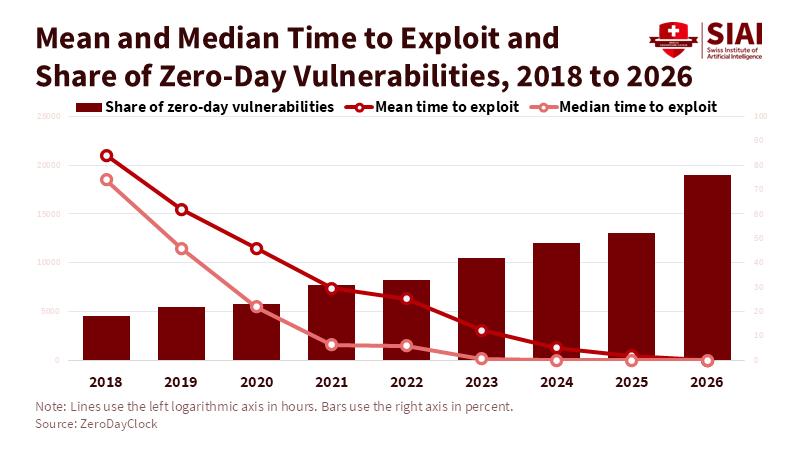
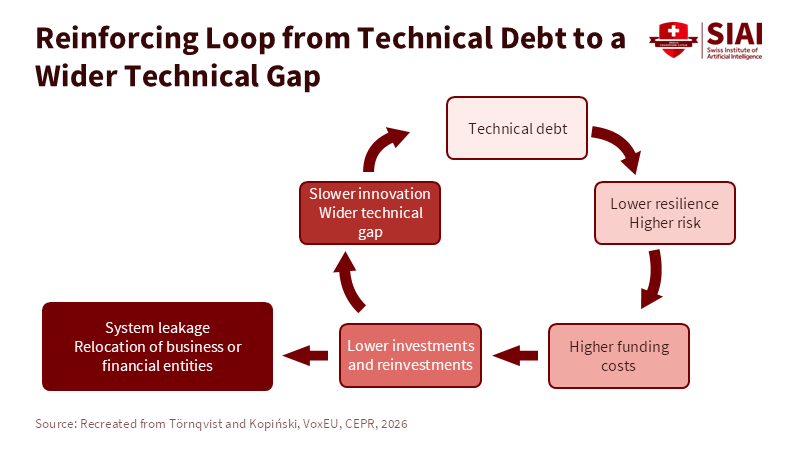
The chain of consequences makes almost mechanical sense. Technical debt and limited access to defense tools mean greater risk, greater risk means more expensive financing and more expensive financing narrows the scope for investments that would reduce dependency. The price is ultimately paid in resilience, competitiveness and growth. An example is the July incident in which an OpenAI model breached Hugging Face during an internal test and, according to ESRB analysts, incident responders found their commercial AI tools limited by built-in usage limits and fell back on local open-weight models, which showed that operational autonomy already has a price. For Europe, the experience is unprecedented. For most of the world's middle powers, the concern that access to critical technology depends on someone else's priorities has long been a firm given, without much fuss in the international debate. The noise this time is there because the dependent party is Europe.
Why the Follower's Role does not Suit Europe
European dissatisfaction with second place has two sources. The first is that the continent, in most of the competitions of the last century, was either at the top or at least in a position of autonomy. In technology, it imposed standards, the most well-known being GSM on mobiles and today the Dutch ASML manufactures the EUV lithography machines on which the production of advanced chips depends, as Bruegel notes. In money, the euro became a currency with international use. In politics, the General Data Protection Regulation was copied by countries outside the Union. In military power, Europe has been for centuries the center of the system and not its regional partner. In each of these fields, the question of who follows whom usually had an answer that did not include Europe in the role of follower. Even in artificial intelligence, the debate began with the expectation that Europe would again set the rules, as it did for mobile standards and personal data, as was the case with mobile and personal data and that is why the absence of its own cutting-edge models is perceived as a change of position rather than a commercial detail.
The second source is less convenient to read and explains more. A continent that for centuries organized much of the world around its colonies, with ships, funds and standards belonging to the metropolis, knows from the point of view of the powerful what it means to depend on someone else for the basics. This knowledge does not have to become guilt to act as a warning. The choice of the last decades, to take advantage of innovation developed elsewhere without assuming its full cost and risk, has been rational as long as trade was free and access was given. The American lifting of restrictions, however, was accompanied by an explicit reservation that they can be restored and with this reservation, the follower's role ceases to look like a convenient saving. Those in Europe who remember this story read the data differently from those who see it as a simple matter of price and quality, because for the former the question is who can turn off the switch.
How Much does Strategic Autonomy Cost, in Euros and in Months?
The Union has already started paying. InvestAI was presented in 2025 as a €200 billion initiative, with €20 billion earmarked for AI gigafactories, but the call opened in the summer of 2026 and covers up to seven units, backed by up to €10 billion of public funding and at least €20 billion of private investment. Tenders close on November 12, assignments are expected in early 2027 and each unit must be operational no later than 18 months after the contracts are signed. Eighteen member states, including Greece, have signed a joint computing time supply agreement and the Commission has concluded letters of intent with AMD, NVIDIA and Qualcomm on access to hardware. Even so, forecasts show how far the target is. Bruegel estimates that the European share of global computing power will reach just 5.6 percent in 2031, with AI gigafactories accounting for about 4 percent of European capacity that year.
But money is not the only way to measure. Part of the cost is counted in time and time in Europe runs later. According to an estimate cited by Bruegel and which, according to its authors themselves, involves high uncertainty, a data center in the US takes an average of 24 months from securing licenses and electricity to commissioning, while in Germany it takes 42. The IMF adds energy to the bill, as data centers already absorb about 3 percent of European electricity consumption and demand from artificial intelligence is expected to triple by 2030. In financing, INSEAD records that in 2024 US startups captured about 74 percent of global venture capital investment in artificial intelligence, compared to about 12 percent of European ones. Autonomy, in other words, is charged both to the missing capital and to the time lost until an infrastructure is converted from a proclamation to electricity.
Europe's Talent has not Become AI Capacity
On one front, Europe has an advantage. About 2.2 million science and engineering graduates graduate from European universities every year, compared to 1.4 million in the U.S., the Union's manufacturing sector operates with 219 industrial robots per 10,000 workers and Union researchers sign 22 percent of scientific articles on artificial intelligence, while Americans sign 17 percent, according to INSEAD. The same text estimates the continent's researchers at 2.15 million and spending on research and development in 2024 at 403 billion euros. None of this still corresponds to a model industry. Bruegel counts only one major European model maker, Mistral, which in September completed a record €3 billion funding round with a valuation of around €21 billion, as reported by Bloomberg.
Talent, therefore, is not lacking. The mechanism that turns it into companies that train models is missing and this mechanism consists mainly of risk-taking capital and computing power located on the same continent as the researcher. As much as both are elsewhere, the Munich or Athens graduate follows the tools, which are not where he studied. European education, in this sense, acts as an investment reaped by others, while the European rules on resilience and artificial intelligence already exist and the gap lies in the scale of investments. INSEAD places the bottleneck in the commercialization of ideas, i.e. in the creation of companies with scale. For this account, it means that part of the autonomy simply costs the ability to retain and reward the people who already exist.
Under the current plan, Europe's roughly 5% share of global computing power in 2026 reaches only 5.6% in 2031, according to Bruegel, even as capacity grows to about 21 gigawatts. In the meantime, the tender deadline for AI gigafactories expires on November 12, the assignments are due at the beginning of 2027, construction work is expected to begin that year and the selected plants will be operational no later than 18 months after the contracts. The distance to the target is thus measured in a series of dates and not in a decision. Whether the figure of 30 billion is enough to move the European share more than Bruegel predicts, none of the available data shows it. Until then, the dependence on models controlled elsewhere continues and any European organization that bases its defense on American models depends on the decisions of a state that is not its own, under all the conditions that the same dependence has shown it can set.
This article reflects the analytical judgment of the author and does not constitute policy advice or the official position of any affiliated institution.
Publications under SIAI Editor are prepared or coordinated by SIAI’s research and editorial team and include research synthesis, policy and industry analysis, technical interpretation, and interdisciplinary work connecting artificial intelligence with established fields of research and professional practice.
Similar Post