How the Value of Human Labor Is Truly Judged in the Age of Artificial Intelligence

His recent work examines the broader socioeconomic consequences of artificial intelligence, including labor markets, public finance, demographic change, institutional adaptation, and the distributional effects of technological progress.
He holds a PhD in Mathematical Finance from Boston University, and previously earned an MSc in Finance and Economics from the London School of Economics. He completed his undergraduate studies in Economics at Seoul National University under the Korea Foundation for Advanced Studies scholarship program.
Authored on
Modified
Exposure alone rarely predicts real productivity or employment outcomes
Verification cost and demand elasticity decide where AI pays off
Entry-level learning task loss may cost more than it saves

At an American customer service company, access to an AI assistant increased the number of requests resolved by each employee per hour by 15 percent in a sample of 5,172 people, with the biggest gains recorded in the least experienced. Humlum and Vestergaard, linking two surveys to administrative employment registers in Denmark for 25,000 workers in eleven exposed occupations, found no significant effect on pay or hours worked, while users themselves reported savings of just 2.8 percent of their time. An analysis by Brynjolfsson, Chandar and Chen of U.S. payroll data up to June 2026 shows that the employment of 22- to 25-year-olds in high-exposure occupations is about 19 percent lower than it would be if it had followed the pace of their less exposed peers. Three datasets for the same period paint pictures that are hard to reconcile and it is precisely this discrepancy that reveals how the value of human labor is changing today. Exposure alone rarely predicts real productivity or employment outcomes. Verification cost and demand elasticity decide where AI pays off. Entry-level learning task loss may cost more than it saves.
The Three Filters that Determine the Value of Human Labor
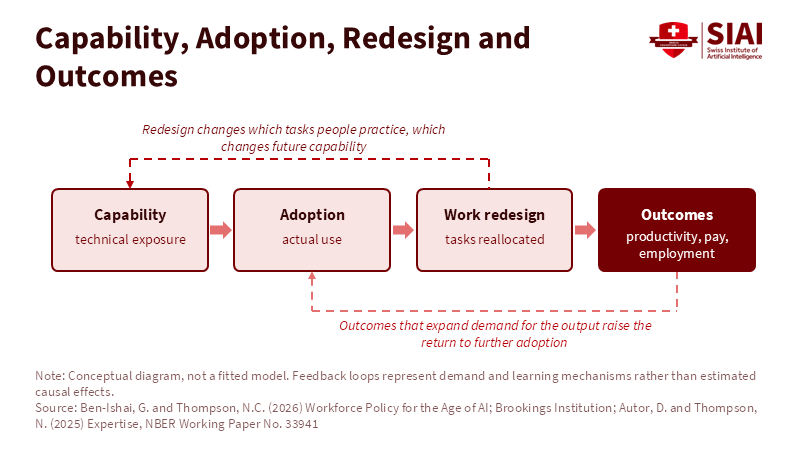
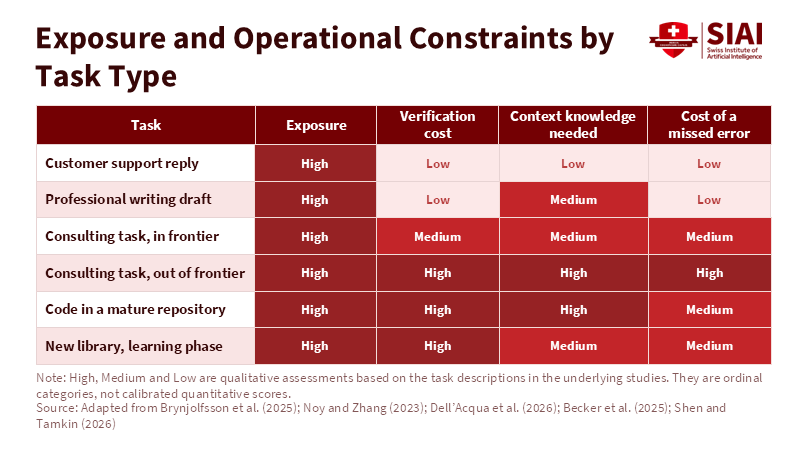
The usual explanation starts from exposure, i.e. how many tasks a profession can technically perform in a model. This explanation omits two intermediate steps. The first concerns the economic logic of delegation, since a task that the model can perform is not assigned to it when the cost of controlling the result, integrating it into an existing process and the expected cost of a mistake that will go unnoticed outweigh the benefit. The second concern is demand, since a productivity gain reduces the demand for labor only when the demand for the product itself does not increase enough to absorb the time saved. Ben-Ishai and Thompson's analysis for Brookings concludes the same point from a policy perspective, arguing that exposure is a misleading organizational principle, since the question that counts is how the value of human expertise changes.
A third, less obvious element concerns learning. If the tasks that younger workers used to learn from are now assigned to models, fewer people will in the future acquire the expertise needed to control the results of AI, so the cost of control, rather than decreasing as technology improves, may increase years later. These three filters, technical competence, the economic logic of delegation and demand, together with this learning loop, make up a much more complex framework than a simple exposure ranking and explain why two occupations with a similar percentage of exposed tasks can end up with completely opposite results.
Where Artificial Intelligence Works and Where it Does not
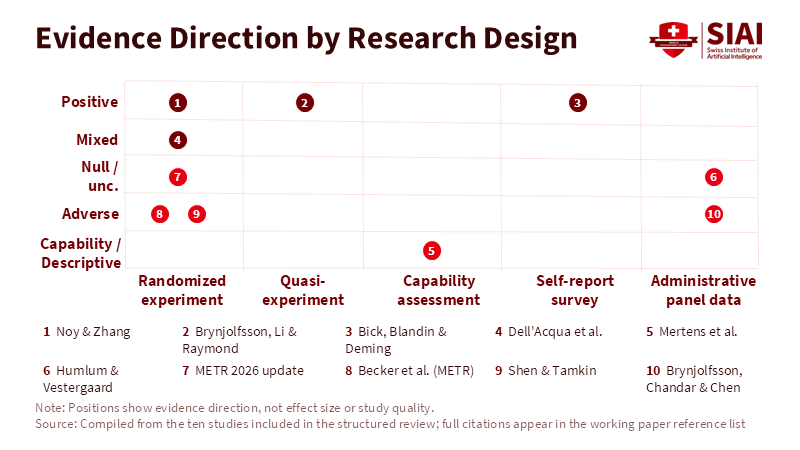
A review of ten studies, from randomized experiments to Danish administrative data and U.S. payroll, shows a clear pattern. Positive results are concentrated in stand-alone tasks where the quality of the outcome is quickly seen, either by the client or by an evaluator. At the same customer service firm, the assistant had been trained in successful same-business conversations and the employee could accept, modify, or ignore their suggestion at the time of the conversation. In an experiment by Dell'Acqua and partners with 758 consultants, those with access to AI completed 12.2 percent more tasks within the model's capacity limits, with speed increased by 25.1 percent and quality improved by over 40 percent. On a task outside these limits, however, they were 19 percentage points less likely to provide a correct solution than those who worked without the tool, without knowing in advance which side of the limit each task was on.
Unfavorable or zero results occur where the correct answer depends on knowledge that is not contained in the mandate itself, or where the measured quantity is learning rather than the product. In the Danish research, zero effect on earnings was true even for those who declared daily use or worked in businesses that encouraged and financed adoption, which the authors attribute to the small size of the profit combined with its weak transmission to wages. The discrepancy between the two categories of results does not in itself prove the hypothesis about control costs, since the studies differ simultaneously in population, tool, period and measurement, but it remains compatible with it in each case examined.
Speed, Reliability and the Hidden Cost of Control
The most rigorous test of the hypothesis comes from programming, where exposure is among the highest in any index. In a randomized experiment by Becker, Rush, Barnes and Rein on behalf of METR, sixteen experienced programmers worked on 246 tasks within repositories they had known well for years. Before they started, they had predicted that AI would reduce the completion time by 24 percent and after completion they estimated that it had reduced it by 20 percent. The measurement showed that the time increased by 19 percent. The distance between perception and measurement reaches 39 points on an index where working without the tool equals 100 and it shows how easily the time to check, correct and adapt code to unwritten requirements of a project can escape a self-report.
Broader proficiency data from Mertens and colleagues at MIT FutureTech, with over 17,000 evaluations of experienced workers in realistic tasks, show that six out of ten model responses are accepted without any correction, with the rate ranging from 46.8 percent in legal tasks to 72.5 percent in installation and repair. Success declines mildly as the length of duty increases, while the time to halve the failure rate rises from 2.19 years for five-minute tasks to 2.76 years for twenty-four-hour tasks. A simple sensitivity scenario shows how fragile such a gain is in practice. In Noy and Zhang's experiment with professional texts, access to a language model reduced time by 40 percent, i.e. a sixty-minute task saves a gross 24 minutes. However, with a 10 percent rework probability, the net benefit is zeroed out when the test lasts just 18 minutes and with a 30 percent probability when it lasts just six minutes.
An alternative explanation deserves attention here. One could argue that these discrepancies are only a matter of time, since as the capacity of the models rises and the cost of use falls, the cost of control will shrink and the results will converge towards the positive findings of the experiments. This explanation has some basis, since the same MIT FutureTech predictions, which the authors consider a ceiling rather than an estimate, give success rates of 80 percent to 95 percent in most textual tasks by 2029. But its limits are seen when the debate moves from adoption to outcome. The elasticity of demand and the cost of a mistake in a legal opinion are not functions of time and in the Danish survey, the zero effect applied even to those already ahead of this time scale, with daily use and employer support. Analysis from SIAI reaches a similar conclusion, arguing that access is not integration and that the economic value of AI increasingly arises from its connection to data, workflows and decision-making systems.
Who Bears the Cost of Learning
The same studies agree on one point: artificial intelligence squeezes performance differences between employees. In the consultants' experiment, those who started among the lowest performers improved by 43 percent, compared with 17 percent for those who started among the highest. This interpretation matters because it suggests the tool can transfer to younger people practices that used to take years to learn alongside experienced colleagues. A separate experiment by Shen and Tamkin on developers learning a new library, however, showed that improvement in performance does not automatically mean improvement in ability. Better output does not prove learning, a concern now surfacing across workplace-governance debates more broadly. Those with access to AI scored 17 percent lower on comprehension tests a few minutes after completing the task, with the biggest difference showing up in debugging, while those who asked for conceptual explanations rather than assigning the task entirely scored significantly higher. The pattern fits a broader argument that outsourcing thought cannot last as a substitute for building it.
Exposure is neither uniform nor gender-neutral. According to the revised index by Gmyrek and colleagues for the International Labour Organization, 4.7 percent of the world's female employment belongs to the highest category of exposure to generative AI, compared to 2.4 percent for men, while in high-income economies 41 percent of female employment is exposed, compared to 28 percent of men. The difference mainly reflects the concentration of women in clerical and office positions, such as data entry and accounting clerks, that remain the most exposed. If these positions are self-contained, cheap to control and with inelastic demand, they have exactly the characteristics for which the analysis predicts a decrease in labour demand without a corresponding increase in output.
The organizational side of the same problem appears in an analysis by Boston Consulting Group, which argues that traditional staff pyramids are giving way to smaller teams where experienced executives work directly with AI, while new hires are expected to contribute from day one at a level that previously required years of experience. The finding comes from interviews with tech executives and leaves open whether the standard applies more broadly, but the same payroll data shows that the gap for new employees persists even when technology companies are excluded, which weakens the view that this is just an idiosyncrasy of an industry. The broader risk is that AI productivity gains thin jobs before they erase them outright.
The practical conclusion is narrow but clear. Controlling the work produced by artificial intelligence requires the same specialization as its production, often even greater, while precisely the tasks from which this specialization is acquired are the first to be assigned to models today. Statistical services and businesses need two measurements that are currently missing: the net time saved after screening and reworking by job category and recruitment in entry-level positions by occupation and age. The first would show where the adoption of technology is really working. The second would show where the training of the next generation of people who will be called upon to check its results is starting to dwindle, long before this is shown in unemployment statistics. Companion research on workforce policy frames the same problem as one of skills and economic security.
This article is based on an original research article published by The Economy Research. For the original version, please refer to [AI and Workforce] AI Adoption and the Changing Value of Human Work.
This article reflects the analytical judgment of the author and does not constitute policy advice or the official position of any affiliated institution.
His recent work examines the broader socioeconomic consequences of artificial intelligence, including labor markets, public finance, demographic change, institutional adaptation, and the distributional effects of technological progress.
He holds a PhD in Mathematical Finance from Boston University, and previously earned an MSc in Finance and Economics from the London School of Economics. He completed his undergraduate studies in Economics at Seoul National University under the Korea Foundation for Advanced Studies scholarship program.
Similar Post