[AI and Workforce] Workforce Policy for AI Transition, Skills and Economic Security
Published
Keith Lee*
*Swiss Institute of Artificial Intelligence, Chaltenbodenstrasse 26, 8834 Schindellegi, Schwyz, Switzerland

The public debate on artificial intelligence and work usually treats reskilling as the self-evident answer to labour-market adjustment. This paper argues that workforce policy for the transition to AI should start from an observable problem, name the reason why private decisions are not enough, and prescribe an intervention that can be evaluated. Based on programme evaluations from the United States, the United Kingdom and the Netherlands, 2026 administrative payroll data, and official rule documentation in the U.S., Germany, Singapore and South Korea, the analysis shows that training without a link to actual hiring demand has a weak track record, that training subsidies to employers often finance training that would have been done anyway, and that wage insurance for older displaced U.S. workers, as assessed using a quasi-experimental design, increased employment and covered its costs. In U.S. payroll data, the first measurable signs appear mainly as a decrease in young hires in exposed occupations, while layoffs remain limited, and thus escape tools triggered by job loss. The paper proposes a diagnostic matrix, a monitoring framework with proposed and non-calibrated thresholds, and two pilot projects: work-based AI capability development with additionality conditions, and enhanced re-employment support with a temporary salary supplement, the eligibility of which does not require proof that the AI caused the dismissal. The analysis does not substantiate causal effects of AI-specific policies, as such assessments do not yet exist.
1. Introduction - Policy Problem and Welfare Criteria
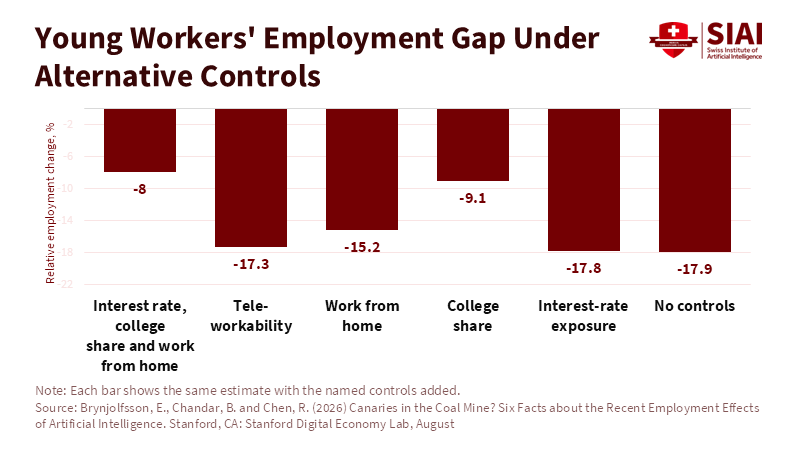
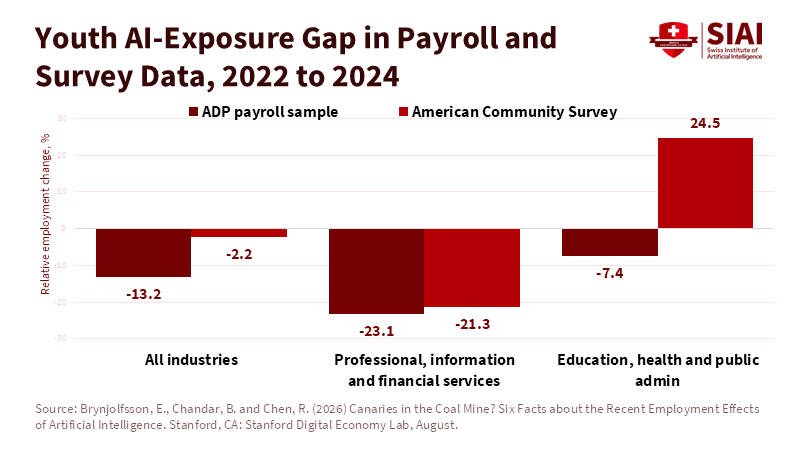
From April 2024 to December 2025, around 350 employees across Germany received the Qualifizierungsgeld, the salary replacement benefit introduced to keep those threatened by structural change within the same company.[1] In the USA, the Trade Adjustment Assistance Program, which for decades was the main federal tool for employees who lost their jobs due to a recognised structural cause, has not certified new groups of beneficiaries since July 1, 2022.[2] In the same period, administrative payroll data analysed by the Stanford Digital Economy Lab shows that the employment of 22- to 25-year-olds in the occupations with the highest exposure to AI was in June 2026 about 19% lower than it would have been if it had followed their peers in less exposed occupations, with the adjustment occurring mainly through fewer hires rather than more separations.[3] The three elements together describe the problem that the document addresses. The workforce policy for the transition to artificial intelligence is based on tools that are activated with a dismissal or with a certified cause, while the first measurable signal may instead be reduced hiring.
The usual answer is reskilling. A summary of the economic literature published by Brookings in September 2026 concludes that exposure to AI is the wrong organisational principle for workforce policy, that reskilling alone is not enough for displaced workers, and that public action should prioritize those who actually lose their jobs and those who gain access to new, high-productivity positions.[4] This position is the starting point here, with a correction. Neither exposure nor dismissal is a sufficient criterion for intervention. It needs an observable problem, a reason why employee and business decisions do not solve it on their own, and a measure that can be evaluated with a predetermined indicator. The period from 2023 to 2026 made the issue more urgent as governments introduced transition-related measures before evidence on AI-specific effects had matured. In the United States, for example, the July 2025 AI Action Plan called for rapid retraining of workers displaced by AI.[5] None of these measures indicates which outcome will be considered a failure. In this paper, exposure means that AI can affect a task, while feasibility means that it can meet a specified operational requirement. Adoption refers to actual use in a defined workplace and period. Automation transfers task execution to AI, whereas augmentation assists human execution. Productivity, employment, hours, earnings and job quality are treated as separate outcomes.
The success of an intervention is defined by four outcomes evaluated separately: the productivity of the companies involved, the cumulative real earnings, the quality of employment, i.e. stability, hours and the use of skills, and the duration of the transition to a stable position. With U.S. Social Security data for the period 1974 to 2008, men who were made redundant in collective redundancies lost an average of 1.4 years of previous earnings when unemployment was below 6%, and 2.8 years when unemployment was above 8%.[6] The well-being measured includes workers who lose a job or income, new entrants, businesses that finance part of the training and taxpayers, and therefore the budgetary costs are considered together with the opportunity costs. The time horizon for employee outcomes is four years, as long as the best available evaluations follow, and the distribution is evaluated separately from the overall result. An efficiency-based case for public intervention requires a lack of coordination, unequal organisational capacity, labour-market disruption, underinvestment in training, risk passed on to third parties or a lack of common standards.
The research question is which public interventions can reduce persistent transition losses and widen access to productive labour, given the uncertainty about the development of AI and its distributional consequences. The contribution of the document is a policy selection framework and two pilot projects with the possibility of evaluation. The first hypothesis is that training alone fails when the binding constraint is weak hiring demand, mobility costs, loss of income or incomplete information on job quality; its test is whether blended support improves sustained employment compared to training alone, and the hypothesis would be weakened by sustained gains from stand-alone training programmes in local labour markets with weak hiring demand. The second is that employers underinvest in transferable skills when the benefits are reaped by future employers, and that the question that counts for co-financing is whether it adds training and recruitment or subsidises what would be done anyway. The third is that a policy that increases national AI capacity may leave certain groups worse off, and therefore the overall benefits, their distribution and the opportunity cost of public spending are assessed separately. The analysis focuses on the public decision: when a state should intervene, with what instrument and against which evaluation criterion. Frontier-talent policy and broad workforce adjustment are treated as distinct programmes with different target populations and spending objectives.
2. Evidence and Intervention Rationale
The most serious alternative explanation for the current situation is that there is still no problem that needs a specific policy. A recent employee-level study, linking adoption surveys to administrative registers in Denmark, estimates zero effects of AI chat tools on earnings and recorded hours, excludes effects greater than 2% two years later, and finds the same result for intensive users, early adopters, and workers at the start of their careers.[7] Even the Stanford analysis, which documents the gap in young workers, does not find a generalised displacement in the economy as a whole, notes that the finding weakens when education is controlled, that some deviations precede generative AI and that it is more pronounced in the ADP sample than in national surveys, and expressly interprets its findings as descriptive indications without a causal claim.[8] If the effects are small, uncertain and partly cyclical, then existing institutions, unemployment insurance, active policies and educational funding are sufficient. The argument has weight, and the document accepts part of it: there is currently no documentation to justify new income transfers based on AI as the cause.
However, the limits of the argument are specific. The general institutions are not channel-neutral. Unemployment insurance requires a history of contributions and loss of a job, and a graduate who is not hired has neither. In Germany, which has one of the most comprehensive systems, out of the approximately 188,000 entries into unemployment from insured employment in February 2026, around 61,000 concerned people without entitlement to benefits.[9] The cost of waiting, on the other hand, is not symmetrical. Losses from redundancy are doubled when it occurs in a market with high unemployment, as the data in Section 1 showed, and a policy designed after unemployment rises will be implemented precisely in the conditions where it is least effective. The alternative explanation therefore shows what should not be done, i.e. special benefits for AI without a definition of the problem, and does not exclude the preparation of tools with a cause-neutral criterion that can be evaluated before they are needed on a large scale.
Experience with training is the second sticking point. The meta-analysis by Card, Kluve and Weber, which gathered estimates from more than 200 evaluations of active employment policies, concluded that the average effects are close to zero in the short term and become more positive two to three years after completion, with greater gains for programmes that build human capital and for those coming from long-term unemployment.[10] Randomized evaluations of sectoral programmes in the U.S., combining initial participant selection, occupation-specific training, support services, and a close relationship with employers, found persistent pay increases of between 12% and 34%, mainly because participants found positions in higher-wage industries and occupations and less because employment increased.[11] On the other hand, the Trade Adjustment Assistance evaluation under the 2002 amendments found that the participants, most of whom spent a long time in training, had lower earnings than the comparison group in the first years, that in the fourth year the difference ranged from US$3,300 less to zero depending on the comparison group, and that their total income over the four years was lower despite the additional benefits.[12] The comparison supports the first hypothesis as formulated. The evidence is more favourable when training is linked to specific employer demand and less favourable when it is offered as a general entitlement after job loss without reserved positions.
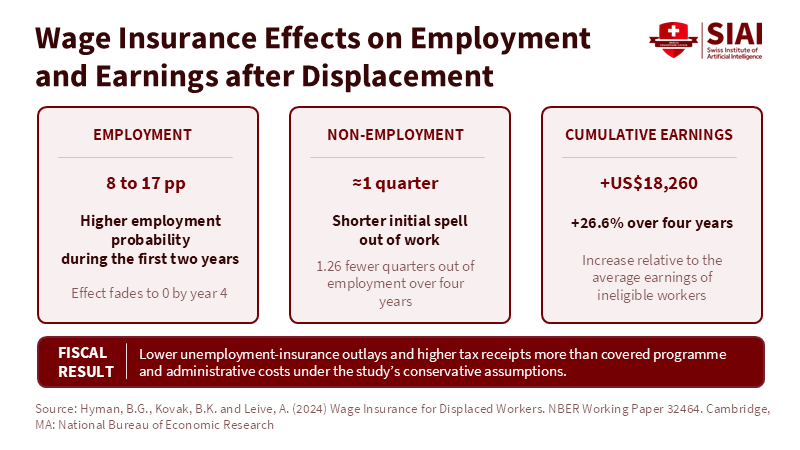
Wage insurance provides the strongest quasi-experimental evidence considered here, but it also raises the most difficult transfer question for the paper. Hyman, Kovak and Leive studied the Reemployment Trade Adjustment Assistance strand, which paid displaced workers aged 50 and over up to half the difference between old and new wages for up to two years, based on the discontinuity of the age of eligibility in a sample of 76,500 workers from about 1,000 companies. Eligibility increased the likelihood of employment by 8 to 17 percentage points in the first two years, an effect that was eliminated after four years, and increased four-year cumulative earnings by more than US$18,000, or 26%, mainly because it shortened the duration of unemployment, while tax collections and reduced unemployment insurance covered the cost of the programme.[13] The finding weakens a central premise of the analysis, namely that eligibility criteria should be neutral as to cause. The programme operated within a system that certified trade-related job loss. Cause certification therefore did not prevent an effective result, and the narrower claim is that AI-related causation may be substantially harder to verify, as Section 5 shows.
For the second hypothesis, the theory is older than the tools. In Becker's competitive-market model, firms have limited incentives to finance fully transferable general skills.[14] Acemoglu and Pischke have shown that in imperfect labour markets firms finance some of the general training but less than what is socially desirable.[15] Analysis of sectoral programmes attributes part of their success precisely to training in transferable and certifiable skills, which is likely to be under-provided because employers are afraid of attracting those trained by competitors.[16] The documentation for co-financing is less favourable. The evaluation of Employer Training Pilots in the United Kingdom, which offered free training and salary compensation to employers for low-skilled workers, did not find a statistically significant effect on participation in training in the first three years and resulted in a high rate of training that would have taken place without the subsidy.[17] In the Netherlands, an additional tax deduction for the training of workers over 40 years of age was associated with a 15% to 20% higher rate of training just above the age limit, but the difference mainly reflected workers just below the age limit postponing training until they qualified.[18] Underinvestment is therefore possible, but its remedy by means of general subsidies has a history of low additionality.
Each policy instrument examined here requires its own rationale for intervention. For employer-linked training, the reason is the externality of the transferable skill, which is partly reaped by the next employer. For entry routes through work, it is the failure of coordination: when firms individually remove entry tasks to reduce current costs, while the future supply of experienced professionals depends on someone training beginners. For mobility support and search support, it is the lack of information about available positions and about the value of skills in other employers. For the wage supplement, it is the limitation of funding, since a household cannot borrow against future earnings nor can it be privately insured against wage loss, along with the adjustment frictions that prolong unemployment. For small businesses, it is the unequal organisational capacity in the face of fixed implementation costs, and for statistics, the lack of common standards along with the risk that is passed on to third parties when businesses do not capture the role of AI in personnel decisions.
The distributive objective is a different argument and is not presented here as a market failure. Even in a frictionless market, a society can choose to compensate workers who are burdened by a change that benefits the whole. This choice is judged by another measure, i.e. by who is burdened, how much and at what cost to taxpayers, while the market failure argument is judged by whether the intervention improves an outcome that private decisions leave worse. The remuneration supplement is based on both arguments, and its assessment must show separately the effect on the speed of rehiring, which concerns efficiency, and the income transfer, which concerns distribution.
3. Worker and Firm Diagnosis
The diagnosis distinguishes four groups because the same technological fact creates different problems in each: displaced workers, workers with wage erosion without dismissal, new entrants who find fewer learning opportunities, and businesses with a skills gap. For the displaced, the first hypothesis names four barriers that training does not remove. Weak hiring demand means that the positions for which one will be trained do not exist in the number or place needed. Mobility costs include moving, loss of social networks and, for older workers, loss of seniority. The loss of income during the transition makes a few months of training a luxury for households without savings, and the lack of information on the quality of jobs makes it difficult to judge which certification will be recognised by employers and which position has prospects for development.
Mobility costs and lack of information work together. The employer who reduces staff knows which jobs are being removed, the employer who hires knows which jobs are opening, and no one has a reason to share the information with the other or with the employee. The German Government describes regional matching platforms, the Arbeitsmarktdrehscheiben, which connect companies that release workers with companies that need them, with the participation of trade unions, employers' organisations and the employment service.[19] Moving directly from one job to another without intermediate unemployment avoids precisely the period during which losses accumulate, but no evidence of the effectiveness of the platforms has been identified, and the report describes a design, not an effect.
The second group does not appear in any unemployment register. In the context of expertise summarized by Brookings, when AI automates the less specialized tasks of a profession, the value of the remaining expertise rises and employment decreases, while when it automates the more specialized ones, entry into the profession is facilitated, employment can increase, and wages are squeezed.[20] The second case produces workers who see the value of their skills fall without losing their position, and for them none of the tools of the four countries in Table 2 are activated. The diagnosis must separate this mechanism from dismissal, because the appropriate tool is a path of advancement within the profession or the transition to a better-paid position, while unemployment support does not address it.
The third group, new entrants, do not lose a position; they miss the opportunity to obtain the first, and the effect is recorded as a hiring lag in occupations where AI is used to automate tasks and less so in those where it complements them.[21] This population does not appear on redundancy registers, has no contribution history and is often not entitled to support.
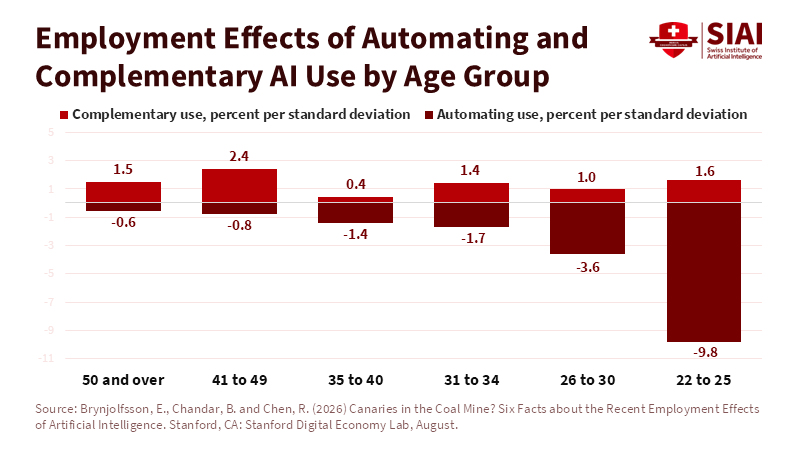
The response of these workers is not passive. An analysis by The Economy argues that, for young workers, familiarity with AI is increasingly becoming a condition of entry because tasks that once formed the first stage of professional learning, such as initial research, first-draft text and simple code, are often relatively easy to support or automate with generative AI.[22] The observation has a direct consequence for diagnosis. A programme that teaches young people how to use AI tools addresses a problem that they are already solving, while the problem they do not solve on their own is access to positions where they will gain the judgment to evaluate what the tool produces.
For the fourth group, businesses, enterprise diffusion data show that the ability of firms to integrate tools is distinct from the presence of frontier researchers. In 2025, around 55% of large enterprises in the European Union used at least one AI technology, compared to around 30% of medium-sized enterprises and 17% of small enterprises and among enterprises that had considered using it without adopting it, the lack of relevant specialisation was reported by 70.3%.[23] A SIAI analysis on the transition of enterprises to AI argues that access to models has become cheap, while implementation remains difficult, because it requires connection to data, reordering workflows, control rules and staff training, and concludes that subsidising subscriptions would target the least scarce element.[24] The consequence for policy is that unequal organisational capacity can create a genuine implementation constraint, but it cannot be corrected simply through cheaper licences. It is corrected, if corrected, by training tied to a specific implementation project, which is the subject of the first pilot project.
Businesses also have reasons not to record the role of AI in personnel decisions. Since March 2025, the New York WARN filing system has asked employers filing a collective redundancy notice whether technological innovation or automation contributed to the redundancies, and in the first year of implementation, no businesses listed AI as a cause.[25] The result is open to two readings, that AI does not cause collective redundancies or that companies do not declare it, and the data do not distinguish between them. The source is a law firm account, not official statistics, and is read with this caveat; the finding, however, matches the payroll data, which traces the adjustment in hiring, while notice is only required for layoffs.
The diagnosis therefore follows a fixed sequence. It starts from the group and a measurable symptom, identifies the mechanism, names the reason for intervention, selects a tool, and defines in advance the indicator that will judge it. The diagnosis uses recurring functions, notably customer service, accounting and software development, while healthcare administration is treated separately. Table 1 applies the order to seven problems arising from the items in Sections 2 and 3.
Table 1. Policy Diagnosis Matrix
| Target group | Observable problem | Mechanism / rationale | Possible instrument | Measurable outcome |
|---|---|---|---|---|
| Displaced workers | Lower-paid re-employment or prolonged unemployment | Income loss, skill loss and limited private insurance | Enhanced re-employment support with temporary wage supplement | Time to re-employment; four-year real earnings; cost per sustained placement |
| Displaced or at-risk workers | Vacancies elsewhere while exposed workers remain unemployed | Mobility costs and incomplete job information | Employer matching and mobility support | Transitions to equal- or higher-paid jobs within 12 months |
| Workers completing broad training | Training without recruitment | Weak hiring demand rather than a training-market failure | Income and search support; pause training cycles without employer demand | Employment at 6 and 12 months |
| Workers with wage erosion | Lower real earnings without dismissal | Changing value of expertise; incomplete information on progression | Progression pathways and transition support | Real earnings and movement to senior positions within 24 months |
| New entrants | Lower hiring in exposed occupations without higher separations | Loss of entry roles and learning opportunities | Paid work-based entry routes linked to verified milestones | Employment and earnings relative to a comparison group |
| Firms with a capability gap | SMEs consider AI but do not adopt because expertise is lacking | Fixed implementation costs and underinvestment in transferable skills | Work-based capability development with additionality conditions | Additional training, work quality and sustained skill use |
| System-wide | AI-related personnel changes are not consistently recorded | Weak reporting incentives and no common standard | Common reporting standard for redundancy notices and business surveys | Consistency across declarations, payroll and hiring data |
The table does not prioritize problems and does not assume that they all exist in every country. It serves as a control. If a measure cannot be placed in one of its lines, it either does not know which problem it solves or does not know by which indicator it will be judged.
4. Comparative Institutions
The four countries are examined with the same questions: which body implements the measure and with what capacity, what incentive is given to employers, what event triggers the worker's support, how much support is provided and for how long, and whether there is an evaluation of the results. The rules are listed as they were on 23 September 2026, based on official documentation, and usage numbers are only reported where the competent authority publishes them. A policy communication documents an intention rather than an effect, and the comparison that follows is institutional, without attributing any impact to any of the measures.
The United States has expanded short-term training instruments while cause-specific income support has contracted. Unemployment insurance remains a federal and state system, with an amount and duration set by each state, and reintegration services are provided by state employment center networks. Trade Adjustment Assistance, and with it the wage insurance arm evaluated by Hyman, Kovak, and Leive, has not accepted new worker-group certifications since 1 July 2022, and its reinstatement requires legislation.[26] The AI Action Plan of July 2025 calls on the Department of Labor to establish a research centre on the impact of AI on the labour market, to use available discretionary resources for rapid retraining of those displaced by AI, and to issue guidance to help states identify eligible displaced workers in sectors with significant AI-related structural change.[27] The plan captures intentions, and for none of them has there been a published result. The latest directive transfers to the states the very problem of attribution of cause that Section 5 considers the most difficult. As of 1 July 2026, Pell grants can fund programmes of 150 to 599 hours of instruction lasting at least eight and less than fifteen weeks, with the approval of the state governor and the federal Secretary of Education.[28] Federal programme-eligibility rules require completion and job-placement rates of at least 70%.[29] In July 2026, the Department of Labor allocated nearly US$162 million through five apprenticeship deals that pay institutions when apprentices reach verified retention and progression milestones.[30] The U.S. toolkit is thus rich in outcome-based training and poor in income support for those who are rehired for a lower salary, the instrument with the strongest causal evidence reviewed here.
Germany has the opposite provision. Arbeitslosengeld I replaces 60% of the net salary, or 67% for those who have at least one child, for six to twelve months for those under the age of 50 and for up to 24 months from the age of 58 with sufficient insurance time.[31] The Qualifizierungsgeld pays the same percentage of the loss of net salary to workers who train for more than 120 hours to remain in the same undertaking, provided that the need for training due to structural change concerns at least 10% of the staff in undertakings with fewer than 250 employees or 20% in the largest and is recorded in a company agreement or in a collective agreement, the cost of the training being borne by the employer.[32] The Federal Employment Office's information note asks the social partners to identify the areas where workers' activities could be replaced by technologies.[33] Germany already has a company-wide attribution mechanism, based on an agreement between the employer and workers' representatives rather than a unilateral declaration. However, its use is minimal, with around 350 beneficiaries in 21 months, compared to 478 transfer measures with around 39 000 planned participants starting in 2025 alone.[34] The subsidy of €150, about US$170 per month for unemployed people in training leading to a recognised qualification, the Weiterbildungsgeld, has been supplementing the scheme since July 2023.[35] A comparison of the two figures shows that the German system absorbs structural change mainly after the decision to cut jobs, while the tool intended to prevent it remains virtually unused.
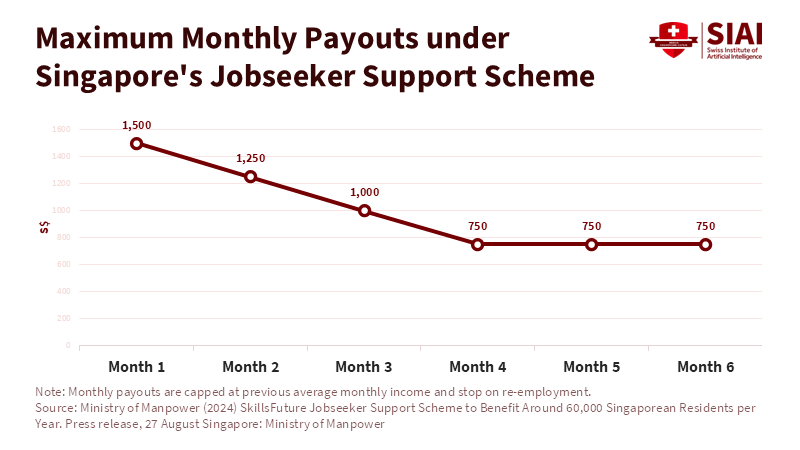
Singapore introduced its first involuntary unemployment benefit in 2025 and designed it with a cause-neutral criterion. SkillsFuture Jobseeker Support pays up to S$6,000, about US$4,700, over six months, with S$1,500, about US$1,200, in the first month and decreasing amounts thereafter, capped at the previous average monthly salary. It is open to citizens from 15 April 2025 and permanent residents from the first quarter of 2026, aged 21 and over, with an average monthly income of up to S$5,000, about US$3,900 in the previous twelve months, residency with an annual taxable value of up to S$31,000, about US$24,200 and employment for at least six of the last twelve months, while payments are subject to an informed job search and stop at recruitment. The Ministry of Manpower estimated approximately 60,000 beneficiaries per year.[36] For training, the SkillsFuture Level-Up Programme has provided since May 2024 a credit of S$4,000, about US$3,100 to each citizen aged 40 or older for selected programmes.[37] It also provides a training allowance equal to 50% of recent average income, up to S$3,000, about US$2,300 per month for up to 24 months, for eligible full-time programmes.[38] The Singapore solution avoids attribution of cause and combines income support with activation, but the age-40 threshold could affect the timing of training decisions, as age thresholds have done in other settings; no published assessment has established such an effect for Singapore.
South Korea has broad unemployment insurance with a relatively compressed daily benefit range. The job-search allowance is equal to 60% of the average salary, but as of January 1, 2026, the daily ceiling is 68,100 won, about US$50 and the minimum is 66,048 won, about US$49, because the minimum is linked to 80% of the minimum hourly wage for eight hours, and the duration ranges from 120 to 270 days depending on age and insurance time.[39] The difference between the upper and lower limit is 2,052 won, about US$1.50 per day. For a high-paid office professional in an exposed occupation, the replacement is therefore much lower than 60%, and the loss on reemployment is not covered by any tool. For those who are not eligible for unemployment insurance, the National Employment Support Program Type I pays low-income job seekers, including young people with no experience, 600,000 won, about US$440 per month for six months, with the possibility of spreading the same total amount over up to one year, subject to the execution of a job-search plan.[40]
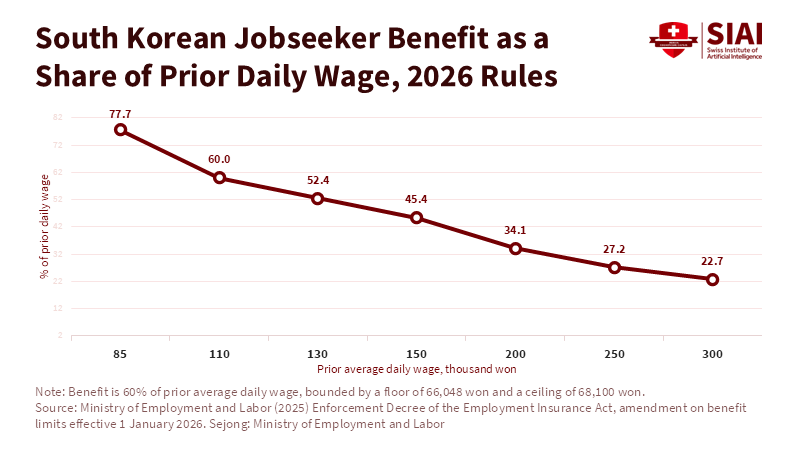
This programme touches on the entry channel that the other three systems leave almost uncovered. The Korean case also has a peculiarity in demand. An analysis published by The Economy on South Korea argues that AI adoption may be running ahead of measured productivity, drawing on Bank of Korea evidence that widespread use and time savings have not translated into a corresponding increase in reported output.[41] If that reading holds, employment effects may appear only after firms reorganise operations, which the available data cannot yet test when companies reorganize operations.
Table 2 brings together the rules, and their comparison reveals an asymmetry. Germany is the only one of the four countries with an institutional mechanism for attribution at the company level, which almost no one uses, while the only wage insurance tool that has been evaluated with a quasi-experimental design, the American one, does not accept new beneficiaries. Korea also covers young people without previous experience with financial support, although with an income criterion that concerns the whole household.
Table 2. Four-Country Institutional Comparison
| Country / tool | Delivery | Employer incentive | Worker support | Available evaluation | Status at cut-off |
|---|---|---|---|---|---|
| United States: TAA / RTAA | Department of Labor and state agencies | None | Trade-certified displacement; RTAA wage-gap support for eligible workers aged 50+ | Quasi-experimental evidence on training and wage insurance | No new group certifications since 1 July 2022 |
| United States: Workforce Pell | Eligible institutions with state/federal approval | None directly | Short workforce programmes eligible for proportional Pell support | No impact evaluation identified | Effective 1 July 2026 |
| United States: Pay-for-Performance Registered Apprenticeship | Five national cooperative agreements | Payments tied to verified retention and progression milestones | Paid work-based learning | No impact evaluation identified | Nearly US$162 million announced 7 July 2026 |
| Germany: Arbeitslosengeld I | Federal Employment Agency | None | 60% of net earnings, or 67% with a child; duration varies by age and insurance record | No specific evaluation reviewed here | Current provision |
| Germany: Qualifizierungsgeld | Federal Employment Agency plus employer/worker agreement | Employer funds training; benefit supports wage loss during training | 60% or 67% of net earnings loss; training over 120 hours under structural-change conditions | Government states impact cannot yet be assessed | From 1 April 2024; low take-up through 2025 |
| Germany: Weiterbildungsgeld | Federal Employment Agency | None | €150 monthly supplement during qualifying training for unemployed workers | No impact evaluation identified | From 1 July 2023 |
| Singapore: Jobseeker Support | Workforce Singapore | None | Cause-neutral temporary support up to S$6,000 over six months, subject to eligibility and search activity | No published impact evaluation identified | Citizens from April 2025; permanent residents from 2026 |
| Singapore: SkillsFuture Level-Up | SkillsFuture Singapore / public institutions | None directly | S$4,000 mid-career credit and training allowance for eligible full-time study | No published impact evaluation identified | Credit from May 2024; allowance from 2025 |
| South Korea: unemployment benefit / National Employment Support Program I | Ministry of Employment and Labor and employment centres | None | Unemployment insurance with floor/ceiling; separate support for eligible low-income jobseekers | No specific impact evaluation reviewed here | 2026 rules in force |
Reading the table requires a caveat. The evaluation column is the most uniform finding of the comparison, since for none of the measures adopted after 2023 a published impact assessment was identified by the cut-off date, while the two tools with evaluation belong to a programme that has stopped accepting new beneficiaries. The amounts are not compared between countries without adjustment to wages and prices, and the table does not convert them. The comparison is about the activation logic, i.e. which event opens access and who is left out, and it is this logic that determines whether a system can capture the channel of hires that did not take place.
5. Instruments and Evaluation
The choice of tool follows the diagnosis, regardless of the technology label. Each measure needs four elements before it starts: the target population, the result indicator, the comparison group and the stop rule. The latter is missing from almost all the measures in Table 2. Without a stop rule, a programme with minimal use, such as Qualifizierungsgeld, is not redesigned and abolished, it just remains.
Policy options are compared to the limitations of diagnosis rather than at an abstract level. Employer-linked training targets workers with a skills gap where there is a documented demand; it is implemented by training providers together with employers who contribute time and supervision, costs mainly in working and teaching hours, pays off after two to three years and risks subsidising what would already be done. Entry pathways through work are aimed at new entrants, implemented by employers with public payment by milestones and risk funding positions that would open up anyway or displacing unsubsidised people. Mobility support and search support are targeted at displaced persons and at-risk workers, implemented by public employment services, have a low cost per person and only pay off where jobs exist. The salary supplement is aimed at those who are rehired with a lower salary, is implemented through insurance systems, has costs that depend on the size of the losses and has the only quasi-experimental assessment that found it self-financing, with the risk of squeezing the wages offered. The two pilot projects correspond to the documentation gaps with the greatest value for a financing decision: the additionality of on-the-job training and the transfer of wage insurance to a population not defined by the cause of the loss.
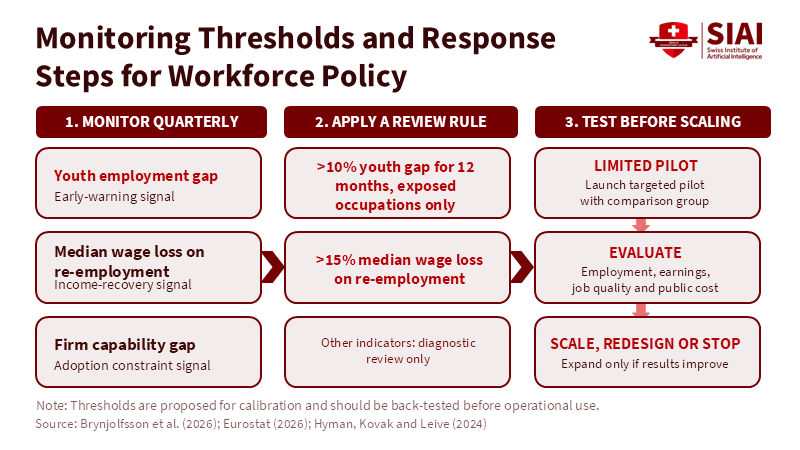
Given uncertainty about the trajectory of AI deployment, the first tool is a monitoring system that defines when policy moves from observation to testing and from testing to scale. It tracks five metrics: the relative employment of 22 to 25-year-olds in exposed occupations, using the Stanford researchers' method; the hire-to-exit ratio in the same occupations, which indicates whether the pressure passes through entry or exit; the share of new unemployment entries without benefit entitlement, which in Germany in February 2026 was around 61,000 out of 188,000 entries, i.e. around 32%; the loss of wages when rehiring displaced people; and the share of SMEs citing a lack of specialisation as a barrier to AI.
The thresholds that trigger the response are suggestions, not calibrated values. A relative youth employment gap of more than 10% that persists for twelve months and does not occur in non-exposed occupations would trigger pilot entry programmes, and a median wage loss of more than 15% among rehires would trigger the pay supplement test. Before any use, the thresholds must be retrospectively checked for how many false alarms they would have produced in previous recessions and how slowly they would have reacted.
The framework has three levels of response. In monitoring, the competent authority publishes the indicators quarterly without further action. When a threshold is exceeded, the corresponding pilot project is activated on a limited scale, with a comparison group, and a tool is expanded only if the test showed a result and the condition remains present. Response does not bypass the test, because a tool that scales without it cannot later be evaluated. If the effects of AI remain small, as the alternative explanation in Section 2 argues, the framework remains at the first level at minimal cost; if they grow, the tools will already have been tested.
Pilot project A concerns the development of AI competence within the job and answers the second hypothesis. It targets an operation in an area with documented employer demand, for example accounting or customer service in a region where vacancies and business declarations of lack of skills are recorded. The programme combines paid learning time, supervised practice in real work with AI tools and performance evaluation against predefined quality criteria, and compares with the existing training offer, not with the absence of any support. The public co-funding only covers hours above the firm's documented training base in the previous two years. The offer is drawn from among eligible workplaces so that learning passed from colleague to colleague does not transfer the intervention to the comparison group; if randomisation is not accepted, rollout proceeds in random order by workplace by workplace. The analysis is done on the basis of the initial assignment so that businesses that refuse or leave remain in their initially assigned group, and attrition is checked to see if it differs between groups. Results are measured at baseline, at 6 and 12 months: quality of work, time per job, continued use of the skill, remuneration and retention, together with costs for employer and employee. Completion of the programme is an implementation measure and not an economic outcome. The main indicators and subgroups are preregistered before enrolment begins, and the sample size is calculated from an effect that would matter for a funding decision. An employee who leaves for a better-paid position is recorded with the salary of the destination, because the transferability of the skill is exactly what is required, and a comparison of the companies that accept the offer with those that reject it shows whether the results only concern companies that would train anyway.
Pilot project B is about rehiring and salary recovery and needs to address the problem of attribution of cause. Certification along the lines of Trade Adjustment Assistance is much more difficult for AI than for trade: cut-back decisions have many causes, AI can reduce hiring without generating a dismissal event, the firm controls the information and has reasons not to declare AI, and the New York experience shows that a simple statement does not yield evidence. The main channel, the recruitment that did not take place, does not even produce an event for certification. Exposure avoids self-declaration, but rests on exposure, which the Brookings summary considers the wrong organising and would exclude those displaced by professions that the indicators underestimate. A requirement that cannot be reliably implemented ends up excluding the beneficiaries for whom it was designed. The proposed design therefore makes eligibility neutral as to the cause: workers who have involuntarily lost their jobs after a minimum seniority are eligible, and the role of AI is recorded separately, through a questionnaire to the employer and job change data, so that the assessment shows whether the programme performs differently for workers from exposed occupations.
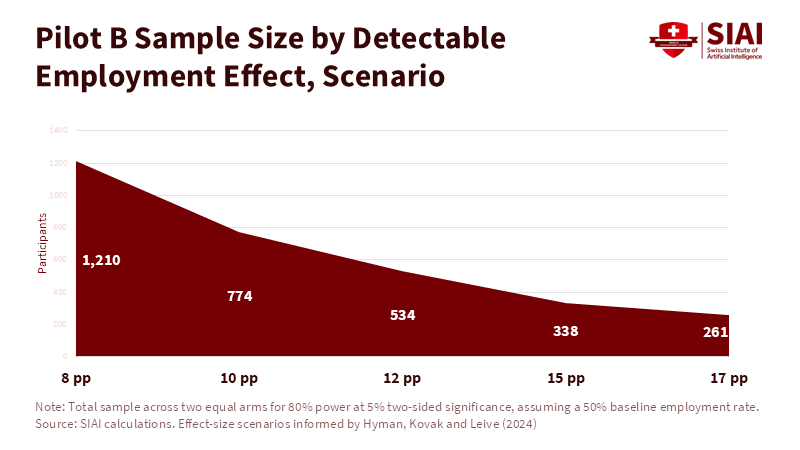
The parameters of pilot plan B are suggestions to be calibrated. The intervention team receives enhanced placement support, with a consultant who knows local employers, and a temporary salary supplement when rehired, while the comparison group receives the existing service. The reference salary is calculated from the insurance earnings of the twelve months prior to the job loss. The supplement covers half of the difference, as in the U.S. standard, for up to two years, with an annual maximum amount defined as a percentage of the national median wage. For part-time jobs the difference is calculated on the hourly wage, with a minimum number of hours, so that the supplement does not reward the reduction in hours. It is not paid for re-employment by the same or by an affiliated employer, and employers who recruit beneficiaries are monitored for displacement of non-subsidised workers in the same positions. In the testing phase, funding comes from the general budget, so as not to change the rights of the insured. Because the supplement is added to the existing support without taking away any rights, random assignment of the additional offer may be ethically defensible, subject to legal and ethical review in the country concerned. This is a proposed test plan and not a new national right. Where existing provision includes training, the evaluation should identify the incremental effect of placement and earnings support relative to that training offer; otherwise, a separate training-only comparator is required to test the first hypothesis directly. Detecting an employment effect at the low end of the U.S. estimate, 8 percentage points, would require about 1,210 participants, against about 256 at the high end of 17 points.
The results of Plan B are time to re-employment, cumulative real earnings, stability and quality of the new post, and public cost per additional sustained placement. Two weaknesses need to be explicitly checked. Cause-neutral eligibility broadens the population and costs, while the finding of self-financing comes from older workers with long seniority and lower education, for whom the losses from redundancy are particularly large. The second concerns salaries: as Hyman, Kovak and Leive point out, employers may reduce salary offers when the programme acquires scale, and therefore the assessment compares the salaries of positions offered to beneficiaries with those offered to non-beneficiaries to see whether the supplement accelerates useful transitions or encourages poor matches.
The results must be able to change a funding decision, otherwise they are not worth producing. If Plan A does not increase the hours of training above the comparison group, the co-funding is abolished and the resources are transferred to search or income support. If it increases them without changing the quality of work or the use of the skill at 12 months, the plan turns to more supervised practice before any extension. If Plan B reduces the re-employment time at a cost per additional sustained placement lower than the existing service, the expansion to other areas is justified. If it accelerates re-employment while the salaries of the new positions fall compared to non-beneficiaries, the maximum amount and duration are redesigned, and if it does not affect employment, the supplement only acts as an income transfer and is now judged against the distributive criterion of Section 2. For the gap in young recruitment, which neither of the two plans fills, the apprenticeship with pay by milestones needs its own evaluation, because it rewards staying and not whether the position would have been created without the payment.
Both plans need public registration of the design before the registration of the first participant, an evaluator independent of the implementing service, linking of insurance, payroll and training administrative data under data protection rules, and publication of the results even when they are zero or negative, as was done with Trade Adjustment Assistance. Table 3 summarizes the two protocols.
Table 3. Two Pilot Protocols
| Item | Pilot A: Work-Based AI Capability Development | Pilot B: Re-employment and Earnings Recovery |
| Target problem | Underinvestment in transferable AI application skills and unequal organisational capacity | Persistent earnings loss and long unemployment after involuntary job loss |
| Population | Defined function and region with documented employer demand | Involuntarily displaced workers in a defined local labour market |
| Intervention | Paid learning time, supervised practice and performance assessment; co-funding above the firm baseline | Enhanced placement support plus a temporary supplement covering part of the wage gap |
| Counterfactual | Existing training offer | Existing employment service and unemployment insurance |
| Assignment | Randomised workplace offer or randomised phased rollout; analyse by initial assignment | Randomised offer, eligible discontinuity or phased rollout where legally feasible |
| Main outcomes | Additional training, work quality, time per task and sustained skill use | Time to re-employment and cumulative real earnings |
| Secondary outcomes | Earnings, retention, mobility and hiring by experience level | Job stability, job quality, offered wages and subgroup effects |
| Horizon | Baseline, 6 and 12 months | 24-month intervention window; follow-up up to 48 months |
| Costs | Work and teaching time, supervision, public co-funding and worker costs | Supplement, placement, administration and data costs, net of taxes and reduced unemployment support |
| Continuation criterion | Continue only if additional training and sustained skill use improve relative to the comparison group | Extend only if employment improves at an acceptable cost per additional sustained placement |
| Uncertainty / implementation risk | Spillovers, firm heterogeneity and subsidy of training that would occur anyway | Transferability from U.S. evidence, administrative burden, wage-offer effects and displacement of unsubsidised workers |
Recommendations are shared across different bodies. Workers in exposed occupations have an interest in choosing training that is recognised by more than one employer. Managers need to record which entry jobs are removed and how new hires will gain the experience those tasks used to provide. Companies that reorganise work with AI can publish recruitment by experience level, and professional bodies can set certifications to assess AI results in their industry. Universities can publish employment results by programme. Governments are responsible for functions that no individual firm has an incentive to organise on its own: the monitoring system, the common recording standard, income insurance and the design of assessments.
6. Capability and Distribution
The third hypothesis concerns the relationship between national AI capacity and distribution, and the evidence supports it more with mechanisms than with measurements. Each of the measures in Table 2 selects a population through its rules. The credit of the Level-Up Programme goes to those who have turned 40, while the hiring gap documented by the payroll data is for 22 to 25 years old. Qualifizierungsgeld requires a business agreement or collective agreement, procedures that exist mainly in larger and organized companies, and excludes only very small ones from the requirement. The integration and placement limits of the U.S. regulation for short programmes protect public spending, but give operators an incentive to select participants with a higher probability of success. None of these rules are wrong in themselves. But everyone transfers resources to groups that are not necessarily the ones that are burdened.
National AI capability can be separated into talent production, hosting and deployment, which helps explain why frontier-talent policy and broad workforce adjustment are not the same programme. Researcher visas, lab funding and targets for the number of AI professionals are for a small population and are judged by hosting and retention indicators. The tools examined here are relevant to the much larger population of industry professionals and the wider workforce and are judged by pay, employment and transition duration. The two policies are complementary, since the development of AI in enterprises depends mainly on professionals who know how to evaluate its results, but compete for the same budget, and a portfolio that measures only cutting-edge competence may seem successful while the recruitment gap of young people is growing. The available evidence does not allow the distribution between the two strands to be defined in advance. However, they do allow it to be declared, along with the indicator that each one will judge.
The possibility of hidden labour-market fragmentation, in which workers lose ground without a recorded dismissal, is among the most difficult distributional consequences for policy.[42] A graduate who was not hired in a data analysis position in 2025 does not appear in any register, but if his first position is in a lower-paid occupation, the difference can follow him for years, as displacement losses can. Here the presumptions have a limit that must be declared. The Danish study found zero effects for workers at the start of their careers as well, while U.S. payroll data finds a significant gap, and the difference may be due to different institutions, different samples, different periods, or a different definition of the outcome. Until the two lines agree or their disagreement is explained, the extent of the distributional damage to young people remains an open question.
There is also a tension between capacity and distribution within the enterprises themselves. Pilot project A aims to increase the use of AI in small enterprises, a deployment function that is distinct from the production and hosting of talent. If the implementation goes through the removal of entry tasks, the success of the pilot in the main indicator may be accompanied by fewer hires of beginners in the same enterprises. That is why the assessment records hires by experience level as a secondary outcome and reports them separately from the overall indicator.
Opportunity costs link the two questions. The meta-analysis of active policies showed that human capital programmes pay off after two to three years, while wage insurance paid off mainly in the first two years, through a faster return to work. A budget allocated entirely to training postpones benefits to the future and leaves the transition period uncovered, while a budget allocated entirely to income support does not change skills. The division between the two is a political choice, but it can be done with data if the pilot projects measure the same outcomes at the same time intervals.
The limits of the analysis are specific. There is still no evaluation of any tool designed for the transition to AI, and all the causal findings used come from other contexts, notably international trade, recessions and training of the unemployed, so their transferability to AI-related adjustment remains uncertain. The attribution of the hiring lag in AI remains descriptive. The comparison of the four countries is institutional and does not allow conclusions about the effectiveness of their measures. The limits of the monitoring framework have not been calibrated. The figures come from publications between 2004 and 2026, with data reaching back to 1974, and do not add up to a single picture. The framework is revised when a monitoring threshold is exceeded or returned, when an evaluation of a Table 2 tool is published, and when the Danish and U.S. series for young workers converge or when their divergence is explained.
7. Conclusion - Designing Measurable Workforce Policy for the AI Transition
Workforce policy for the transition to AI does not need a new benefit category with the label of technology. It needs diagnostic discipline: an observable problem, a reason why private decisions do not solve it, and a measure that can fail in a way that is visible. Training evidence is more favourable when provision is linked to identifiable employer demand, some employer co-funding schemes have largely subsidised training that would have occurred anyway and the strongest causal evidence reviewed here concerns wage insurance, which has little presence in the systems examined.
The most important finding concerns the channel. In the U.S. payroll evidence examined here, the clearest early pressure appears in hiring among young workers, while the tools are activated by layoffs and certified causes. If this distance remains, countries will be able to show low unemployment and at the same time lose the path through which the experience is gained that they will later need to evaluate the results of AI itself. Whether the lag of young people will prove to be temporary or permanent cannot yet be judged.
The practical conclusion is narrow. Governments should separately measure hires and departures in exposed occupations, declare in advance the thresholds that trigger action, and test wage insurance with cause-neutral eligibility, capturing the role of AI as an element of analysis rather than a condition of access.
Annex A. Reproducibility Notes
Table A1. Reproducibility Register
| Exhibit | Source base | Variable | Unit | Reference period | Transformation / control |
|---|---|---|---|---|---|
| Table 1 | Synthesis of evidence in Sections 2 and 3 | Problem, mechanism, instrument, outcome | Qualitative categories | 2004–2026 | Conceptual synthesis; no composite score |
| Table 2 | Official U.S., German, Singaporean and South Korean rules and agency documents | Eligibility, benefit, duration, delivery and evaluation status | Original currency units and percentages | Rules in force at 23 September 2026 | Original currency units in the table; Section 4 text gives nominal US$ equivalents at 23 September 2026 exchange rates |
| Table 3 | Abramovsky et al.; Leuven and Oosterbeek; Hyman, Kovak and Leive; policy design in Section 5 | Counterfactual, outcomes, horizon, costs and continuation rule | Qualitative protocol fields | Design as of September 2026 | Pilot parameters are proposals to calibrate |
Planned sensitivity checks: retroactive application of monitoring thresholds to data from the 2001 and 2008 recessions to measure false alarms and delays; comparison of the youth employment indicator with national labour force surveys instead of private payroll data; recalculation of replacement in Korea for different salary levels; and sensitivity of Pilot B costs to alternative eligibility populations.
References
[1, 9, 19, 34] Deutscher Bundestag (2026) Antwort der Bundesregierung auf die Kleine Anfrage der Fraktion BÜNDNIS 90/DIE GRÜNEN: Stand der Planungen für eine Modernisierung der Arbeitslosenversicherung. Drucksache 21/6740, 25 June. Berlin: Deutscher Bundestag.
[2, 26] U.S. Department of Labor (2023) Trade Adjustment Assistance Program Termination: Frequently Asked Questions. Training and Employment Guidance Letter 14-22, Attachment I. Washington, DC: Employment and Training Administration.
[3, 8, 21] Brynjolfsson, E., Chandar, B. and Chen, R. (2026) Canaries in the Coal Mine? Six Facts about the Recent Employment Effects of Artificial Intelligence. Revised August 2026. Stanford, CA: Stanford Digital Economy Lab.
[4, 20] Ben-Ishai, G. and Thompson, N.C. (2026) Workforce Policy for the Age of AI: Recommendations from the Economic Literature. Washington, DC: Brookings Institution, 15 September.
[5, 27] The White House (2025) Winning the Race: America’s AI Action Plan. Washington, DC: Executive Office of the President, July.
[6] Davis, S.J. and von Wachter, T. (2011) ‘Recessions and the Costs of Job Loss’, Brookings Papers on Economic Activity, Fall, pp. 1–72.
[7] Humlum, A. and Vestergaard, E. (2025, revised 2026) Still Waters, Rapid Currents: Early Labor Market Transformation under Generative AI. NBER Working Paper 33777. Cambridge, MA: National Bureau of Economic Research.
[10] Card, D., Kluve, J. and Weber, A. (2018) ‘What Works? A Meta-Analysis of Recent Active Labor Market Program Evaluations’, Journal of the European Economic Association, 16(3), pp. 894–931.
[11, 16] Katz, L.F., Roth, J., Hendra, R. and Schaberg, K. (2022) ‘Why Do Sectoral Employment Programs Work? Lessons from WorkAdvance’, Journal of Labor Economics, 40(S1), pp. S249–S291.
[12] D’Amico, R. and Schochet, P.Z. (2012) The Evaluation of the Trade Adjustment Assistance Program: A Synthesis of Major Findings. ETA Occasional Paper 2013-08. Washington, DC: U.S. Department of Labor.
[13] Hyman, B.G., Kovak, B.K. and Leive, A. (2024) Wage Insurance for Displaced Workers. NBER Working Paper 32464. Cambridge, MA: National Bureau of Economic Research.
[14] Becker, G.S. (1964) Human Capital: A Theoretical and Empirical Analysis, with Special Reference to Education. New York: National Bureau of Economic Research.
[15] Acemoglu, D. and Pischke, J.-S. (1999) ‘Beyond Becker: Training in Imperfect Labour Markets’, Economic Journal, 109(453), pp. F112–F142.
[17] Abramovsky, L., Battistin, E., Fitzsimons, E., Goodman, A. and Simpson, H. (2011) ‘Providing Employers with Incentives to Train Low-Skilled Workers: Evidence from the UK Employer Training Pilots’, Journal of Labor Economics, 29(1), pp. 153–193.
[18] Leuven, E. and Oosterbeek, H. (2004) ‘Evaluating the Effect of Tax Deductions on Training’, Journal of Labor Economics, 22(2), pp. 461–488.
[22] The Economy Editorial Board (2026) ‘Age and AI Adoption: The Curve That Hides Two Different Stories’, The Economy AI Review, 20 September.
[23] Eurostat (2026) The Use of Artificial Intelligence Technologies in the European Union: Key Results, 2026 Edition. Luxembourg: Publications Office of the European Union.
[24] Lee, K. (2026) From AI Access to Organizational Capability: Pricing the Corporate AI Transition. Schindellegi: Swiss Institute of Artificial Intelligence, 9 August.
[25] Quackenboss, R.T. and Meyer, M. (2026) ‘New York WARN Act: No AI-Related Layoffs Reported in First Year of Adding AI-Related Disclosure to the System’, Hunton Employment & Labor Perspectives, 18 May.
[28] United States Congress (2025) Public Law 119-21: An Act to Provide for Reconciliation Pursuant to Title II of H. Con. Res. 14, 4 July. Washington, DC: U.S. Government Publishing Office.
[29] U.S. Department of Education (2026) 2026–2027 Federal Student Aid Handbook, Volume 2, Chapter 2: Program Eligibility, Written Arrangements, and Distance Education. Washington, DC: Federal Student Aid.
[30] U.S. Department of Labor (2026) ‘US Department of Labor Awards $162M to Expand Registered Apprenticeship through Performance-Based Incentives in Key Industry Sectors’, News Release 26-1012-NAT, 7 July. Washington, DC: Employment and Training Administration.
[31, 35] Bundesministerium der Justiz und für Verbraucherschutz (2026) Sozialgesetzbuch Drittes Buch (III): Arbeitsförderung. Relevant provisions in force at the research cut-off. Berlin: Bundesministerium der Justiz und für Verbraucherschutz.
[32] Bundesagentur für Arbeit (2026) Qualifizierungsgeld. Nürnberg: Bundesagentur für Arbeit.
[33] Bundesagentur für Arbeit (2024) Merkblatt Qualifizierungsgeld für Arbeitgeber sowie für Arbeitnehmerinnen und Arbeitnehmer. Nürnberg: Bundesagentur für Arbeit.
[36] Ministry of Manpower Singapore (2024) ‘SkillsFuture Jobseeker Support Scheme to Benefit Around 60,000 Singapore Residents per Year’, press release, 27 August. Singapore: Ministry of Manpower.
[37] Ministry of Education Singapore (2024) ‘New SkillsFuture Level-Up Programme to Boost Mid-Career Upskilling and Reskilling’, press release, 4 March. Singapore: Ministry of Education.
[38] Government of Singapore (2026) Mid-Career Workers. Singapore: Government of Singapore. Accessed 23 September 2026.
[39] 고용노동부 [Ministry of Employment and Labor] ‘「고용보험법」 시행령 등 일부개정령안 국무회의 심의·의결’ [Cabinet Approval of Partial Amendments to the Enforcement Decree of the Employment Insurance Act and Related Decrees], 16 December. Sejong: Ministry of Employment and Labor.
[40] 고용24 [Work24] ‘취업지원신청’ [Employment Support Application]. Korea Employment Information Service and Ministry of Employment and Labor. Accessed 23 September 2026.
[41] The Economy Editorial Board (2026) ‘Korea’s AI Paradox: High Adoption, Low Productivity’, The Economy AI Review, 29 August.
[42] Simmance, C. (2026) ‘Nobody Was Made Redundant: AI’s Hidden Labour-Market Divide’, The Economy AI Review, 15 September.