Why AI Transition Policy Needs Measurable Limits

His recent work examines the broader socioeconomic consequences of artificial intelligence, including labor markets, public finance, demographic change, institutional adaptation, and the distributional effects of technological progress.
He holds a PhD in Mathematical Finance from Boston University, and previously earned an MSc in Finance and Economics from the London School of Economics. He completed his undergraduate studies in Economics at Seoul National University under the Korea Foundation for Advanced Studies scholarship program.
Authored on
Modified
AI cuts youth hiring, not layoffs, first
Retraining alone rarely works; wage insurance does
Governments need measurable triggers before scaling tools

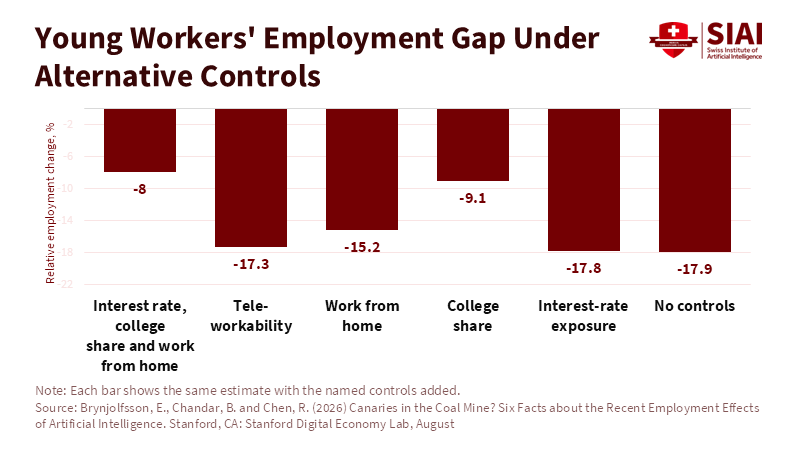
From November 2022 to June 2026, the employment of 22- to 25-year-olds in the U.S. occupations with the highest exposure to AI was about 19 percent lower than it would have been if it had followed its peers into less exposed occupations, according to administrative payroll data analyzed by the Stanford Digital Economy Lab. Layoffs in the same occupational categories did not increase accordingly. The adjustment went almost exclusively through fewer hires. This finding stands at the center of a recent survey of AI transition policy and exposes a design gap that the public debate usually overlooks. The support tools that most countries currently have are triggered by a layoff or a certified cause, while the first measurable signal from AI is something different, a hiring that just didn't happen.
A Measurable Problem, Not a Technology Label
The usual response to the transition is retraining. A summary of the economic literature published by the Brookings Institution in September 2026 concludes that exposure to artificial intelligence is the wrong organizational principle for workforce policy and that retraining alone is not enough for those who have already lost their positions. Research starts from this position with a correction: neither exposure nor dismissal is a sufficient criterion for intervention. It takes an observable problem, a reason why private decisions do not solve it on their own and a measure that can be evaluated with a predetermined indicator. The success of an intervention is ultimately judged by four figures that are examined separately, the productivity of the participating companies, the cumulative real earnings, the quality of employment and the duration of the transition to a stable position.
But there is also a serious objection to all this concern. A study linking Danish surveys of AI-tool adoption to administrative wage records finds no effect on earnings or recorded hours worked, not even for intensive users or those at the beginning of their careers. Even Stanford's own analysis does not identify generalized displacement across the economy, notes that the finding weakens when education is controlled and explicitly presents it as a descriptive indication rather than a causal assessment. If the effects are small, uncertain and partly cyclical, existing institutions may suffice. The argument has weight. However, the general systems are not channel-neutral, since unemployment insurance requires a history of contributions and dismissal, while a graduate who is simply not hired does not have either.
Why AI Transition Policy Needs Wage Insurance, Not Just Training
Experience with training paints a two-sided picture. A meta-analysis gathering estimates from more than 200 evaluations of active employment policies found near-zero average effects in the short term, which become more positive two to three years after completion, with greater gains for programs that build human capital. Randomized evaluations of sectoral programs in the U.S., combining initial selection of participants, training in specific occupations and a close relationship with employers, found persistent pay increases between 12 percent and 34 percent. In contrast, the Trade Adjustment Assistance assessment carried out for the U.S. Department of Labor found that participants, most of whom spent a long time in training, had lower total earnings than the comparison group in the first four years. The difference is the link to actual employer demand; training pays off when it leads to specific positions and fails when offered as a general right after dismissal.
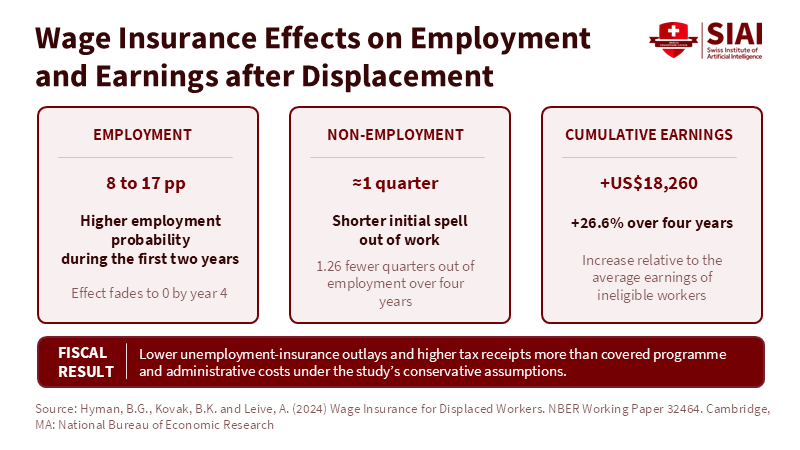
The most convincing documentation concerns a completely different tool. A quasi-experimental study examined the wage insurance arm of Trade Adjustment Assistance, which covered up to half the difference between old and new wages for workers 50 and older. Taking advantage of the discontinuity in eligibility age, it found that inclusion increased the likelihood of employment by 8 to 17 percentage points in the first two years and four-year cumulative earnings by over $18,000, or 26 percent, while tax receipts and reduced unemployment insurance covered the cost of the program. But this program stopped accepting new beneficiaries on July 1, 2022, according to the U.S. Department of Labor itself, just when the better-documented solution would have been most useful. Broader tax-and-labour analysis has reached a similar conclusion, noting that wage insurance may be better suited to mid-career displaced workers than generic long-term courses.
Four Groups, No Single Fix
The research distinguishes four groups of workers that the same technological event affects differently. Displaced workers face weak hiring demand, mobility costs and loss of income during the transition. A second group never appears in any unemployment register, since when artificial intelligence automates the less specialized tasks of a profession, the value of the rest of the expertise goes up and employment can be reduced without any layoffs being recorded. The third group is newcomers, who do not lose a position but miss the opportunity to obtain the first, exactly the phenomenon recorded by Stanford data, where AI familiarity is fast becoming a condition of entry for new hires. The fourth group is small and medium-sized enterprises. In 2025, just 17 percent of small businesses in the European Union were using artificial intelligence, compared to 55 percent of large ones and among those that had considered it without adopting it, 70.3 percent cited a lack of specialization as an obstacle, according to Eurostat data.
None of the four groups is properly covered by a single tool. Post-dismissal income support leaves out those who lose value without being fired, while training does not solve the problem of young people who already know how to use AI tools but need access to positions where they will gain the judgment to evaluate what they produce. Cheaper access to models, in turn, does not solve the problem of small businesses, where implementation requires connection to data, reordering workflows and staff training, not just cheaper tool licensure. The very development of AI in business depends to a large extent precisely on professionals capable of implementing it, not just cutting-edge researchers, at a moment when diffusion is outrunning adaptation across most employers.
Comparing Four Countries Reveals a Common Gap
The survey compares the rules in the United States, Germany, Singapore and South Korea with the same questions: which body implements the measure, what incentive is given to employers, what event triggers employee support and whether there is an evaluation of the results. Germany has the only institutional mechanism for attribution of cause at the company level, Qualifizierungsgeld, which is based on an agreement between employer and employee representatives rather than a unilateral declaration. But this mechanism remains almost unused, with only 350 beneficiaries in 21 months, according to a response from the German government to parliament, at the same time that about 61,000 of the 188,000 new registrations in February 2026 were for workers without any entitlement to benefits.
This reading highlights an asymmetry that is repeated in all four countries. No published impact assessments have been identified for the measures adopted after 2023, while the only tool with strong causal evidence, U.S. wage insurance, has already stopped accepting new beneficiaries. Governments seem to be designing new tools faster than evaluating old ones and the survey treats this gap as just as serious as the lack of support for new entrants.
Table 1. Workforce Policy and Evaluation Across Four Countries
| Country | Main tool for AI-related displacement | Evaluation available |
|---|---|---|
| United States | Wage insurance (closed to new entrants since July 2022) | Yes, strong quasi-experimental evidence |
| Germany | Qualifizierungsgeld, company-level agreement | Not yet assessed |
| Singapore | Cause-neutral jobseeker support | Not yet assessed |
| South Korea | Standard unemployment insurance | Not yet assessed |
Because uncertainty about the course of artificial intelligence remains high, the research proposes a five-indicator monitoring system instead of a new benefit category. It tracks the relative employment of 22- to 25-year-olds in exposed occupations, the hire-to-exit ratio in the same occupations, the share of young unemployed without the right to benefits, the wage loss on re-employment and the share of small and medium-sized enterprises reporting a lack of skilling. The thresholds that would trigger action, such as a relative youth employment gap of more than 10 percent that is maintained for twelve months, are explicitly presented as proposals to be calibrated and not as confirmed thresholds, precisely because there is not yet a data history to test them.
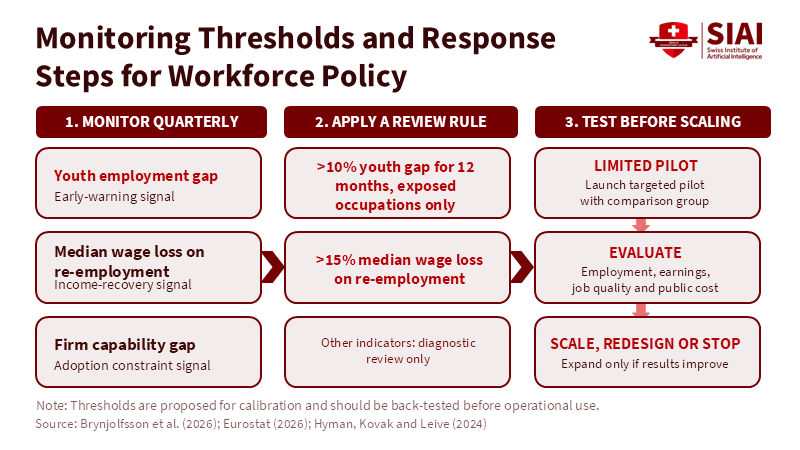
Two pilot projects are based on this framework. The first combines paid learning time, supervised practice with AI tools and performance evaluation in small businesses with documented demand, with public co-funding covering only hours above the company's historical training base. The second transfers salary insurance to a population whose eligibility does not require proof that the AI caused the dismissal, precisely because such proof is much more difficult than it was for international trade. Both plans state the population, the result indicator, the comparison group and the stop rule in advance, so that a negative result leads to the abolition of funding and not just silence.
The conclusion of the survey is narrow but accurate. The first measurable pressure from artificial intelligence comes mainly from hires that did not take place, while almost all existing tools are activated with a layoff or with a certified cause. As long as this distance remains, a country may show low unemployment and at the same time lose the path through which younger workers gain the experience they will need later to judge the results of artificial intelligence themselves. The research does not claim to know whether this lag will prove to be temporary or permanent. It calls for something more specific: for governments to measure hires and departures in exposed occupations separately, to declare in advance the thresholds that trigger action and to test wage insurance with a cause-neutral eligibility criterion before it is needed on a large scale.
This article is based on an original research article published by The Economy Research. For the original version, please refer to [AI and Workforce] Workforce Policy for AI Transition, Skills and Economic Security.
This article reflects the analytical judgment of the author and does not constitute policy advice or the official position of any affiliated institution.
His recent work examines the broader socioeconomic consequences of artificial intelligence, including labor markets, public finance, demographic change, institutional adaptation, and the distributional effects of technological progress.
He holds a PhD in Mathematical Finance from Boston University, and previously earned an MSc in Finance and Economics from the London School of Economics. He completed his undergraduate studies in Economics at Seoul National University under the Korea Foundation for Advanced Studies scholarship program.
Similar Post