The AI Skills Gap Companies Keep Solving the Wrong Way

His recent work examines the broader socioeconomic consequences of artificial intelligence, including labor markets, public finance, demographic change, institutional adaptation, and the distributional effects of technological progress.
He holds a PhD in Mathematical Finance from Boston University, and previously earned an MSc in Finance and Economics from the London School of Economics. He completed his undergraduate studies in Economics at Seoul National University under the Korea Foundation for Advanced Studies scholarship program.
Authored on
Modified
Training existing staff outperforms hiring AI specialists tenfold
Error costs, not time saved, justify AI training investment
Entry-level jobs vanish first, threatening future expert pipelines

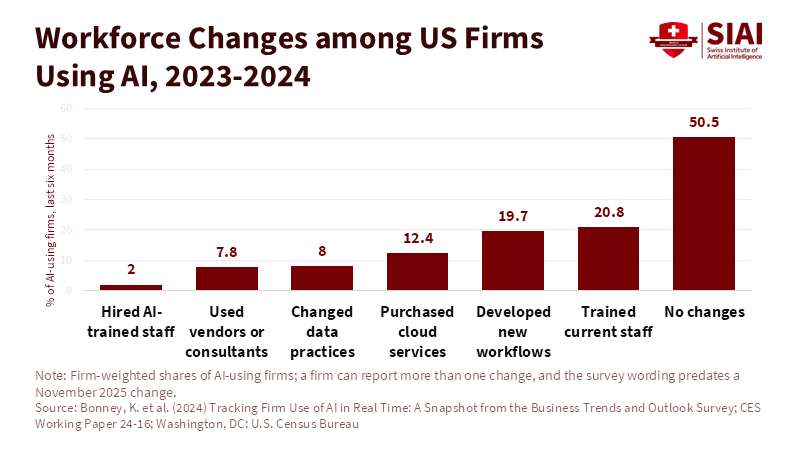
Just 2 percent of U.S. businesses using artificial intelligence, hereinafter AI, hired staff already trained in AI in the past six months, while 20.8 percent simply preferred to train the staff they already had, according to the U.S. Census Bureau's Business Trends and Outlook supplemental questionnaire. The ratio of ten to one indicates something that the debate about AI adoption often overlooks. The real decision is not about which model to buy, but who within the business will learn to use it, who will control its results and who will pay the cost of that learning. The choice between hiring an expert and training existing staff is not a technical issue of software procurement. It is a decision to invest in human capital, with costs and weights that rarely appear in the initial debate over closing the AI skills gap.
The AI Skills Gap Behind Stalled Adoption
In 2025, 20.0 percent of European companies with ten or more employees used at least one AI technology, but among those who looked at it without proceeding, the most common reason was the lack of relevant expertise, at 70.3 percent, according to Eurostat data. The finding does not concern cutting-edge researchers or developers, it concerns people capable of judging when a result of the model stands and when it does not, i.e. precisely the staff who already know the job. The economic literature summarized by the Brookings Institution concludes at the same point, that successful adoption depends on whether the user knows when to trust the tool and this judgment is learned within the subject, not in general.
At the same time, Boston Consulting Group's interviews with tech executives described a leveling of hierarchies and a shrinking of traditional entry pathways for new employees, while an analysis by consultants in Forbes concluded that the AI strategy is a workforce strategy. Danish administrative data from 25,000 employees paints a more modest picture of the same transition, with users reporting time savings of just 2.8 percent of working hours, without this being reflected in earnings or logged hours. The three observations together show why the decision to adopt AI cannot be seen as a technology market, since it changes who learns the job, how quickly and at what cost, long before any productivity gains are seen.
The same official surveys show how they acquire this ability in practice. Among European companies using AI, 57.9 percent bought ready-made commercial software, 28.6 percent used a system adapted from an external provider and only 21.8 percent developed the system on their own, with the difference between sectors being large: in IT 41.1 percent developed a solution with their own staff, in catering only 10.2 percent.
The Hidden Cost of Hiring a Specialist
A study of personnel data from an American financial firm for the period 2003 to 2009 found that external hires were initially paid about 18 percent more than employees who were promoted to the same positions, had lower ratings in the first two years and left more often. The mechanism is simple. The external candidate brings measurable qualifications but lacks knowledge of the organization, which is not shown on any resume and for a team introducing AI this knowledge is often more valuable than technical expertise, because it determines when a draft of the model respects the terms of a contract or insurance coverage. Experimental evidence shows the same from another perspective: in an experiment with nearly 800 Boston Consulting Group consultants, AI improved performance within the limits of its capabilities, but consultants who used it outside of these limits were 19 percentage points less likely to give a correct answer, while in a customer service center with over 5,000 employees, access to an AI assistant increased productivity by 34 percent for less experienced employees and only marginally for the most experienced.
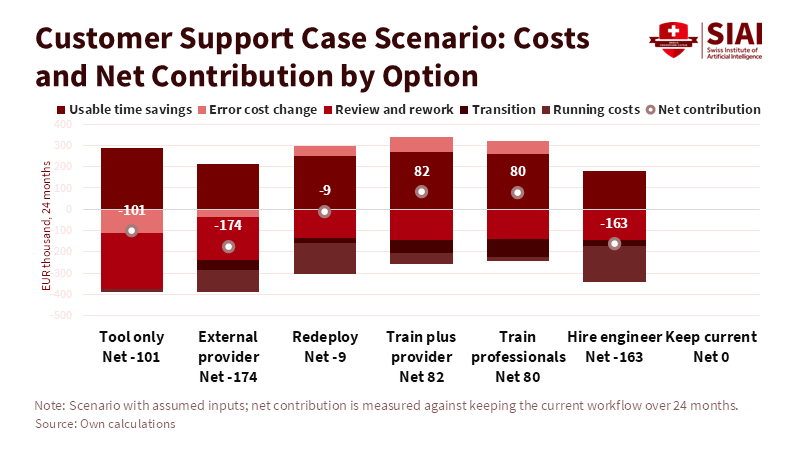
A model decision implemented in a typical customer service center with 6,000 cases per month makes this difference concrete. Over a 24-month horizon, only two of the seven alternatives perform positively relative to maintaining the current workflow and both involve training existing employees, with or without outside help for technical integration. Hiring an AI engineer and outsourcing both result in a net loss, mainly because they increase the error rate in a job where every mistake has an immediate reimbursement cost. The advantage of training depends almost entirely on this error cost, not on the time saved, an indication that the value of an AI tool is ultimately judged by who controls it. The same model shows that the threshold above which training is worth it depends less on the volume of work and more on the time of checking each result, since the longer it takes an experienced employee to confirm a draft, the greater the minimum amount of work that justifies the investment.
Who Pays When Entry-Level Jobs Disappear
The most serious objection to this picture is that the size of the business, not the nature of the project, determines the choice, since large companies use external providers and adapt software with their own staff much more often than small ones, simply because they have the resources to do both. But the objection only explains the frequency of choices, not why internal development is many times more common in IT than in catering, where the size of businesses does not differ so drastically and it does not explain why in an environment of urgent delivery and a large technical gap, such as a software maintenance team with a contractual deadline, recruitment and outsourcing take precedence over training. The standard is therefore not universal, but depends on how much institutional knowledge weighs on the job in question.
In résumé and job-posting data for millions of employees in U.S. companies, the employment of new employees in companies that adopted generative AI fell by 7.7 percent six quarters after adoption, while the employment of senior executives was not affected. A theoretical argument explains why this can be a problem even when overall employment does not change. New employees gain implicit knowledge by working alongside experienced colleagues, contracts cannot prescribe this knowledge transfer and so businesses tend to automate entry-level tasks more than would be collectively advantageous. Each company individually gains from cost reduction, but the labor market as a whole is thus losing the next generation of experienced auditors.
The Commonwealth Bank of Australia has provided a tangible example of how easily this weighting can be misjudged. In July 2025, the bank announced the elimination of 45 customer service positions following the introduction of an AI voice assistant, but reversed the decision the following month, acknowledging that the initial assessment had not taken into account all operational parameters and that call volumes were increasing. Boston Consulting Group suggests that entry routes evolve rather than disappear, which requires that youth learning be recorded as an investment rather than a cost to be cut. On a much smaller scale, an accounting firm with just 300 client files per month showed the opposite end of the same spectrum: for the first year no change worked better than simply maintaining the existing workflow and training was only marginally preferred after the second year, an indication that available time matters just as much as the size of the skills gap.
Governance doesn't Automatically Follow Speed
Operational decisions on hiring, compensation and evaluation are often decentralized, with rules that aren't always applied horizontally and AI doesn't create this disparity, it accelerates it. In Syndio's survey of over 400 HR and compensation executives, 24 percent said their organization "often" deviates from compensation policies when making decisions, 40 percent "occasionally," and just 3 percent "never." A tool that suggests salaries or ranks candidates allows a supervisor to make decisions in an hour that used to take a week and the documentation it produces seems uniform even when the judgments behind it aren't.
A hypothetical example shows how quickly such decisions add up. A company with 200 AI-certified professionals and an average annual salary of €48,000 would pay €96,000 a year if it gave everyone a flat bonus of 5 percent. But if each supervisor decides separately, with a bonus of 0 percent to 15 percent and an additional retention increase of 10 percent for those who receive an external offer, the annual cost rises to €172,800, 80 percent above the uniform rule, with a pay difference of up to 25 percentage points between employees with the same certification. Each decision has its own logic, but no one sees the sum and if bonuses are incorporated into the basic salary, the cost is repeated every year. The distribution of responsibilities follows the same logic throughout the company: direct supervisors judge each recruitment and evaluation, the remuneration committee approves exceptions to the policy, the human resources department maintains the rules and their consistency, while the management holds responsibility for decisions with long-term consequences, such as restructuring positions or restricting the entry of new employees.
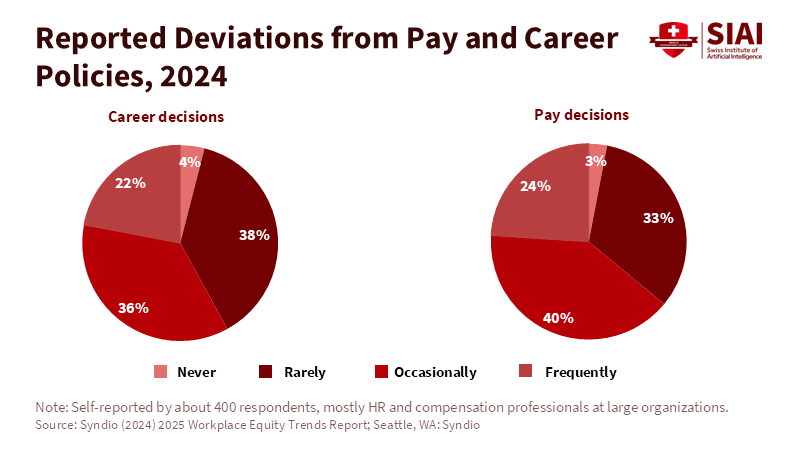
Table 1. Governance Matrix for AI-Powered Workforce Decisions
| Hiring | Automated screening and ranking | Selection rates, internal-hire share |
|---|---|---|
| Compensation | Salary and raise proposals | Share of off-policy decisions |
| Performance | AI-drafted assessments | Score dispersion, objections |
| Work allocation | Automated task assignment | Learning-task share, unaided performance |
The practical conclusion is not for a business to avoid AI, nor to stop automating simple entry tasks, but to treat learning as a cost that is budgeted just as much as a model's licenses and control as a skill built within the team rather than within a new resume. The ten-to-one ratio between training and recruitment shows something more specific than cost, i.e. where the real value of an AI investment is today, to the people who already know the job and not to the tool that makes it easier for them. The same template shows which variables are worth measuring before such a decision, the actual time to check each result, the hours that the team can absorb, the free time of experienced auditors and the cost of an error. Whether the ten-to-one ratio will change as models improve remains open.
This article is based on an original research article published by The Economy Research. For the original version, please refer to [AI and Workforce] How Firms Build AI Workforce Capability.
This article reflects the analytical judgment of the author and does not constitute policy advice or the official position of any affiliated institution.
His recent work examines the broader socioeconomic consequences of artificial intelligence, including labor markets, public finance, demographic change, institutional adaptation, and the distributional effects of technological progress.
He holds a PhD in Mathematical Finance from Boston University, and previously earned an MSc in Finance and Economics from the London School of Economics. He completed his undergraduate studies in Economics at Seoul National University under the Korea Foundation for Advanced Studies scholarship program.
Similar Post