Europe in the AI Value Chain: Little Capital, a Lot of Talent and the Choice of Open Weights

Publications under SIAI Editor are prepared or coordinated by SIAI’s research and editorial team and include research synthesis, policy and industry analysis, technical interpretation, and interdisciplinary work connecting artificial intelligence with established fields of research and professional practice.
Authored on
Modified
Europe cannot fund a full AI stack while rearming
Its real advantage is trained researchers, not capital
Open-weight models bought by defence secure model-level sovereignty

On June 12, 2026, the U.S. Department of Commerce imposed export controls on Anthropic's two most advanced models and the company, unable to distinguish its users based on nationality, disabled them for all its customers. Access was restored on July 1, but for almost three weeks every European company or public service that had based day-to-day operations on these models was left without them, by a decision of a government that is not accountable to any European voter. The episode coincided with a less spectacular finding: the European Union has about 2 gigawatts of computing power for artificial intelligence this year, close to 5 percent of the global total, when the United States has about 35. Europe's position in the AI value chain is therefore judged on two levels together: the physical and the model and in neither of them does Brussels' policy match the instruments that the continent really has.
Why Gigafactories Do Not Close the Compute Gap
The official response to the physical deficit was gigafactories, up to five large facilities dedicated to training cutting-edge models. Measured in megawatts, the plan is much smaller than its announcement. According to Bruegel's analysis, the five gigafactories will add a total of around 750 megawatts, i.e. 4 percent of the approximately 21 gigawatts that the Union is expected to have in 2031 and in terms of power consumption, they rank 37th out of 101 planned European data centers. Even with all the projects currently on paper, the European share of global computing power is projected to reach only 5.6 percent in 2031, while the American will remain above two-thirds, which means that the gap in absolute terms is widening even as European power increases tenfold.
The most uncomfortable finding for those announcing such programs is that funds are not even the binding constraint. Of the 101 projects, 76 are entirely privately financed and account for 84 percent of the planned capacity. The problem lies in time: in the United States, it takes an average of 24 months from obtaining licenses and electricity to operation, in Germany 42 and in Frankfurt, Amsterdam or Dublin the connection to the grid can take seven to ten years. In a model cited by Bruegel, a year of delay costs a 100-megawatt center more than 5.5 percent of its life cycle value, more than a doubling of the price of energy. These are responsibilities of national, regional and municipal authorities, which no new building touches, at the same time that the three U.S. cloud providers already control about 70 percent of the European cloud market and the infrastructure costs of American groups for 2026 are estimated at close to $760 billion.
Defense Claims the Same Fiscal Space
The question of how many member states can finance a common European computing infrastructure depends less on technology and more on defense. At the 2025 Hague summit, NATO allies pledged to spend 5 percent of GDP by 2035, 3.5 percent on the hard core of defense and 1.5 percent on related investments. The 2026 figures show how far Europe is from this target, with ten allies just above the old 2 percent threshold and Slovenia remaining below it, while the Czech Republic and Slovakia have said they will not pursue the 5 percent target, either because they consider the threat low or because they prefer to direct money to areas such as health. Governments that cannot or do not want to pay for air defense will hardly pay for pan-European data centers.
The hierarchy is correct because the military threat from Russia is immediate, while a full European AI stack is mainly projected as insurance against eventualities. The problem is aggravated by the implementation history. The 2024 Draghi Report estimated that the Union needs additional investments of €750 to 800 billion per year to close the competitiveness gap and by the end of July 2026 only 60 of its 383 recommendations, or 15.7 percent, had been fully implemented, leading to the establishment of an independent group in August to get the agenda moving again. A political class that implements less than a sixth of the proposals for its own competitiveness does not seem ready to coordinate hundreds of billions of euros in a common infrastructure and the programmable sovereignty approach, which provides for a minimum common hard core of computing power, comes up against precisely this limit.
What Europe Holds in the AI Value Chain
If Europe is assessed on capital or energy, the inventory ends quickly while if it is evaluated in terms of its people, the picture changes. In 2021, Europe accounted for 17 percent of global patent applications, compared to 21 percent in the United States and 25 percent in China, but only about a third of the inventions registered by European universities and research institutions are commercially exploited. Almost 30 percent of European start-ups founded between 2008 and 2021 and later reached a valuation of more than a billion dollars moved their headquarters abroad, mainly to the United States. In models, the Union accounts for almost none of the notable models of 2025 and has essentially one significant developer, Mistral. Europe produces knowledge in quantity that keeps it close to its two competitors and the gap opens at the moment when knowledge has to become a company, a product and a job.
There are signs that the flow of people is starting to change. Interface's analysis of the movements of more than 1.6 million AI professionals found that Germany, Finland and Switzerland increased the share of those trained within the country and that the percentage of Americans changing jobs and moving abroad rose from just under 3 percent in 2021 to almost 6 percent in 2025. A talent that is left without finding a cutting-edge employer remains untapped capital, the training of which has already been paid for by European taxpayers. In terms of general equilibrium, Europe is rich in highly skilled human capital and poor in high-risk capital, cheap energy and quick permitting and its governments still plan as if they had the initial endowments of the United States.
Open Weights as a Proxy for Ownership at the Model Level
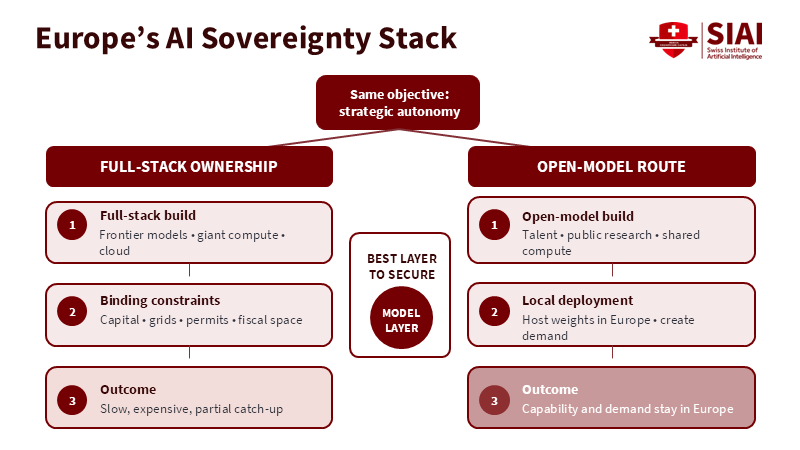
Installing infrastructure on European soil makes it difficult to cut it off at the physical level, but it leaves open the danger revealed in June, because the model layer can still be cut off. Anthropic's models were closed to everyone because they operated exclusively through U.S.-run services, while an open-weight model already installed on European servers would have continued to work. Programmable sovereignty, as described by Bruegel researchers, involves rules embedded in public procurement, independent model evaluation and common standards around a minimum core of shared computing power and open weights complement the scheme where it is weakest, turning an access relationship into an ownership relationship. For an economy without a surplus of capital, leadership in open weights is the closest available approach to ownership, with costs measured mainly in supercomputer hours and researcher salaries, i.e. the resources that Europe has.
China figured this out earlier. Between February 2025 and February 2026, Chinese models accounted for 41 percent of Hugging Face downloads, compared to 36.5 percent of American ones and their diffusion transfers architectures, standards and dependencies to countries that cannot pay the prices of closed American models. In Washington, the debate has turned to distilling capabilities from closed models, with SIAI research resulting in independent verification, targeted sanctions and public investment in open alternatives, with no ban on open weights. Europe has a deeper tradition in this practice, since CERN made web software freely available in 1993 and it can add something that is missing from the market: a strict definition of the open model, since many models that are projected as open keep the data and details of their training closed.
Who Pays and Who Decides
A European open-weight model cannot be financed with the logic of return on capital, since it does not sell access to its main product. Still, it can be organized like CERN, as a joint non-profit research infrastructure that offers European graduates work at the technological frontier. Demand may come from defense procurement, which will increase anyway if the Ministries of Defense require the systems they buy to operate on European soil without an external connection. The objection that published weights can be modified by anyone has a basis and it is dealt with by staggered publication and independent evaluation before release and dependence on American processors changes form, since a load of processors that has already been installed is not revoked by letter. A public good available to everyone and to American companies is also much more difficult to present as a hostile action than a protected national system, which counts for a continent that depends on the United States for its security.
June 2026 showed where the risk that matters most lies and the data show that the funds to cover it with infrastructure do not exist, as defense absorbs fiscal space and private infrastructure stumbles on permits that no gigafactory accelerates. Europe's position in the AI value chain will be judged by whether its governments transfer public money from new buildings to open models bought by defense and whether national authorities reform licenses and networks that only they control. The implementation track record of the last two years does not give much reason for optimism and the window in which open model standards are formed will not remain open forever.
This article reflects the analytical judgment of the author and does not constitute policy advice or the official position of any affiliated institution.
Center for Strategic and International Studies (2026) The Department of Commerce Restricted Access to Anthropic's Latest Models. What Comes Next? Washington, DC: Center for Strategic and International Studies.
CNBC (2026) 'Anthropic says Trump admin has lifted export controls on Claude Fable 5 and Mythos 5', CNBC, 30 June.
Draghi, M. (2024) The Future of European Competitiveness. Brussels: European Commission.
García-Herrero, A. and Dutta, S. (2026) Programmable Sovereignty: Coordinated Specialisation as a Response to the N-2 Problem in Artificial Intelligence. Working Paper 25/2026. Brussels: Bruegel.
Gasper, F. (2026) Defence Spending: Who Is Doing What? July 2026. Tallinn: International Centre for Defence and Security.
Hugging Face (2026) State of Open Source on Hugging Face: Spring 2026. New York: Hugging Face.
Il Foglio (2026) 'Economists and start-up founders to reform the EU: the Rhine Group is launched', Il Foglio, 25 August.
International Centre for Defence and Security (2026) NATO's New Defence Spending Target: Who's Planning What in 2026? Tallinn: International Centre for Defence and Security.
Lee, K. (2026) Open Weights, Extracted Capabilities: Reassessing the Distillation Economy and the Contest for American AI Leadership. Schindellegi: Swiss Institute of Artificial Intelligence.
Liesenfeld, A. and Dingemanse, M. (2024) 'Rethinking open source generative AI: open-washing and the EU AI Act', in Proceedings of the 2024 ACM Conference on Fairness, Accountability, and Transparency. New York: ACM.
Martens, B. and Schenk, T. (2026) How Can Europe Address Its Pressing Artificial Intelligence Compute Infrastructure Shortfall? Policy Brief 18/2026. Brussels: Bruegel.
Pal, S., Schneider, C. and Lazzaroni, R.M. (2026) Talent In, Talent Out: The Shifting Geography of the Global AI Workforce. Berlin: Interface.
Publications under SIAI Editor are prepared or coordinated by SIAI’s research and editorial team and include research synthesis, policy and industry analysis, technical interpretation, and interdisciplinary work connecting artificial intelligence with established fields of research and professional practice.
Similar Post