[AI and Tax] Europe’s AI Race and the Fiscal State
Published
Keith Lee*
*Swiss Institute of Artificial Intelligence, Chaltenbodenstrasse 26, 8834 Schindellegi, Schwyz, Switzerland

Europe can benefit substantially from artificial intelligence without owning every frontier AI model. Imported models, cloud services and compute capacity can still boost productivity, improve public services and support economic growth. The more difficult question is whether Europe's share of the income, profits and strategic value generated by AI will suffice to support its fiscal capacity, when much of the underlying intellectual property, infrastructure and corporate ownership remains abroad. The article examines this challenge through four interconnected races: frontier models; compute, cloud and energy; capital and ownership; and industrial diffusion. The analysis shows that Europe's principal weakness is neither a lack of technological boldness nor reliance upon it, but its inability to translate research, savings and industrial excellence into scalable firms, domestic ownership and taxable income. A narrow domestic claim on AI-generated rents could weaken Europe’s fiscal capacity and bargaining power even as adoption raises productivity. Nevertheless, Europe continues to enjoy strategic advantages in advanced manufacturing, semiconductor equipment and advanced industrial firms, regulated industries and applied AI. The paper concludes that the most credible European AI strategy would entail neither technological autarky nor passive dependence, but high adoption combined with minimum viable technological sovereignty: accelerating infrastructure rollout, deepening scale-up financing, establishing more strategic procurement, ramping up industrial diffusion, developing domestic integration capabilities and retaining ownership in selected strategic AI layers. Otherwise, Europe risks becoming an efficient user of foreign AI while capturing too little of the surplus needed to finance its social model.
[AI and Tax] is an independent research series developed by Professor Keith Lee following his presentation at the conference Inequalities in Longevity, held at Fondazione Giorgio Cini in Venice on 3–4 July 2026, and a subsequent substantive discussion with Federico Fubini of Corriere della Sera concerning AI-driven productivity, labour income, and fiscal capacity.
Public-facing adaptation
A public-facing adaptation of this research, written by the author for a wider readership, is available from The Economy Review: “[AI and Tax] Europe’s AI Fiscal Capacity Depends on More Than Adoption.”
1. Introduction - Europe Does Not Need to Own Every AI Model
Europe does not need to have a comprehensive set of frontier models, cutting-edge chip designs, cloud platforms and vast data centres in order to derive benefits from AI. An importer of powerful models can still achieve a higher level of productivity, a higher level of output, improved provision of public services and a higher level of private investment.[1] The fundamental mistake in the analysis is to view the extent of technological use as the extent of technological capture. Welfare can be imported in the form of productivity improvements, while intellectual-property income, platform rents, capital gains and much of corporate profit are captured elsewhere.[2] In that case, Europe acquires a fraction of the efficiency dividend, but does not gain an equal fraction of the surplus created by the new general-purpose technology. Hence, the critical question is not whether imported AI can enhance European wellbeing but whether, in a steady equilibrium between a high rate of adoption and a low level of ownership, European nations would be trying to finance pensions, health care, education, social insurance and adjustment strategies from a narrower domestic claim on AI-driven rents than the magnitude of the fiscal challenge they face would command.
That proposition must not be transformed into an argument for technological autarchy or broadly autarkic economics relative to the U.S. Ordinary economic interdependence is a standard condition of advanced capitalism; strategic dependence is a narrower condition in which one side has the ability to withhold access, impose conditions, or extract value through the existence of deeply localized infrastructure, de jure control, critical layers of software, or essential supply chokepoints elsewhere.[3] Europe's challenge is not to recreate the entire global AI stack domestically, much less to exclude it and in any case, to ensure international market access supports scientific and technological progress. It must avoid excessive reliance on productive imported capacity with too weak a European foothold on the rents, revenue streams and strategic possibilities that a ubiquitous AI industry would afford. Hence, the importance of Europe's leverage and underlying success, without exaggerating the importance of individual firms. ASML is a genuine strategic asset: the company says it is the current sole supplier of EUV lithography systems, which are its premier product and are used in the production of leading-edge chips.[4] Yet even taking that at face value, ASML's own disclosures demonstrate how this strength is highly embedded in a supply-service system extended worldwide and remains subject to export controls.[5] One chokepoint enterprise is strategic for Europe, but not a perfect substitute for broader technological sovereignty.
The common refrain that Europe is insufficiently hungry is thus best taken as a diagnostic question, not a settled verdict. The fundamental problem may be less a civilizational dearth of aspiration than an institutional failure to translate Europe's vast savings pool, research assets, niche industrial competences and regulatory infrastructure into high-risk capital, swifter approvals, commercial scale and globally competitive enterprises. European Central Bank research highlights how the poor allocation of savings into productive investment remains an underlying European problem, while IMF work underscores how Europe is plagued by a fragmented venture-capital market, pronounced home bias and feeble cross-border savings.[6,7] European Commission efforts from 2025 onward, such as the Savings and Investments Union and the Startup and Scale-up strategy, represent an implicit recognition that Europe does not merely lack invention but also scaling, funding and global competitiveness.[8] It is therefore impossible to evaluate Europe's AI situation through a single headline indicator. Model numbers ignore industry spread; announced investment does not establish deployed capacity; megawatt numbers offer little insight into grid connection times, chip availability, or platform understanding; cloud use offers little information on wealth creation; even high levels of deployment do not demonstrate Europe's ability to enjoy the fiscal benefits. A comprehensive analysis must weigh four interrelated battles: frontier models; capital and ownership; electricity, computing, cloud and energy; and industrial diffusion. Only by comparing these will it be possible to answer the central fiscal question posed by this paper: does Europe's social model require a minimum level of ownership and control over AI to be fiscally resilient in an AI-dominated landscape, or can foreign-technology adoption generate sufficient growth?
2. Europe’s Four AI Races
2.1 Frontier Models and Compute Infrastructure
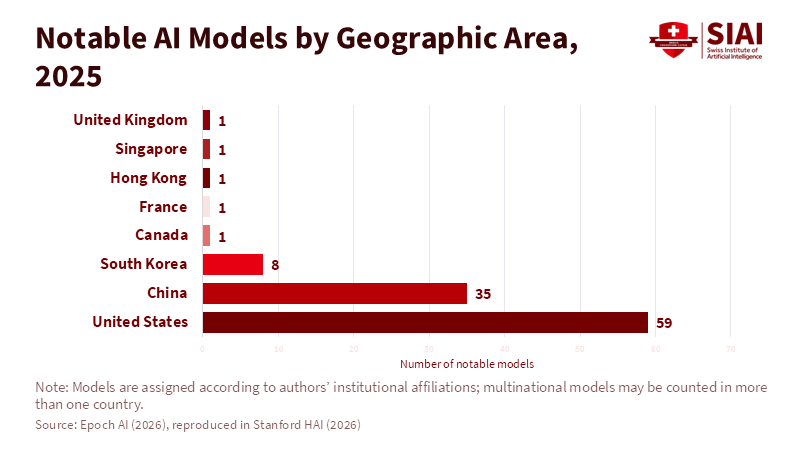
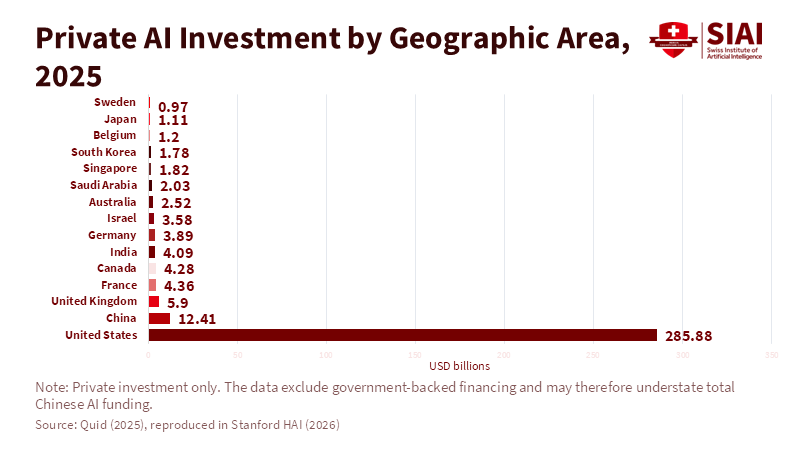
The first race concerns frontier models and on the most sensitive indicators, Europe is not winning it. Stanford's 2026 AI Index states that in 2025, industry was responsible for over 90 percent of AI models that gained prominence, with the U.S. producing 59 notable models and China 35.[9] U.S. private AI investment reached USD 285.9 billion in 2025, more than twenty-three times the reported Chinese level of USD 12.4 billion, although private-investment data may understate China’s total AI financing because of state-supported funding.[10] These are not just small differences: within it lies a picture of a very limited number of companies fed into enormous domestic financial markets, combined with complex and accessible environments for AI compute, shaping the frontier. While Europe is not entirely absent from advanced AI technologies and, indeed, has many promising firms, on the big, capital-intensive race for the future frontier of foundation-model development, the U.S. dominates. That fact alone does not end strategy. For Europe, parity with the U.S. in the frontier-model race over the whole continent is unlikely to be necessary to provide a tangible benefit from AI. The same policy choice that faces the U.S., pursuing all-out competition in frontier-model development, or focusing European capital, human resources, compute and regulation on a few firms and shared facilities that have the potential for scale, or alternatively accepting that Europe will have fewer frontier models but stronger adjacent capabilities, may lead to a similar policy in Europe.
EU policy currently suggests something of a middle ground: The Commission notes that 19 AI Factories and 13 AI Factory Antennas are now operational, that at least 9 new AI-optimised supercomputers will be purchased and brought online and that this will more than triple European High Performance Computing (EuroHPC) AI computing capacity.[11] It also notes the InvestAI Facility is expected to support up to five AI Gigafactories and mobilize investment of €20 billion.[12] However, though this is a substantial commitment, it does not represent a set of established private sector frontier-model fleets on the scale of the U.S., which makes a difference: there is an important distinction between operational AI factories and potential gigafactories and firms which dominate consumer-facing AI models and have fully-developed developer ecosystems.
The second race is for compute, cloud, energy and in this race, the billions of announced infrastructure, again, belie the importance of existing commitment. The Commission's proposed Cloud and AI Development Act outlines explicit policy objectives, including capacity growth, more rapid scaling, greater access to energy, land, water and capital and a framework for cloud and AI sovereignty. It aims to at least triple the EU's data-centre capacity in five to seven years.[13] A corresponding Commission strategy for digitisation and AI in the energy sector notes that data centres currently make up around 2.5 percent of EU electricity demand and that installed capacity is projected to rise from around 12 GW in 2025 to about 28 GW in 2030,[14] adding that demand is already geographically concentrated into a few hotspots and that applications are streaming in at an exponential rate for projects with loads similar to that of heavy industry. This is an important reminder. The challenge in Europe is not merely to deploy x GW of infrastructure, but to get that infrastructure reliably online under conditions of grid congestion, transmission pinch-points, planning delay and competing demands for electricity.
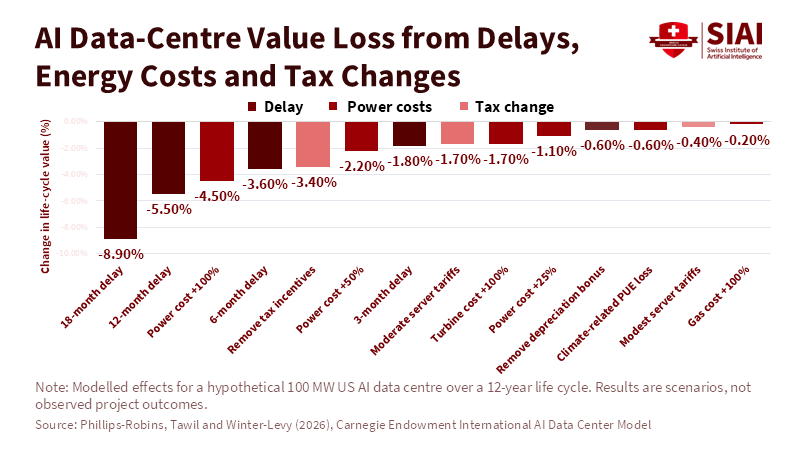
Carnegie's 2026 compute study frames this question in an analytical way. Its main argument is not that demand-side factors (such as tariffs or electricity costs) are irrelevant, but that in project economics, time to power dominates them. For the example of a hypothetical 100 MW U.S. data centre, Carnegie's analysts estimate that the postponement of AI services by one year would result in a reduction of life-cycle value by slightly more than $500 million, or about 5 percent of the project value and that firms should be prepared to pay at least twice the U.S. power costs for one less year of operation.[15] The same report argues that Europe's standing in this technological arms race is old news: it makes a counterfactual calculation that in 2025, the EU had perhaps 5 percent of the world total of high-performance AI compute.[16] Although these estimates are highly uncertain and are formed from incomplete public information, they highlight the power demanded by the world's pre-eminent AI firms to accelerate innovation: connect, run and supply compute fast, not just announce it. Compute is also embedded in a cloud market in which Europe's reliance goes beyond technology to cover companies and rules. The European Parliament 2025 report states that the reliance on AWS, Microsoft Azure and Google Cloud is approximately three-quarters of the EU cloud-infrastructure market, while 13 percent of the market went to EU providers.[17] The same report diagnoses this as a strategic reliance because cloud is the infrastructural level below much current software and because rights and platform lock-in still predominantly take place outside the Union. One reason that the Commission is balanced in its CADA approach is that it presents not only capacity but also sovereignty evaluation and a governmental procurement pathway.
The central fact is not that Europe must displace all foreign hyperscalers. It is that in many cases, the most efficient arrangement will be a diversified transatlantic ecosystem. But if the model provider for compute, storage, orchestration and access to general models turns out to always be offshore, domestic adoption is not sufficient to guarantee that the important revenues and taxable profits accrue domestically. Access to advanced chips also highlights the capacity/sovereignty distinction. Europe has a real upstream advantage in semiconductor manufacturing equipment. ASML says that it is the world's only producer of EUV lithography machines and that they are used for the most advanced chips. But it also says that its lead supplier, Carl Zeiss SMT, is the German supplier of the critical optical elements and that its business is influenced by the Dutch, EU and U.S. regimes on semiconductor export controls.[18] Europe has a critical node in the global semiconductor chain, but not the full set of manufacturing, packaging, design, cloud and platform layers that would make that node translate into full control over AI compute. The point is not that ASML is irrelevant; rather, that the specialized supply-chain strength gives Europe leverage but does not negate the need to access AI compute domestically, to be able to contest the cloud and to have in place a capacity to finance the growing demand for semiconductors in AI.
2.2 Capital, Ownership and Industrial Diffusion
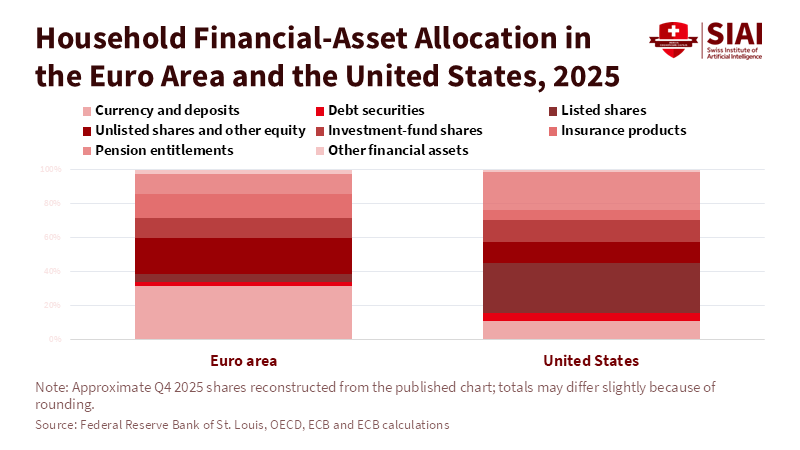
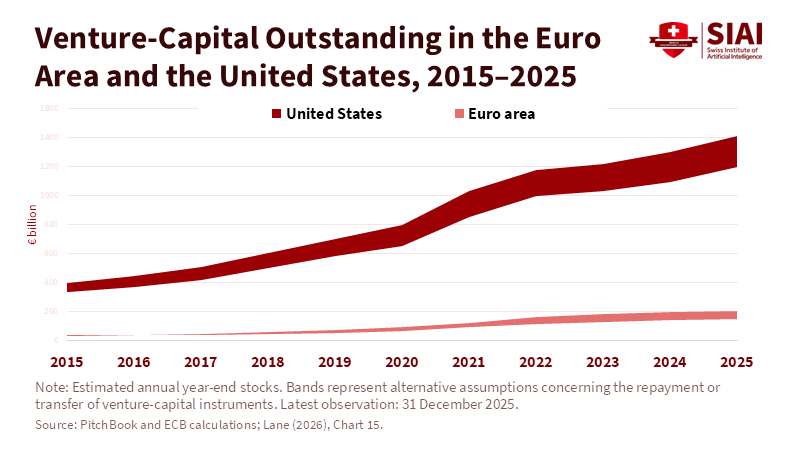
The third race is the capital-and-ownership race, where Europe's weakness is less a shortage of aggregate wealth than a shortage of channels, integration and exits. The ECB's 2026 report on financial integration makes the case that the EU's economic promise is being held back by an inefficient flow of savings into productive investment. EU households continue to hold a relatively large fraction of their financial wealth in deposits and currency, while the share of listed equity is considerably smaller; according to the ECB's summary indicators, EU households hold about a third of their financial wealth in cash and deposits. For this to matter, despite a continent of high savings, if those savings are not effectively channeled into growth equity, venture capital and late-stage finance, they may not even manage to fund their own technological scale-up.[19] Consistent findings emerge across the European institutions. The ECB estimates total venture-capital fund size at approximately €150 billion in the EU and €930 billion in the United States, with U.S. funds investing around six times more.[20] IMF evidence similarly indicates that EU firms receive venture capital less frequently and in smaller amounts than U.S. firms, while European investment remains strongly affected by national home bias.[21] This is about more than just getting the firm underwritten. It is the channel by which ownership of future AI assets and future shares of profit, capital gains and taxable corporate income may migrate outside the EU.
The evidence on relocation, therefore, makes the ownership dimension more tangible. As a 2026 EIB study on innovative EU start-ups and scale-ups states, when a firm is relocated, value creation, intellectual property, strategic decision-making and flows of investment increasingly take place abroad. As evidence, the study finds that about 10 percent of EU scale-ups relocate abroad, 85 percent of these to the U.S. and that within the recent European unicorns, almost 30 percent have migrated their headquarters between 2008 and 2021, mainly to the U.S.[22] The qualitative interviews in the study indicate that founder entrepreneurs who relocate their business are mostly not keen on abandoning Europe entirely. They preserve engineering and R&D activities in Europe and overall they keep ownership structures, legal headquarters, executive functions, commercial activities elsewhere and especially outside Europe in order to tap into larger markets, operate under a simpler regulatory environment and have a wider selection of seasoned go-to-market talent.[23] Although this type of dual footprint business is better than a total exit, it still results in the factors of production being located elsewhere. This structural issue is recognized in the Commission's response, but it is still unproven as having been remedied. The 2025 Startup and Scaleup Strategy already identifies strengthened financing, more rapid market scaling, talent and infrastructure as Key Action Areas, while the 2026 implementation page makes clear that the Scaleup Europe Fund is proposed to be a €5 billion deep-tech scale-up initiative, but that the first close and initial investments are only expected from the autumn of 2026.[24] Proposals are very closely connected to the Savings and Investments Union and, more tentatively, to the proposed EU Inc. Corporate-law regime. This is a gradual step in the right direction, as far as it goes, because it is targeted at deepening capital markets rather than the outright subsidy of inefficient incumbent firms alone. Yet it remains premature to judge the operational impact of AI ownership until we see which proposals make headway in deepening later-stage finance and increasing exit opportunities within Europe.
The fourth race is the industrial-diffusion race and here Europe's role is comparatively more nuanced than the frontier-model stories imply. Eurostat's 2025 enterprise survey found that 20 percent of the 690,498 EU enterprises having ten or more employees adopted at least one of the specified four AI technologies, an increase of 6.47 percentage points on the previous year. For enterprise size, the share adopting AI varied strongly: 17 percent of small enterprises, 30.36 percent of medium-sized enterprises and 55.03 percent of large enterprises used AI. For the sector, the highest shares of total enterprise use were seen in the information and communications sector at 62.52 percent and a broad 'other' category including many professional, scientific and technical activities at 40.43 percent, with all other sectors of activity measured below 25 percent. These figures stand out for their simplicity and transparency: they measure a defined list of technologies, a defined, substantiated population of enterprises and a specific survey period. They therefore reveal genuine diffusion figures, as well as the distance between frontier desirability and economy-wide implementation.[25] Other survey tools paint a generally more upbeat scenario, but due to asking a different question: The EIB Group Investment Surveys 2025 key messages note that EU firms are up to date with their investment in intangibles, investing in research, training and in the application of AI, while also noting that EU firms use these technologies more intensively across their various operational issues. Its front page summary points to the quantitative gap in intensity: using AI, 81 percent of U.S.-based firms use it in two or more internal process areas versus 55 percent of EU-based firms.[26]
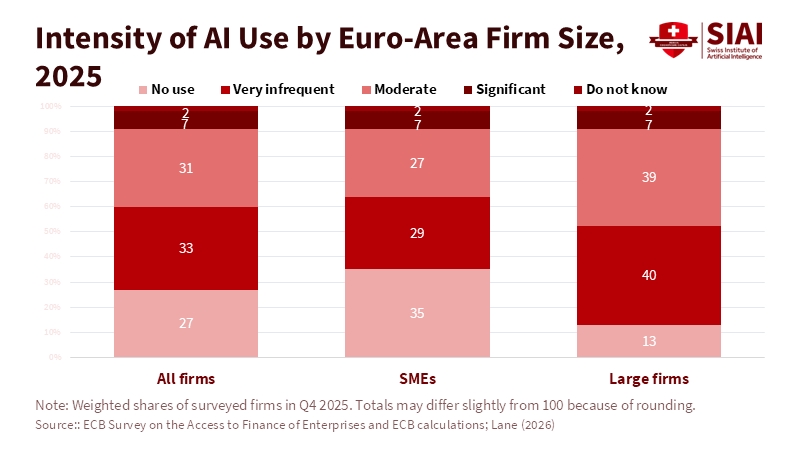
ECB survey information also suggests accelerating diffusion with limited deep integration: reported usage by employees shows an increase in AI application at work from 26 percent in 2024 to 40 percent in 2025 and two-thirds of firms reported that their employees use AI, yet only 7 percent reported significant operational use of AI.[27] The appropriate conclusion is that Europe is not a technologically marginal economy and not a deeply integrated AI economy either. The road to becoming an AI-led system is an intermediate position in which shallow use is spreading faster than deep operational integration.
This matters because one of Europe's best bets on AI may not be to imitate the U.S. platform model, but to innovate at the application level within sectors in which it already commands strong industrial capabilities. OECD research on AI applications in manufacturing finds that the proportion of manufacturing businesses making use of AI in the EU increased from 7 percent to 11 percent between 2021 and 2024, with manufacturing adoption strongest in pharmaceuticals (26 percent) and electronics (25 percent) and notes that most of the AI used in EU manufacturing is purchased rather than developed: around 6 percent of manufacturing firms use bought-in ready-made AI systems, 3 percent use technologies built by third-party developers and fewer than 2 percent develop their own solutions.[28]
That pattern is instructive. Europe's industrial foundation may enable it to convert imported models and tools into efficiency in heavy machinery, automotive supply chains, continuous processes, infrastructure systems, supply chain management, health care innovation and high-end B2B software. But absent ownership changes in those sectors, Europe could still be the place where AI is widely used, but not where the rents are therefore extracted. The Commission's Apply AI Strategy is, at least conceptually, based on this diffusion-first rationale. It proposes sectoral flagships across the following areas: health and pharmaceuticals, mobility, transport and automotive, robotics, manufacturing, engineering and construction, climate and environment, energy, agri-food, defense, communications and the public sector. It has an AI-first orientation and ties that to a buy European initiative and the use of AI Factories, testing sites, regulatory sandboxes and sectoral governance in the public sector in particular.[29] That is more tenable than a simple model-count competition because it has started with Europe's real industrial mix. The risk is, however, that diffusion policy can be successful in raising productivity, even if it is not successful at the fiscal level, if the dominant cloud, model and IP stratum remain foreign. Industrial diffusion is its strength, but it is not wholly a proxy for ownership.
3. What the EU Should Do: Linking AI Strategy to the Fiscal State
3.1 Rent Leakage and Domestic Fiscal Capture
The policy dilemma is reinforced when all four races are considered simultaneously. Europe can logically choose that it will not pursue the comprehensive frontier-model parity, but still observe quantitatively material outcomes from high AI absorption. But that approach alters the pathways whereby growth leads to fiscal capacity. If Europe is largely an importer and adopter of foreign AI, then some of the calculus by which AI-generated surplus occurs will be absent as domestic profit and IP income, but will be felt as cloud contracts, model subscriptions, API access, software licenses, data flows and imported intellectual-property services. From a macro perspective, the challenge is whether import productivity and domestic fiscal capture can be kept apart as separate fields of demand. The question is not whether Europe benefits from AI adoption, but whether sufficient value added by AI adoption can be taxed, owned, listed, domiciled, or otherwise retained here to support fiscal obligations that remain territorially anchored and locally financed. The most direct indication of rent leakage is not AI-specific but is nonetheless very relevant. In his speech on AI and the euro-area economy, Lane notes a fivefold rise compared to the previous ten years in payments for euro-area residents to owners of intellectual property registered in the U.S.; this is shown in the ECB balance-of-payments data on charges for the use of intellectual property products.[30] Lane is clear that he is viewing this as a general phenomenon of technological capital rather than a pure AI measure and this distinction is important.
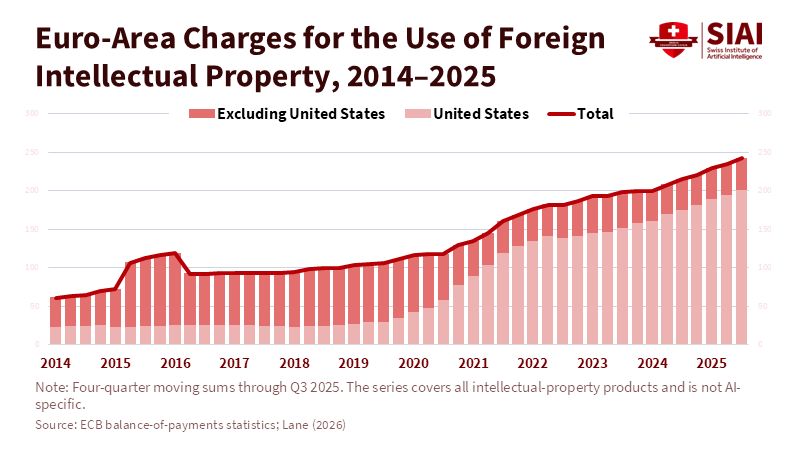
It would be misleading to suggest that all of the increase in payment flows to IP should be attributed to AI. But it would be no less wrong to ignore what the data series shows: as technological ownership is increasingly concentrated in the frontier economies, downstream countries can improve productivity and still pay to import rising quantities of IP services and subsequently use someone else's intangible capital. If AI is delivered through cloud subscriptions and proprietary models licensed from abroad, this logic could be exacerbated. This rent leakage operates through several channels. What does it actually mean in terms of real uses of capital outflow, user costs, transfer of ownership of the contract (or the ownership of the contract), investment capital and corporate shell? At the most superficial layer, it means: European firms might simply have to pay foreign providers for compute, model access and software. The ownership of the contract itself is important: recurring cloud revenue, the inference margins, platform pricing power, the lock-in of customers, the control of downstream ecosystems, all create a sustainable stream of profits that are charged where the provider's IP and corporate center are located. The scaling firms that are sold into Europe, but where the investment or headquarters or listed companies are located elsewhere, reinforce this problem. Hence, the EIB's location study substantiates this by demonstrating how EU-engineered firms tend to keep their engineering teams in Europe, but shift the holding companies or executive functions elsewhere.[31] Real demand for high levels of investment capital and highly skilled labor within the European economy (across regional corporate structures and across territorial jurisdictions) can remain, but the capitalized value of future earnings increasingly occurs outside the EU. This is the core sense in which high adoption can occur with limited domestic fiscal capture.
There is, nevertheless, a strong counterargument that deserves consideration. Foreign ownership does not automatically mean no European access to AI rents. European households, pension funds, insurers and other financial investors may still own foreign equities and thereby receive dividends and capital gains from AI-leading firms in the rest of the world. Lane points out that residents of the euro-area own about one third of the world's listed equity and those holdings generated some 200 billion dollars worth of capital gains in 2025, approximately 1.3 percent of euro-area GDP.[32] The ECB has also documented increased ownership of U.S. Technology stocks by euro-area financial institutions, nonfinancial firms and households. Accordingly, a portion of the outward reallocation of AI rents is already mitigated through portfolio returns. This enhances the degree of precision of sovereignty arguments. The problem for Europe is not that each euro of foreign AI profit is somehow lost to Europe; it is that portfolio gains are less comprehensive, more indirect and less fiscally complete than the direct gains from the corporate, employee, exchange listing and taxation consequences of retaining more ownership at home.
3.2 Productivity, Diffusion and Local Fiscal Obligations
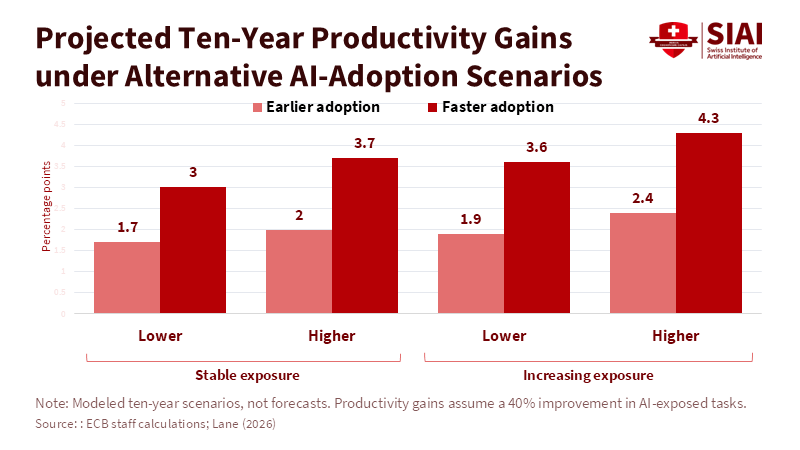
Even if AI-related platform rents are captured offshore, another domestic channel through which the fiscal state can be preserved or reinforced is through increased growth. Imported AI can also enhance the fiscal position if productivity improvements are generated in European companies, if complementing activities are nurtured, if exports grow, if aggregate consumption and if business profitability in domestically taxable industries rise. ECB analysis documents how AI adoption, based on the available work of the ECB, is strongly affected by technology diffusion speeds. The total factor productivity (TFP) boost is expected to be significantly higher under the fast adoption case compared to the low adoption case.[33] This same speech cites firm-specific literature for European adopters reporting clearly significant productivity improvements, combined with cross-firm literature consistent with fairly rapid worker-level diffusion.
Eurostat enterprise survey data also indicate how AI applications have started expanding to territories playing a variety of roles in business administration, production management, marketing, ICT-related security, innovation and logistics; all strengthen the case of a rising tax-flow profit stream even if digital market rents are divided internationally. However, output growth underpins the fiscal base only in certain circumstances. Adoption must be transitioned from marginal experimentation to reconfigured production. Europe's own experience serves as a reminder: Barely 7 percent of euro-area businesses say they significantly use AI and the EIB finds that firms that use AI are less likely to use it across a number of internal processes than their U.S. counterparts.[34] Adoption must be scaled up across high-value-added industries, not just niches of communication and software. It must also have effective competition that ensures related productivity benefits are not purely enjoyed by the foreign platform mark-ups. Fourthly, domestic capabilities, including data processing and integration, process redesign, organizational capital, engineering capabilities, compliance and industry-specific software, must be available domestically so the frontier is exploited and local value added results rather than higher imported-service charges. Absent these four conditions, adoption can amount to an interface-level adoption and insignificant fiscal benefits for host countries. This is why the issue matters for the European fiscal state: Europe's social commitments are still a fixed local cost even if AI rents are not. Eurostat's early estimates put EI social-protection benefits at €4.925 trillion in 2024 or 27.3 percent of GDP, with old-age benefits accounting for 41.5 percent and sickness and healthcare benefits for 29.7 percent.[35] A separate series from Eurostat on government expenditure reveals that in 2023, social protection was still the largest category of government expenditure at 3.309 trillion or 19.2 percent of GDP. These are not discretionary add-on programs. These are the central commitments of European welfare states.
3.3 Minimum Viable Sovereignty and Policy Delivery
Imported AI still may contribute to their finance indirectly via growth and higher productivity and tax income, but the mismatch remains real: the commitment to spend on pensions, healthcare, education, transition support and public administration is fixed in territory; ownership of AI rents is not. Thus, Europe should not aim for low adoption. Its real choice is not between sovereignty and diffusion but between different mixes of the two. A low-adoption/low-ownership equilibrium would combine dependence and stagnation, since this would entail technological dependence and stagnation at once; at the same time, a low-adoption/high-ownership equilibrium is also undesirable, as European actors would develop some technological endowments but boost their productivity only in a limited fashion. On the contrary, a high-adoption/low-ownership equilibrium would not be so different from the above-mentioned case as it would manage to increase welfare and raise tax revenues – but it would also entail persistent rent leakage and strategic dependence if contestability remained low.
The preferred direction is high adoption with fairly high European ownership, or a direction of travel rather than a fully-fledged promise of autarky, the minimum acceptable technological sovereignty being a very modest level of domestic capacity and ownership in the AI space, so that Europe would not be relegated to the position of merely a downstream user. That makes sense because, first, it suggests a compute and infrastructure approach driven by time to power, not indiscriminate fiscal giveaways. The Carnegie evidence indicates that delays, queues for grid connection and time until first operation matter more to data centre economics than small to moderate energy price variations or generic tax incentives. The Commission's own energy "roadmap" points in the same direction by calling for measures to address hotspot congestion, better network planning, flexible connection contracts, use-it-or-lose-it policies for queue management and tripartite agreements on model contracts between public agencies, operators and other energy players. Europe should therefore treat fast-track permitting, integrated grid development, transparent connection criteria, flexible load parameters and low-emissions generation on the same co-located site as typical competitiveness-enhancing measures, rather than as already existing projects. Otherwise, the risk is to subsidize a well-capitalized industry through unwarranted largesse.[36]
Second, Europe needs a capital-and-ownership strategy, based on scale-up finance, exit markets and long-term savings mobilization. The objective cannot simply be more venture capital of any sort, says the ECB's economic analysis, which also notes that institutional investors are not participating enough; this is constraining European venture capital. The IMF, meanwhile, demonstrates that cross-border market fragmentation is still significant.[37] The policy message is that what is needed is not overtaking the U.S. in venture capital per se, but implementing the deeper reforms through which pension funds, insurers and other large investors take risk through venture and growth-equity funds. The Savings and Investments Union, the new 28th Regime company-law initiative and the Scaleup Europe Fund are exactly aimed at aligning intermediation between private investors and capital-and-ownership policies by reducing it, in contrast to simply subsidizing market activity.[38] The real test for them is whether they deepen access to late-stage scale-up deals, make them build exit markets in Europe and offset the outward fragility of holding companies by scaling up private investor participation. Anything that does not prove capable of this standard deserves correction or elimination.
Third, Europe must make industrial diffusion the heart of its AI strategy, not an afterthought to model imitation. That calls for targeting support at those sectors where Europe already has a buildup of industrial capacities and where AI can increase their output, quality, resilience and export capacity: advanced manufacturing; automotive & mobility; pharmaceutical & medical technologies; energy systems; machinery; logistics; industrial software; financial services; and public sector administration. The Apply AI Strategy is already moving in that direction by organizing policies through sectoral flagships and support institutions, such as AI Factories, Digital Innovation Hubs, testing infrastructure and sandboxes.[39] But diffusion calls for more concrete implementation tools: procurement rules that favor interoperability and trustworthy performance, technical and computing support for SMEs, common standards and data ecosystems for the regulated industries, skilled managerial and engineering expertise for process reorganization. The idea is not to keep inefficient European suppliers afloat; it's to create contestable domestic counterparts and integration capabilities around whatever models are most economically efficient to deploy.
Public procurement must be singled out, as it is a policy that makes the industrial strategy directly relevant for the fiscal state. The Commission's Apply AI strategy explicitly advocates a buy European policy for the public sector and CADA calls for an EU-wide sovereignty-assessment mechanism, with a public-sector adoption mechanism.[40] Properly applied, procurement can forge a European demand for secure cloud, AI component integration services, specialized models, sovereign data environments and sector-specific applications in domain areas for which legal sovereignty, continuity of service and public accountability matter more than the last fraction of a frontier-model performance improvement. Improper application, on the other hand, could turn procurement into an expensive insurance scheme for feeble incumbents. The proper principle of procurement is, therefore, not nationality alone, but contestable European capacity, in (potential) lines of business where the use cases are sensitive or infrastructure-like: open standards, multi-cloud resilience, auditability and best-practice supply chains, portability, benchmark performance, sunset reviews. That way, strategic autonomy is strengthened without foreclosing competition.
Fourth, Europe should incorporate fiscal capture into its competitiveness scorecard. Today, AI performance is measured by the number of models, announcements of investments, computing power, or surveys of adoption. Those are indicators, but not sufficient for Europe’s welfare states. Europe will have to pay attention to the ratio of announced to deployed compute, time-to-power, national shares in core AI assets, outward payments for cloud and intellectual property services, the locations of AI-related listings and intellectual property, the outward relocation of scaleups and the bias of public procurement towards domestic taxable activities. None of those indicators on its own would address the tax-base erosion problem, nor would they replace sophisticated tax-policy design. But they would encourage industrial policy to face the question that really matters for the fiscal state: not only does AI increase productivity, but also who benefits from that productivity in forms that can support European social contracts? Lastly, Europe should avoid the temptation of subsidizing every domestic asset that appears to be a critical element of the AI value chain. Additional data centres do not necessarily lead to additional innovation; mere copycat model development can fritter away hard-won public funding; and lavish investment in industries that create these models may give rise to markets that are excessively concentrated. Europe's innovation success will be less about replicating the whole of the U.S. AI cluster than about accelerating adoption while building selected domestic capabilities: a small number of deep capacity and model functionalities, a solid core of later-stage investors, more rapid infrastructure deployment, clear industrial partners and more sophisticated public buyers. The relevant benchmark should not be self-reliance but contestability. Europe must have sufficient credible European capacity in the preeminent layers of AI to keep vendors responsive to European bargaining power in an economic, rather than monopolistic, dependency. The objective is not to own every tier of the AI stack but to retain sufficient capacity to prevent irreversible dependence.
Conclusion - High Adoption with Minimum Viable Sovereignty
Europe need not own all AI models to flourish. It must, however, own and control sufficient local capacity to prevent any systematic decoupling of AI productivity growth from European fiscal capture. The four races draw out a compelling strategic lesson. Regardless of the level of AI performance, the U.S. and China will not match each other across the entire spectrum. On compute and cloud, permitting speed, grid access and platform dependence count more than headline investment claims. On capital markets, it is Europe's weakness as much as its lack of aggregate savings. On AI diffusion, Europe has substantial opportunities given its industrial base and the greater economic significance of applied AI. The fiscally relevant strategy is therefore neither one of autarky nor one of passive dependence. It is a high-adoption approach combined with minimum viable technological sovereignty: faster time to power, targeted support for AI diffusion, cheaper scale-up capital, increased public procurement, deeper industrial diffusion and a fresh focus on who captures AI rents. Absent an explicit, strategic investment in minimum viable technological sovereignty, Europe could end up a highly efficient user of imported AI while others accrue an outsized share of the surplus. Although imported technology is a source of European welfare, it should not also turn the European fiscal state into the residual payer in another AI economy.
This article was prepared as an independent research contribution following Professor Keith Lee’s presentation at the conference Inequalities in Longevity, held at Fondazione Giorgio Cini in Venice on 3–4 July 2026, and a subsequent substantive discussion with Federico Fubini of Corriere della Sera. The discussion helped sharpen the motivating questions concerning AI-driven productivity, the declining employment intensity of economic growth, and the resulting pressures on the public tax base.
The research, analysis, and conclusions were developed independently by the author. This publication is separate from the official conference proceedings and from the editorial coverage published by Corriere della Sera.
Unless expressly stated otherwise, this publication has not been commissioned, reviewed, or endorsed by Fondazione Giorgio Cini or Corriere della Sera. References to the conference and the subsequent discussion describe the intellectual context in which the research developed and do not imply co-authorship, institutional affiliation, formal collaboration, or partnership. The analysis, interpretations, and conclusions are those of the author and do not necessarily reflect the official positions of Fondazione Giorgio Cini, Corriere della Sera, the Swiss Institute of Artificial Intelligence (SIAI), or their respective affiliates.
References
[1, 2, 27, 30, 33] Lane, P.R. (2026) ‘AI and the euro area economy’, keynote speech at the ECB-SAFE-RCEA International Conference on the Climate-Macro-Finance Interface, Frankfurt am Main, 23 March.
[3, 17] European Parliament (2025) Report on European Technological Sovereignty and Digital Infrastructure, A10-0107/2025. Brussels: European Parliament.
[4, 5, 18] ASML (2026) Annual Report 2025. Veldhoven: ASML Holding N.V.
[6, 19] European Central Bank (2026a) Financial Integration and Structure in the Euro Area. Frankfurt am Main: European Central Bank.
[7, 21, 37] Kammer, A. (2025) ‘Making European reforms a success on the ground: Leveraging the EU’s production hubs while leaving no one behind’, remarks at the launch of the Fall 2025 Regional Economic Outlook for Europe, Banque de France, Paris, 13 November.
[8, 38] European Commission (2025a) Savings and Investments Union: Better Financial Opportunities for EU Citizens and Businesses. Brussels: European Commission.
[8] European Commission (2025b) Choose Europe for Your Startup and Scaleup. Brussels: European Commission.
[9, 10] Stanford Institute for Human-Centered Artificial Intelligence (2026) The 2026 AI Index Report. Stanford, CA: Stanford University.
[11] European Commission (2026a) AI Factories. Brussels: Directorate-General for Communications Networks, Content and Technology.
[12] European Commission, European Investment Bank and European Investment Fund (2025) Memorandum of Understanding on AI Gigafactories. Brussels: European Commission.
[13, 40] European Commission (2026b) Proposal for the Cloud and AI Development Act (CADA), COM(2026) 502 final. Brussels: European Commission.
[14, 36] European Commission (2026c) Strategic Roadmap on Digitalisation and AI in the Energy Sector, COM(2026) 501 final. Brussels: Directorate-General for Energy.
[15, 16, 36] Phillips-Robins, A., Tawil, T. and Winter-Levy, S. (2026) The Compute Coalition: How to Build the Future of AI in the Free World. Washington, DC: Carnegie Endowment for International Peace.
[20, 37] Banu, E., Derin, T., Evrard, J., Lambert, C., Legran, D. and Schuster, W.E. (2026) ‘Exploring the investor landscape for venture capital’, in European Central Bank, Financial Integration and Structure in the Euro Area. Frankfurt am Main: European Central Bank.
[22, 23, 31] European Investment Bank (2026) Drivers of Relocation by Innovative EU Startups and Scaleups. Luxembourg: European Investment Bank.
[24, 38] European Innovation Council (2026) Scaleup Europe Fund. Brussels: European Commission.
[24, 38] European Commission (2026d) EU Inc.: A New Harmonised Corporate Legal Regime. Brussels: European Commission.
[25] Eurostat (2025a) ‘20% of EU enterprises use AI technologies’, 11 December. Luxembourg: Eurostat.
[26, 34] European Investment Bank (2025) EIB Investment Survey 2025. Luxembourg: European Investment Bank.
[28] OECD (2026) Progress in Implementing the European Union Coordinated Plan on Artificial Intelligence, Volume 2: Uptake in High-Impact Sectors. Paris: OECD Publishing.
[29, 39] European Commission (2025c) Apply AI Strategy. Brussels: Directorate-General for Communications Networks, Content and Technology.
[32] Lagarde, C. (2026) ‘Turning size into scale: Europe’s new growth model’, acceptance speech at the 42nd Annual NABE Economic Policy Conference, Washington, DC, 23 February.
[35] Eurostat (2025b) ‘EU social benefits expenditure up 7% in 2024’, 7 November. Luxembourg: Eurostat.