Fairness Constraints in AI Advertising Need Proof of Harm

Publications under SIAI Editor are prepared or coordinated by SIAI’s research and editorial team and include research synthesis, policy and industry analysis, technical interpretation, and interdisciplinary work connecting artificial intelligence with established fields of research and professional practice.
Published
Modified
Lower-income zip codes received more ChatGPT ads in an audit
Fairness constraints shrink the feasible set and cost revenue
Constraints need proven harm before they rewrite optimization

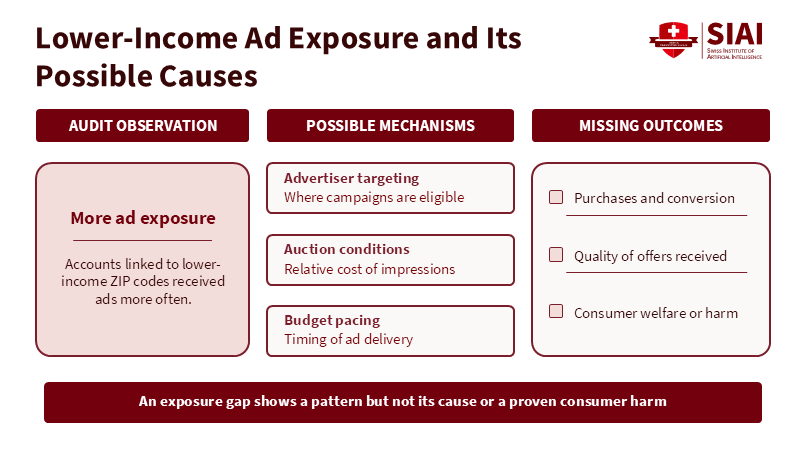
On February 9th, 2026, ChatGPT began displaying ads to users of its free plan and its new Go plan, which costs 8 dollars per month. In October, a team of researchers published a study, summarized for Brookings, on who is being shown these ads. They used 91 sock puppet accounts to collect this data and logged in from various zip codes with different income brackets and race compositions. They were able to collect over 3,600 ads during their study. They were able to find that ads were displayed to accounts from lower-income zip codes at a higher rate. When they looked at the 53 accounts that were displayed ads, zip code income clustered around $60,000, whereas the accounts with no ads peaked near $80,000. They did not find evidence of a disparity when looking at race and found that OpenAI was sticking to its policies of not displaying ads around certain subjects. They recommend that more testing should be done and that transparency and regulation should begin to happen. While this information is important to know, the takeaway from the Brookings article could be seen as jumping to conclusions. It assumes that fairness constraints should be enforced when displaying ads, which is something that hasn't been proven to be true.
What the First ChatGPT Ad Audit Found
There are many positives about their research. They created the accounts between January and March 2026, making sure that each group of Black, Hispanic and white accounts was logged in from low, medium and high income brackets. By logging in from zip codes, they were able to make each account have these properties. They would ask questions that they felt ads could be displayed on, such as how to make lasagna and questions on which OpenAI said it would not display ads, such as those around mental health. They were able to find that some ads were related to the question asked and some weren't. For example, they asked what the best streaming service to watch sports on is, which displayed an ad for streaming services. Another example was how to make pad thai, which returned an ad for DoorDash. After about a month, none of the accounts were receiving ads, which they believe may be from OpenAI detecting the accounts. The team admits that they do not have enough samples to prove that race has no impact on ads being displayed and the same caution applies to the income brackets that they found. They only had 53 accounts that received ads and 38 that didn't.
A sock puppet account set up to look at the number of ads displayed would be very different from someone actually using the service. There would be no history or memories stored, so the system would have little more than the location and the prompt to go off of. If more ads were shown to people in lower-income areas, it could be assumed that this was intentional, but other factors could cause it. Advertisers may have targeted certain areas when they were first advertising on ChatGPT. There may not have been as many competitors bidding on impressions in higher-income areas during the first few weeks of the study. There could be budget allocation that caused ads to be displayed in certain areas more than others, or maybe people who live in lower-income areas are more likely to use DoorDash than those in higher-income areas. All of these things could have caused the disparity that the study found. They are only looking at a small sample of accounts that were receiving ads in the first month of ChatGPT starting to display them. This is something that should continue to be monitored.
Adding Fairness Constraints to Ad Optimization
Delivering ads is an optimization problem. Advertisers want to maximize the amount of revenue they can gain from the ads they are running, so they will bid on how much they are willing to pay for impressions based on how likely a user is to click, how likely the user is to convert after clicking and how much value that conversion has. Then the platform will determine which ad to display to each user based on their likelihood of generating revenue. It will also consider the relevance of the ad to the prompt that the user asked, because if it shows someone an ad that has nothing to do with their prompt, it could decrease the chance of someone clicking on future ads. If the advertiser has a certain amount of money to spend per day, this can be modeled as a Bellman equation, whose solution gives the optimal decision for each state, which would consist of how much budget is remaining and how long is left to spend it. Delivery systems will not find the optimal solution to this equation but will approximate it by using Lagrangian pacing or contextual bandits that can estimate the probability of someone converting from clicking an ad. There are many ways to do this, but they all follow similar math.
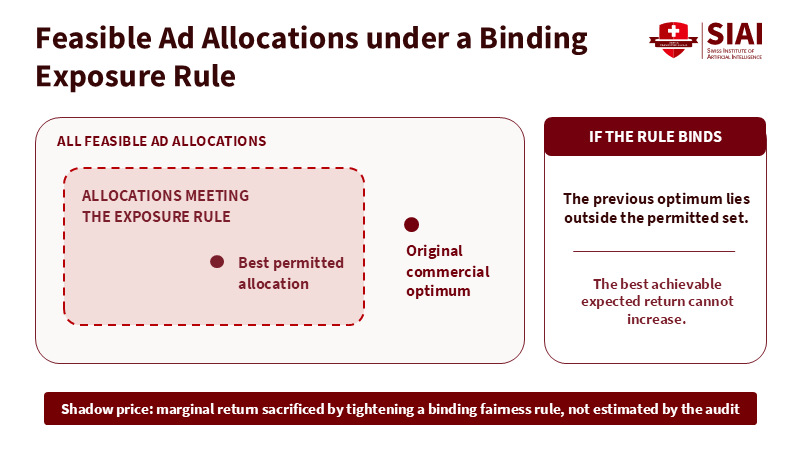
When fairness constraints are added to a problem, the feasible set of solutions can only shrink or stay the same. Since the optimal solution comes from the feasible set of solutions, when that set decreases, the solution can never be greater than the previous solution. If the constraint added to the problem is binding, then the solution will be less than the original solution. The Lagrange multiplier on this constraint gives its shadow price, which is how much revenue is sacrificed, at the margin, to display ads fairly. There have been some studies that have looked at related costs. Researchers from MIT and London Business School found that when a gender-neutral ad for STEM careers was run, the system displayed the ad to men 20% more often than women. This was because it cost more to show an impression to a woman than it did to a man. If the researchers were to display the ad equally to men and women, they would have to increase the amount that they were paying for impressions and it is unknown whether that would be worth it.
An Income Disparity Is Not Proof of Harm
Just because disparity exists doesn't mean that someone is being harmed. In the case of ChatGPT displaying ads to users on its free plan, people are being shown sponsored content, which could be for a streaming service or a discount on a food delivery service. This is displayed to an adult who can choose not to click on the ad or pay to not see them. If someone sees more ads, then they are spending more time looking at ads and if lower-income users are being shown more ads, then they are giving more of their attention to help fund free usage of ChatGPT. Whether or not this is harmful is unknown. There is no way to tell if someone who saw more ads purchased a product or felt as though they were harmed in any way.
Ads shown to competent adults sit in a gray area. The reason the DOJ required Meta to keep the gap between the eligible and the actual audience for most housing ads within 10% was that they fall under fair housing laws. If someone isn't shown an ad for a house, they may miss out on living somewhere. SIAI came to a similar conclusion when analyzing the changes Meta had to make to its ad platform. It believes that ads for housing, employment, credit and education should have constraints on them, but that optimization itself shouldn't be banned. There are some checks and balances that happen in the market. If an advertiser is showing their ad to someone that they don't want to target, they will not get the return on ad spend that they are looking for, which will cause them to adjust their campaigns to show the ad to their desired audience. In the STEM career example above, they could create two different campaigns: one for men and one for women.
What Should Be Regulated in AI Advertising
There are things that should be regulated about AI displaying ads. Deception through an ad on an AI chatbot should be regulated, because someone who trusts the information ChatGPT gives may trust the ad as well. OpenAI has said that it will label its ads and that they will not affect the answer that is given and that it should be verified. Another thing that should be regulated is how conversations feed into ads. Past chats can be used when personalized ads are turned on and the current conversation can be used either way, which could lead to private information being used to target people with ads. Discrimination against people who are in protected classes should also continue to be regulated. These are all things that can be regulated without adding constraints to optimization problems.
Researchers should be allowed to continue to test and see if there are any issues with ChatGPT displaying ads. About a month into the study, the accounts stopped getting ads displayed to them. Laws that would allow researchers to continue to collect this data would give more information about how ChatGPT displays ads. Adding constraints to how ads are displayed requires proof that someone is being harmed and that adding these constraints will decrease that harm. There is currently no research that proves that someone is being harmed by ChatGPT displaying ads to lower-income users.
This article reflects the analytical judgment of the author and does not constitute policy advice or the official position of any affiliated institution.
Publications under SIAI Editor are prepared or coordinated by SIAI’s research and editorial team and include research synthesis, policy and industry analysis, technical interpretation, and interdisciplinary work connecting artificial intelligence with established fields of research and professional practice.
Similar Post