[AI Labor vs. Human Labor] Jevons Paradox and the Hidden Costs of AI Substitution

His recent work examines the broader socioeconomic consequences of artificial intelligence, including labor markets, public finance, demographic change, institutional adaptation, and the distributional effects of technological progress.
He holds a PhD in Mathematical Finance from Boston University, and previously earned an MSc in Finance and Economics from the London School of Economics. He completed his undergraduate studies in Economics at Seoul National University under the Korea Foundation for Advanced Studies scholarship program.
Published
Modified
AI substitution shifts costs into managerial review and control
Jevons effects can expand demand while raising oversight burdens
Accountability remains human even as model reliability improves

For quite some time, the replacement of human labor by AI has been treated as a pure problem of comparative advantage. James does one task, Jones does another and production is shared where everyone has a lower relative cost. Now Jones can be a model. If AI becomes more cost-effective, labor moves to AI. The logic is correct but it is incomplete inside a real company. There is an additional cost that does not easily show up in the model's invoice. Someone has to understand what the AI did, decide if the result can be used and take responsibility when that result becomes a business act. This human weight changes the comparison and limits the Jevons paradox before mass substitution even begins.
Comparative Advantage Extends Beyond the Model Price
The basic idea remains strong. A profession's exposure to AI does not tell by itself whether AI will be used. In German data from 9,835 employees, a model that primarily looks at technical exposure explains about 25% of the difference in adoption. When task-level user costs and worker productivity relative to pay are incorporated, the explanation rises to about 60%. This fits with the way a business should think. It doesn't buy technical competence for the sake of technical competence. It buys output at a certain cost. If AI needs a lot of integration, control, process change and special management, its relative position gets worse even when the model looks impressive in a benchmark.
Some costs are obvious. The cost of use is usually measured around the system itself. License, compute, integration, security, monitoring. But within the company there is also a cognitive cost. The person who approves a decision has to mentally re-enter the work to understand it. If a model writes a financial analysis, the manager who signs cannot just see that the text is well written. The assumptions, data, exceptions and consequences of a wrong hypothesis still have to be understood. For routine work this may be small. For a serious decision, it can become much larger, and rather quickly. The work seems to have left the human but part of it returns in a more condensed form to the person who has the right to approve.
The difference between use and replacement can also be seen in the adoption data. At the end of 2025, about 18% of U.S. businesses said they had adopted AI in a business function, while about 41% of employees said they were using generative AI at work. The metrics aren't directly comparable but they do show that tools can spread across companies long before the number of jobs changes. This is another sign that measurement needs to get to the point where using the model actually changes the cost of an accomplished task. Until then, much of AI functions as a supplementary asset around human decisions, rather than a standalone replacement.
Jevons Paradox and the Managerial Review Bottleneck
The Jevons paradox is attractive to AI because it gives an optimistic answer to the simple story of replacement. If AI makes a service cheaper, the demand for the service may increase. Call centers in the Philippines are a useful example. Employment continued to grow until 2025 and approached two million, even though customer service is considered one of the most exposed categories of work. Technology can reduce the cost per contact and make more contacts economically feasible. In this case, higher productivity doesn't have to mean less total work. It can mean a bigger market and this is a real possibility and should not be lost in predictions of mass layoffs.
There is a difference between coal and corporate decision-making. If a steam engine consumes coal more efficiently, no executive needs to rethink every molecule of energy before approving it. With AI, every increase in production can create a new audit queue. More drafts, more proposals, more decisions, more code and more automated actions can reach humans who have to approve them. If the output of AI increases tenfold, the human control system cannot always increase tenfold. There comes a paradox within the Jevons paradox itself. Technology makes generating results cheaper but it can make the attention of the responsible executive a rarer and more expensive resource.
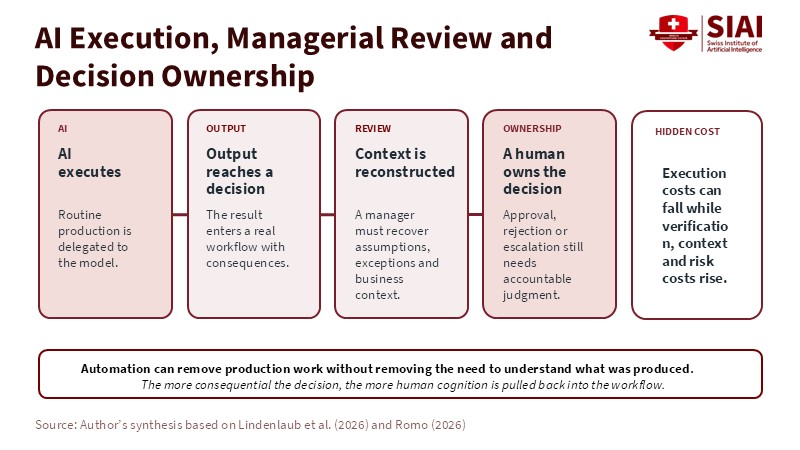
The productivity of call centers shows how easily these two results are confused. In a large customer service study covering 5,172 agents, a generative AI tool increased productivity by about 15% on average and helped less experienced workers the most. This can reduce the hours it takes for a consistent volume of calls. It can also make service cheaper and increase volume. The second effect looks like Jevons paradox. Nevertheless, the more cases go through the system, the more difficult exceptions eventually reach people. AI removes the ordinary piece and can leave the worker with a smaller but more challenging set of cases. Average productivity goes up, while the cognitive intensity of human work can also go up.
The Cognitive Re-insourcing of Work
Cognitive re-insourcing is one way to describe what happens. A task is given to AI but the critical part of it comes back to the human when the time comes for acceptance. The manager doesn't do all the work again. Enough of the reasoning still has to be reconstructed to know what is being approved. This is more demanding than a simple spelling or formatting check. In a legal, financial, technical, or regulatory decision, the value often lies in the exceptions. The model can produce routine work very quickly, while much of the risk remains concentrated in the exceptions. The business has then reduced production time but concentrated responsibility on a smaller group of people who have to identify the difficult cases.
This explains why replacement costs may seem lower on a spreadsheet than they are in practice. The model price is easy to see. Managerial time is not, it gets scattered across reviews, corrections, meetings and small decisions that rarely appear as one clear cost. The cost of a wrong decision is even harder to put into a simple average, because many times it is low-frequency and high-damage. It can involve legal liability, clients, reputation, regulatory compliance, or loss of institutional knowledge. This is why true comparative advantage must also measure the distribution of risk. A system can be cheaper per task and more expensive per decision that can stand without additional human remediation.
If a company removes the people who owned the process too quickly, it also loses the benchmark with which it controls the system. Institutional knowledge is not always found in manuals or databases. It is found in small exceptions, customer relationships, old decisions and informal rules that employees have learned over time. The more AI takes over the normal flow, the easier it is to underestimate this knowledge because it only appears when something goes wrong. Then the business discovers that it has saved the cost of the performer but has lost some of the ability to judge the performer. These costs occur in practice and are part of the actual price of substitution.
Responsibility Remains Human
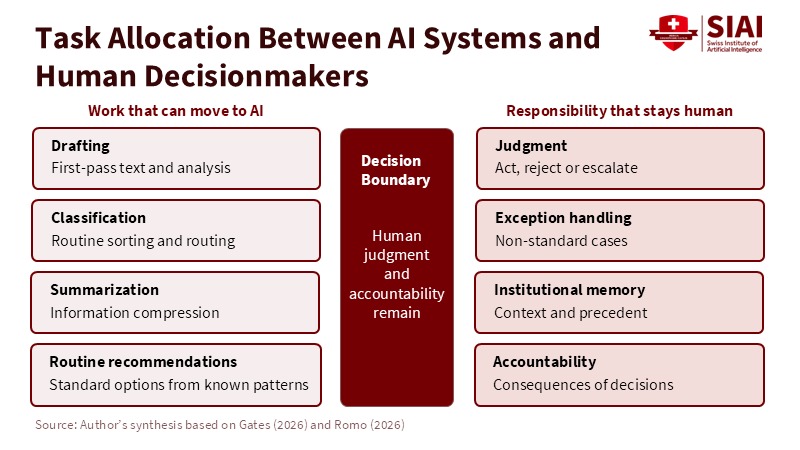
The most interesting test is to remove hallucination from the problem. Even if AI reaches a near-zero percentage of factual errors, the finances of many tasks would change drastically. This does not eliminate responsibility. A model can give a correct prediction and the business can make the wrong decision because it chose the wrong goal, the wrong risk threshold, or the wrong use of the prediction. It can also make a choice that is technically correct and business-damaging because it ignored a customer, regulation, or consequence that wasn't in the prompt. The person who decided to delegate the task to AI remains responsible for explaining why the decision was acceptable.
This is where the logic of James and Jones changes again because if Jones is human, then can share not only production but also judgment, memory and responsibility. If Jones is AI, production can be transferred without accountability being transferred in the same way. This makes James seemingly more productive and at the same time more burdened with decisions. The next phase of AI will therefore be judged by something more difficult than cost per token or success rate in benchmarks. It will be judged by how cheaply a company can turn AI output into a decision that a human can actually defend. If these costs fall, comparative advantage will move quickly and the Jevons paradox may become stronger. If they remain high, human labor will remain within the system, not always as a producer but as the carrier that absorbs the risk.
This article reflects the analytical judgment of the author and does not constitute policy advice or the official position of any affiliated institution.
His recent work examines the broader socioeconomic consequences of artificial intelligence, including labor markets, public finance, demographic change, institutional adaptation, and the distributional effects of technological progress.
He holds a PhD in Mathematical Finance from Boston University, and previously earned an MSc in Finance and Economics from the London School of Economics. He completed his undergraduate studies in Economics at Seoul National University under the Korea Foundation for Advanced Studies scholarship program.
Similar Post