The Productivity Channels AI Actually Opens

Publications under SIAI Editor are prepared or coordinated by SIAI’s research and editorial team and include research synthesis, policy and industry analysis, technical interpretation, and interdisciplinary work connecting artificial intelligence with established fields of research and professional practice.
Published
Modified
Anthropic data shows AI speedups favor long, high-value tasks
Bottleneck tasks limit uniform gains even in AI-heavy jobs
Closing the gap needs domain judgment training, not prompting

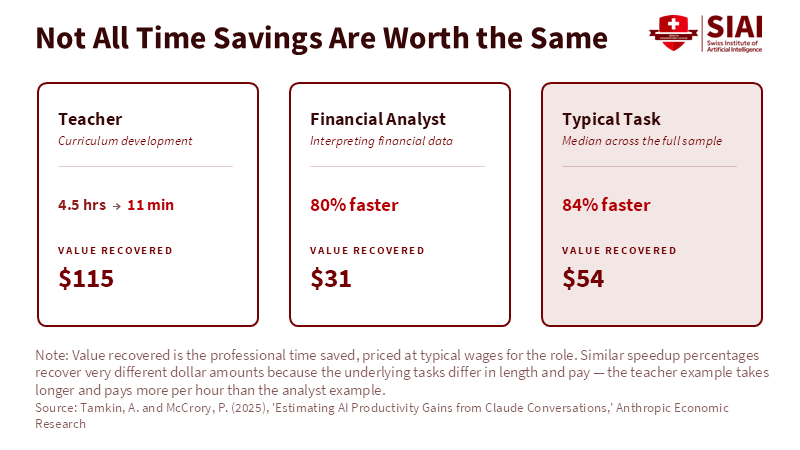
Among the task-level AI usage figures now in circulation, one number stands out from the rest: in a hundred thousand real conversations from a large AI assistant, the typical task was completed 84% faster with the help of AI than without it. This is not a response to a survey or an optimistic forecast. It's a direct assessment of what actually happened when someone used the tool for real work. The average job in this sample would cost about fifty-four dollars in business time if it was done without assistance. Such numbers explain why AI productivity channels attract so much attention. What they do not explain on their own is why these channels are opening up so much wider for some workers, jobs and countries than for others.
Where Productivity Channels Are Concentrated
Software development tops this list by a wide margin, contributing an estimated 19% of the total productivity benefit attributable to current AI usage, according to a detailed record of U.S. labor productivity. It is followed by general administration and management with about 6%, then market research and marketing with 5%, customer service with 4% and secondary education with 3%. These are not the professions with the most employees. They are the professions where AI happens to be used for tasks large and complex enough to have weight when the time savings at the economy level add up.
This last point deserves more attention than it usually gets. A task of developing educational materials that would take a teacher four and a half hours by hand can be completed in about eleven minutes with the help of AI, saving about one hundred and fifteen dollars worth of teacher salaries. Financial analysts save about 80% of the time on tasks like interpreting financial data, worth about thirty-one dollars each. Food preparation and installation work also saves time, but the tasks themselves are shorter and cheaper in the first place, so the dollar value recovered is less even when the savings rate looks similar. Productivity channels, in other words, don't just depend on how quickly a task is completed. They depend equally on how great and how valuable this work was in the first place.
The administration and the legal profession are near the top on both scales at the same time. The average administrative work that humans bring to AI, such as selecting investments or reviewing a contract, would take a professional about two hours without assistance and legal jobs are approaching that average. These are also some of the highest-paid hours in the economy, so even a modest percentage acceleration in them recovers more measurable value than a large acceleration to a thirty-minute job of a lower-paying role. Across the sample, the time saved per task is weakly correlated with the cost of labor, but the tasks that humans actually bring to AI lean strongly toward large, expensive, cognitively demanding activities. This gradient, more than the raw acceleration rate, determines which occupations end up at the top of the productivity channel rankings.
Why Channels Are Opening Wider in Some Countries
A complementary stream of international research helps to explain why the same channels described above translate into very different national outcomes. Two factors do most of the work. The first is how ready a country's regulatory and institutional environment is to support the use of AI on a large scale, combined with the size of its service sector, which together determine how much value a country derives in relation to its economy. The second is the linguistic and cultural distance from the data used to train today's leading models, which determines how quickly this value diffuses beyond a narrow professional core once acquired.
This cross-country picture has been examined closely elsewhere. What is important for this text is narrower and more actionable day to day: once a channel is opened in a given country, what determines who actually benefits from it. This question lies below the level of national policy, in the choices made by individual workers and employers about which tasks to pass through AI and how much they trust the outcome. That's where the rest of this text will remain.
The Bottleneck Tasks AI Leaves Behind
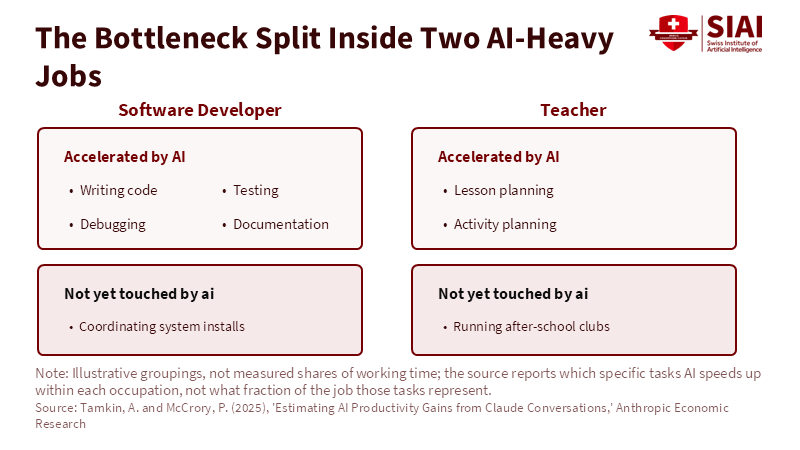
Even within professions that show great measurable benefits, the picture is uneven. Software developers see AI dramatically accelerating code writing, debugging, auditing and documentation. The same developers see almost no measurable use of AI to coordinate a system installation or oversee other engineers. Educators see AI accelerating the planning of lessons and activities. They see virtually no AI involvement in running an extracurricular group or managing a classroom at the time it happens. As AI-accelerated tasks take up a smaller portion of a job, tasks that AI can't touch become a larger part of what is actually left to be done. Development researchers have long argued that progress is constrained less by what a technology is good at and more by what remains necessary and difficult to improve. This observation fits perfectly with this particular pattern.
Job-level accelerations also vary wildly for reasons that have little to do with skill. Checking a diagnostic image shows only about 20% time savings, mainly because an experienced professional could already do it quickly without help. Gathering information from scattered reports shows closer to 95% savings because reading, extracting and citing text are close to what these models do best. Across the sample, most jobs are somewhere between 50% and 95%, with a concentration of around 80% to 90%. None of these fluctuations are related to how experienced or well-trained the person performing the task is. It's related to how well the job itself fits in with what a language model is designed for, which means that two workers with identical skills can see very different measurable benefits depending on which piece of their work happens to go through AI.
This is the most underrated part of the productivity narrative. An employee whose job is partly rapid writing of a text and another a face-to-face crisis does not gain an 84% acceleration in his entire role, no matter how good the underlying model becomes in the part of writing. Its overall output depends on how well it manages the boundary between what AI can accelerate and what it can't. This is a skill and it doesn't automatically come along with the tool itself.
Why Prompting Alone Will Not Close the Gap
Basic AI literacy, knowing how to phrase a good prompt, once looked sufficient to spread these gains evenly across a workforce. The task-level evidence does not support that. The tasks with the greatest measurable value, in administration, law and financial analysis, are also the tasks that require real specialized judgment to be correctly identified and controlled once the model produces an answer. Getting a quick but incorrect answer to a complex legal or financial question is not a productivity gain. It is a responsibility with a shorter response time. The employees who reap the largest share of AI measurable value are disproportionately those who already had the specialized ability to guide the tool well and identify its mistakes, which is a different skill than knowing how to write a clear instruction.
Here it becomes difficult to avoid the argument in favor of a serious post-secondary or postgraduate education. Prompting, when taught as a self-contained skill, teaches people how to ask. It teaches little in how to judge what is returned and judgment is exactly what distinguishes a genuine time-saver from a quick mistake. Bridging the gap between workers who reap the AI productivity pathways and those who don't will require sector-specific training, far beyond how to use a conversational interface, provided after standard training and refreshed as the tools themselves change. Without this investment, the same uneven pattern seen in today's occupational data, concentrated benefits for those who already had the underlying expertise, would simply be repeated for the next generation of workers trying to catch up.
This is not a small gap that closes on its own as the tools become friendlier. The estimates behind this text already assume something close to universal adoption within the next decade and even with this generous assumption, the resulting gain in labor productivity depends entirely on whether the tasks that a technology accelerates match where people actually spend their time. A worker who never learns to pass the right part of their job through AI or who can't tell a plausible answer from a correct one, doesn't benefit from an 84% acceleration that is happening somewhere else in the economy. Acceleration has to happen in one's own hands, in one's own work and this requires a level of fluency far beyond what a short course in prompting can offer.
The eighty-four percent that opened this text is real and will likely continue to grow as models improve. Whether this number translates into broad income growth or a widening gap between those who can lead AI well and those who can't depends on a choice that societies have not yet taken seriously enough: whether to address education in the crisis as a key infrastructure for an AI economy or to leave it to chance. Productivity channels are already open. What happens next depends on who learns to use them.
This article reflects the analytical judgment of the author and does not constitute policy advice or the official position of any affiliated institution.
Publications under SIAI Editor are prepared or coordinated by SIAI’s research and editorial team and include research synthesis, policy and industry analysis, technical interpretation, and interdisciplinary work connecting artificial intelligence with established fields of research and professional practice.
Similar Post