AI Is Eliminating East Asia's Reverse-Engineering Advantage

His recent work examines the socioeconomic consequences of artificial intelligence, including labor markets, public finance, demographic change, institutional adaptation, and the distributional effects of technological progress.
He also serves as Executive Editor, Research & Review at The Economy, overseeing research-oriented editorial coverage, analytical contributions, and engagement with academic and industry specialists.
He holds a PhD in Mathematical Finance from Boston University, an MSc in Finance and Economics from the London School of Economics, and a bachelor's degree in Economics from Seoul National University, where he studied under the Korea Foundation for Advanced Studies scholarship program.
Published
Modified
AI agents now make software reverse engineering cheap and fast
East Asia’s catch-up relied on abundant, low-cost engineering labour
Future competitiveness may depend on original innovation instead

On the 6th of October 2026, the project REA (Reverse Engineer Anything) had fewer than 10,000 stars on GitHub. Eight days later, it had 234,477 stars. Very few commercial software packages will ever reach that level of growth. The software was built by Morluto, who uses that as his online alias. It allows users to point AI agents at existing decompiler software such as Ghidra, IDA Pro, and Hopper to read code that has been compiled. It can then recreate a version of that code. Usually, when talking about AI reverse engineering, the focus is on cybersecurity or stealing IP. There is also an industrial angle to this: reverse engineering allowed East Asia to become technologically advanced over the course of the last century. The problem is that it took many engineers to do it.
There is nothing complex about what reverse engineering requires. An engineer can take a piece of compiled code and find the functions inside it. Reverse engineering is just looking at these functions and understanding what they do. Once a function is understood, the engineer can start to understand data structures and test assumptions. This is something that could take months for a large piece of software. Morluto states that reverse engineering is just pattern matching, which LLMs are great at. Productivity gains from AI have been shown to not be consistent. In one test in 2025, developers were found to be 19 percent slower at completing 246 tasks when using AI. They believed they would be 24 percent faster but were working with code they knew. Reverse engineering will be on the opposite end of the spectrum because the code is unfamiliar. The work means looking at functions and figuring out what they do, which is a task that AI can do very quickly.
How East Asia Reverse-Engineered Its Way Up
As mentioned before, reverse engineering has allowed East Asian countries to take technology from the West and make it cheaper. When Sony bought a license from Western Electric in 1953, it only cost $25,000. It took a few months to get approval from the Ministry of International Trade and Industry (MITI) before Sony could use their foreign exchange. Western Electric believed that the main use for transistors would be in hearing aids. Sony used the license and some documentation from Bell Labs to learn how to manufacture semiconductors. By 1955, they had a radio for sale called the TR-55. The license only gave them knowledge of how to use the technology. It took engineers to turn that knowledge into a product that could be made cheaply and on a large scale. Japan had an abundance of engineers.
South Korea did this around 30 years later. When Samsung wanted to get into the DRAM business in 1983, they were told no by all of the major players in the space. Hitachi, Motorola, NEC, Texas Instruments, and Toshiba all declined. It was not until June of 1983 that Micron agreed to license their 64K DRAM. By November, they had samples of the DRAM working. They reverse-engineered a 256K DRAM to avoid paying license fees. They had samples of this DRAM by July of 1985. By 1993, Samsung was the world's largest DRAM producer. China has also used this technique on a larger scale, with the government helping guide the way. The one common theme is that it took engineers to do this and they were cheaper and more plentiful in East Asia.
What AI Still Cannot Copy
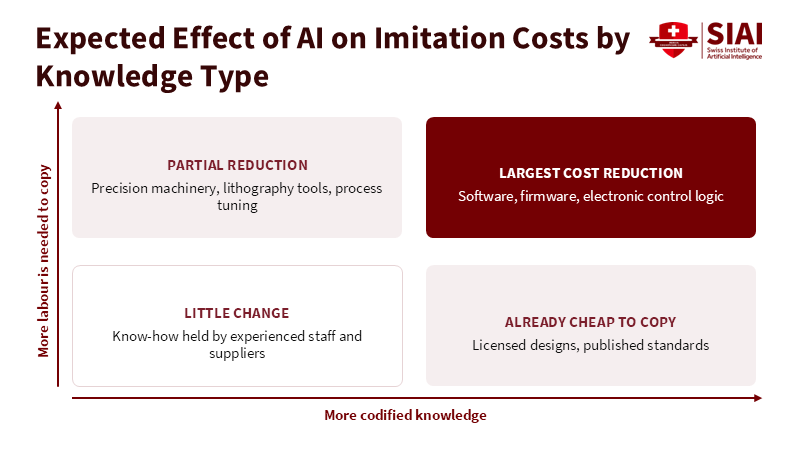
Lithography machines show where this will start to fail. In October of 2025, TrendForce, citing The National Interest, reported that Chinese engineers disassembled an ASML lithography machine and could not reassemble it. They had to call ASML for repairs. ASML found out what happened when they went to repair the machine. This may not be 100 percent true, as no independent source has confirmed it. It can be used as an example of where this will not work. China has been reported to try and copy lithography machines many times. With America restricting the sales of these machines, it has become more of a need than a want. The article also states that China is keeping export controls on rare earths. The US likely will not lift its restrictions on selling chips and China will continue to try to reverse engineer them.
A lithography machine cannot simply be taken apart and copied. A piece of software can be copied, run in a virtual machine and reverse-engineered as many times as needed. There is only one lithography machine and breaking it loses some of that knowledge. Many of these processes are trade secrets that are only known by certain people. There will always be some elements of pattern recognition that will need to be done, whether it is finding how to program a machine or learning the process to create a certain output. These are things AI can speed up.
Why Cheap Copying Changes Reshoring
One reason companies have moved manufacturing overseas is because of all the engineering that goes into it. A lot of assembly can be automated, but engineers are still needed to figure out how to make new parts or how to code software that runs on a machine. There was an average of 148,230 open jobs for engineering and IT in Germany during Q1 of 2024. That is a 333 jobs-to-100 unemployed engineers ratio. By Q2 of 2025, this number was down to 106,310. That is a decrease of 22.1 percent year over year. This is mainly due to the slow economy, but it shows how fast the need for engineers can decrease. If AI can do in an hour what takes an engineer in Shenzhen a quarter, there is little reason to keep that work there.
The World Bank recently published an article that stated that one-fifth of workers in Europe and Central Asia have jobs that are exposed to AI. Fewer than one in ten companies are using AI and most of them are using it for simple tasks. They believe the main risk over the next 10 years is too little AI adoption. The same applies to products. If a country does not have many workers but all those workers can do more work with AI, it can rebuild that capability as long as it has the money to do it. This will be a talking point for many European countries as they try to figure out what they can bring back home. Software and machine parts will probably be some of the first things.
Why East Asia Keeps Its Lead for Now
It can be argued that Seoul and Shenzhen will have more engineers and more products to copy. China spent 3.63 trillion yuan on R&D in 2024. This is an increase of 8.9 percent from the previous year. Korea spent 4.96 percent of its GDP on R&D in 2023. Only Israel spent more as a percentage of GDP among OECD countries. Companies account for 79.2 percent of all R&D in Korea, so they will be quick to implement new technology. If products can't be copied faster, firms will want to do that where there are the most products to copy and suppliers nearby. There will still be more manufacturing in East Asia for the time being.
This argument will become less valid over time. The reason East Asia had an advantage was that engineering was cheaper than it was in Europe. AI is lowering the amount of engineering that needs to be done on each project. As that number gets lower, the amount saved by doing it in East Asia gets less. R&D spending is going towards development rather than basic research. China only spent 250.09 billion yuan on basic research in 2024, which was less than 7 percent of its total R&D spending. Experimental development was around 81 percent. Korea had a similar breakdown in 2023, with basic research making up 14.9 percent of its R&D spending. This means that they are focusing on improving products that already exist, which is exactly what AI is making cheaper.
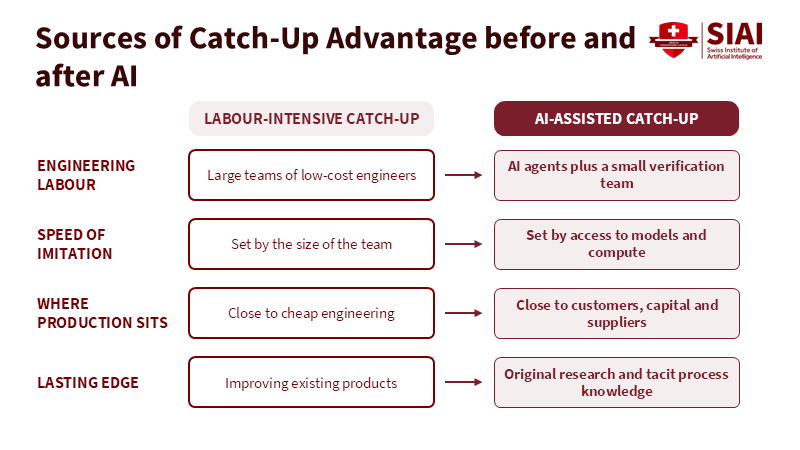
When Sony bought that license in 1953, it was cheap. What was expensive was all of the engineering that went into making that product. Samsung was able to do this in about six months when they got into the DRAM business in 1983. If AI can do more of that engineering for less, then that path to becoming an industrial power will shrink. Will Japan, Korea, and China be able to focus on innovating new products at the same rate that AI is making it cheaper to copy products? What is clear is that the ASML machine, if the story is true, will take longer to copy than software.
This article reflects the analytical judgment of the author and does not constitute policy advice or the official position of any affiliated institution.
His recent work examines the socioeconomic consequences of artificial intelligence, including labor markets, public finance, demographic change, institutional adaptation, and the distributional effects of technological progress.
He also serves as Executive Editor, Research & Review at The Economy, overseeing research-oriented editorial coverage, analytical contributions, and engagement with academic and industry specialists.
He holds a PhD in Mathematical Finance from Boston University, an MSc in Finance and Economics from the London School of Economics, and a bachelor's degree in Economics from Seoul National University, where he studied under the Korea Foundation for Advanced Studies scholarship program.
Similar Post