AI and Productivity: Little to Do with Age and Size of the Business

Publications under SIAI Editor are prepared or coordinated by SIAI’s research and editorial team and include research synthesis, policy and industry analysis, technical interpretation, and interdisciplinary work connecting artificial intelligence with established fields of research and professional practice.
Published
Modified
Age and size track AI spending, not returns
Learning and adaptability may drive AI productivity gains
Marginal return, not firm size, should set spending

Every new survey of corporate AI spending seems to deliver the same verdict: younger firms, younger boards and bigger, more productive companies are spending the most and the gap is widening each year. The pattern is easy to read as a story about generations and scale and it has already started to shape how AI productivity is discussed, with age and firm size treated almost as if they explained who will win from the technology. Spending, however, is not the same thing as return. A dollar spent on AI says little about what that dollar produces and the characteristics that line up with heavy spending may simply sit alongside the things that actually decide whether a worker or a firm gets more out of the same tool, such as a readiness to experiment, technical skill, the speed at which new functions are learned and the economics of the next dollar invested.
AI Adoption Repeats Earlier Waves of Technology
On average, U.S. businesses plan to spend $2,043 per employee on AI this year, compared with $1,363 last year; UK businesses plan to increase spending per employee from $422 to $725. Across these and other surveys of managers, firms spending the most on AI tend also to be the most productive, pay higher average wages, have a younger average age of the board of directors and have been established for a shorter period of time. All of these correlations seem robust. However, none of them answers whether age (of directors, or of the firm) causes differences in productivity from the use of AI. Or, indeed, whether it correlates with the true causes of such differences. None of these survey data reveals the return on a dollar spent on AI.
Firms have successively invested in PCs, IT systems, Internet, Cloud and other forms of digitisation over the past 30 years. Which firms invested and to what degree of success depended on many factors, including preparedness, good practice, financial resources, skills of employees and so on. AI is likely to be no different, only on a greater scale, given its potential to perform a wider range of tasks, including mental functions. So too much should not be read into the fact that younger businesses spend more. Businesses of shorter vintage may find it easier to implement changes to processes, but be less well endowed with other assets such as data sets, funds and client base. Younger directors may be more willing to try new applications, but this is unlikely to be strictly related to their age.
Several factors may correlate with the younger age of businesses or directors. Firstly, they may be more inclined to try new technology and persist despite initial unsuccessful attempts. The extent of experimentation could be captured directly by questions about usage. Someone with substantial experience in an area, aged 50, who systematically explores uses of an LLM in that area would be expected to achieve better results than their 25-year-old peer who deploys the LLM to improve the style of correspondence. For Danish businesses, business-level characteristics associated with greater usage were primarily size and degree of digitization and the characteristics of employees, notably levels of education and the proportion studying STEM subjects. Productivity and the capital-to-labour ratio were not strongly related. For individuals, the preparedness of the employee was important and age could well operate through this channel.
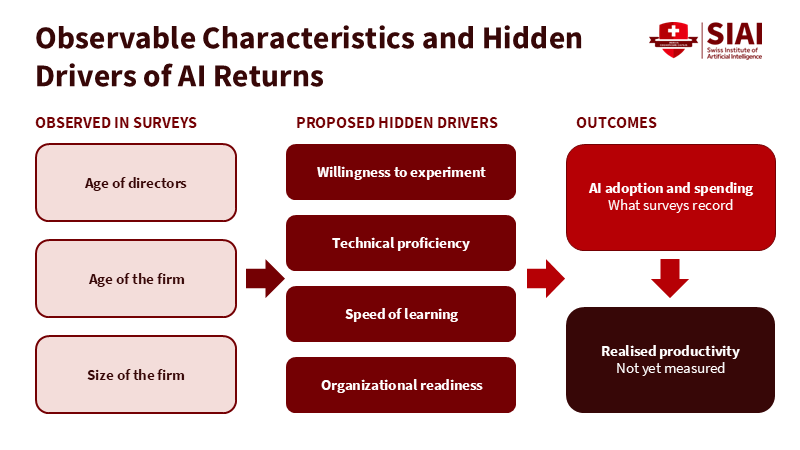
Employees may also differ in pre-existing skills with technology. There are few barriers to accessing models, but there is substantial scope to deploy them effectively or not to perform a given task. Employees with knowledge of an area combined with general IT skills will be better placed to benefit than those with one or none. Finally, employees will differ in their speed of learning. Given that models and functionality are updated frequently, those able and willing to reorganise tasks, experiment with new uses, take up further functionality, etc., will continue to increase the return to their use. So a dummy variable indicating any usage of AI would be expected to have limited explanatory value.
AI Productivity Returns May Rise over Time
In one application to call-centre employees, the use of GenAI increased the number of problems solved per hour by 14% and by 34% for the bottom performers. This seems at odds with the greater role of preparedness to experiment and skills, discussed above. Of course, in the short run one would expect the largest benefit to accrue to those lacking skill, as the algorithm substitutes for their lack of knowledge but one would also expect the most skilled to develop more sophisticated uses of the algorithm, generating greater increases in productivity over time. It is not yet known how much of this occurs, if any; it would be premature to conclude that it must follow the experience of previous technologies, where the distribution of initial gains did not necessarily match longer-run gains.
Accordingly, an empirical strategy might include a range of controls for characteristics of the individual: age, years of experience and educational attainment; preparedness to experiment with and speed of learning from new technology; general skills with technology and assessing its performance; and business characteristics, such as provision of training, encouragement from managers, data availability and ease of adapting processes. Variables measuring the productivity impact might include the quality of outputs, time taken, frequency and type of mistakes and the difficulty of problems handled. Key to the hypothesis would be a reduction in the coefficient on age after inclusion of variables for preparedness to experiment and technical skill. Some evidence consistent with this is that businesses increasing their expenditure on AI experienced around 1 percentage point greater annual productivity growth from 2018 to 2024, attributable to the accumulation of organisational capital.
Larger Firms Earn More on Average, Not at the Margin
Larger businesses would be expected to enjoy a greater average return on investment in AI due to synergies between different activities. For example, algorithms developed to address enquiries from clients could be extended to other interactions with clients and other internal activities, with decreasing incremental cost given available data sets and other IT systems. Consistent with this, European businesses adopting AI experienced approximately 4% greater labour productivity in the short run, mostly limited to medium and large firms and to a greater extent if they also made other associated investments. So there are good reasons to expect larger firms to benefit more, via similar channels as discussed above.
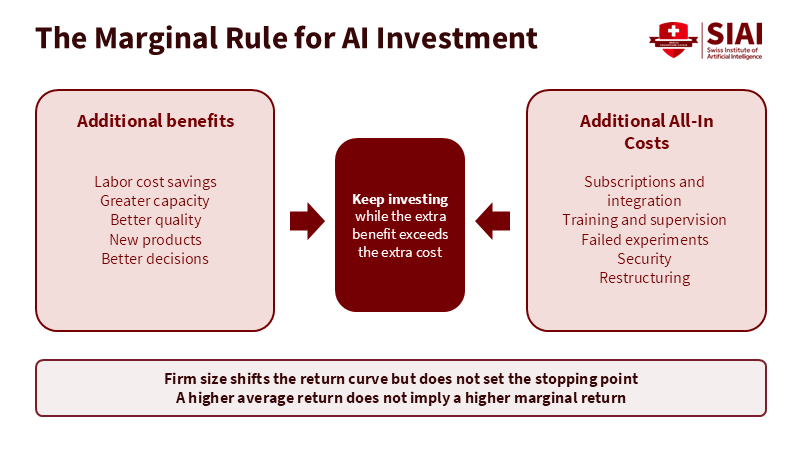
However, it does not follow that they would have a greater return to an incremental dollar of expenditure. Of course, there will be examples of very expensive implementations generating modest benefits and small firms enjoying substantial benefits from modest expenditure. Each firm would want to invest up to the point where the discounted expected flow of future benefits was equal to total additional costs. Benefits would include reduced labour input, increased output, higher quality, range and quality of products offered and improved decision-making. Costs would extend well beyond subscription fees to include implementation, training, monitoring, errors, information security and reorganisation. So there are also reasons to expect diminishing marginal returns as scale increases. Whether and how the marginal product of spending varies with the size of the business could be investigated by regression analysis, again controlling for various capabilities and characteristics of existing operations, including current productivity levels and suitability of activities for application of the technology.
Where the Productivity Divide May Fall
The differential in benefits from AI may be primarily between individuals and businesses able and willing to make use of lessons learned from using it, versus those less able and inclined to continue sub-optimal working practices. To the extent these characteristics coincide with younger age and greater size, a correlation would be observed, but the causal factors would lie elsewhere. Current data indicate only levels of intended expenditure, which confirms that larger and younger businesses are investing greater amounts. Longer-run consequences for productivity are yet to be determined and may take some time given the dependence on the accumulation of organisational capital.
Alternatively, of course, once all relevant variables are included in the analysis, younger age of directors could continue to be associated with higher productivity returns, implying a more direct role, for example, longer investment horizons or contacts. In that case, the justification for numerous initiatives targeting specific ages or sizes of businesses would be strengthened. In either case, it would be informative to learn how rapidly employees were able to increase their productivity from existing levels of deployment of AI and the marginal product of further spending. Available information does not yet distinguish between these possibilities.
This article reflects the analytical judgment of the author and does not constitute policy advice or the official position of any affiliated institution.
Publications under SIAI Editor are prepared or coordinated by SIAI’s research and editorial team and include research synthesis, policy and industry analysis, technical interpretation, and interdisciplinary work connecting artificial intelligence with established fields of research and professional practice.
Similar Post