Generational Gap in AI: Why Age Alone Does Not Explain Adoption

Publications under SIAI Editor are prepared or coordinated by SIAI’s research and editorial team and include research synthesis, policy and industry analysis, technical interpretation, and interdisciplinary work connecting artificial intelligence with established fields of research and professional practice.
Published
Modified
Age alone does not explain the generational AI gap
Exposure and institutional support shape different adoption paths
Younger and older users face different pressures to adopt

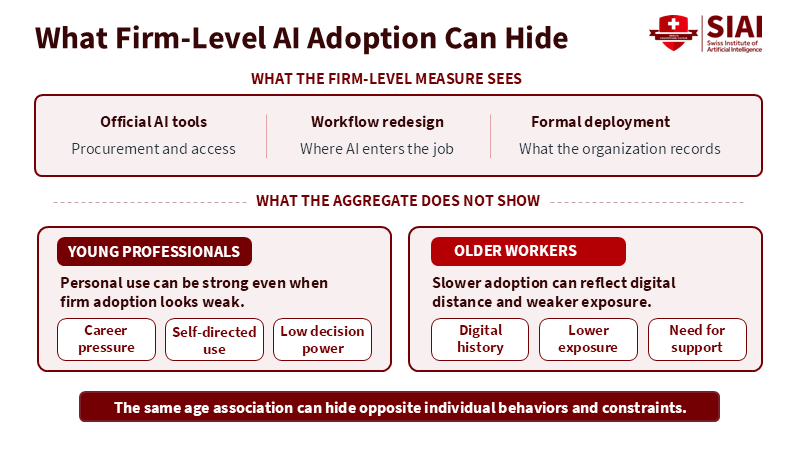
The generational gap in AI is easy to describe and harder to explain. In 2026, 66 percent of Americans aged 18 to 29 said they were using AI chatbots, compared to 23 percent of those aged 65 and older. The difference in self-confidence was even greater. Almost one in three under 30 said they were very confident in their ability to use chatbots, while among those 65 and older the figure was just 6 percent. It's tempting to think that age explains almost everything. But this reading leaves out how familiarity with a technology is acquired. Age coincides with different professional exposure, different digital experiences, different needs and different entry points. The gap is real. The mechanism that creates it is much less simple.
The Generational Gap in AI Starts With Exposure
Age initially acts as a historical advantage or disadvantage. A 25-year-old in 2026 has spent almost his entire conscious life in environments where digital services, search engines, applications and constantly changing interfaces are considered normal. A 70-year-old has spent much of his professional life before this condition. This does not determine the latter's ability to learn AI. But it does determine how many previous steps are taken for granted when a new tool appears. Using a chatbot requires less technical knowledge than many previous digital systems, but it still requires comfort with accounts, settings, online search, source evaluation and personal data management.
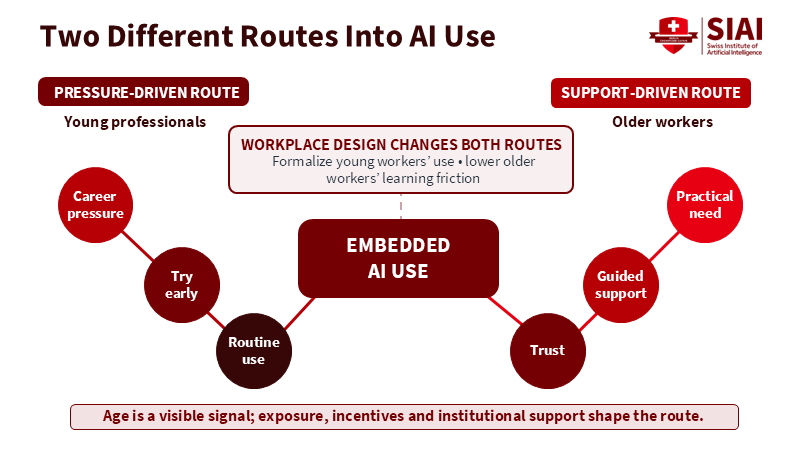
Daily exposure reinforces this difference. Younger people encounter AI within work, search services, smartphones and tools they already use. Older people, particularly those who have left the labor market, have fewer mandatory contacts with such systems. In an international survey of people aged 60 to 85, those who remained employed used AI about three times more than those who had retired. This shifts attention from age to exposure. The calendar year of birth remains relevant, but part of its effect runs through work. The business, the colleague, the new process and the need to complete a particular task create recurring touchpoints that a retiree may simply not have.
Older Users’ Uncertainty Is Not Simple Resistance
The data for older users initially seems to confirm the picture of resistance. In the U.S., 77 percent of those aged 65 and over were not using chatbots at the beginning of 2026. Only 19 percent were using ChatGPT, compared to 61 percent in the 18 to 29 age group. Older people were also much more likely to state uncertainty about what AI will do in society or in their own lives. If the generation gap is only read through these percentages, the easy explanation is that the technology encounters an age resistance that is difficult to change.
The picture becomes different when the reasons are examined. In a global survey of older adults, 41 percent cited potential misuse of personal data as a barrier, 34 percent didn't know which AI tools to use and 23 percent didn't know where to start. Only 15 percent said they weren't interested in learning more. 44 percent preferred easy-to-use guides that they could follow at their own pace and nearly one in three preferred online training from AI providers. These aren't responses from people who have collectively rejected the technology. They describe an entry problem. When the initial cost of learning is higher and the practical benefit isn't yet apparent, not using it can feel like resistance when in fact it's waiting.
There is also an older clue that is worth preserving. Research around the adoption of previous technologies by older adults has found that utility, convenience and confidence often explained more than just a negative attitude towards technology. Older users could have a positive view when a tool solved a clear problem, despite concerns about safety and reliability. AI does not remove this mechanism. It makes it more important because much of its value is only realized after a little practical use.
Younger Adults Use More Without Trusting More
The opposite error occurs when the high use of young people automatically translates into enthusiasm. Americans under 30 are the most frequent users of many AI tools, but in 2026 they were also the age group with the most negative assessment of the future social impact of the technology. 48 percent expected a negative impact on society and 37 percent a negative impact personally. In those 65 and older, the corresponding percentages were lower, although the uncertainty was greater. Use and acceptance therefore do not necessarily go together. One may consider a tool necessary and at the same time not trust the direction it is leading.
This is of institutional importance. For new employees, AI appears at a stage where there is not yet a large stock of professional experience to act as a protection. Workplaces are increasingly making AI competence part of ordinary professional participation, even among employees who remain wary of the technology. This pressure explains why the behavior of young people should not be read as pure technophilia. An employee may use generative AI every day because the productivity expected in the role has already changed or because he thinks that without this skill it will be more difficult to get the next position.
The same makes the concept of "digital native" problematic. Comfort with apps and platforms does not equate to the ability to assess the quality of an answer, understand when a model produces an incorrect result, or make the right judgment about what data should not be entered into an external system. Young people usually start with lower psychological and operational costs of use. This does not mean that they start with integrated AI literacy. Frequency of use measures exposure. It does not measure proficiency in itself.
Institutions Can Widen or Narrow the Gap
If age were the deciding factor, the possibilities for intervention would be limited. But the large difference between employees and older retirees shows that the environment can significantly shift behavior. An organization that introduces AI along with hands-on training, secure accounts, clear rules for data and human support reduces first-time costs. An organization that simply buys a tool and assumes that employees will learn on their own leaves the advantage to those who already had reason to experiment. In this way, a difference in previous experience turns into a larger difference in productivity.
The same logic applies outside of work. As banking, health, customer service and public services integrate AI, access isn't just ensured because there's a chatbot on the screen. For a savvy digital user, the conversational interface can reduce complexity. For someone who is already worried about scams, personal data, or incorrect answers, it can create a new level of uncertainty. The ability to switch to human service, clear explanations for data usage and training on real needs are therefore part of the technological infrastructure itself, not external social benefits.
This also changes how generational comparisons should be read. If two age groups have different uses, the next question is not just which is more receptive, but which group has an employer-provided account, which has a colleague who can show proper use, which performs tasks where the outcome is immediately apparent and which has to bear the cost of learning without a clear benefit. Once these variables are in the picture, the generational gap in AI starts to look more like an institutional effect manifested through age.
Age Is a Signal, Not the Cause
Age remains a useful indicator. It would be just as wrong to ignore it because other factors matter. Past digital experience has been accumulating over decades and the differences in exposure are real. Older adults show lower use and much lower confidence in today's tools. Younger people use AI more and encounter technology more often at work and in everyday digital life. This distribution isn't going to disappear just because interfaces are getting easier.
Where correction is needed is in causality. For an organization knowing that an employee is 62 years old does not tell if they use AI every day, if they work in a high-exposure industry, whether they have received training, or if they already have strong digital skills. Similarly, being 23 years old does not guarantee that they understand the limits of a model or that they can properly integrate AI into a professional process. Age acts as a short indicator for many different experiences that often coincide. The more institutions deal with these experiences directly, the less accurate age becomes as a predictor of behavior.
This is perhaps the most useful point for the next phase of adoption. The generational gap in AI will not close because today's young people will gradually replace today's older ones. Each new technological phase creates new groups with different levels of exposure and different adaptability.If familiarity is acquired mainly through work, then those outside it will continue to lag behind. If training remains informal, those who are already confident will learn faster. Age will continue to show in the data, but the size of the difference will depend largely on the environment created around the tool.
This article reflects the analytical judgment of the author and does not constitute policy advice or the official position of any affiliated institution.
Publications under SIAI Editor are prepared or coordinated by SIAI’s research and editorial team and include research synthesis, policy and industry analysis, technical interpretation, and interdisciplinary work connecting artificial intelligence with established fields of research and professional practice.
Similar Post