AI Productivity and Fiscal Capacity: Why Gains Don't Guarantee Revenue

Publications under SIAI Editor are prepared or coordinated by SIAI’s research and editorial team and include research synthesis, policy and industry analysis, technical interpretation, and interdisciplinary work connecting artificial intelligence with established fields of research and professional practice.
Published
Modified
AI's technical gains don't automatically become tax revenue
Governments risk spending AI dividends before they exist
No tax system yet converts compute into public revenue

A few months ago, a common assumption held that if artificial intelligence makes businesses more productive, the state would eventually see more revenue. That assumption no longer holds up. This assumes a chain of four links, from technical efficiency to the public purse and each link in this chain can be broken without anyone noticing it in time. The question is no longer whether AI increases production. The question is to whom this increase goes, how much of it ever reaches taxable form and whether the political process will have time to build institutions of redistribution before the patience of those who see no benefit is exhausted.
Four Levels: From AI Productivity to Fiscal Capacity
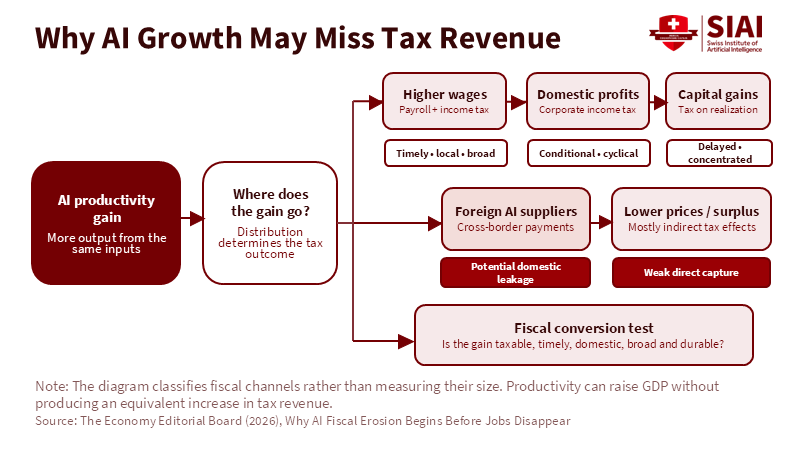
The confusion starts with the language we use. We say "artificial intelligence increases productivity" as if it were a single measurement, when there are four distinct levels of analysis hidden, each with its own question and logic. The first level is technical productivity: can an AI system produce more or better output with fewer inputs? Here the data is relatively clear, at least at the level of specific tasks. The second level is economic value: who receives the resulting income and profits? Is the third the taxable value: can governments effectively tax these profits, given the mobility of capital? And the fourth is fiscal capacity: is the additional revenue saved or spent before it even appears in books?
Starting from this separation, it becomes easier to see why the public debate about AI and public finances so often confuses technical performance with fiscal capacity. These are three varied sizes, not one and increasing the first does not automatically imply an increase in the third. This confusion is not merely semantic. When a business executive says that artificial intelligence "increases productivity by forty percent," he is almost always talking about the first level, that of a specific task measured in laboratory conditions. When a politician promises that the same technology will "save the budget," he is implicitly talking about the fourth level, without having proven anything about the two in between.
Artificial Intelligence, Interest Rates and the Productivity-Revenue Gap
The central question is not whether artificial intelligence will solve the American fiscal problem, an issue that has already been discussed extensively elsewhere. The more relevant question is whether the benefits of a real increase in productivity at work will be redistributed more widely in society or whether they will be concentrated in a few hands while the rest bear the costs of the transition.
Companies have poured huge capital into artificial intelligence infrastructure, data centers, chips and energy, but we do not yet see a similar economic return at the level of balance sheets, as shown by the distance between individual time gains and national productivity figures, a distance that the literature now calls the paradox of artificial intelligence productivity. As long as this gap between capital expenditure and yield remains open, the slower any benefit will spread to the wider economy.
There is a second side to this gap, which is related to interest rates. Building data centers, buying chips and securing energy require capital on a scale not seen before in such a brief period of time, as the recent tension in bond markets shows. As demand for capital rises faster than domestic savings, borrowing costs tend to go up as well, even if the underlying technology eventually delivers the expected benefits. The result is a paradoxical dynamic: the same investment that promises future productivity is currently driving up the cost of money for everyone, including the public sector, before any benefit in tax revenues is even confirmed.
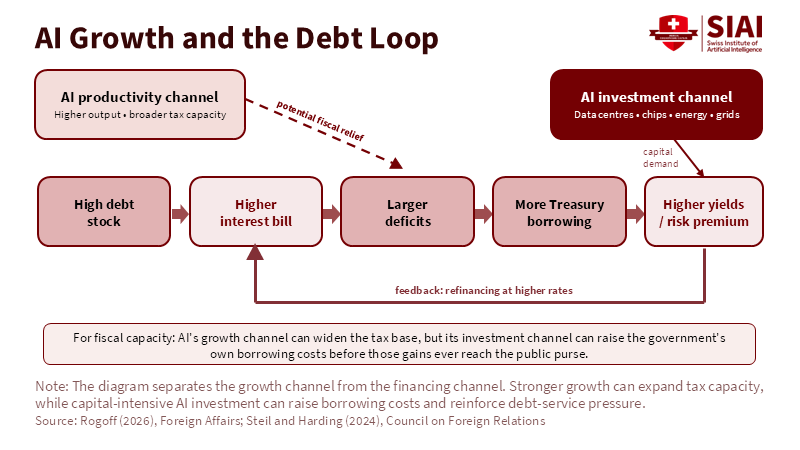
We are already seeing the first symptom of this delay: workers' incomes are not rising, on the contrary, in many sectors, workers are being laid off before it is even proven that technology can completely replace them. Companies seem to be cutting staff based on expected productivity gains, not confirmed ones. Without increased labor income, higher productivity does not guarantee more tax revenues, which is confirmed by a recent study on the fiscal erosion caused by artificial intelligence. This point partly overlaps with the broader debate on U.S. public debt though the emphasis here is different: the more pressing question is not whether the state finds enough revenue, but whether workers see their share first. And there's a third, more worrying scenario: Despite high productivity, rising unemployment could force central banks to turn to expansionary monetary policy, an inverted version of stagflation not yet seen in modern economic data, with high output and low employment coexisting instead of low output and high inflation.
The Government Cannot Spend an AI Dividend Before It Exists
A second concern involves timing. The political process does not wait for confirmation before committing. The expectation of future revenues from artificial intelligence may already finance, at least rhetorically, new spending commitments, while the revenues themselves remain hypothetical. This pattern has repeated across recent technological cycles: promise precedes proof and when proof is delayed, spending commitment has already become politically irreversible.
The problem is not just fiscal; it is also institutional. A state that plans its budget around expected productivity gains, rather than confirmed revenues, shifts risk to the future without openly acknowledging it. If profits are delayed, as the data on the gap between capital expenditure and return show, the state finds itself with new obligations and without the revenues that justified them. This pattern is already visible in proposals for tax breaks and expanded benefits that explicitly invoke the future of artificial intelligence as an excuse.
The dynamic resembles borrowing against an inheritance that has not yet been liquidated. Borrowing against an inheritance that may be delayed, reduced or contested is rarely considered sound practice. But governments are often under more political pressure to behave just like that, especially when the alternative is to explain to voters why they are not yet sharing in the benefits of a technology that the government itself has touted as transformative.
From Compute to Tax Revenue: The Missing Institutional Link
A third point concerns what might be called the institutional chain: the series of steps needed to convert computing power into tax revenue. This chain does not yet exist in full form in most major economies. It needs tax systems capable of identifying where value is created, not just where it is accounted for. It also takes political will to tax capital at least as effectively as labor, which the current systems, based largely on wage taxes, do not do well.
A concrete example helps make the issue more tangible. Taxation of data centers, one of the most visible tangible expressions of investment in AI, proves disproportionately difficult precisely because the geography of value does not coincide with the geography of physical establishment, as a recent analysis on data center taxation shows. A building full of servers may be in one area, while the profits it generates are accounted for elsewhere, with the result that the local community bears the costs of energy and infrastructure without a corresponding tax benefit.
Without this institutional link, the technical progress of artificial intelligence may well continue for years without ever translating into a corresponding fiscal capacity. This is not pessimism towards technology, but realism towards the institutions that manage it. AI can completely change how value is generated in an economy, though that doesn't mean it will change how that value is shared just as quickly. This gap, between the speed of technological change and the slow adaptation of institutions, is likely to shape the political economy of the next decade more than any individual growth forecast.
It is no longer enough to ask whether AI will make the economy bigger. We must ask who will keep the biggest chunk, what part will ever go to the public purse and what will happen to the people who lose their jobs in the meantime, before anything is proven at the level of national accounts. Technical productivity, taxable value and fiscal capacity will remain three different quantities if we do not consciously build the bridge between them. This bridge depends on institutional choices that have not yet been made, not on technology alone and the longer we delay making them, the harder it becomes to build confidence in AI's benefits among those who have not yet seen them.
This article reflects the analytical judgment of the author and does not constitute policy advice or the official position of any affiliated institution.
Publications under SIAI Editor are prepared or coordinated by SIAI’s research and editorial team and include research synthesis, policy and industry analysis, technical interpretation, and interdisciplinary work connecting artificial intelligence with established fields of research and professional practice.
Similar Post