Superhuman Labor and the Feedback Loop No One Is Watching

Publications under SIAI Editor are prepared or coordinated by SIAI’s research and editorial team and include research synthesis, policy and industry analysis, technical interpretation, and interdisciplinary work connecting artificial intelligence with established fields of research and professional practice.
Published
Modified
AI tools now let researchers work like small teams
Explosive growth needs fresh judgment, not recycled output
The real bottleneck has shifted from compute to people

Initially, optimists were dismissed because people naturally assumed, when anyone argued that each new AI tool would create a runaway feedback loop of self-improvement, that they simply didn't understand what it was they were talking about. Large models predict text and they don't think in the way humans think and to confuse their output with being intelligent struck one as a bit of a category mistake that had simply been dressed up in technical language. This comfortable doubt enabled people to dismiss the outlandish predictions.
Since then the position has only moved a little. Not because the models suddenly changed into something new, but because the implementation of what "superhuman labor" really entails exposes how close it is to the feedback loop idea, which was quickly thrown out. They are not the same, but they are both close enough for the dismissal of one to easily lead to an underestimation of the other.
A Researcher Who No Longer Required Assistance
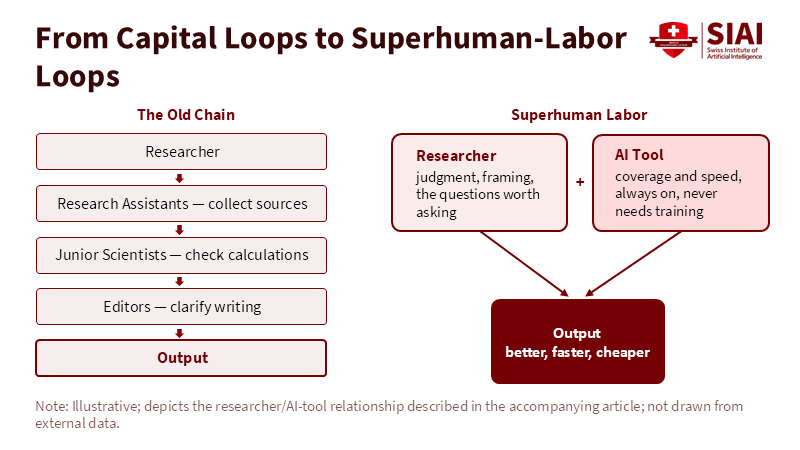
Imagine a researcher working in a subfield they do not know well. Under the old model, success required a chain of individuals: research assistants collecting sources, junior scientists double-checking calculations, editors clarifying writing. Every extra individual added to that process not only took more time, but cost something in coordination expense, plus the same chunk of the researcher's attention, since those other people needed to be managed. That chain has not vanished, but for an increasing fraction of those activities, it has been replaced by a single person working alongside AI tools.
What has changed is not that the researcher is smarter. What has changed is that the missing pieces of a project, relevant literature to brief on, those small analytical steps that would already have taken an entire afternoon, are now being filled in by a system that is perpetually operational and never needs training. The researcher provides judgment, framing and the questions worth answering. The tool provides coverage and speed. The two together produce work that is better than what the researcher alone would have produced, faster than a team and at a cost so small next to a human salary that it is almost incidental, even if the system is not, literally, free. That is what superhuman labor means here: better, faster and cheap enough to matter. It does not mean artificial general intelligence.
From Assistant to Something Closer to a Partner
Superhuman labor, defined this way, still leaves humans in the driver's seat. The machine does the correcting, the retrieving, the composing; the human makes the decisions about what to go after. But the division is not necessarily a firm one and in some areas it has already shifted. Education is an obvious case, since the material being taught is usually already settled. An intelligent tutoring system does not have to come up with new knowledge; it only has to communicate what is known efficiently, adapt to a student's rate of learning and monitor comprehension periodically. Within that context, the division of labor between a human teacher and an AI system can be rather egalitarian and sometimes the machine does most of the work.
Research is the hardest case and this is where the analogy is most flawed. The open questions of a field are, by their very nature, yet to be answered anywhere, so an AI tool cannot simply retrieve the answer the way a tutoring system retrieves a known concept. What gets outsourced instead is a narrower species of mental work: sorting evidence, writing early attempts at argument, noting contradictions a fatigued brain would overlook. It is a smaller fraction of the total effort than in education, but a significant fraction and it is growing. If this trend is followed far enough, the split of effort in research begins to echo the division of labor already apparent within classrooms. At that point a closer approach to an intelligence explosion becomes conceivable, not because any one output pushes the state of the art, but because the volume and velocity of incremental successes snowball.
When the Loop Feeds on Itself
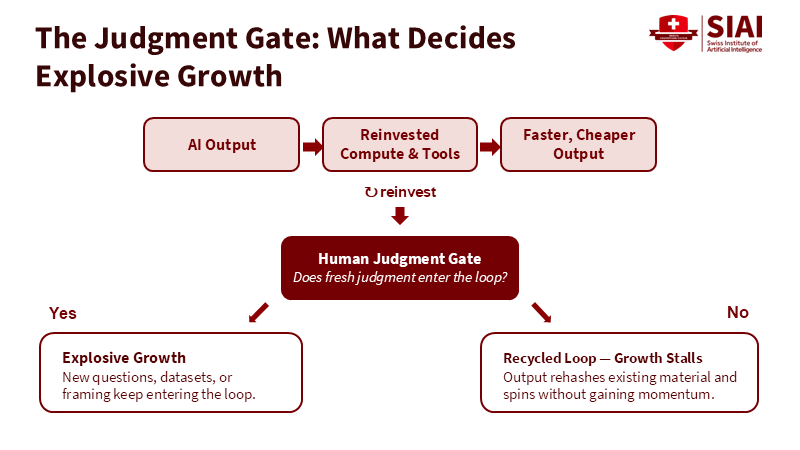
There is a flip side and a recent commentary on this very issue drives the point home. If the output of an AI system is largely just a rehashing of material already out there, then any feedback loop built on that output can never really escape itself; the system polishes existing ideas and sends them back out as though new and the loop simply spins in circles rather than gaining momentum. Human skill underlies this problem in a way that is easy to overlook. The senior researchers who now enable AI-enhanced work were themselves trained before these tools existed and their competence is being drawn down at a faster rate than it can be replenished, since the very shortcuts that make junior work easier can also be the shortcuts that prevent newer researchers from cultivating the competence their elders relied on.
That argument redefines what is actually necessary for an intelligence explosion to occur. It is not sufficient for a model to be merely fast or articulate. The system must have some point of new cognitive input to process and at this moment that point remains mostly human. A researcher providing a real question, a unique dataset, or a novel framing inserts into the loop something that was not already embedded in its training data. Without that input, the loop just spins its wheels, rephrasing itself again and again, producing a large quantity of output for no additional insight. Given the right kind of input, it might actually go somewhere.
The Bottleneck Has Moved to Humans
Combining these two ideas produces a more coherent picture. Superhuman labor is the output of a human working with AI tools to produce a lot more work, a lot more quickly and at a much lower price point. An intelligence explosion is what occurs when enough superhuman labor feeds back into the system across a field, provided the loop is fed genuine novel human input each time, rather than simply recycling its own material. The marginal quality gained per interaction with any particular tool may not be large, but accumulated over a discipline and over an extended time, that expansion is no longer modest.
In other words, the constraint has moved, not gone away. Compute and model quality still matter, but they are no longer the binding limit in the sectors where this phenomenon is furthest along. The bottleneck now is a human being, one capable of using these tools well and asking questions sharp enough to keep the feedback loop pointed at something genuinely new. That is a different kind of bottleneck than the one most people bring to the question of AI. It is not primarily a matter of hardware or training. It is a human bottleneck and it will not be solved simply by scaling models up. In the end, the optimists do not seem to have got the idea wrong about what AI actually does. What they are underestimating is how much still depends on the people doing the feeding and how quickly that dependency can take over.
This article reflects the analytical judgment of the author and does not constitute policy advice or the official position of any affiliated institution.
Publications under SIAI Editor are prepared or coordinated by SIAI’s research and editorial team and include research synthesis, policy and industry analysis, technical interpretation, and interdisciplinary work connecting artificial intelligence with established fields of research and professional practice.
Similar Post