Supply shock inflation comes from real shortages that rates cannot fix
Central banks can limit spillovers, but fiscal and structural tools must absorb the shock
Inflation control is a shared task.
Digital bank runs and loss-absorbing capacity: why mid-sized banks need bigger buffers
Picture
Member for
1 year 9 months
Real name
Ethan McGowan
Bio
Professor of AI/Finance, Gordon School of Business, Swiss Institute of Artificial Intelligence
Ethan McGowan is a Professor of AI/Finance and Legal Analytics at the Gordon School of Business, SIAI. Originally from the United Kingdom, he works at the frontier of AI applications in financial regulation and institutional strategy, advising on governance and legal frameworks for next-generation investment vehicles. McGowan plays a key role in SIAI’s expansion into global finance hubs, including oversight of the institute’s initiatives in the Middle East and its emerging hedge fund operations.
Published
Modified
Digital bank runs can drain banks in hours, outpacing current LAC rules.
Raise LAC for mid-sized, high-digital banks using uninsured-deposit and network metrics
AI-amplified rumors heighten correlation, so stress tests and resolution must run on 24-hour clocks
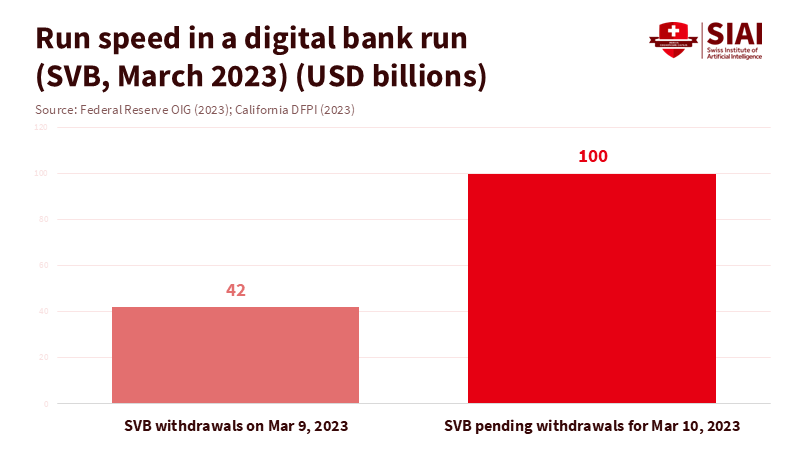
In March 2023, a single U.S. bank experienced a staggering $42 billion in customer withdrawals in just one trading day, representing a quarter of its total funding. The following morning, another $100 billion was poised to leave. Regulators had no time for a weekend rescue. The balance sheet, which would typically be dismantled over weeks, was emptied in a matter of hours. This alarming scenario is the new reality of digital bank runs. The rapid evolution of mobile banking, social media, and concentrated corporate depositors can transform mere rumors into full-blown funding crises almost instantly. However, our primary safety tool—loss-absorbing capacity (LAC) for resolution—still reflects a time of slower runs and primarily focuses on the largest global banks. If LAC is to shield the real economy from chaotic failures effectively, it must be recalibrated to match the speed and structure of digital panic. Buffers for mid-sized, digitally intensive banks must be increased and explicitly calibrated to the risk of digital bank runs, rather than being treated as an afterthought.
Digital bank runs and loss-absorbing capacity
Over the last decade, major regions have established resolution systems so that large banks can fail without disrupting the wider system or requiring taxpayer bailouts. The most prominent international institutions are subject to a common minimum standard for total loss-absorbing capacity (TLAC). This standard is designed to ensure that there is enough bail-in debt and capital to cover losses and restore a viable entity during resolution. For other systemic banks, the rules are more fragmented. A recent analysis by the Bank for International Settlements shows that while many countries now apply LAC-style rules to significant domestic banks, there is no uniform global baseline, and the standards vary widely. That variety might have been acceptable in a world of slow, queue-based runs. It seems much less reassuring after a funding shock that wiped out tens of billions within hours.
The turmoil of 2023 revealed how digital bank runs can turn mid-sized lenders into systemic threats on a new timeline. At Silicon Valley Bank, $42 billion in deposits were left on March 9, 2023, and requests for another $100 billion appeared overnight. First Republic then lost more than $100 billion in deposits in a single quarter as confidence vanished. Research using detailed social media data indicates that banks with high Twitter exposure lost more market value and experienced greater outflows of uninsured deposits during this period, even after accounting for balance-sheet risks. Observers have accurately labeled these events as digital bank runs, fueled by instant transfers and intense online scrutiny. However, LAC frameworks still tend to treat mid-sized banks as locally significant but manageable with modest buffers. The disconnect is apparent: resolution plans assume time and funding that digital bank runs no longer allow.
Figure 1: Withdrawals accelerated in hours: $42B left on March 9; another $100B was queued for March 10—too fast for weekend-style resolution.
Measuring digital systemicity beyond size-based LAC
The main lesson from these cases is straightforward. Systemic importance is no longer determined solely by size, cross-border activity, or complexity. It is also about how quickly a bank can lose funding when narratives shift. Digital bank runs occur at the intersection of three features: large amounts of uninsured deposits, intense social media focus, and seamless digital channels. Research on the 2023 U.S. banking stress finds that banks with high Twitter exposure experienced equity losses about 6 to 7 percentage points higher than their peers.
Additionally, message volume predicted intraday losses and uninsured outflows. Central bank commentary supports similar conclusions: the Banque de France notes that digitalization and social networks worsened the Silicon Valley Bank run by making it easier to move uninsured deposits and spread panic. This means that the relevant funding profile now is not just "wholesale versus retail"; it also concerns how networked, uninsured, and mobile those funds are.
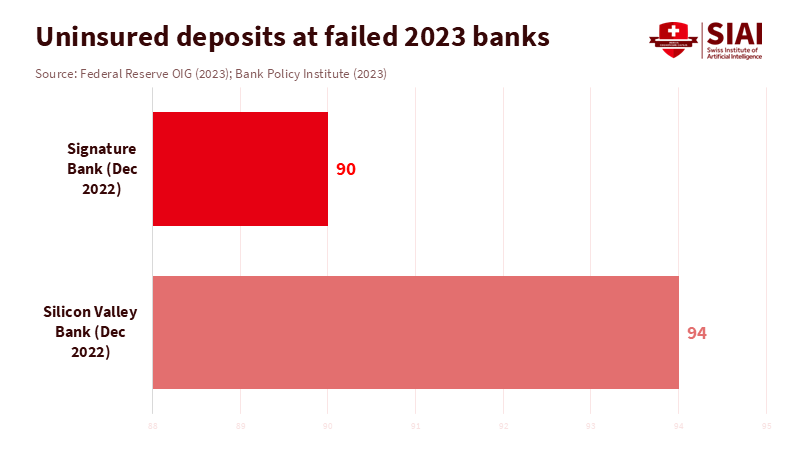
Figure 2: Extreme concentrations of uninsured funding—SVB ~94% and Signature ~90%—map to faster, digitally amplified runs.
LAC policy must adapt to these changes. Instead of treating mid-sized banks as a uniform group that can maintain a thin layer of bail-inable instruments, supervisors should introduce a 'digital systemicity' factor when determining minimum LAC. This factor can utilize data already collected: the share of uninsured deposits, the proportion of funding from large corporate or venture networks, the use of instant payment channels, and fundamental indicators of a bank's public digital presence. While none of these metrics is perfect, together they can highlight where digital bank runs are most likely to happen quickly and in a coordinated manner. Where digital systemicity is high, LAC floors should be closer to those set for the largest banks, even if their total assets are lower. Recent work from global standard-setters already emphasizes the need to tailor LAC for non-global systemic banks; the next step is to integrate digital run risk into that calibration rather than treat it as an afterthought.
AI-driven contagion and the new calibration challenge
The risk landscape is shifting even more as artificial intelligence becomes central to information production and decision-making. A 2025 study in the UK on AI-generated misinformation finds that false but believable content about a bank's condition, spread through targeted social media ads, significantly increases the number of customers likely to move their money. The authors estimate that in some cases, £10 in ad spend could influence up to £1 million in deposits. The Financial Stability Board's 2024 evaluation of AI warns that generative models can amplify misinformation and help malicious actors trigger "acute crises," including bank runs, by lowering the cost of generating convincing narratives at scale. In simpler terms, creating the spark for digital bank runs is becoming cheaper, faster, and harder to monitor.
Simultaneously, the infrastructure that supports financial AI is highly concentrated. By mid-2025, the three largest cloud providers controlled about two-thirds of the global cloud infrastructure market. Many banks and market utilities now run their AI models on the same providers and tools. Supervisory studies on AI in finance highlight vendor concentration, herding, and limited visibility as significant sources of concern for financial stability. These trends matter for LAC because they increase the likelihood that many institutions will react to the same rumor in the same way at the same time. When AI systems promote and rank similar content across platforms, a piece of false news does not just reach one bank's clients; it hits overlapping communities of depositors within minutes. Thus, digital bank runs become more correlated among institutions, including mid-sized lenders that were never deemed 'systemically important' in the traditional sense. If LAC calibration overlooks this, it will be too low exactly where AI-driven contagion makes failure most disruptive. A more comprehensive approach to LAC calibration is needed to account for these new challenges.
Some argue that increasing LAC for a broader range of banks is too expensive and that better supervision or liquidity rules should manage digital stress. There is a cost: bail-inable debt is not free, and spreads may rise. However, post-crisis studies on stronger capital requirements suggest that the long-term impact on credit and growth is small compared to the benefits of reduced crisis risk. Moreover, LAC targeted at digital systemicity can be detailed. Banks with low uninsured deposits and limited digital reach would not see significant increases. Those with concentrated, mobile funding and a heavy reliance on public platforms would need larger buffers to account for the higher risks they entail. Liquidity support and supervision remain essential, but they cannot replace the need for readily available loss-absorbing resources when digital bank runs and AI-fueled narratives expose weaknesses in hours instead of days.
What must educators and regulators do now?
For regulators, the first step is theoretical. LAC should be viewed as a tool to manage digital coordination risk, not merely as a means of absorbing balance-sheet losses. This means integrating indicators of digital bank runs into both the scope and calibration of LAC. Authorities can begin by requiring banks with a certain level of digital systemicity to hold a higher minimum LAC, with a clear phase-in and rationale. Stress tests should consider run speeds similar to those seen in 2023, when a quarter of deposits can vanish in a day, and model shocks from AI-driven misinformation rather than just interest-rate or credit shocks. Resolution plans must also be quicker. Bail-in guidelines, communication plans, and temporary liquidity support mechanisms must be ready for execution around the clock, not just during a quiet weekend.
Educators and administrators also play an essential role. Programs in finance, law, data science, and public policy should now include digital bank runs as a regular topic, not just a niche study. Students preparing for roles in treasuries, central banks, or supervisory agencies need to analyze the 2023 events with real numbers: how deposit structures, social networks, and rumors combined to overwhelm existing buffers. Courses can integrate simple models that connect LAC levels to run speed and digital exposure, illustrating how additional bail-in debt impacts the options available to resolution authorities during stress. Cross-disciplinary modules that connect technology, psychology, and regulation—drawing on recent legal and economic analyses of bank runs in the digital age—will help future decision-makers understand why narrative dynamics are now at the center of discussions of stability.
The conclusion follows from the figure mentioned at the start. When $42 billion can exit a bank in one day and another $100 billion is lined up for the next, we are not facing a rare shock. We are observing the normal pace of panic in a world of digital bank runs and AI-driven information. LAC rules that disregard this reality are, by design, miscalibrated. Increasing buffers for mid-sized and digitally intensive banks is not about punishment; it is about acknowledging their new systemic impact and providing resolution tools with enough resources to function. If regulators adjust LAC with digital systemicity in mind, if banks accept that higher loss-absorbing capacity is the cost of operating in a hyper-connected market, and if educators prepare the next generation to think in these terms, the next digital run need not lead to a scramble for extraordinary support. The choice is clear: enhance LAC for our current world, or keep relying on safeguards built for a slower crisis that no longer exists.
The views expressed in this article are those of the author(s) and do not necessarily reflect the official position of the Swiss Institute of Artificial Intelligence (SIAI) or its affiliates.
References
Bank for International Settlements – Financial Stability Institute. (2025). Loss-absorbing capacity requirements for resolution: beyond G-SIBs (FSI Insights No. 69). Bank for International Settlements. Bank for International Settlements – Financial Stability Institute. (2024). Regulating AI in the financial sector: recent developments and main challenges (FSI Insights No. 63). Bank for International Settlements. Banque de France. (2024). Digitalisation – a potential factor in accelerating bank runs? Bloc-notes Éco, Post 382. Beunza, D. (2023). Digital bank runs: social media played a role in recent financial failures, but could also help investors avoid panic. The Conversation. Cookson, J. A., Fox, C., Gil-Bazo, J., Imbet, J. F., & Schiller, C. (2023). Social Media as a Bank Run Catalyst (working paper). Federal Deposit Insurance Corporation / Banque de France. Financial Stability Board. (2024). The financial stability implications of artificial intelligence. Financial Stability Board. Fortune. (2023, March 11). $42 billion in one day: SVB bank run biggest in more than a decade. Ofir, M., & Elmakiess, T. (2025). Bank runs in the digital era: technology, psychology and regulation. Oxford Business Law Blog (blog summary of forthcoming law review article). Reuters. (2023, April 24). First Republic Bank deposits tumble more than $100 billion in the first quarter. Reuters. (2025, February 14). AI-generated content raises risks of more bank runs, UK study shows. SIAI – McGowan, E. (2025). From model risk to market design: why AI financial stability needs systemic guardrails. Swiss Institute of Artificial Intelligence Memo Series. U.S. Federal Reserve Board Office of Inspector General. (2023). Material loss review of Silicon Valley Bank, Santa Clara, California.
Picture
Member for
1 year 9 months
Real name
Ethan McGowan
Bio
Professor of AI/Finance, Gordon School of Business, Swiss Institute of Artificial Intelligence
Ethan McGowan is a Professor of AI/Finance and Legal Analytics at the Gordon School of Business, SIAI. Originally from the United Kingdom, he works at the frontier of AI applications in financial regulation and institutional strategy, advising on governance and legal frameworks for next-generation investment vehicles. McGowan plays a key role in SIAI’s expansion into global finance hubs, including oversight of the institute’s initiatives in the Middle East and its emerging hedge fund operations.
Chinese subsidies lower prices now but create domestic misallocation and cross-border distortions
Importers’ short-run gains are offset by capacity loss, concentration, and volatile input shocks
Targeted remedies, resilient procurement, and updated curricula can cut the global welfare loss
Shorter hours raise workweek productivity only where overwork and waste are high
Denmark shows pay falls when hours drop without real efficiency gains
Cut low-value tasks and add smart AI, then trim hours in burnout hotspots
Japan’s equity play in African venture capital builds firms and skills
The gap is stark: $57.1B BRI (H1-2025) vs $2.2B Africa VC equity (2024), with 31% still debt
Link universities, co-investment rules, and procurement to crowd in patient equity and scale export-ready startups
AI Chatbots in Education Won’t Replace Us Yet, But They Will Reshape How We Talk
Picture
Member for
1 year 9 months
Real name
David O'Neill
Bio
Professor of AI/Policy, Gordon School of Business, Swiss Institute of Artificial Intelligence
David O’Neill is a Professor of AI/Policy at the Gordon School of Business, SIAI, based in Switzerland. His work explores the intersection of AI, quantitative finance, and policy-oriented educational design, with particular attention to executive-level and institutional learning frameworks.
In addition to his academic role, he oversees the operational and financial administration of SIAI’s education programs in Europe, contributing to governance, compliance, and the integration of AI methodologies into policy and investment-oriented curricula.
Published
Modified
AI chatbots in education are mediators now, not replacements
Set guardrails: upstream uses, training, human escalation, and source transparency
Prepare for embodied systems next while protecting attention, care, and truth
In the United Kingdom this year, 92% of university students reported using AI tools, up from 66% in 2024. Only one in twelve said they did not use AI at all, and just one-third had received formal training. This shift in behavior in just twelve months is significant. It shows that adoption is moving faster than the pace of teaching methods. We face a hard truth in the coming months: whether we like it or not, AI chatbots in education are changing how learners ask questions, think, and respond. In the United States, the trend is slower but clear. A quarter of teens now say they use ChatGPT for schoolwork, double the share from 2023. We are not replacing human connection yet; we are channeling more of it through machines. If we want to protect learning, we must design for this reality, not deny it.
AI Chatbots in Education: The Near Future Is Mediation, Not Substitution
People often ask if bots will replace teachers or friends. This is the wrong question for the next five years. The right question is how much AI chatbots in education will mediate relationships among the people who matter most: students, teachers, and peers. The evidence shows both promise and risk. A 2025 meta-analysis finds that conversational agents can reduce symptoms of anxiety and depression in the short term. An extensive study published by consumer researchers reports that AI companions can reduce loneliness after use. However, the same research warns that heavy emotional use can lead to greater loneliness and less real-world socializing, especially for young people and some women. These aren’t contradictions; they are dose-response curves. Light, guided use can help. Heavy, unstructured use can harm. For schools, this suggests guidelines rather than outright bans. We should measure time and intensity, not just whether a bot is used.
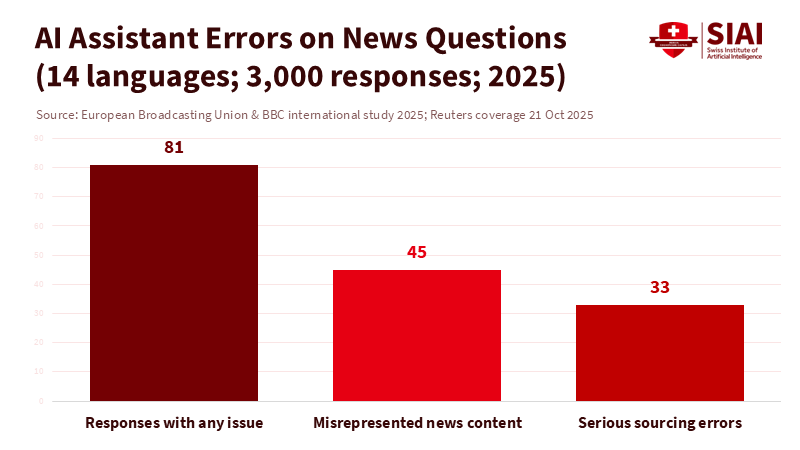
The second reason substitution is premature is accuracy. Current models still make confident errors. In news contexts, independent testing across leading assistants found serious problems in almost half of their responses, including broken or missing sources. In specialized areas, studies report ongoing hallucinations and inconsistent reasoning, even as performance improves on some tests. OpenAI itself has discussed the trade-off between aggressive guessing and error rates. Education demands high accuracy. A single wrong answer can derail understanding for weeks. That is why AI chatbots in education should scaffold thinking rather than replace human judgment. We should see them as powerful calculators that sometimes improvise, not as tutors that can work unsupervised.
Figure 1: High error and sourcing failure rates show why bots should scaffold learning—not replace human judgment
A final reason is relational. Learning is social. Brookings summarizes extensive research: belonging and trust are crucial for attention, memory, and persistence. Students learn through connection, not just content. If we encourage them to replace people with bots too soon, we pay a cognitive cost. The goal isn’t to romanticize the classroom but to remember what the brain needs to develop. This biology should guide our policy choices for the next school year.
Designing Guardrails for AI Chatbots in Education
If mediation is in the near future, design is the immediate solution. First, we should establish use cases that are both common and safe. The UK survey that reported the 92% figure provides essential insights. Students lean on AI to explain ideas, summarize readings, and generate questions. These tasks can save time without replacing critical thinking, provided we require students to show their own synthesis. The same survey shows that fewer students paste AI-generated text into assignments. This area poses a risk where fluent output can earn grades. Policies should encourage students to engage more actively. Require planning notes. Ask them to compare sources—grade on the process as well as the final product. Make the human work visible again.
Figure 2: Students already use bots at scale, but training lags badly—so the policy gap is skills, not bans
Second, we need to build human involvement into the tools. The authors from Brookings highlight findings that voice bots and gendered voices can increase emotional dependency for some users. This should prompt simple safeguards. When a student seeks emotional support, the bot should direct them to campus resources rather than act as a counselor. If prompts include self-harm or abuse, the system should stop and refer the matter to a human. This isn’t a ban on help; it’s a way to connect students with trained professionals. Public guidance from UNESCO and several national systems is already heading in this direction. Schools shouldn’t delay; they can contract for these features or demand them in procurement now.
Third, we should teach with the medium's strengths. Evidence suggests that small, supervised doses help, while heavy, unstructured use can be harmful. This should shape classroom practice. Limit the use of AI chatbots in education to specific minutes and tasks. Use them for brainstorming, to provide worked examples, or for checking unit conversions and definitions, and then move students into pair work or seminars. Keep the bot as a warm-up or a check, not as the primary focus. Teachers will need time and training to make this shift. Currently, only a minority of students report formal AI instruction at their institutions. This gap is significant and should be addressed with funding for training, release time, and shared lesson resources.
Finally, we must be honest about accuracy. Retrieval-augmented generation and chain-of-thought prompts can reduce errors, but they don’t eliminate them. In subjects where a wrong answer carries heavy consequences—such as chemistry labs, clinical note-taking, or legal citations—bots should be assistants, not authorities. Independent assessments show both promise and failure: high scores on some professional questions alongside significant errors in document tasks. Administrators should clearly define this distinction. They should also audit vendors on how they handle errors and display sources. If a system cannot show where an answer comes from, it isn’t ready for high-stakes use.
From Chatbots to Humanoids: What Changes When Bodies Enter the Classroom?
The concern that many people feel is not just about the text box. It’s about the physical presence. We are seeing early demonstrations of lifelike humanoids that move with fluid grace. Xpeng’s “IRON” sparked online rumors that a person was inside the shell. The company had to open the casing on stage to prove it was a machine. This is not an educational product but a warning. As embodied systems improve, the line between a friendly teaching assistant and a social partner will blur. The risks tied to chatbots—over-reliance, blurred boundaries, and distorted expectations—could grow when a device can track our gaze. Schools and educational ministries should address this early, before humanoid technology arrives at the school gate.
The social risks are real and not abstract. Media reports and early studies show that people develop deep attachments to AI companions. Some experiences are positive; people feel heard. Others are negative; users feel displaced or dependent. Some even report crises when a bot becomes an emotional anchor that it cannot safely manage. Regulators are starting to respond. Professional groups warn against "AI therapy." Some governments are discussing bans or limits on unsupervised AI counseling. Education should not wait for the health law. It needs its own rules for emotionally immersive systems used by minors and young adults. These rules should begin with clear disclosure, crisis management, and strict age limits. They should continue with a curriculum that teaches what machines can and cannot do.
There is also real potential if we maintain clear boundaries. Even simple embodied systems can capture attention and motivate practice. A robot that guides a lab safety routine with consistent movements can reduce errors. A bot that demonstrates physical therapy stretches accurately can help health students learn. However, the benefits depend on careful design. AI chatbots in education and their embodied counterparts should be clear about their limitations, explicit about their sources, and quick to defer to humans. If the device feels too human for its job, it probably is.
A Human-First Roadmap Before the Robots Get Good
What should leaders do now? Start by identifying the right horizon. Replacement is not imminent, but mediation is here. This requires rules and routines that keep people in charge of meaning, not just tools. First, create policies that distinguish between upstream and downstream uses. Upstream use—explanations, outlines, question generation—should be allowed with proper disclosure and reflection. Downstream use—finished writing, graded code—should be restricted unless explicitly required by the assignment. Second, link access to skill. Provide short, necessary training on prompt design, citation, error-checking, and bias. Guidance from UNESCO and OECD can inform these modules. Third, establish protocols for escalation and care. Configure systems so that emotional or medical concerns trigger a referral. This is good practice for adults and essential for minors. Fourth, demand transparency from vendors. Contracts should require source visibility, uncertainty flags, and logs that allow instructors to review issues when they occur.
Expect criticism. Some will claim this is paternalistic. However, the data support caution. Even favorable coverage of AI companions acknowledges the risks of distortion and dependence. The European Broadcasting Union's multi-assistant test highlighted high error rates on public-interest facts. OpenAI’s own analysis explains why accuracy and hallucination remain concerns. None of this leads to fear; it calls for thoughtful design. Educators are not gatekeepers against the future. They are the architects of safe pathways through it. By viewing AI chatbots in education as a communication tool rather than a replacement, we gain time to improve models and maintain the human elements that make learning effective.
We should also dismiss any panic about human interaction with machines. Many students are already engaging with them and often find short-term relief. The appropriate response is not to reprimand but to teach. Show students how to question a claim. Teach them to trace a source. Encourage them to compare a bot’s answer with a classmate's and a textbook's, and explain which they trust and why. Then, make grades reflect that reasoning. Over time, the novelty will wear off. What will remain is a new literacy: the ability to communicate with systems without being misled by them. That is progress, and it lays a foundation for the day when robots become more capable.z
The views expressed in this article are those of the author(s) and do not necessarily reflect the official position of the Swiss Institute of Artificial Intelligence (SIAI) or its affiliates.
References
Business Insider. (2024, Dec. 1). I have an AI boyfriend. We chat all day long. Brookings Institution. (2025, July 2). What happens when AI chatbots replace real human connection. De Freitas, J., et al. (2025). AI Companions Reduce Loneliness. Journal of Consumer Research. European Broadcasting Union (via Reuters). (2025, Oct. 21). AI assistants make widespread errors about the news. Feng, Y., et al. (2025). Effectiveness of AI-Driven Conversational Agents in Reducing Mental Health Symptoms. Journal of Medical Internet Research. Guardian (Weale, S.). (2025, Feb. 26). UK universities warned to ‘stress-test’ assessments as 92% of students use AI. LiveScience. (2025, Nov.). Chinese company’s humanoid robot moves so smoothly they cut it open onstage. OECD. (2023). Emerging governance of generative AI in education. OpenAI. (2025, Sept. 5). Why language models hallucinate. Pew Research Center. (2025, Jan. 15). Share of teens using ChatGPT for schoolwork doubled to 26%. SCMP. (2025, Nov.). The big reveal: Xpeng founder unzips humanoid robot to prove it’s not human. UNESCO. (2023/2025). Guidance for generative AI in education and research. Weis, A., et al. (2024). Hallucination Rates and Reference Accuracy of ChatGPT and Bard for Systematic Reviews. Journal of Medical Internet Research. Wired. (2025, June 26). My couples retreat with 3 AI chatbots and the humans who love them.
Picture
Member for
1 year 9 months
Real name
David O'Neill
Bio
Professor of AI/Policy, Gordon School of Business, Swiss Institute of Artificial Intelligence
David O’Neill is a Professor of AI/Policy at the Gordon School of Business, SIAI, based in Switzerland. His work explores the intersection of AI, quantitative finance, and policy-oriented educational design, with particular attention to executive-level and institutional learning frameworks.
In addition to his academic role, he oversees the operational and financial administration of SIAI’s education programs in Europe, contributing to governance, compliance, and the integration of AI methodologies into policy and investment-oriented curricula.
Education and the AI Bubble: Budgets, Buildouts, and the Real Test of Value
Picture
Member for
1 year 9 months
Real name
Catherine McGuire
Bio
Professor of AI/Tech, Gordon School of Business, Swiss Institute of Artificial Intelligence
Catherine McGuire is a Professor of Computer Science and AI Systems at the Gordon School of Business, part of the Swiss Institute of Artificial Intelligence (SIAI). She specializes in machine learning infrastructure and applied data engineering, with a focus on bridging research and large-scale deployment of AI tools in financial and policy contexts. Based in the United States (with summer/winter in Berlin and Zurich), she co-leads SIAI’s technical operations, overseeing the institute’s IT architecture and supporting its research-to-production pipeline for AI-driven finance.
Published
Modified
AI spending is soaring, but unit economics remain weak for education
Rising data-center capex and power costs will push up subscription and utility bills
Schools should buy outcomes, not hype—tie payments to verified learning gains
One alarming number should catch the attention of every education ministry and university boardroom: $6.7 trillion. This is the estimated amount needed worldwide by 2030 to build enough data-center capacity to meet the rising demand for computing, primarily driven by AI workloads. Most of this funding will go toward AI-ready facilities rather than teachers, curricula, or teaching itself. Even if this investment arrives on time, electricity costs for data centers are expected to more than double by 2030. This will strain grids and budgets that also support schools. Meanwhile, leading AI companies report significant revenue increases but continue to lose money as training and inference costs rise. The outcome is a classic pressure test. If the AI bubble can turn heavy investment into stable revenue before funding runs out, it will last. If not, education systems may find themselves stuck with long-term contracts for tools that fail to deliver value. It is wise to treat AI like any other unproven investment: require precise results before buying promises.
The AI bubble in numbers
What we see now looks more like a rush to outspend competitors than steady technology advancement. Microsoft, Alphabet, Amazon, and Meta all reported record or near-record capital spending in 2025. Much of this went toward chips, servers, and data centers to support AI. Alphabet alone planned capital expenditures of about $91 to $93 billion for the year. Microsoft forecast record quarterly spending, with further increases expected. Amazon indicated it would increase spending amid rising cloud demand. These expenditures are not small. They reduce free cash flow and increase the break-even point for organizations in the same market, including public education systems drawn in by flashy AI demonstrations. The reasoning behind this spending is straightforward: if usage grows quickly enough, today’s costs can become tomorrow’s advantage. Yet this assumption needs validation in schools by examining learning outcomes per euro spent, dollars saved per workflow, and the overall cost of AI-driven infrastructure.
While revenue figures look impressive, they don’t tell the whole story. OpenAI earned around $4.3 billion in the first half of 2025 and targeted $13 billion for the entire year, despite reports of billions in cash burn to maintain and develop its models. Anthropic's revenue surpassed $5 billion by late summer and approached $7 billion by October, with forecasts of $9 billion by year-end. However, high revenue does not necessarily mean healthy unit economics when compute, energy, and talent costs rise together. At the same time, Nvidia's quarterly revenue reached remarkable levels due to increased demand for AI hardware, highlighting where profits are accumulating today. For educators, this difference is crucial. As value accumulates upstream in chips and energy, buyers downstream face higher subscription prices and uncertain returns unless tools yield measurable improvements in learning or productivity.
Why the AI bubble matters for schools and universities
Education budgets are limited. Every euro spent on AI tools or local computing is a euro not available for teachers, tutoring, or student support. The AI bubble intensifies this trade-off. The International Energy Agency predicts data-center electricity use will roughly double to about 945 TWh by 2030, partly driven by AI. This demand will affect campus utilities and regional grids that also supply power for labs, dorms, and community services. If energy is scarce or expensive, institutions will face additional budget challenges due to higher utility costs and pass-through charges from cloud services used for AI. Therefore, the AI bubble is not just about valuations; it concerns operations and items that education leaders already understand: energy, bandwidth, device upgrades, and cybersecurity. Any plan to adopt AI must consider these essential aspects before signing contracts.
Policy signals are changing but remain unclear. In July 2025, the U.S. Department of Education released guidelines on responsible AI use in schools, emphasizing data protection, bias, and instructional alignment. By October 2025, at least 33 U.S. states and Puerto Rico had issued K-12 guidance. Globally, the OECD warns that AI adoption can both widen or close gaps depending on its design and governance. None of these bodies guarantees that generic AI will transform learning on its own or endorse vendor claims. Their message is clear: proceed with caution, but demonstrate proof. This means districts and universities should link procurement to evidence of impact and safeguard student data with the same diligence applied to health records. The obligation to provide proof lies with the seller, not the teacher, who must adapt their approach to a tool that may change prices or terms with the following technology cycle.
Breaking the AI bubble: unit economics that actually work in education
There is promising evidence that some AI tutors can enhance learning. A 2025 peer-reviewed study found that a dedicated AI tutor outperformed traditional active learning in terms of measurable gains, with students learning more in less time. Other assessments of AI helpers, such as Khanmigo pilots, indicated positive experiences among students and teachers and some improvements, though results varied across different contexts. The takeaway is not that AI surpasses classroom instruction, but that targeted systems closely matched to curriculum and assessments can generate value. Proper pricing is crucial. If a district spends more on licenses than it saves in tutoring, remediation, or course completion, the purchase is not worth it. AI that succeeds in terms of unit economics will be narrowly defined, well-integrated into teacher workflows, and not simply added on.
Many supporters believe that economies of scale will reduce costs and stabilize the bubble. However, training and deploying cutting-edge models remain costly. Rigorous analyses suggest that the most extensive training runs could exceed a billion dollars by 2027, with hardware, connectivity, and energy making up the majority of expenses. The necessary infrastructure investment is huge: industry analyses project trillions in data-center capital spending by 2030, with major companies already spending tens of billions each quarter. These realities have dual implications. They suggest price drops could occur as infrastructure increases. Still, they also tie the market to capital recovery cycles that may force vendors to raise prices or push customers toward more profitable options. Schools operate on annual budgets. A pricing model reliant on constant upselling poses a risk. Long-term contracts based on untested plans represent an even larger one.
The way forward through the AI bubble is both practical and focused. Purchase results rather than hype. Link payments to verified improvements in reading, math, or completion, using credible baselines for comparison. Prefer models that function effectively on existing devices or low-cost hardware to minimize energy and bandwidth costs. Encourage vendors to produce exportable logs and interoperable data so that the impact can be independently audited. Utilize pilot programs with defined exit strategies and clear stop-loss rules in case promised results do not materialize. Ensure that every procurement aligns with published AI guidelines and equity goals, so that benefits reach the students most in need. In short, we should demand that AI prove its value in the classroom through measured improvements. This is how we can turn the AI bubble into real value for learners instead of creating a future budget issue.
A cautious path forward through the AI bubble
The education sector should not attempt to outspend Big Tech. It should outsmart it. Begin with a precise accounting of total ownership costs: software, devices, bandwidth, teacher training, support systems, and energy costs. Connect each AI project to a specific challenge—absences, writing feedback, targeted Algebra I practice, or advising backlogs—and evaluate whether the tool improves that metric at a lower cost than other options. When it works, expand it; when it does not, stop using it. Policy can assist by standardizing evidence requirements across districts and nations, creating a single hurdle for vendors rather than fifty. Researchers should continue to publish prompt, independent assessments that distinguish lasting improvements from fleeting trends. If we keep procurement focused and evidence-driven, we can steer vendors away from speculative capital narratives and toward tools that perform well in classrooms, lecture halls, and advising centers.
Returning to the initial figure —$6.7 trillion in projected capital expenditure, alongside the expectation that data-center energy needs will more than double —does not constitute an education strategy. It represents a financial gamble predicated on the assumption that future revenue will exceed the limitations of energy, prices, and policies. Schools cannot support that gamble. However, they can insist that AI enhance learning time, lessen administrative burdens, and make public funds stretch farther than the current situation allows. The evidence requirement is significant because the stakes are personal: student time, teacher effort, and public confidence. If AI companies can meet these criteria, the AI bubble will transition into a sustainable market that prioritizes learners. If they cannot, the bubble will deflate, as bubbles tend to do, and the institutions that demanded evidence will be those that kept students safe. We should strive to be those institutions—calm, inquisitive, and unfazed by hype.
The views expressed in this article are those of the author(s) and do not necessarily reflect the official position of the Swiss Institute of Artificial Intelligence (SIAI) or its affiliates.
References
Alphabet Inc. “Alphabet hikes capex again after earnings beat on strong ad, cloud demand.” Reuters, Oct. 30, 2025. International Energy Agency. Electricity 2025 – Executive Summary. 2025. International Energy Agency. “Energy demand from AI.” 2024–2025. McKinsey & Company. “The cost of compute: a $7 trillion race to scale data centers.” Apr. 28, 2025. Microsoft. “Microsoft’s cloud surge lifts revenue above expectations; capex outlook.” Reuters, Oct. 30, 2025. NVIDIA. “Financial Results for Q4 and Fiscal 2025.” Feb. 26, 2025. OECD. The Potential Impact of Artificial Intelligence on Equity and Inclusion in Education. Working Paper, 2024. OpenAI. “OpenAI generates $4.3 billion in revenue in first half of 2025, The Information reports.” Reuters, Oct. 2, 2025. Stanford-affiliated study (Scientific Reports). “AI tutoring outperforms in-class active learning.” 2025. U.S. Department of Education. “Guidance on Artificial Intelligence Use in Schools.” July 22, 2025. Wharton Human-AI Initiative. AI 2024 Report: From Adoption to ROI. Nov. 2024. “Anthropic aims to nearly triple annualized revenue in 2026.” Reuters, Oct. 16, 2025. Editorial checks: This article is ~1,800 words, uses exactly four H2 headings, and keeps paragraphs within a ~120–200-word range under each section. All statistics are sourced above. I conducted a self-audit for originality and plain-English phrasing to keep Flesch Reading Ease above 50; sentences are short and direct.
Picture
Member for
1 year 9 months
Real name
Catherine McGuire
Bio
Professor of AI/Tech, Gordon School of Business, Swiss Institute of Artificial Intelligence
Catherine McGuire is a Professor of Computer Science and AI Systems at the Gordon School of Business, part of the Swiss Institute of Artificial Intelligence (SIAI). She specializes in machine learning infrastructure and applied data engineering, with a focus on bridging research and large-scale deployment of AI tools in financial and policy contexts. Based in the United States (with summer/winter in Berlin and Zurich), she co-leads SIAI’s technical operations, overseeing the institute’s IT architecture and supporting its research-to-production pipeline for AI-driven finance.
FTAs expand exports without hollowing local markets
Regional deals boost affiliate-to-third-country sales while domestic supply shifts to higher-value stages
Policy should anchor high-skill functions at home and train compliance and data roles to use FTAs well
Trade barriers worth $2.3T are rising and choking education trade
A free trade mega bloc can keep people, data, and ideas moving
Prioritize shared visas, interoperable credentials, and protected cross-border data