The AI Premium Is About Implementation, Not Access

His recent work examines the broader socioeconomic consequences of artificial intelligence, including labor markets, public finance, demographic change, institutional adaptation, and the distributional effects of technological progress.
He holds a PhD in Mathematical Finance from Boston University, and previously earned an MSc in Finance and Economics from the London School of Economics. He completed his undergraduate studies in Economics at Seoul National University under the Korea Foundation for Advanced Studies scholarship program.
Published
Modified
AI access is common; implementation creates value
Deeper AI use carries a stronger market signal
Future advantage will depend on workflow redesign and outcomes

In the first four months of 2024, weekly AI token consumption on one major routing platform sat in the billions. By April 2026, it had climbed past 15 trillion tokens a week, a cumulative jump of roughly 1,362 times in just over two years. That is the kind of number that makes AI adoption sound like a settled fact. Yet the same period produced surveys in which most companies claimed to be using AI, while most also reported no measurable change in productivity or staffing. Those two realities are not in conflict. They describe different things: how much AI capability exists in the world and how much of it has actually been built into the way a company works. That distinction is exactly what recent stock market evidence on the AI premium has started to price.
The Measurement Problem Behind AI Access
Corporate AI use gets counted in ways that blur together very different situations. A firm can be labeled an adopter because one employee has a chatbot license, because a single department redesigned a workflow around model output or because software has been wired directly into company data and decision systems. Official statistics tend to flatten these into one figure. Eurostat found that just under 20 percent of European Union firms with ten or more employees used at least one AI technology in 2025, while a narrower measure of AI actually used in production put the figure closer to 7 percent in the United States and 4 percent in the European Union. Federal Reserve researchers have pointed out that this kind of gap makes it hard to separate incidental experimentation from adoption that actually changes how work gets done. A cross-country survey of more than 5,000 senior executives captured the same disconnect directly: around 70 percent of firms reported active AI use, while more than 80 percent reported no effect on productivity or employment over the prior three years.
That combination, widespread reported use alongside limited measured impact, looks less like AI failing to deliver and more like an implementation lag. Buying access to a model is now cheap and fast. Connecting that model to real data, real workflows and real accountability structures is neither. Firms still need to decide who can use a model, what data it touches, how outputs get checked and who is responsible when something goes wrong. Those tasks resemble the kind of complementary investment that earlier general-purpose technologies also required before their productivity effects became visible in the numbers. Their current scarcity is part of what current asset prices appear to be reflecting.
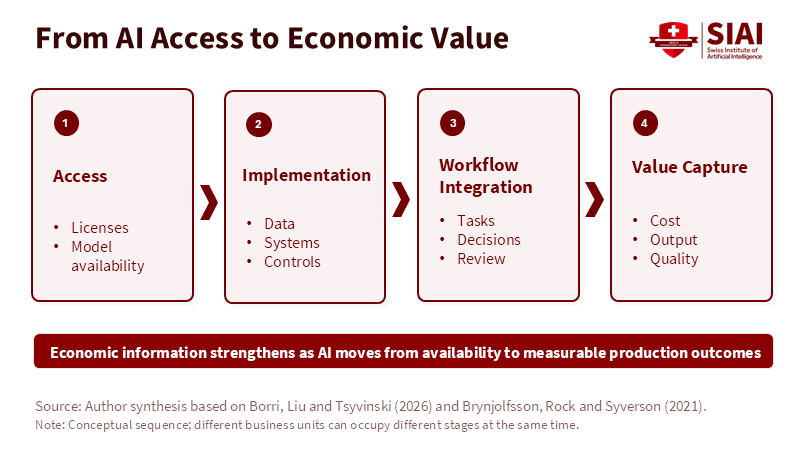
Nominal adoption figures amplify the confusion further once different surveys are placed side by side. One federal business survey put AI use at roughly 18 percent of firms once the question was broadened to cover any business function, while a separate employment-weighted survey produced a figure near 78 percent and a worker-level survey landed closer to 41 percent. Much of that spread comes down to differences in how the question is asked and how responses get weighted, rather than any real disagreement about how AI is being used. Corporate announcements suffer from a related problem. A statement that a company has launched an AI strategy could describe anything from a completed production redesign to an early budget line and mention counts in regulatory filings cannot tell those apart on their own.
What the AI Premium Actually Rewards
Recent asset-pricing research gives that idea a concrete test. Rather than relying on survey answers, one 2026 study built a market factor directly from realized AI consumption recorded through an API routing service between January 2024 and April 2026, covering roughly 380 trillion tokens across more than 400 models. Firms whose stock returns moved most closely with growth in that consumption factor went on to earn meaningfully higher returns than firms with low exposure, with a value-weighted spread of about 64 basis points per week in the baseline estimate. That spread is the empirical core of the AI premium described here. That spread held up after controlling for technology-sector exposure, semiconductor returns, AI-themed funds and public attention.
What matters for corporate strategy is how that signal changed with the type of consumption behind it. Exposure built from frontier, closed-source models produced a much stronger return spread than exposure built from open-weight usage. The same pattern showed up for paid and long-tenured accounts against new ones and for long, complex prompts against short ones. Casual and entry-level use barely moved the needle, while sustained, experienced, technically demanding use moved it substantially.
That gap is a more useful way to separate genuine deployment from superficial subscription counts than any binary yes-or-no adoption question could manage, since seat counts and registered users cannot tell a company that quietly builds real workflows around a model apart from one that lets its licenses go unused after an initial trial.
It is worth being precise about what a positive premium actually means here. It is a statement about the return investors require for taking on AI-related exposure, not a guarantee that markets assign higher present value to AI-heavy firms. A higher expected return can reflect stronger growth prospects, greater risk or both and technological shifts often raise uncertainty for exactly this reason: investors are still learning which businesses will benefit and which will not.
The signal also does not appear to be a short-lived reaction to headlines. Around frontier model releases, high-exposure firms outperformed low-exposure firms by roughly 1.9 percent over a five-day window, yet the broader spread persisted even after those release weeks were removed from the sample. Geography adds a further layer. The spread was a statistically meaningful 17.9 basis points per week in developed markets, while the corresponding emerging-market estimate was close to zero. That pattern is consistent with pricing being strongest where firms, investors and infrastructure sit closest to the technological frontier, rather than proof that firms in developed economies are inherently better at putting AI to use.
Implementation as the Scarce Input
The occupational pattern behind this premium reinforces the implementation story. Positive market-implied AI exposure clusters around installation, repair, programming, persuasion and other systems-oriented skills, while analytical, scientific and operations-control skills sit on the negative side. That does not mean installation work is permanently worth more than analysis. It more likely reflects where the current bottleneck sits. Before machine-generated analysis can be produced and used at scale, someone has to build the pipes: connect models to data, define access rules, train staff and design the checks that make outputs trustworthy. Field evidence backs this up in pieces. AI assistance raised issue-resolution rates for customer-support agents by 15 percent, concentrated among less experienced workers, while a controlled trial with experienced open-source developers found tools slowing them down on complex, familiar codebases. A workplace collaboration experiment at Procter and Gamble found that individuals working with AI could match the performance of two-person teams. None of these results point in one direction. Together, they show that the value of a model depends entirely on how it is wired into a specific task, not on the model itself.
Firm-size patterns tell a similar story. In 2025, just over 55 percent of large European Union enterprises reported using at least one AI technology, against roughly 30 percent of medium firms and 17 percent of small ones. Eurostat links that gradient to implementation complexity and the fixed costs of building the surrounding organizational capacity, not to differences in access to the underlying technology. A model endpoint can be purchased in an afternoon. The systems, training and internal trust needed to use it productively cannot.
Where the Premium Goes Next
This is where the current pattern of skill exposure should be read as a snapshot of an early phase rather than a fixed hierarchy. Installation, repair and systems-integration skills carry the strongest positive exposure to the AI factor today, while science and operations-control skills sit furthest on the negative side. As enterprise platforms, connectors and evaluation tooling become standardized, the scarcity behind that installation premium should fade. Once most firms can wire a model into their systems with similar ease, that step stops separating leaders from followers and competitive advantage should shift toward what firms actually do with the resulting capacity: which tasks get delegated to models, how outputs get verified and how much expensive analytical work gets replaced without a loss in decision quality.
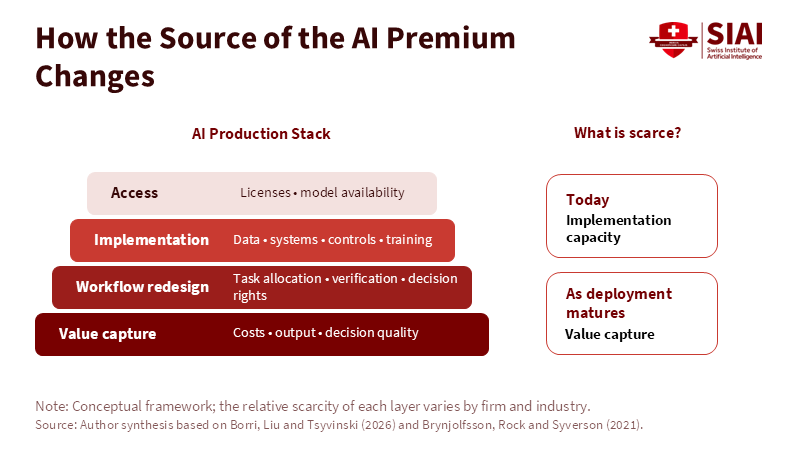
Underneath that shift sits a governance question companies will need to answer regardless of how standardized the tooling becomes. Generative outputs are plausible rather than fixed and their reliability varies by task and context. Checking every output erodes much of the cost advantage AI is supposed to deliver, while checking too little accumulates risk quietly until it surfaces somewhere expensive. Getting that balance right will matter more as analytical work itself becomes cheap to produce and responsibility for a decision cannot be handed off to a model along with the analysis behind it. That is why coordination, judgment and persuasion stay valuable even as raw analytical output becomes commoditized.
The jump from billions to trillions of tokens a week describes how much AI capability now exists in the economy. It says very little about which firms have turned that capability into lower costs, faster decisions or better outcomes and the market evidence so far agrees: it is the depth and sophistication of use, not the scale of access, that carries pricing information today. The practical takeaway for any company evaluating its own AI strategy is straightforward. Counting licenses or usage claims will not reveal much. What will matter, now and increasingly over time, is whether AI has actually been built into how decisions get made and work gets done.
This article is based on an original research article published by The Economy Research. For the original version, please refer to From AI Access to Organizational Capability: Pricing the Corporate AI Transition.
This article reflects the analytical judgment of the author and does not constitute policy advice or the official position of any affiliated institution.
His recent work examines the broader socioeconomic consequences of artificial intelligence, including labor markets, public finance, demographic change, institutional adaptation, and the distributional effects of technological progress.
He holds a PhD in Mathematical Finance from Boston University, and previously earned an MSc in Finance and Economics from the London School of Economics. He completed his undergraduate studies in Economics at Seoul National University under the Korea Foundation for Advanced Studies scholarship program.
Similar Post