Why AI War Crimes Accountability Starts With a Missing Defendant

Publications under SIAI Editor are prepared or coordinated by SIAI’s research and editorial team and include research synthesis, policy and industry analysis, technical interpretation, and interdisciplinary work connecting artificial intelligence with established fields of research and professional practice.
Published
Modified
AI reorganizes accountability for war crimes; it does not erase who is responsible
Ukraine shows cameras can prove intent; Gaza shows AI can obscure it
Synthetic media now lets perpetrators deny real evidence, demanding two preserved accountability chains
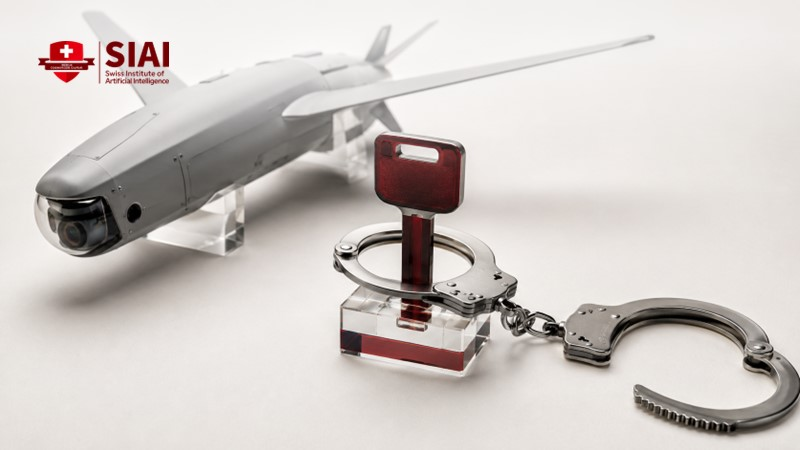
Two scenes are worth holding side by side. In the first, a row of men sits in a courtroom in 1945, confronted with their own signatures, their own orders, the people who carried those orders out. In the second, a drone circles a building, a model scores the odds that a shape on a screen is a fighter, and somewhere a strike happens with nobody visibly pulling anything. AI war crimes accountability has become urgent partly because these two scenes feel like they belong to different moral universes, and it's tempting to assume the second one lacks a clear answer to the question the first one settled: who did this.
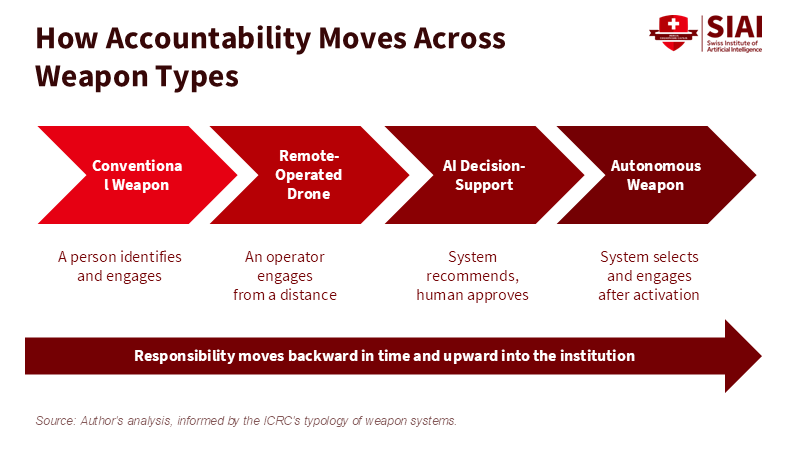
The assumption deserves more scrutiny than it usually gets. The instinct that automation erases responsibility has real philosophical pedigree, but it may be confusing a location problem with an absence problem. The people who decided to build a targeting system, trust its output, and put it into a live conflict zone are, in most cases, still identifiable. How many hands touch a decision, and how far back the real choices happen, is what has changed and how far back in time the consequential choices tend to get made. A war crime that once required someone standing close enough to see a face might now trace back through a procurement office, a training dataset, and a command policy set months before anyone opened a live feed. The chain has gotten longer and harder to follow. Whether it has become untraceable is a separate, harder question, and one this piece takes seriously rather than assuming away.
There's a second, newer complication layered on top of the first, and it may be the more difficult one to solve. Even when the human chain behind a strike can, in principle, be reconstructed, the visual record of what happened is now contestable in ways it rarely used to be. Generative tools can manufacture footage of an atrocity that never occurred, and they can just as easily be invoked to cast doubt on footage of one that did. Both moves push toward the same outcome: a public, and eventually a court, less able to say with confidence what happened and who should answer for it.
What Nuremberg Actually Proved
Return to that 1945 courtroom for a moment because the lesson people usually draw from it is worth revisiting. The common version says guilt always rises to the top, that the people who give orders bear it and the people who follow them are largely shielded. What the tribunal actually established was narrower, and arguably more useful for the present moment: an institution cannot fully absorb a crime the way a sponge absorbs water. A state can issue an order, but a state cannot be marched into a cell. Someone specific generally has to answer, and depending on what they knew, what they controlled, and whether a real choice was available to them, that someone can sit at almost any level of a hierarchy.
That last part is easy to underweight. Following orders was never treated as an automatic excuse under the postwar principles, but it wasn't treated as an automatic conviction either. The judgment asked what a person actually understood about what they were doing and whether they had meaningful room to refuse. That test was built for humans operating inside bureaucracies, and it translates, imperfectly but usefully, to humans operating inside algorithmic systems. A commander who activates a system with a known error rate, known blind spots, and a known population beneath it hasn't been replaced by that system so much as handed a decision with foreseeable consequences, which is the kind of decision legal systems have long claimed the ability to judge, even if doing so here will take real work.
Ukraine Suggests the Gap Is Often Manufactured, Not Built In
Skeptics of this argument sometimes point to Ukraine as evidence that drones create exactly the kind of anonymity that makes prosecution difficult. What the documentation there suggests is more complicated, and in places points the other way. Investigators looking into a sustained campaign of drone strikes on civilians in one Ukrainian region found operators using commercially available drones, watching their targets clearly enough on camera to identify a woman walking her dog or an ambulance arriving at a scene, and apparently striking anyway. Much of the footage came from channels linked to the units involved, posted in a way that reads less like concealment and more like indifference to being seen.
A camera, an apparent decision, and a surviving record don't look much like an accountability gap in the usual sense. There's a camera, an apparent decision, and a record that survived. What a case like this suggests is that precision and moral distance aren't necessarily the same thing. A system clear enough to let someone spare a civilian is also clear enough to let them target one deliberately, and when that happens, the technology hasn't obviously done much to the underlying chain of responsibility beyond making it easier, in this instance, to document. The pattern won't hold everywhere, but it's enough to show remote weapons don't automatically launder guilt on their own." (removes the duplicate.
Gaza Shows Where the Real Difficulty Sits
Gaza is the harder case, and it deserves to be treated as genuinely harder rather than waved past. There, by several accounts, artificial intelligence appears to have operated further upstream, generating and ranking lists of potential targets rather than simply assisting someone's aim. Reporting citing military intelligence sources described a system that flagged tens of thousands of names, paired with a review process that, according to those accounts, sometimes amounted to seconds of human attention before a strike was authorized. Independent human rights observers found the reported error rates and review times, if accurate, troubling enough to help explain casualty figures that would be difficult to account for through manual targeting alone.
Those specific claims remain contested, and treating disputed reporting as settled fact would be its own kind of mistake. The underlying question survives however the details eventually resolve. Even in a fairly charitable reading, humans built the target-generation system, humans set the threshold for how much verification a strike required, and humans apparently decided that speed mattered more than scrutiny in at least some cases. Very little of that decision belongs to the software itself. The temptation to say the algorithm did it is exactly the move any serious account of AI war crimes accountability probably needs to resist, since it's the one that lets responsibility drift upward and outward until it lands nowhere in particular.
The Second Front Few Frameworks Are Ready For
Even a carefully reconstructed chain of human decisions runs into a newer obstacle, one most legal frameworks weren't built with in mind. Convincing synthetic images and video have made it possible, at least in principle, to deny real atrocities simply by asserting, plausibly enough, that the evidence is fabricated. A government or armed group no longer necessarily has to disprove a photograph. It may only need to seed enough public doubt that the photograph gets treated as unreliable, which can quietly shift the burden of proof onto grieving families and independent investigators rather than the people responsible for what happened.
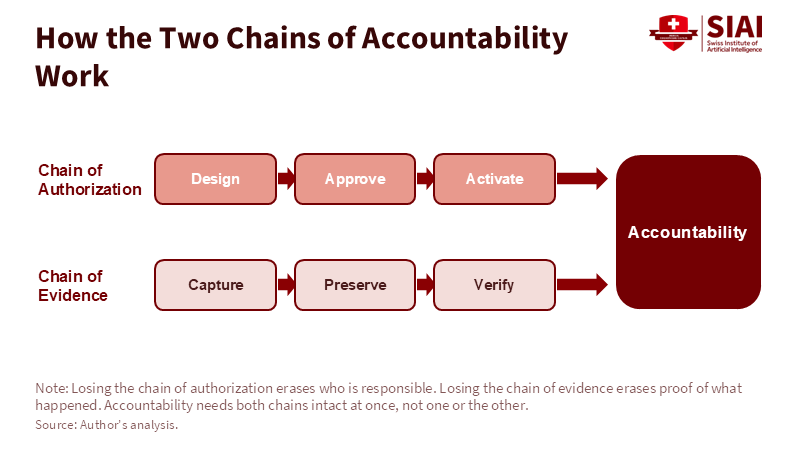
This is part of why a serious approach to accountability probably has to protect two separate threads at once rather than one. The first is a record of who designed, approved, and activated a given system, kept in a form resilient enough to survive an institution's later attempt to muddy it. The second is a record of what actually happened on the ground: images, logs, testimony, ideally authenticated before anyone has the chance to flood the space with convincing fakes. Losing the first thread tends to make responsibility hard to locate; losing the second makes it hard to prove even once it's been found. Modern conflict seems to be testing both threads at roughly the same time, which is a reasonable argument for treating them as one problem rather than two separate ones.
None of this suggests new weapons make accountability impossible. It suggests accountability now depends more than it used to on preserving records deliberately, rather than assuming they will simply exist. That looks like a solvable problem, though probably only if the people building and deploying these systems are treated, from the outset, as the ones responsible for solving it.
This article is based on an original research article published by The Economy Research. For the original version, please refer to The Machine Cannot Stand Trial: Responsibility for War Crimes in the Age of AI.
This article reflects the analytical judgment of the author and does not constitute policy advice or the official position of any affiliated institution.
Publications under SIAI Editor are prepared or coordinated by SIAI’s research and editorial team and include research synthesis, policy and industry analysis, technical interpretation, and interdisciplinary work connecting artificial intelligence with established fields of research and professional practice.
Similar Post