Corriere della Sera Features SIAI Analysis of AI and Fiscal Erosion

Publications under SIAI Editor are prepared or coordinated by SIAI’s research and editorial team and include research synthesis, policy and industry analysis, technical interpretation, and interdisciplinary work connecting artificial intelligence with established fields of research and professional practice.
Published
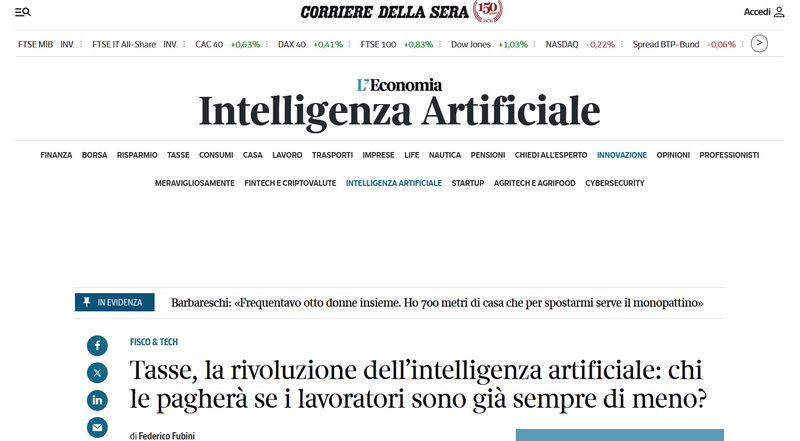
Corriere della Sera has featured commentary from Professor Keith Lee of the Swiss Institute of Artificial Intelligence in an article by Federico Fubini examining how artificial intelligence may reshape employment, labor-based taxation, and the fiscal capacity of advanced economies.
The article draws substantially on Professor Lee’s analysis of
- highly AI-augmented workers,
- the concentration of productivity gains among a relatively small group,
- the transfer of economic value from labor income toward corporate profits and AI-related rents,
- and the resulting pressure on labor-based tax systems.
The article also considers the difficulty governments may face in replacing income-tax and social-contribution revenues if AI adoption reduces employment in knowledge-intensive industries.
- Original coverage: Tasse, la rivoluzione dell’intelligenza artificiale: chi le pagherà se i lavoratori sono già sempre di meno? | Corriere.it
Source: Tasse, la rivoluzione dell’intelligenza artificiale: chi le pagherà se i lavoratori sono già sempre di meno? | Corriere.it
Selected coverage in Italian:
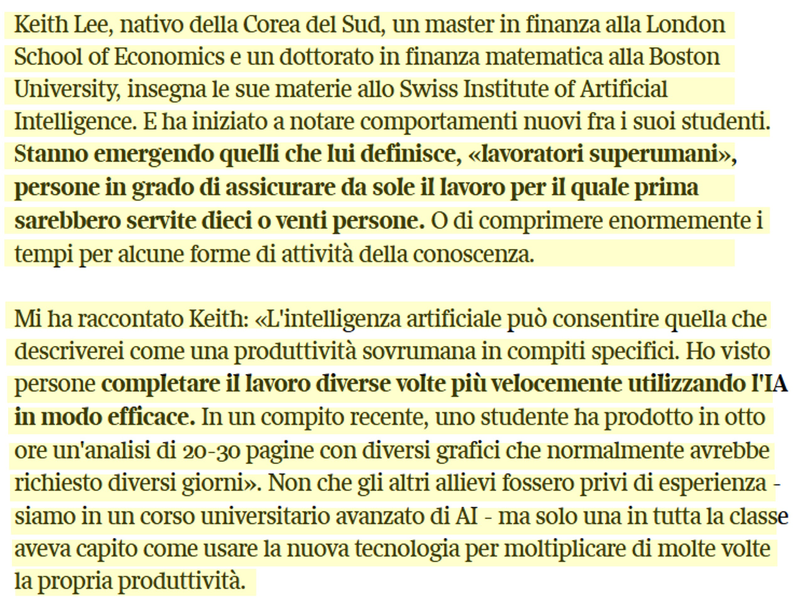
Keith Lee, nativo della Corea del Sud, un master in finanza alla London School of Economics e un dottorato in finanza matematica alla Boston University, insegna le sue materie allo Swiss Institute of Artificial Intelligence. E ha iniziato a notare comportamenti nuovi fra i suoi studenti. Stanno emergendo quelli che lui definisce, «lavoratori superumani», persone in grado di assicurare da sole il lavoro per il quale prima sarebbero servite dieci o venti persone. O di comprimere enormemente i tempi per alcune forme di attività della conoscenza.
Mi ha raccontato Keith: «L'intelligenza artificiale può consentire quella che descriverei come una produttività sovrumana in compiti specifici. Ho visto persone completare il lavoro diverse volte più velocemente utilizzando l'IA in modo efficace. In un compito recente, uno studente ha prodotto in otto ore un'analisi di 20-30 pagine con diversi grafici che normalmente avrebbe richiesto diversi giorni». Non che gli altri allievi fossero privi di esperienza - siamo in un corso universitario avanzato di AI - ma solo una in tutta la classe aveva capito come usare la nuova tecnologia per moltiplicare di molte volte la propria produttività.
Source: Tasse, la rivoluzione dell’intelligenza artificiale: chi le pagherà se i lavoratori sono già sempre di meno? | Corriere.it
English translation of selected coverage:
Keith Lee, a South Korean native, holds a master's degree in finance from the London School of Economics and a doctorate in mathematical finance from Boston University, teaches his subjects at the Swiss Institute of Artificial Intelligence. And he began to notice new behaviors among his students. What he calls "superhuman workers" are emerging, people who can provide jobs on their own for which ten or twenty people would have been needed before. Or to enormously compress the time for some forms of knowledge activities.
Keith told me: "Artificial intelligence can enable what I would describe as superhuman productivity in specific tasks. I've seen people complete work several times faster using AI effectively. In a recent assignment, a student produced a 20-30 page analysis with several graphs in eight hours that would normally have taken several days." Not that the other students were inexperienced - we are in an advanced university course in AI - but only one in the whole class had understood how to use the new technology to multiply their productivity many times over.
A related Executive AI Brief expands on the discussion, including the relationship between AI-driven labor substitution, fiscal erosion, data-center taxation, and the geographic distribution of AI-generated value.
| Theme in Corriere coverage | SIAI follow-up research |
|---|---|
| AI-enabled labor productivity | Labor Income, AI Rents and Fiscal Erosion |
| Mobility of AI-generated rents | Data-Center Taxation and the Geography of AI Value |
| Tax treatment of AI profits | Taxing AI Profits in Europe |
| Europe’s strategic position | Europe’s AI Race and the Fiscal State |
Further analysis by SIAI
- Further analysis: AI and Tax: Who Captures the Productivity Dividend? | Swiss Institute of Artificial Intelligence
Following the Venice conference at Fondazione Giorgio Cini and Professor Lee’s subsequent interview with Federico Fubini of Corriere della Sera, SIAI developed a four-part research series examining the fiscal consequences of AI-driven productivity growth.
The papers examine the same issue from the perspectives of labor income, AI-generated rents, data-center taxation, Euro tax policy, and Europe's broader AI strategy.
AI and Tax research series
- [AI and Tax] Labor Income, AI Rents and Fiscal Erosion | Swiss Institute of Artificial Intelligence
- [AI and Tax] Data-Center Taxation and the Geography of AI Value | Swiss Institute of Artificial Intelligence
- [AI and Tax] Taxing AI Profits in Europe | Swiss Institute of Artificial Intelligence
- [AI and Tax] Europe’s AI Race and the Fiscal State | Swiss Institute of Artificial Intelligence
Publications under SIAI Editor are prepared or coordinated by SIAI’s research and editorial team and include research synthesis, policy and industry analysis, technical interpretation, and interdisciplinary work connecting artificial intelligence with established fields of research and professional practice.
Similar Post