Fortune Features SIAI Commentary on the Economics of AI Adoption

Publications under SIAI Editor are prepared or coordinated by SIAI’s research and editorial team and include research synthesis, policy and industry analysis, technical interpretation, and interdisciplinary work connecting artificial intelligence with established fields of research and professional practice.
Published
Fortune published an article on 28 April 2026 examining the rising cost of enterprise AI adoption and the economic conditions under which AI systems can replace or complement human labor.
*Originally published by Fortune on 28 April 2026; subsequently expanded and updated on 14 June 2026.
Professor Keith Lee of the Swiss Institute of Artificial Intelligence contributed commentary on the current mismatch between AI capabilities and their operating costs, including the effects of computing infrastructure, energy consumption, and implementation expenses.
The original Fortune article is available below.
- Fortune coverage — updated 14 June 2026:
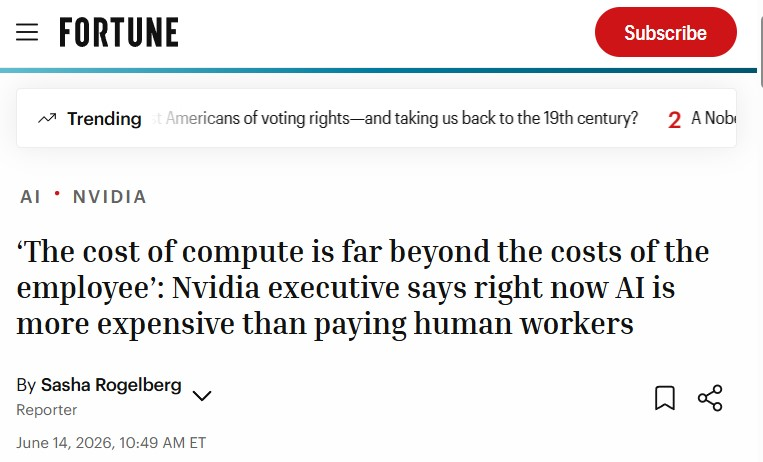
Source: ‘The cost of compute is far beyond the costs of the employee’: Nvidia executive says right now AI is more expensive than paying human workers
Coverage at a glance
| Publication | Contribution | Subject | Related SIAI analysis |
|---|---|---|---|
| Fortune | Commentary from Professor Keith Lee | Enterprise AI costs and labor substitution | AI Costs More Than Human Labor—For Now |
Source: ‘The cost of compute is far beyond the costs of the employee’: Nvidia executive says right now AI is more expensive than paying human workers
Quotes:
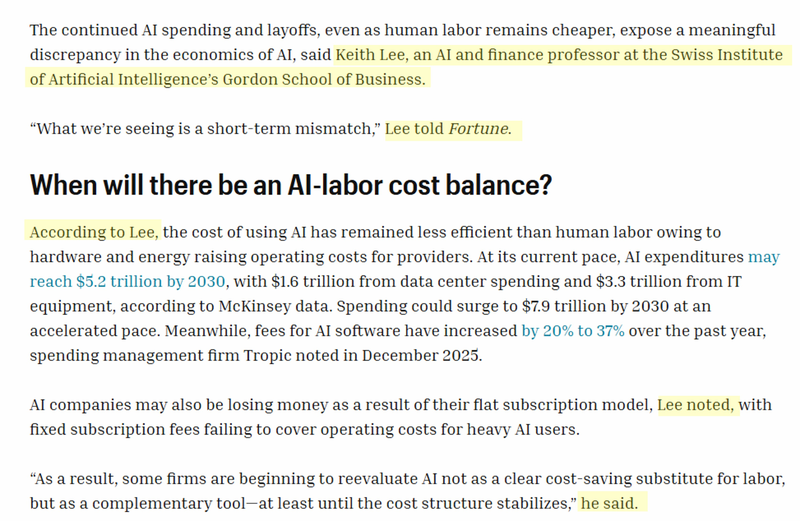
The continued AI spending and layoffs, even as human labor remains cheaper, expose a meaningful discrepancy in the economics of AI, said Keith Lee, an AI and finance professor at the Swiss Institute of Artificial Intelligence’s Gordon School of Business.
“What we’re seeing is a short-term mismatch,” Lee told Fortune.
When will there be an AI-labor cost balance?
According to Lee, the cost of using AI has remained less efficient than human labor owing to hardware and energy raising operating costs for providers. At its current pace, AI expenditures may reach $5.2 trillion by 2030, with \$1.6 trillion from data center spending and \$3.3 trillion from IT equipment, according to McKinsey data. Spending could surge to \$7.9 trillion by 2030 at an accelerated pace. Meanwhile, fees for AI software have increased by 20% to 37% over the past year, spending management firm Tropic noted in December 2025.
AI companies may also be losing money as a result of their flat subscription model, Lee noted, with fixed subscription fees failing to cover operating costs for heavy AI users.
“As a result, some firms are beginning to reevaluate AI not as a clear cost-saving substitute for labor, but as a complementary tool—at least until the cost structure stabilizes,” he said.
Source: ‘The cost of compute is far beyond the costs of the employee’: Nvidia executive says right now AI is more expensive than paying human workers
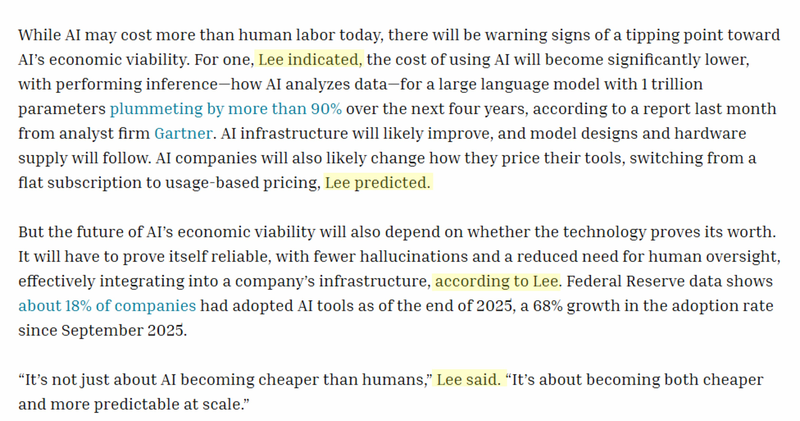
While AI may cost more than human labor today, there will be warning signs of a tipping point toward AI’s economic viability. For one, Lee indicated, the cost of using AI will become significantly lower, with performing inference—how AI analyzes data—for a large language model with 1 trillion parameters plummeting by more than 90% over the next four years, according to a report last month from analyst firm Gartner. AI infrastructure will likely improve, and model designs and hardware supply will follow. AI companies will also likely change how they price their tools, switching from a flat subscription to usage-based pricing, Lee predicted.
But the future of AI’s economic viability will also depend on whether the technology proves its worth. It will have to prove itself reliable, with fewer hallucinations and a reduced need for human oversight, effectively integrating into a company’s infrastructure, according to Lee. Federal Reserve data shows about 18% of companies had adopted AI tools as of the end of 2025, a 68% growth in the adoption rate since September 2025.
“It’s not just about AI becoming cheaper than humans,” Lee said. “It’s about becoming both cheaper and more predictable at scale.”
Subsequent pick-ups by other media:
- Yahoo Finance: ‘The cost of compute is far beyond the costs of the employees’: Nvidia executive says right now AI is more expensive than paying human workers
- Enterpreneur: Nvidia VP Says AI Is More Expensive Than Hiring Human Workers
Further SIAI Analysis
A related Executive AI Brief provides a more detailed discussion of the economic reasoning behind the commentary, including why rapid improvements in AI capability do not necessarily translate into immediate or uniform labor substitution.
Publications under SIAI Editor are prepared or coordinated by SIAI’s research and editorial team and include research synthesis, policy and industry analysis, technical interpretation, and interdisciplinary work connecting artificial intelligence with established fields of research and professional practice.
Similar Post