AI Energy Efficiency in Education: The Policy Lever to Bend the Power Curve

AI Energy Efficiency in Education: The Policy Lever to Bend the Power Curve

Picture

Member for

1 year 9 months
Real name
Catherine McGuire
Bio
Professor of AI/Tech, Gordon School of Business, Swiss Institute of Artificial Intelligence

Catherine McGuire is a Professor of Computer Science and AI Systems at the Gordon School of Business, part of the Swiss Institute of Artificial Intelligence (SIAI). She specializes in machine learning infrastructure and applied data engineering, with a focus on bridging research and large-scale deployment of AI tools in financial and policy contexts. Based in the United States (with summer/winter in Berlin and Zurich), she co-leads SIAI’s technical operations, overseeing the institute’s IT architecture and supporting its research-to-production pipeline for AI-driven finance.

Modified

AI energy use is rising, but efficiency per task is collapsing
Education improves outcomes by optimizing energy usage and focusing on small models.Do this, and costs and emissions fall while learning quality holds

The key figure in today's discussion about AI and the grid isn't a terawatt-hour forecast but 0.4 joules per token, a number that reframes AI energy efficiency in education. This is the energy cost that NVIDIA now reports for advanced inference on its latest accelerator stack. According to the company's own long-term data, this shows about a 100,000-fold efficiency improvement in large-model inference over the past decade. However, looking at this number alone can be misleading. Total electricity demand from data centers is still expected to rise sharply in the United States, China, and Europe as AI continues to grow. But it changes the perspective. If energy usage per unit of practical AI work is decreasing, then total demand is not fixed; it's something that can be influenced by policy. Education systems, which are major consumers of edtech, cloud services, and campus computing, can establish rules and incentives that transform quick efficiency gains into reduced bills, lower emissions, and improved learning outcomes. The decision isn't about choosing between growth and restraint; it's about managing growth versus prioritizing efficiency in a way that also increases access to resources.

AI Energy Efficiency in Education: From More Power to Better Power

The common belief is that AI will burden the grids and increase emissions. Critical analyses warn that, without changes to current policies, AI-driven electricity use could significantly increase global greenhouse gas emissions through 2030. Models at the regional level forecast significant increases in data center energy use, with roughly 240 TWh in the United States, 175 TWh in China, and 45 TWh in Europe, compared to 2024 levels, by the end of the decade. These numbers are concerning and highlight the need for investment in generation, transmission, and storage. Yet these assessments also acknowledge considerable uncertainty, much of which relates to efficiency. This includes how quickly computing power per watt improves, how widely those improvements spread, and how much software and operational practices can reduce energy use per task. The risk is real, but the slope of the curve is not set in stone.

The technical case for a flatter curve is increasingly evident. Mixture-of-Experts (MoE) architectures now utilize only a small portion of parameters for each token, thereby decreasing the number of floating-point operations (flops) without compromising quality. A notable example processes tokens by activating approximately 37 billion out of 671 billion parameters, which significantly reduces computing needs per token, supported by distillation that transfers reasoning skills from larger models to smaller ones for everyday tasks. At the system level, techniques such as speculative decoding, KV-cache reuse, quantization to 4–8 bits, and improved batch scheduling all further reduce energy use per request. On the hardware front, the transition from previous GPU generations to Blackwell-class accelerators delivers significant speed gains while using far fewer joules per token. Internal benchmarks indicate substantial improvements in inference speed, accompanied by only moderate increases in total power.

Additionally, major cloud providers now report fleet-wide Power Usage Effectiveness (PUE) of nearly 1.1, which means that most extra energy use beyond chips and memory has already been minimized. Collectively, this represents an ongoing optimization process—from algorithms to silicon to cooling systems—that continues to drive down energy usage per beneficial outcome. Policy can determine whether these savings are realized.
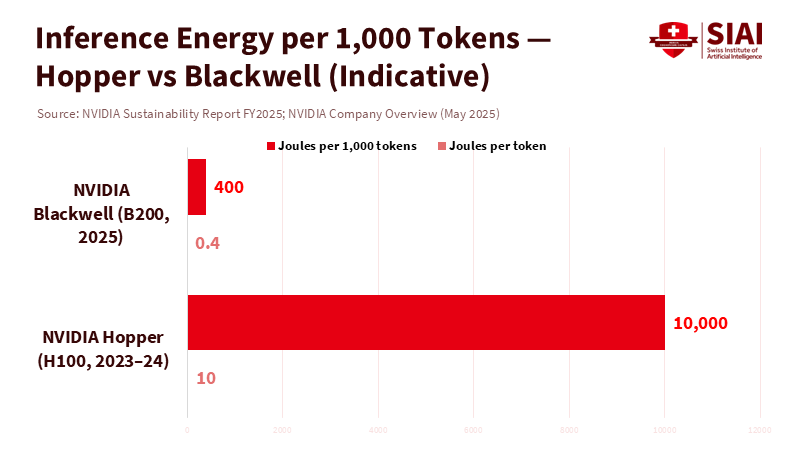
Figure 1: New GPUs cut energy per token by ~25×, turning efficiency into the main policy lever for campuses.

AI Energy Efficiency in Education: What It Means for Classrooms and Campuses

Education budgets are feeling the impact of AI, with expenses including cloud bills, device updates, and hidden costs such as latency and downtime. An efficiency-first approach can make these bills smaller and more predictable while increasing access to AI support, feedback, and research tools. The first step is to establish procurement metrics that monitor energy per unit of learning value. Instead of simply purchasing "AI capacity," ministries and universities should aim to buy tokens per watt or joules per graded essay, with vendors required to specify model details, precision, and routing strategies. When privacy and timing allow, it's best to default to smaller distilled models for routine tasks like summaries, grammar checks, and feedback aligned with rubrics, saving larger models for specific needs. This won't compromise quality; it reflects how MoE systems function internally. With effective routing, a campus can handle 80–90% of requests with smaller models and switch to larger ones only when necessary, dramatically reducing energy use while maintaining quality where needed. A simple calculation using the published energy figures for new accelerators shows that moving a million-token daily workload from a 5 J/token baseline to 0.5 J/token—through distillation, quantization, and hardware upgrades—could save about 4.5 MWh per day before considering PUE adjustments. Even at an already efficient ~1.1 PUE, this represents significant budget relief and measurable reductions in carbon emissions.
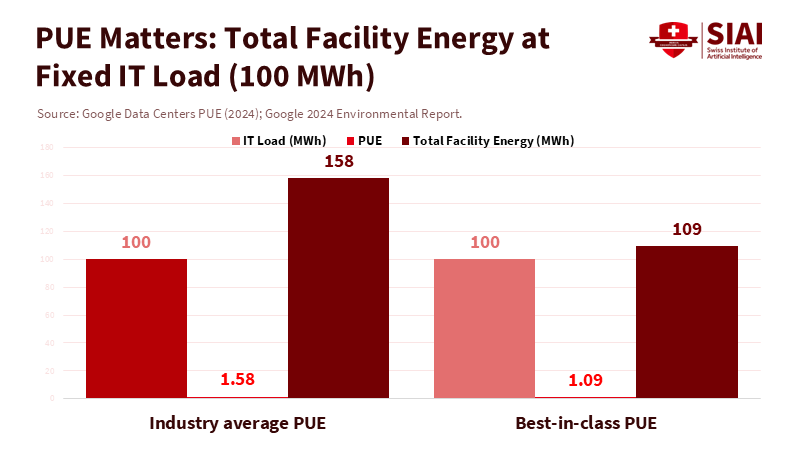
Figure 2: Moving from a typical 1.58 PUE to ~1.09 saves ~49 MWh for every 100 MWh of IT work—money and carbon you can bank.

Secondly, workload management should be included in edtech implementation guides. Many uses of generative AI in education occur asynchronously—such as grading batches, generating prompts, and cleaning datasets—so grouping tasks and scheduling them during off-peak times can reduce the load without affecting users. Retrieval-augmented generation (RAG) reduces token counts by incorporating relevant snippets, rather than requiring models to derive responses from scratch. Speculative decoding enables a lighter model to generate tokens, which a heavier model then verifies, thereby boosting throughput while reducing energy use per output. Caching prevents the need to repeat system prompts and instructions across different groups. None of these requires the latest models; they need contracts that demand efficiency. Partnering with cloud providers that have best-in-class PUE and ensuring campuses only use on-prem servers when necessary can turn technical efficiency into policy efficiency: lowering total energy while achieving the same or better learning outcomes.

Bending the curve, not the mission

Critics may raise the concern of rebound effects: if we cut the energy required for an AI query by 10 times, won't usage rise by 10 times, negating the savings? Sometimes yes. But rebound is not an absolute rule, especially when buyers enforce limits. Public education can establish budget-based guidelines, such as caps on tokens per student aligned with educational objectives, and a tiered model routing that only escalates when the value demands it. Just as printers evolved from unmanaged to managed queues, AI requests can operate under quality-of-service guidelines that prioritize efficiency and reliability. The overall forecasts that trouble us most assume current practices will remain in place; changing the practices will change the estimates. Moreover, when usage increases for legitimate reasons—such as broader access and improved instruction—efficiency ensures that the extra energy used is lower per unit of learning than it would have been, which reflects responsible scaling.

Another critique is that claims of efficiency are overstated. It's smart to question the numbers. However, various independent assessments point in the same direction. Vendor reports reveal significant improvements in joules per token for recent accelerators, and third-party evaluations analyze these speed claims, showing that while overall rack power might increase, the work done per unit of energy rises at a much faster rate. Additionally, peer-reviewed methods are emerging to measure model performance in terms of energy and water use across various deployments. Even if any single claim is overly optimistic, the trend is clear, and different vendors can replicate the combination of architectural efficiency, distillation, and hardware co-design. For education leaders, the best approach is not disbelief; it's conditional acceptance: create procurement policies that reward demonstrated efficiency and penalize unclear energy use.

A third concern is infrastructure; schools in many areas face rising tariffs and overloaded grids. That's precisely why workload placement is crucial. Keep privacy-sensitive or time-critical tasks on energy-efficient local devices whenever possible; send batch tasks to cloud regions with cleaner grids and better cooling systems. Require vendors to disclose region-specific emission metrics and give buyers choices. Where a national cloud or academic network is available, education ministries can negotiate sector-wide rates and efficiency commitments, including plans for carbon-intensity disclosures per thousand tokens. This isn't unnecessary bureaucracy; it's modern IT management for a resource that is limited and costly.

Some may wonder if high-profile efficiency cases, such as affordable, effective chatbots, are exceptions. They are indications of what's possible. A notable case achieves competitive performance at a fraction of the cost of conventional computing by leveraging routing efficiency, targeted distillation, and hardware-aware training. Independent industry analysis credits its efficiency not to miraculous data but to solid engineering. As these techniques become more widespread, they redefine the efficient frontier for inference costs relevant to education—such as translation, formative feedback, concept checks, and code explanations—where smaller and mid-sized models already perform well if appropriately designed and fine-tuned on carefully chosen data. The policy opportunity is to connect contracts to that frontier so that savings are passed through.

Lastly, there is the challenge posed by climate change. Predictions of AI-related emissions growth are not mere scare tactics; they serve as alerts about a future without discipline in efficiency. If we take no action, power consumption by data centers will continue to rise into the 2030s, and some areas will revert to higher carbon generation to meet peak demands. If we do take action—by establishing efficiency metrics, timing workloads intelligently, and relocating computing resources wisely—education can seize the benefits of AI while reducing the energy required for each learning gain. This isn't just a financial story; it's a matter of credibility for the sector. Students and families will notice whether schools truly embody the sustainability principles they teach.

So, what should leaders do right now? First, revise requests for proposals (RFPs) to make energy per outcome a key criterion for awards, complete with clear measurement plans and third-party audit rights. Second, default to small models using distilled or MoE-routing for routine tasks and only escalate to larger models based on explicit policies. Implement management strategies to handle prompts and caches, minimizing recomputation. Third, partner with organizations that maintain a PUE close to 1.1 and have documented plans for joules per token, while also insisting on region-specific carbon intensity disclosures for hosted workloads. Fourth, strengthen internal capabilities: a small "AI systems" team to tune routing, batch jobs, and RAG pipelines is far more valuable than another generic SaaS license. Fifth, educate: help faculty and students understand why efficiency is equivalent to access and how choices regarding prompts, model selection, and timing impact energy use. This is how education can evolve AI from a flashy pilot into lasting infrastructure.

The final test is straightforward. If, two years from now, your campus is using significantly more AI but spending less per student on energy and emitting less per graduate, you will have bent the curve. The technology already provides the tools: a sub-joule token in the data center, a distilled model on the device, and an MoE gate that only processes what's necessary. The policy work involves placing the fulcrum correctly—through contracts, metrics, and operations—and then applying pressure. The conversation about whether AI inevitably requires ever more energy will continue, but in education, we don't need inevitability; we need results. The key figure to monitor is not solely terawatt-hours but the energy per learning gain. With focus, that number can continue to decrease even as access increases. That's the future we should strive for.


The views expressed in this article are those of the author(s) and do not necessarily reflect the official position of the Swiss Institute of Artificial Intelligence (SIAI) or its affiliates.


References

Bain & Company. (2025). DeepSeek: A Game Changer in AI Efficiency? (MoE routing and distillation details).
Brookings Institution. (2025, Aug. 12). Why AI demand for energy will continue to increase. (Context on the drivers of rising aggregate demand and unit-efficiency trends).
Google. (2024, July). 2024 Environmental Report; Power Usage Effectiveness (PUE) methodology page (fleet-wide PUE ~1.09).
International Energy Agency. (2025, Apr. 10). Energy and AI; Energy demand from AI (regional projections to 2030 for data-center electricity use).
International Monetary Fund. (2025, May 13). AI Needs More Abundant Power Supplies to Keep Driving Economic Growth (emissions implications under current policies).
NVIDIA. (2025, Jun. 11). Sustainability Report, FY2025 (long-run efficiency trend; ~0.4 J/token reference).
Zilliz/Milvus. (2025). How does DeepSeek achieve high performance with lower computational costs? (architecture and training optimizations that generalize).
Zhou, Z. et al. (2025, May 14). How Hungry is AI? Benchmarking Energy, Water, and Environmental Footprints of LLM Inference (infrastructure-aware benchmarking methods).

Picture

Member for

1 year 9 months
Real name
Catherine McGuire
Bio
Professor of AI/Tech, Gordon School of Business, Swiss Institute of Artificial Intelligence

Catherine McGuire is a Professor of Computer Science and AI Systems at the Gordon School of Business, part of the Swiss Institute of Artificial Intelligence (SIAI). She specializes in machine learning infrastructure and applied data engineering, with a focus on bridging research and large-scale deployment of AI tools in financial and policy contexts. Based in the United States (with summer/winter in Berlin and Zurich), she co-leads SIAI’s technical operations, overseeing the institute’s IT architecture and supporting its research-to-production pipeline for AI-driven finance.


Hot Memory, Cold Politics: How the Emotional Intensity of Historical Memory in Japan, China, and South Korea Affects Political Dynamics

Media-driven memory politics outpaces classroom teaching in East Asia
Cross-border, source-based history lessons can counter quick nationalist swings
Schools must prime students before flashpoints to cool future conflicts

The Vanishing Middle of Software Work and What Schools Must Do About It

The Vanishing Middle of Software Work and What Schools Must Do About It

Picture

Member for

1 year 9 months
Real name
Catherine McGuire
Bio
Professor of AI/Tech, Gordon School of Business, Swiss Institute of Artificial Intelligence

Catherine McGuire is a Professor of Computer Science and AI Systems at the Gordon School of Business, part of the Swiss Institute of Artificial Intelligence (SIAI). She specializes in machine learning infrastructure and applied data engineering, with a focus on bridging research and large-scale deployment of AI tools in financial and policy contexts. Based in the United States (with summer/winter in Berlin and Zurich), she co-leads SIAI’s technical operations, overseeing the institute’s IT architecture and supporting its research-to-production pipeline for AI-driven finance.

Modified

AI is collapsing routine “middle” software work as adoption soars
Schools must teach systems thinking, safe AI use, and verification-first delivery
Employers will favor small, senior-led teams; therefore, curricula must reflect this reality

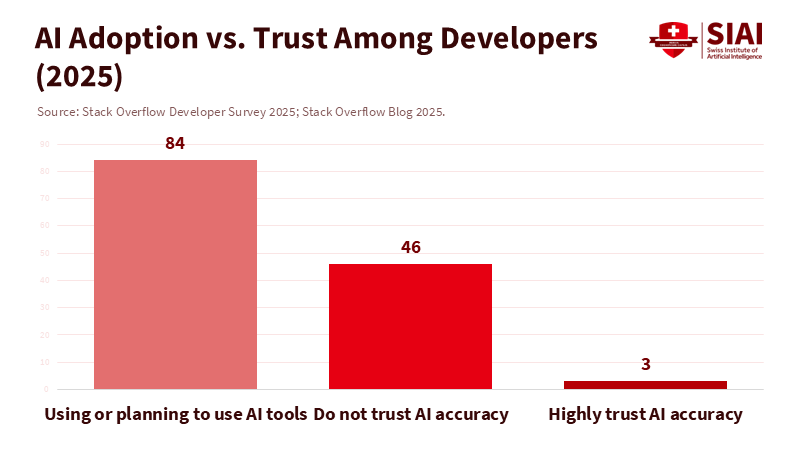
The key number in computing education right now is 84. That’s the percentage of developers in 2025 who use or plan to use AI tools at work, with most professionals using them daily. The trend is increasing. These new habits are lasting. The impact is real. Randomized trials have shown that AI-assisted pair programming can make specific coding tasks approximately 56% faster. Broader studies with knowledge workers show significant improvements in output and quality for well-defined tasks. If routine programming can be done in half the time, often by people who are still learning, the job market will not balance out. It will split. Junior and mid-level tasks are being automated or absorbed into smaller teams led by senior professionals. Employers are also indicating this shift: job postings in tech remain significantly lower than pre-pandemic levels, experience requirements are increasing, and corporate leaders are openly stating that AI enables them to accomplish more with fewer employees. The middle is disappearing, and education policy needs to determine whether to train for a shrinking area or redesign it.

We must be clear about what is disappearing and what is not. Government and industry data indicate that the most noticeable job losses are in “programmer” roles, which involve converting specifications into code, rather than in broader “software developer” roles that encompass design, integration, product judgment, and collaboration with stakeholders. This distinction matters for schools because it relates to the skills that AI struggles to replace: scoping, decomposition, security, systems thinking, and the social aspects of software delivery. It also aligns with regional statistics that may seem contradictory at first but are consistent underneath: the EU still reports millions of ICT specialists employed and ongoing hiring gaps, but firms also report challenges in finding the right mix of senior skills, rather than more entry-level workers. In short, demand is moving up the ladder.

The Middle Is Collapsing, Not the Profession

The near-term market signals are stark. Tech job postings on Indeed are weak, down about a third from early 2020 levels, after a significant pullback in 2023-2024. Where postings do exist, the requirements have increased: roles seeking 2-4 years of experience dropped from 46% to 40% between mid-2022 and mid-2025. In comparison, postings requiring over 5 years of experience rose from 37% to 42%. This is not a general “no more developers” situation; it suggests a “fewer average developers” reality. It reflects a production model where a small senior team, equipped with reliable AI tools, accomplishes what used to take multiple junior staff members. This trend is also evident from the leadership of major software companies, where finance leaders openly discuss AI as a way to create leaner organizations.

We also have evidence from learning curves to explain why entry-level positions are the most vulnerable to change. In field tests with generative AI, less-experienced workers often see the most significant boost in productivity on well-defined tasks. This effect can temporarily flatten parts of the experience gradient. Suppose a novice using an AI tool can complete the same narrow task as a mid-level employee. In that case, the firm's logical choice is to reduce mid-level roles or move them overseas. At the same time, these studies also show uneven gains for tasks that are more complex—such as setting specifications, solving ambiguous requirements, and managing unique challenges. These tasks still require significant human involvement and demand higher skill levels. This is why we are witnessing a decline in routine programming roles. At the same time, higher-leverage developer work remains stable or even grows over the medium term. Projections from the U.S. Bureau of Labor Statistics still indicate double-digit growth for developers through 2034, even as “programmer” employment declines. The market is not disappearing; it is changing.

Figure 1: AI is now default, but trust lags—wide adoption coexists with active distrust, reinforcing “use with verification” in curricula.

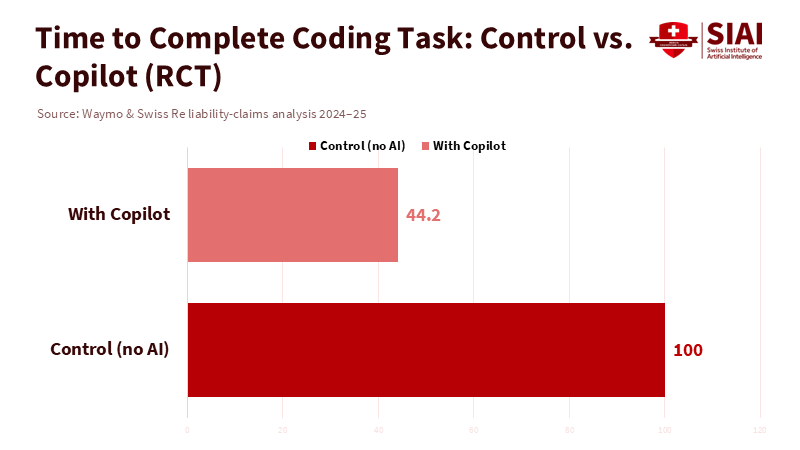
The team structure is shifting, too. The modern technology stack allows a lead engineer to manage agents, code generators, and testing frameworks throughout the development process. GitHub’s Copilot RCT recorded a 55.8% time reduction on a specific JavaScript task; data from Octoverse reveals a rise in AI-related repositories and tools. Insights from leaders suggest that AI has become an integral part of daily workflows, rather than a novelty. As a result, “ticket factories” staffed by layers of average workers are being replaced by small, senior-led teams that oversee automation, manage architecture, and address risks like security, privacy, and governance.

A New Skills Bar for Schools and Employers

If the middle is disappearing, entry into the field must not rely on the tasks that are vanishing. The old model—introduction to computer science, followed by two years of basic ticket work—no longer fits the market. Stack Overflow’s 2025 data show nearly all developers have experience with AI tools; even Gen Z’s early career paths are being redefined around tools rather than just spending time on repetitive tasks. However, the same surveys reveal a trust gap: almost half of developers do not trust the accuracy of AI outputs, and many lose time fixing generated code. This combination—high usage with low trust—highlights the need for AI literacy, verification workflows, and secure integration habits. Education must shift from “using the tool” to “designing a process that guides the tool.”

Curricula should adapt in three practical ways. First, shift evaluation from isolated coding to complete delivery under constraints. Students should define requirements with stakeholders, prompt responsible development, verify results through tests, and deliver minimal increments. Second, introduce systems thinking earlier. This means making architecture, interfaces, observability, and performance trade-offs understandable to first- and second-year students, not just in capstone projects. Third, formalize human-in-the-loop methods: code reviews, testing for model errors, and reproducible logs for prompts. These are not just extras; they are essential tasks. Since trust is a primary issue, we should include “explain-and-verify” as a skill, focusing on executable specifications, property-based tests, and static analysis, along with code generation. The aim is to produce fewer “average coders” and more junior systems engineers who can manage automation responsibly.

Employers must also rethink their design for early-career roles. Successful corporate experiments demonstrate that AI performs best when combined with guidelines and collaborative learning, including clear task-fit criteria, libraries of approved prompts, and structured peer coaching. Rotations should focus on integration, security reviews, and on-call simulations, rather than just completing tasks. Apprenticeships can evolve into “automation residencies” where new hires learn to connect tools, review outputs, and address unique challenges. If we do this, AI can help early-career talent advance faster in areas of the job that truly matter—ownership, judgment, and communication—rather than getting stuck on tasks that automation can easily take over.

Figure 2: A randomized trial shows Copilot users finished a standard coding task in 44.2% of the time—evidence for assessment that emphasizes verification, not raw keystrokes.

What Education Must Do Now

The policy direction should not be to resist the use of AI in the classroom. It should focus on enforcing real-world use with clear outcomes. We should require that accredited computing programs teach and assess responsible AI use from the start: students must disclose any assistance, maintain logs of prompts and tests, and explain how they verified results. Programs should place more weight on design quality, test coverage, and adaptability to change, rather than just counting lines of code. This aligns with the job market's signal that developers, not programmers, will create the most value. It also prepares students for the tools they will encounter immediately after graduation.

Funding should support cross-disciplinary build studios where education, health, climate issues, and public-sector partners present real problems. Students should work in small teams mentored by senior professionals, using AI freely but justifying each decision with automated tests and risk notes. The studios would publish open rubrics, datasets, and evaluations to boost quality across educational institutions. Since the EU reports both a large ICT workforce and continuous skill shortages, these studios should be regionally focused, addressing public needs, and open to apprentices and those seeking to upskill—not just degree-seekers. This approach will widen opportunities while avoiding training for tasks that are quickly disappearing.

Teacher development is the critical missing link. We need fast, practice-focused certification for “AI-integrated software teaching,” along with grants for redesigning test-heavy courses. The technology stack is essential: IDE plugins that log prompts and changes, CI pipelines that conduct static analysis and property-based tests, and dashboards that highlight insecure dependencies or data leaks. This is not about monitoring students; it is about professionalism. This is how we can transform the trust gap from a concern into a teachable skill: “never trust, always verify.”

Critics may argue that this is just a passing trend and that hiring for junior positions will rebound. There is some truth to that; economic cycles do matter, and developer jobs are expected to keep growing over the next decade. However, the shift in job composition is genuine. U.S. data shows that programming roles have lost more than a quarter of their jobs in two years, even as developer positions remain steady. Job postings remain low, and experience requirements are increasing.
Meanwhile, leaders from companies like Microsoft and SAP describe AI as already woven into everyday operations and cost management. Relying on a return to pre-AI job structures is not wise; it is evasion. The best move is to focus on the tasks that are hardest to automate and most crucial to oversee.

A final practical step is to align assessment with the job markets where students will actually work. Utilize open-source contributions as graded Projects. The Octoverse data indicate that AI-related projects are increasing rapidly, and students should have a tangible record of genuine collaboration. Promote internships that resemble “integration sprints,” not just bug-fixing marathons. Evaluate what truly matters for employability in an AI-driven world: the ability to break down problems, understand risk, prioritize testing, manage tools, and communicate trade-offs with non-engineers. These are valuable skills. These are the habits that enable small teams to achieve what larger groups could without overwhelming the system—or the students.

A more minor team, a higher standard, a stronger school

We began with 84, a clear indicator that AI is now a standard part of software work. We should conclude with another number that keeps us grounded: 56. That’s how much time can be saved on a real coding task in a randomized trial of AI pair programming. When productivity gains of this magnitude occur within companies, the market will not accommodate “average” workers completing routine tasks. It will favor those who can lead projects, integrate systems, and verify results. Suppose education continues to prepare students for roles that are fading away. In that case, we will let them down twice—once by misunderstanding the job market and again by not equipping them with the necessary habits to make AI effective and secure. The alternative is achievable. Teach students to take ownership of problems, to use AI openly and transparently, and to plan for both failure and success. The teams of the future will be smaller. Let our schools empower them to be stronger.


The views expressed in this article are those of the author(s) and do not necessarily reflect the official position of the Swiss Institute of Artificial Intelligence (SIAI) or its affiliates.


References

BCG / Harvard Business School (2023). Navigating the Jagged Technological Frontier: Field Experimental Evidence of the Effects of AI on Knowledge Worker Productivity and Quality. Harvard Business School Working Paper 24-013.
Brainhub (2025). Is There a Future for Software Engineers? The Impact of AI on Software Development. Brainhub Library.
Brynjolfsson, E., Li, D., & Raymond, L. (2023). Generative AI at Work. NBER Working Paper 31161.
Fortune (2025, Sept. 2). Microsoft CEO Satya Nadella reveals 5 AI prompts that can supercharge your everyday workflow.
GitHub (2022). Research: Quantifying GitHub Copilot’s Impact on Developer Productivity and Happiness. GitHub Blog.
GitHub (2024). Octoverse 2024: The State of Generative AI. GitHub Blog.
Indeed Hiring Lab (2025, July 30). The U.S. Tech Hiring Freeze Continues. Indeed Hiring Lab (2025, July 30). Experience Requirements Have Tightened Amid the Tech Hiring Freeze.
MIT News (2023, July 14). A study finds that ChatGPT boosts worker productivity for specific writing tasks.
Peng, S., Kalliamvakou, E., Cihon, P., & Demirer, M. (2023). The Impact of AI on Developer Productivity: Evidence from GitHub Copilot. arXiv:2302.06590.
Stack Overflow (2024). Developer Survey—AI.
Stack Overflow (2025). Developer Survey—AI.
Stack Overflow Blog (2025, Sept. 10). AI vs Gen Z: How AI has changed the career pathway for junior developers.
U.S. Bureau of Labor Statistics (2025, Aug. 28). Employment Projections—2024–2034; Software Developers, QA Analysts, and Testers. Occupational Outlook Handbook.
Washington Post (2025, Mar. 14). More than a quarter of computer-programming jobs just vanished. What happened?
Yahoo Finance (2025). CFO of $320 billion software firm: AI will help us “afford to…” (SAP workforce comments).
Eurostat (2024–2025). ICT specialists in employment: Towards Digital Decade targets for Europe.
ITPro & TechRadar (2025). Developers adopt AI while trust declines; 46% don’t trust AI outputs.

Picture

Member for

1 year 9 months
Real name
Catherine McGuire
Bio
Professor of AI/Tech, Gordon School of Business, Swiss Institute of Artificial Intelligence

Catherine McGuire is a Professor of Computer Science and AI Systems at the Gordon School of Business, part of the Swiss Institute of Artificial Intelligence (SIAI). She specializes in machine learning infrastructure and applied data engineering, with a focus on bridging research and large-scale deployment of AI tools in financial and policy contexts. Based in the United States (with summer/winter in Berlin and Zurich), she co-leads SIAI’s technical operations, overseeing the institute’s IT architecture and supporting its research-to-production pipeline for AI-driven finance.