The Limits of Financial Coercion: Why a US Treasury Sell-Off by One Power Would Backfire
Selling US Treasuries hurts the seller first by lowering the value of what remains
Only coordinated action by major holders could move markets, and that coordination is unlikely
US Treasuries function as a shared stability asset, not a usable financial weapon

The data center boom is not the new factory — unless we rewrite the deal
The data center boom is not the new factory — unless we rewrite the deal

Ethan McGowan is a Professor of AI/Finance and Legal Analytics at the Gordon School of Business, SIAI. Originally from the United Kingdom, he works at the frontier of AI applications in financial regulation and institutional strategy, advising on governance and legal frameworks for next-generation investment vehicles. McGowan plays a key role in SIAI’s expansion into global finance hubs, including oversight of the institute’s initiatives in the Middle East and its emerging hedge fund operations.
Published
Modified
Data centers are not modern factories and rarely create broad local prosperity.
They often raise local power costs while delivering few permanent jobs.
Only strict public-benefit energy rules can rebalance the deal.
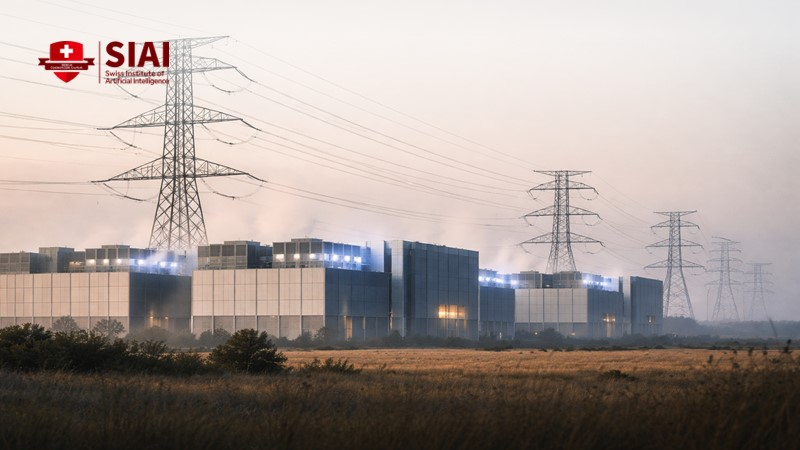
The data center boom is changing small towns and electrical networks faster than most local governments can track. Global electricity use by data centers reached the hundreds of terawatt-hour range recently, and industry forecasts see consumption roughly doubling within a decade — a scale shock that would make a single new campus as consequential for a rural grid as a mid-sized steel plant once was. That stark fact reframes our question: are data centers destined to play the same civic and economic role that factories did in the 20th century, building broad local prosperity through plentiful jobs and supplier networks, or will they instead function as capital-intensive, low-employment facilities that extract affordable power and offer limited community payoff? This column argues the latter is the default outcome today. The differences among those futures depend on policy: electricity contracts, tax incentives, and whether each data center must be paired with on-site generation or with community power programs that intentionally return value to local residents. Without those bargains, the “21st-century factory” claim collapses into a short construction boom and long-term local costs.
Why the data center boom looks factory-like — and why that resemblance misleads
The raw numbers explain the analogy’s appeal. Modern hyperscale data centers require land, roads, cooling and, above all, immense, reliable power. That visible footprint resembles a factory campus: new buildings, heavy trucks, an inflow of contractors, and municipal revenues tied to construction and property. In many places, officials and economic development teams sell the project this way: quick construction jobs, higher tax bases, corporate donations and the hope of a nascent tech cluster. Those short-lived gains are real. Construction phases can employ hundreds or thousands of workers for months or years. Local suppliers benefit for the duration. Municipal budgets experience an immediate spike in receipts attributable to permit fees and developer payments. Those outcomes are the origin of the factory metaphor — a large, visible employer that forms local life.
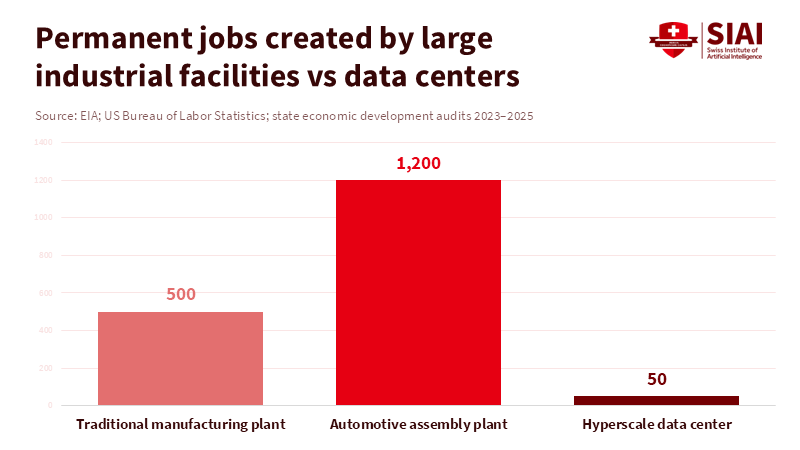
But the similarity stops when facilities begin steady operations. Unlike a 20th-century factory that required large, skilled, and semi-skilled local labor forces for day-to-day production, many modern data centers run on automation and remote management. Once built, the permanent on-site workforce is often small relative to a site’s capital value and energy draw. The pattern emerging from recent studies shows a recurring mismatch: big infrastructure and power demands, modest operational payrolls. That means the civic bargain that once justified factory siting—dozens or hundreds of durable local jobs plus supplier ecosystems—is not automatic for data centers. The policy lesson is plain: if a community treats a data center solely as a factory replacement, it will likely end up with an expensive power bill and a handful of long-term jobs, not the broad prosperity promised.
Energy, bills and the hidden transfer of value in the data center boom
Power is the fulcrum. Data centers’ electricity demand is already substantial; reputable sector projections indicate that global data-center electricity use will increase substantially in the near term. That increase matters at the local level because grid upgrades, emergency generation and firm capacity all carry costs. Utilities and developers negotiate who pays. If those costs are socialized—through rate changes or long-term cost-recovery mechanisms—local ratepayers may face higher bills, while the data center benefits from access to cheap, reliable power. In effect, the private benefit of hosting a data center can become a public cost unless contracts are reformed.
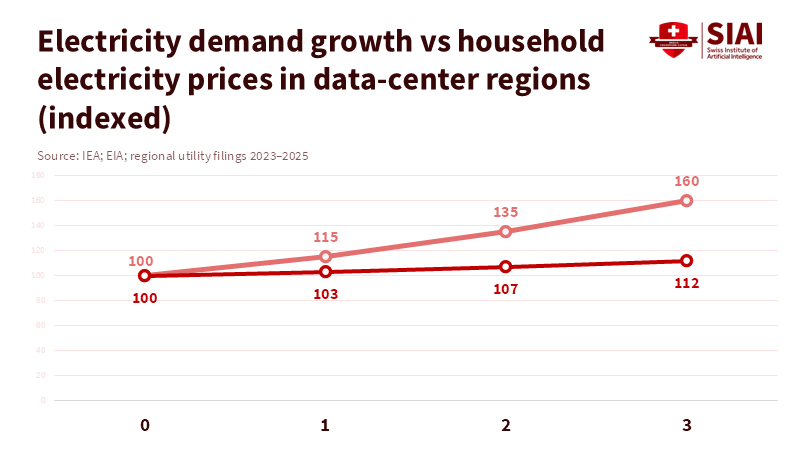
That transfer is not hypothetical. Where clusters concentrate, utilities have warned that new, sudden loads require new substations, reconductoring, or even fossil-fuel backup to meet reliability standards during peak demand or outages. Those investments are often recovered through rate mechanisms that touch every household and small business. The visible result is an alarming local complaint: residents see new, gleaming campuses and then receive higher bills. For many small or rural communities, that outcome is politically explosive because it reverses the expected social contract. The structural fix is to rewrite the bargain: require onsite firm capacity that benefits the community; demand lower wholesale rates for residents; or tie grid upgrades directly to shared community pricing programs. Otherwise, the data center boom behaves like an energy parasite — great, concentrated demand that saps local affordability while producing limited local employment.
Jobs, taxes and the gap between promise and reality of the data center boom
Employment claims have driven many municipal approvals. Industry and allied consultants frequently produce projections that include indirect supply-chain jobs, and some national studies report figures that appear striking when read without context. Those broader estimates frequently include induced employment—the jobs supported across an entire national supply chain—and one-time construction roles. In contrast, direct, permanent on-site employment at a single hyperscale campus is often modest: dozens to low hundreds, not thousands. This distinction matters because communities vote, plan schools, and approve zoning in accordance with expectations regarding durable jobs and tax flows.
Recent audits and state studies show the dissonance. Detailed, state-level reviews show that while capital investment and construction increase short-term employment and local revenues, recurring operations generate far fewer local jobs than advertised—and tax deals often blunt the fiscal gains. When generous exemptions or equipment tax breaks are granted to attract projects, net long-term revenue may decline, leaving local budgets to shoulder infrastructure and service costs. Critics maintain this represents a poor return on public incentives. Supporters counter that national supply chain impacts and corporate tax remittances justify incentives. The sensible policy path recognizes both truths: count direct permanent roles separately from temporary construction work and design incentive packages that scale with demonstrable, long-term local benefits. Without that discipline, the data center boom will deliver a construction windfall and then a thin, steady stream of local benefits—far from the mass-employment factories once offered.
A practical bargain: SMRs, community power, and rewriting the deal for the data center boom
If data centers will not reliably create large-scale local employment, then communities must demand a different kind of return: shared, affordable, and resilient energy. Small, small reactors (SMRs) and other firm, local generation options have moved from abstract ideas to concrete corporate experiments. Major cloud providers have announced agreements and investments to pair data centers with advanced nuclear or long-term firm capacity procurement. When implemented, such arrangements can insulate grids, reduce marginal power costs for local customers, and provide a revenue or capacity stream that can be repurposed for public goods. The crucial policy requirement is simple: require every major new campus to demonstrate community power benefits that lower household or municipal rates or to dedicate a concrete portion of firm output to local public use.
There are multiple practical forms this bargain can take. An SMR or co-located firm generator, jointly owned with the utility, can deliver lower-cost, uninterrupted power to a local tariff band for residents and municipal facilities. Alternatively, a community benefit agreement can lock a data center into long-term payments to a local energy trust that subsidizes electricity for low-income households and public schools. Another option is a capacity-sharing rule: a percentage of off-peak power is sold back at cost to local businesses. Each design needs clear, enforceable metrics and independent auditing to prevent creative accounting. The point is not to stop data centers, but to align their massive energy footprint with durable, local public value, rather than abandoning communities to bear the external costs while tech firms capture private gains.
Reclaiming the civic bargain in the data center boom
The data center boom will not, on its own, become the 21st-century factory that spreads prosperity widely. The default pattern is one of enormous capital investment, intense short-term employment, and small operational payrolls — coupled with long-term pressures on energy systems and local affordability. Communities can accept that reality or they can legislate a different bargain: require firm generation commitments, community-priced electricity, and incentive structures that scale with demonstrable local benefits. These are not theoretical fixes. There are emerging corporate and utility experiments pairing data infrastructure with SMRs and long-term power contracts — moves that, if replicated under public oversight and with binding community returns, would produce something closer to a factory’s civic role. The policy test for the next wave of siting decisions is this: can a locality negotiate a binding, transparent package that turns raw kilowatts into local wealth, not local cost? If the answer is no, then the towns that host these campuses will have traded a short boom for a long bill. It is time to make the data center boom pay for the people it affects.
The views expressed in this article are those of the author(s) and do not necessarily reflect the official position of the Swiss Institute of Artificial Intelligence (SIAI) or its affiliates.
References
Energy Information Administration (IEA). 2025. Energy and AI: Energy demand from AI. International Energy Agency.
JLARC (Joint Legislative Audit and Review Commission). 2024. Data Centers in Virginia. Commonwealth of Virginia.
Lawrence Berkeley National Laboratory (Shehabi et al.). 2024. United States Data Center Energy Usage Report. LBNL-2001637.
Northern Virginia Technology Council (NVTC). 2024. The Impact of Data Centers on Virginia's State and Local Economies.
PwC / Data Center Coalition. 2025. Economic Contributions of Data Centers in the United States 2017–2023. PricewaterhouseCoopers.
Financial Times. 2024. Google orders small modular nuclear reactors for its data centres.
Food & Water Watch. 2026. The Illusion of Big Tech's Data Center Employment Claims.
Congressional Research Service. 2026. Data Centers and Their Energy Consumption (CRS product R48646).
Ethan McGowan is a Professor of AI/Finance and Legal Analytics at the Gordon School of Business, SIAI. Originally from the United Kingdom, he works at the frontier of AI applications in financial regulation and institutional strategy, advising on governance and legal frameworks for next-generation investment vehicles. McGowan plays a key role in SIAI’s expansion into global finance hubs, including oversight of the institute’s initiatives in the Middle East and its emerging hedge fund operations.

















Wiping or Fighting? Why the China economic footprint is now the battlefield — and what education must do about it
This is no longer a race to catch up, but a push to reduce strategic dependence on China
Supply chains and education systems are now instruments of geopolitical power
Resilience will depend on how quickly institutions adapt skills, policy, and procurement

When FDI Buys Into a Chain, Not a Country: Rethinking Success in the Age of Cross-Border Production
FDI now succeeds by linking into global value chains, not by expanding domestic production
German investment in China uses local labor and efficiency while value stays global
Policy should shape how FDI integrates into chains, not just how much arrives

Energy-Driven Inflation: Why the 2020s Price Surge Was an Energy and Supply Shock — and What Schools Should Do About It
The early-2020s inflation surge was driven by energy and supply shocks, not monetary excess
Energy costs set off pricing cascades and productivity losses across key sectors
Policy should prioritize supply resilience over demand tightening

The Third AI Stack Is a Hope, Not a Strategy: Why Europe and Korea Can’t Catch an entrenched US–China Duopoly
The Third AI Stack Is a Hope, Not a Strategy: Why Europe and Korea Can’t Catch an entrenched US–China Duopoly

His recent work examines the broader socioeconomic consequences of artificial intelligence, including labor markets, public finance, demographic change, institutional adaptation, and the distributional effects of technological progress.
He holds a PhD in Mathematical Finance from Boston University, and previously earned an MSc in Finance and Economics from the London School of Economics. He completed his undergraduate studies in Economics at Seoul National University under the Korea Foundation for Advanced Studies scholarship program.
Published
Modified
The third AI stack is a political ambition, not an industrial reality
China’s open-source push wins users, not hardware supremacy
Europe and Korea must focus on interoperability and skills, not full-stack rivalry

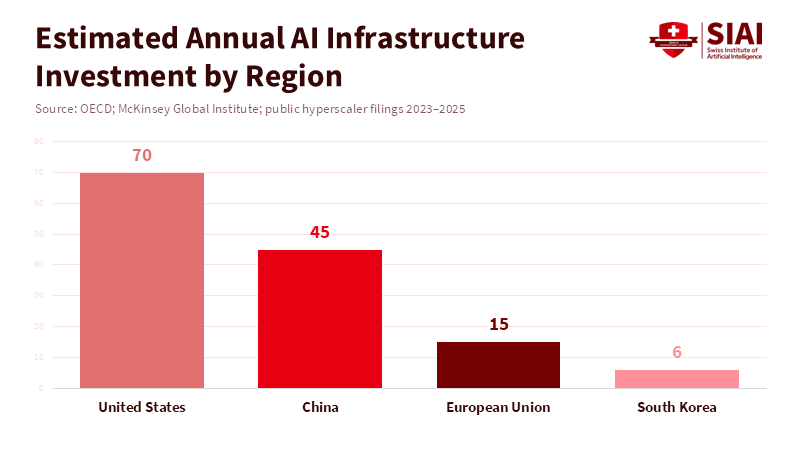
Between August 2024 and August 2025, Chinese open-model developers accounted for roughly 17% of global Hugging Face downloads—surpassing U.S. developers for the first time. That single data point captures a truth and a misreading at once: China has achieved scale in open-source and community adoption, but scale in downloads is not the same as an independent, competitive compute and platform stack. The talk of a third AI stack—a European or Korean alternative that will sit beside the U.S. and China—mixes aspiration with wishful thinking. Open-source diffusion buys influence and the breadth of users. It does not automatically produce the high-performance silicon, the global cloud infrastructure, or the developer lock-in that underpin dominant AI platforms. If decision-makers and instructors in Europe and Korea make strategy from comfort, they will misread the extent of capital, talent, and time required to translate downloads into durable industrial power.
Why the "third AI stack" is a mirage
When we refer to the third AI stack, we mean a self-sustaining, region-led combination of hardware, software standards, and large-scale cloud services that can engage global customers and developers independently of U.S. or Chinese ecosystems. That is a very high bar. Building it requires three mutually reinforcing assets at an industrial scale: advanced silicon, a large installed base of high-end cloud nodes, and widely adopted developer tools and runtimes. Europe and Korea have pockets of strength—excellent researchers, healthy public funding, leading semiconductor firms in Korea—but they lack the simultaneous depth across all three pillars. Export controls and supply-chain frictions have altered incentives. The U.S. controls high-end GPU exports and has layered licensing reviews, slowing the direct flow of the world’s fastest inference hardware; this constrains some Chinese compute access but does not erase the huge lead that proprietary GPU frameworks and optimized software stacks already enjoy. Those controls alter incentives but do not shrink the technical gap overnight.
Capital matters more than rhetoric. To catch up after a decade of lag requires orders of magnitude more investment than typical national AI grants provide. Training the largest models needs sustained petaflop-years of compute and the advanced interconnects and memory hierarchies that only a few vendors can supply. Korea’s chipmakers can and do make excellent GPUs for consumer and embedded markets; competing at datacenter-class AI compute needs sustained foundry access, advanced packaging, and validated software toolchains that are expensive and time-consuming. Likewise, European cloud operators can focus on sovereign clouds and regulation-friendly offerings, but winning global developer mindshare requires low friction, competitive pricing, and a thriving community-driven ecosystem—things that privilege incumbents with broad scale. In short, the gap is structural, not simply financial or political.
Finally, we should separate user-facing openness from platform control. China’s success in open-model downloads shows how well governments and firms can seed ecosystems when proprietary hardware is constrained. But hosting, inference, and production deployments still congregate where performance, reliability, and developer convenience converge. Until an alternative stack meets those baseline expectations on cost and latency, enterprises and researchers will keep one foot in the U.S. or Chinese ecosystems, and hedging will win over wholesale migration.
How China’s open-source play reshapes the “third AI stack” narrative
China’s open-weight push is clever and consequential. By freely releasing model weights and encouraging derivative works, Chinese firms have multiplied global usage and created an optics advantage in the Global South and among developers who prize openness. That movement is not trivial: an ecosystem of lighter models, efficient condensation techniques, and developer tools can make AI useful inside constrained settings. This becomes a form of platform-building that competes on accessibility rather than raw exaflops. The result is a two-track competition: one axis is the top-tier compute race; the other is broad-based software adoption. China leads the latter. That matters for standards, formats, and the flows of talent and data that shape long-term software interoperability.
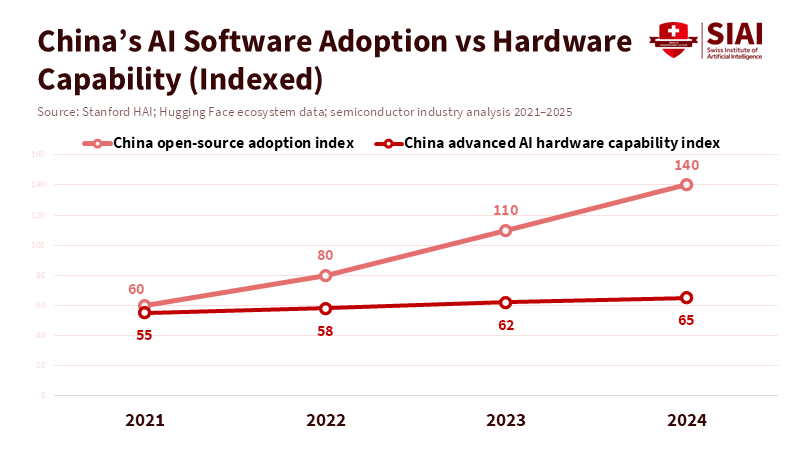
But this competitive win has limits. Open models need inference capacity to power commercial services at scale. When the highest-performance accelerators are absent or restricted, the economics and latency of large-scale services change. China’s response has been to develop indigenous chips and high-volume data center capacity. Early chips are serviceable and serve many workloads well, but independent analyses suggest they lag top-tier Nvidia chips in raw throughput and capability—sometimes by margins that matter for the most demanding training and inference uses. The engineering deficit combines node-level performance gaps with deficits in software maturity: compiler toolchains, distributed training orchestration, and optimized kernels are hard to replicate quickly. Engineers can reduce gaps over time, but these gaps interact with supply chains and standards in ways that compound the incumbent's advantage.
Another realistic implication: China’s open strategy has bought it a different kind of influence. If Chinese models, libraries, and runtimes become the de facto norms in many emerging markets, they shape developer expectations and institutional procurement. Europe and Korea can still set rules about data governance, privacy, and ethical uses. But norm-setting without compatible infrastructure is incomplete. The countries that combine standards with market-simulacra—deployable clouds, certified hardware, and developer incentives—will have more leverage. The open-source approach gives China a broad base from which to project standards through use; it is not yet a claim on high-end performance, but it is a claim on adoption and default formats.
Policy choices for educators, administrators, and policy makers in a US–China duopoly
Educatorshave to adapt curricula to the new terrain. Teaching neural network architecture without hands-on experience on modern accelerators is increasingly theoretical. Universities and vocational programs should prioritize access to a mix of cloud credits that expose students to both leading commercial stacks and popular open-source stacks used in real-world settings. That means negotiating partnerships to rotate cloud access, funding GPU hours for labs, and building coursework that evaluates compromises between performance and cost. Policymakers should treat computer access as infrastructure—like labs or telescopes—rather than an ephemeral grant. Subsidizing access to testbeds, investing in software toolchains, and underwriting open benchmarking projects will have outsized returns compared to one-off research grants. When students learn to optimize for latency and cost on real hardware, they graduate with industrially relevant skills rather than abstract knowledge.
Administrators and procurement officials face a choice matrix. They can double down on national sovereignty—buying local hardware and mandating local deployment—or pragmatically hedge by instrumenting multi-cloud and multi-stack interoperability. The latter is the wiser posture. Insisting on a pure “third AI stack” that isolates education systems and public services risks lock-in to immature platforms that will carry higher long-run operating costs. Instead, public institutions should require interoperability layers, fund open benchmarks, and sponsor translator tooling so models and datasets can port across stacks. That approach safeguards the regulatory agency while keeping operational performance within tolerable bounds. It also creates an exportable product: governments that can demonstrate safe, portable, and efficient AI deployments will have a stronger voice in global standards negotiations.
We must also face hard political-economic questions. China’s decision to prefer domestic stacks is a deliberate infant-industry strategy. If those domestic engineers succeed, the global configuration shifts; if they fail, China will still have bought time for its software standards to entrench in pockets of the world. Either outcome imposes costs and benefits on education systems. For universities and think tanks, the practical implication is clear: invest in cross-sectional analysis and applied deployments now. Trial projects that benchmark similar services on different stacks, publish the methods and results, and teach students to reason about trade-offs. In short, convert geopolitical uncertainty into a pedagogical advantage.
From wishful thinking to workable strategy
The third AI stack continues as a compelling political slogan. It promises national autonomy and dignity. It will not, however, spring into being because leaders declare it. The evidence is simple: open-model downloads are a form of influence but not an immediate substitute for exascale compute, top-shelf hardware, or mature software stacks. Europe and Korea can and should aim for partial sovereignty—investing in secure clouds, supporting open toolchains, and training engineers across multiple stacks—but the clearer path to impact lies in pragmatic interoperability, targeted industrial investment, and educational reform. We should treat compute and developer access as public goods, not prizes to be hoarded. That means real budgets for testbeds, transparent benchmarks, and curriculum revisions that privilege operational competence. If policymakers act with that realism, educators will graduate learners who can move between stacks rather than waiting for a mythical third column to appear. The world will be safer and more plural if alternative stacks grow by winning customers with clear trade-offs, not by political proclamation. The opening statistic matters because it highlights where influence is currently accumulating; our job now is to convert that influence into durable, responsible capacity—practically, cheaply, and with an eye on standards, not slogans.
The views expressed in this article are those of the author(s) and do not necessarily reflect the official position of the Swiss Institute of Artificial Intelligence (SIAI) or its affiliates.
References
Chin, C. L. (2026). Standards are the new frontier in the US–China AI competition. East Asia Forum.
CSIS. (2025). The limits of chip export controls in meeting the China challenge. Center for Strategic and International Studies.
Financial Times. (2025). China leapfrogs the US in the global market for 'open' AI models. Financial Times.
Hugging Face / Stanford HAI analysis. (2025). China's diverse open-weight AI ecosystem and its policy implications. Stanford HAI briefing.
International analysis of chip performance. (2025). The H20 problem: inference, supercomputers, and US hardware. Independent analysis.
Reuters. (2026). NVIDIA AI chip sales to China stalled by US security review. Reuters.
His recent work examines the broader socioeconomic consequences of artificial intelligence, including labor markets, public finance, demographic change, institutional adaptation, and the distributional effects of technological progress.
He holds a PhD in Mathematical Finance from Boston University, and previously earned an MSc in Finance and Economics from the London School of Economics. He completed his undergraduate studies in Economics at Seoul National University under the Korea Foundation for Advanced Studies scholarship program.
Why an EU federation is the Only Real Way to Build Bigger, Competitive European Firms
Europe’s problem is not a lack of firms, but a system that keeps them small
An EU federation is best understood as industrial infrastructure, not constitutional ambition
Without enforced market integration, Europe will keep exporting its champions instead of building them

When Policies Push Factories Over the Border: How Misaligned Climate Policy Creates Carbon Leakage
Misaligned climate policy shifts emissions across borders instead of cutting them globally
Uneven rules push firms to relocate production rather than invest in deep decarbonisation
Only coordinated incentives can stop carbon leakage and restore policy credibility

Sun-First Strategy: How “solar-first development” is changing growth math for middle-income countries
Cheap solar has reshaped the growth logic for power-scarce economies
Solar-first strategies deliver faster, cheaper energy than nuclear in most cases today
The challenge is timing: build solar now and scale complexity only when demand rises

Light for Sale: Reframing the Data Center Community Impact as a Power and Trust Problem
Light for Sale: Reframing the Data Center Community Impact as a Power and Trust Problem
His recent work examines the broader socioeconomic consequences of artificial intelligence, including labor markets, public finance, demographic change, institutional adaptation, and the distributional effects of technological progress.
He holds a PhD in Mathematical Finance from Boston University, and previously earned an MSc in Finance and Economics from the London School of Economics. He completed his undergraduate studies in Economics at Seoul National University under the Korea Foundation for Advanced Studies scholarship program.
Published
Modified
AI data centers are straining local power systems
Donations cannot replace enforceable community agreements
Real benefits require binding commitments to the grid

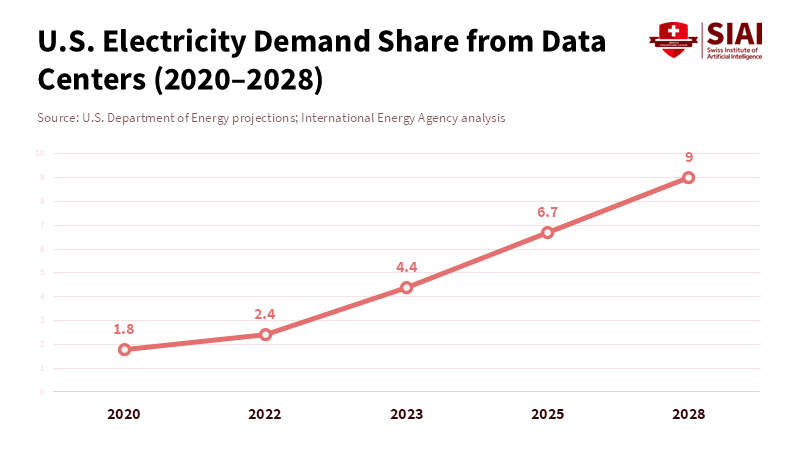
In 2023, U.S. data centers consumed about 4.4% of the country's electricity. Some predict this will go up a lot in the next five years. Now, 4.4% might not sound like much, but it's enough to make any mayor, school head, or utility company think hard about those energy bills and possible power shortages in the winter. Here's the thing: when companies build these huge AI data centers, they're not merely setting up servers. They're changing the local energy landscape, the town's negotiating position, and public trust in the system. So, those donations to schools, promises of jobs, and fancy community events? They're nice, but they don't replace solid, legally binding agreements that address energy and the community's needs directly. If we keep treating these donations as the only factor in data center community impact, we're letting private deals obscure risks everyone shares. This is about changing the way we talk about this issue. Community benefits are important, but only if they're tied to clear, verifiable commitments on energy, jobs, and governance. This way, we protect regular people from being left in the dark.
Why Charity Isn't Enough
We all know the usual routine: A big company promises money for schools, says they'll train local people, and maybe builds a nice public space. These things do help. Schools get stuff, some people get jobs, and some groups get more money. But these are often one-time things that don't really solve the main problem: the huge amount of electricity needed to run AI and the decisions about how to reliably get that energy. In the U.S., data centers are using more and more electricity. It's more than a possibility anymore. Government reports and international energy groups all show that this demand is going way up. When we treat community benefits as just for show, rather than as legally tied to energy outcomes, we're making a deal where the community takes on the risks while the companies get good publicity. This difference between what looks good and what's really required is the main thing we need to fix.
What happens because of this? Places with many AI data centers experience higher energy demand, less available energy, and higher prices when there are issues with energy delivery or fuel. Energy companies and studies warn of real risks: winter peaks, cold weather, and fuel shortages can disrupt the system when these large new energy users come online. The usual response – thank-you ceremonies and awards – doesn't do anything to make more electricity, improve energy delivery, or create reserve energy options. A real data center community impact plan connects those gifts to long-term investments that change the energy supply: promises of energy capacity, on-site energy generation with strict rules about pollution and reliability, and legal support for energy grid upgrades. These are very different from just handing out donations.
Looking at the Money Behind the Gifts
To create enforceable deals, we must understand the costs and what matters in negotiations. Building an AI data center can cost hundreds of millions, sometimes over half a billion, for a typical-sized facility. Equipment, especially high-powered computer processors and energy infrastructure, is a high cost up front.
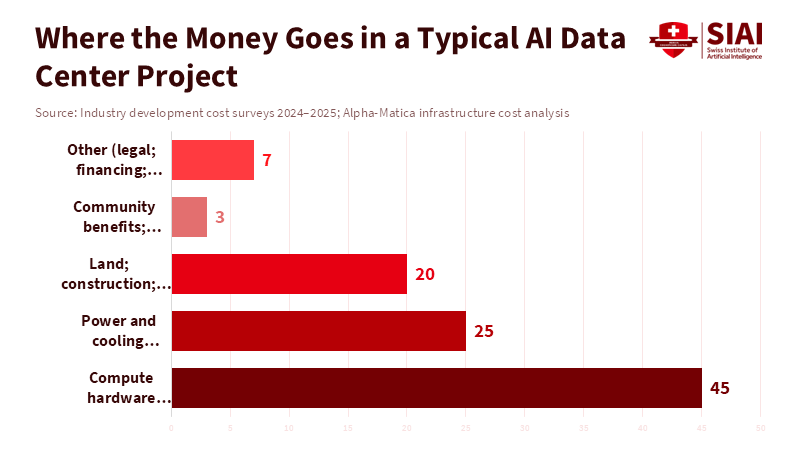
That's why companies talk about local benefits: jobs and donations are cheap compared to long-term investments in energy. But these gestures can't replace what the community needs to keep the lights on. When a data center needs new energy sources or major upgrades to the energy grid, the community has to wait years for approvals and construction before it sees any benefit. And the community's trust is easily broken if the only visible benefits are temporary and cannot be enforced.
Smart community benefit agreements can change this situation. Instead of accepting a one-time payment for approval, local governments should require commitments contingent on specific conditions: starting operations only when the energy grid is ready, contributing to energy delivery or generation, and clear job-training programs with defined employment and wage targets.
This changes who the community is in the data center community impact, from people who watch the PR to people who sign contracts with the right to check on things. It's important to remember that many companies don't have unlimited money. Hardware costs and financial cycles limit their cash. That means getting creative with money – using public and private funds, long-term energy contracts, or even local bonds – can assist in bridging the gap while keeping the risks public and the benefits enforceable.
Governance, Fairness, and the Energy Grid
Saying that community benefits should be part of a contract isn't simply a technical thing. It's concerning fairness. Voluntary donations often go to visible places – schools, parks, sports fields – while less obvious problems happen elsewhere: small businesses paying higher rates, renters living near power stations, or communities dealing with construction issues.
Binding agreements can specify how benefits are shared, require community monitoring, and fund investments that reduce local risks, such as helping people make their homes more energy-efficient or providing targeted assistance with energy bills. The more that deals link company actions to scheduled grid improvements, the less likely it is that a whole area will have to cut back on energy use to keep the system working. This puts the community at the center of the discussion, not on the sidelines.
To make this happen, companies, energy providers, and local leaders need to share responsibility for planning over longer periods than companies usually plan. Data center community impact means creating new systems: regional groups that include community representatives, monitoring systems that can be enforced, and rules that stop operations if energy reliability goals aren't met. These aren't unusual things. They're similar to environmental or labor agreements used in other areas. Using them here would turn donations into tools that lock in investments in energy capacity and reliability. In short, charity becomes powerful when it's combined with enforceable engineering.
Addressing the Criticisms: Profit, Speed, and Competition:
Two common complaints will come up. First, this will slow investment and cost jobs. Second: Tougher deals will send projects to other countries or more friendly states during the AI boom. Both deserve honest answers. According to a report from Solar Power World, nearly 2,600 gigawatts of new power generation and energy storage are now seeking grid interconnection across the United States, showing that setting permit requirements in stages that align with business schedules and ensuring that grid upgrades are on track can help protect jobs and communities while supporting project progress. It ensures that the benefits occur at the same time as the impacts.
On the second point, the notion that any U.S. restriction will cause us to lose ground to competitors is exaggerated. The world needs secure, well-regulated data centers, and that favors places that combine reliability with clear rules. Investors want predictability, and communities want certainty. A report from Data Center Watch notes that in the past three months alone, 20 data center projects worth $98 billion faced delays or blockage due to local opposition. This highlights the importance of reducing political risk through careful planning and addressing community concerns to improve the chances of long-term project success.
There's also a technical argument that companies often use: We'll solve this with on-site gas generation or batteries. Many companies are using on-site fuels or combined ways to meet immediate needs. This can reduce short-term stress on the grid, but it can also increase pollution if natural gas is used without strict limits. Recent reports indicate that more people are using natural gas for short-term reliability, raising environmental concerns that communities must consider. Good community benefit agreements include conditions about pollution and efficiency, and a clear plan for adding renewable energy and storage as the energy grid improves. The goal isn't to ban all temporary solutions, but to make them conditional, transparent, and connected to progress toward cleaner energy.
A Policy for Light and Trust
If 4.4% seems abstract, imagine a winter evening when the city asks people to use less electricity because a few new data centers are using a lot of power. That's the risk we take when we stop the conversation at charitable giving. A real data center community impact policy treats benefits as binding agreements that protect public resources and share the benefits fairly. Cities and counties should require operations to happen in stages based on verified grid upgrades, demand financial plans which support long-term energy capacity, and insist on governance systems that give residents the right to check on things and have real ways to fix problems.
To be clear: donations, training programs, and community projects are good things. But they only become fair when they're part of enforceable agreements that precede, not follow, company operations. We can welcome new ideas without losing power. The choice isn't between jobs and reliability. It's between careful, enforceable partnerships and the slow loss of citizen trust when charity tries to fill the gaps that infrastructure investment should cover. Let's create rules that make the benefits of AI real and lasting, not just a show.
The views expressed in this article are those of the author(s) and do not necessarily reflect the official position of the Swiss Institute of Artificial Intelligence (SIAI) or its affiliates.
References
Department of Energy. (2024). DOE Releases New Report Evaluating Increase in Electricity Demand from Data Centers. U.S. Department of Energy.
International Energy Agency. (2024). Energy and AI: Energy Demand from AI. IEA.
Lancaster City. (2025). Lancaster AI Hub: Community Benefits Agreement (Draft). City of Lancaster (PA).
National Association for the Advancement of Colored People (NAACP). (2026). Community Benefits Agreement Template. NAACP.
Reuters. (2026, January 28–29). Forecast record electricity demand to test largest US power grid; US faces growing risks of power outages due to rising winter demand, changing fuel mix. Reuters.
Cleanview / Axios reporting. (2026, Feb). The AI boom is making natural gas great again (analysis of planned on-site power equipment).
Cushman & Wakefield. (2025). Data Center Development Cost Guide 2025. Cushman & Wakefield.
Industry market reports on GPU and data center equipment costs (2024–2025), including market surveys and pricing guides.
His recent work examines the broader socioeconomic consequences of artificial intelligence, including labor markets, public finance, demographic change, institutional adaptation, and the distributional effects of technological progress.
He holds a PhD in Mathematical Finance from Boston University, and previously earned an MSc in Finance and Economics from the London School of Economics. He completed his undergraduate studies in Economics at Seoul National University under the Korea Foundation for Advanced Studies scholarship program.